


Why Internal Planetary Gear Delivers Superior Performance in Compact Drive Systems
The Internal Planetary Gear is unique in small drive systems because it allows for higher torque density, better load distribution, and much better space economy than other gear designs. Its circular form lets several planet gears share the load at the same time, which lowers the stress on each tooth while keeping the size of the gearbox small. This configuration provides high mechanical efficiency within limited spaces. It is therefore essential for industrial gear, mining equipment, and aerospace uses that must have performance and dependability.
Understanding Internal Planetary Gears: Mechanism and Design Principles
The Core Architecture of Ring Gears
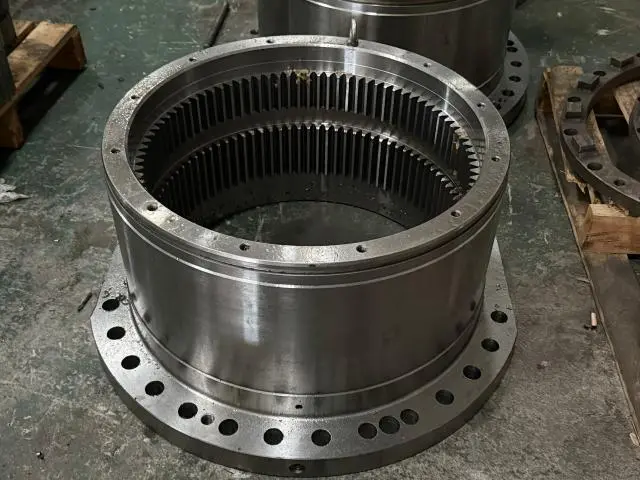
Internal Planetary Gear features teeth cut into a cylindrical frame's inner surface, meshing with planet gears orbiting a central sun gear. This epicyclic design enables power flow through multiple load paths simultaneously. YIZHI MACHINERY maintains ISO 5-6 Grade accuracy through advanced hobbing, milling, and grinding. CMM inspection verifies radial runout, profile deviation, and helix deviation for consistent tooth contact patterns under load, directly affecting noise levels and service life.
Material Selection and Heat Treatment Protocols
Performance depends on material choice. YIZHI MACHINERY uses premium alloy steels like 20CrMnTi, AISI8620, and 18CrNiMo7 with carburising, quenching, or induction hardening achieving 58-62 HRC surface hardness and 30-40 HRC core toughness. This dual-property structure balances wear resistance with impact capacity. Metallurgical testing through nital etch confirms effective case depth while preventing grinding burns that compromise wear strength.
Load Distribution Mechanics
When internal ring gear teeth and external planet gear teeth touch, the concave-convex contact surface makes less Hertzian contact stress than external-external meshes. Each planet gear only takes 25–33% of the total load when three or four of them engage the ring gear at the same time. This method for sharing loads greatly increases the life of parts while lowering noise and vibration. These are important factors to consider for aircraft actuators and precision robotic joints where NVH (Noise, Vibration, and Harshness) standards are very strict.
Advantages of Internal Planetary Gears Over Conventional Gear Systems
Unmatched Compactness and Power Density
Industrial gear, mining equipment, and aerospace systems all have to make design choices based on how much room they have. The Internal Planetary Gear design can reduce ratios of up to 10:1 in a single pass and takes up 40–60% less space than parallel-shaft gearboxes of the same size. In robotic joint actuators, electric car wheel hubs, and wind turbine pitch drives, where envelope measurements are very limited, this small size is very helpful.
At YIZHI MACHINERY, we can customize support modules from 0.5 to 50, and helix angles can be changed from 5° to 45°. Because of this, engineers can find the best mix between axial push forces and noise reduction for each job. When used at a 30° helix angle, a helical Internal Planetary Gear can cut transmission error by 15–20% compared to spur designs. This directly improves the accuracy of positioning in CNC machine tool feed systems.
Enhanced Torque Capacity and Thermal Management
Internal Planetary Gear systems transmit significantly more power than single-mesh setups through load distribution across multiple planet gears. The circular design enhances heat dissipation as tooth contact heat transfers through the ring gear housing. This maintains lubricant stability and dimensional consistency during continuous operation. Mining equipment benefits from our Internal Planetary Gear products operating at 120°C with 0.01mm dimensional stability in 24/7 applications.
Superior Operational Smoothness
Multi-point contact in planetary designs reduces vibration transmission through overlapping engagement stages. When one planet gear enters mesh, others already carry load, smoothing torque pulses. This makes Internal Planetary Gear devices ideal for precision applications requiring sub-arcsecond accuracy like telescope drives and semiconductor equipment. Single flank testing ensures transmission error below 15 arcseconds per revolution, meeting performance requirements throughout equipment life.
Applications and Use Cases of Internal Planetary Gears in Industry
Robotics and Automation Systems
Industrial robots need to have zero slack and be able to repeat their positions very accurately. When it comes to six-axis robotic arms, the Internal Planetary Gear is the most important part of harmonic drive options and cycloidal reducers. Our unique solutions for automation clients have backlash that is kept below 3 arcminutes and can handle more than 5,000 Nm of power in small packages.
Planetary transfers make motion smooth, which is especially helpful for collaborative robots (cobots) that work with human operators. The lower vibration makes it less likely that safety monitors will go off, but it still lets you control the force precisely, which is important for delicate assembly jobs. Since 2008, we've been making things, so we know how to get these complex parts to you in 35 to 60 days, which lets you set up automatic production lines quickly.
Mining and Heavy Construction Equipment
Underground mining equipment works in rough, high-shock conditions that quickly destroy gear systems that aren't up to par. The Internal Planetary Gear's strong load distribution can handle the harsh conditions inside longwall shearer ranging arms and continuous mining end drives. For these uses, we use 42CrMo and SAE4340 metals, which are hardened to levels of 1.2 to 1.8 mm to get a surface hardness of 58 to 62 HRC.
Ring gears allow for a sealed design that keeps coal dust, rock particles, and water from getting into the internal parts. This environmental safety raises the time between maintenance checks from 500 to 2,000 working hours, which greatly lowers the cost of downtime. Dragline excavators use planetary winches with our Internal Planetary Gear designs to lift buckets that weigh 100 metric tons or more all the time. This shows how much weight these systems can hold.
Aerospace Actuation Systems
Aircraft control surface actuators must work perfectly in temperatures ranging from -55°C to +125°C and stay in place even when aerodynamic loads are applied. Because it is stable at high temperatures and takes up little space, the Internal Planetary Gear is the best choice for flap drives, landing gear retracting systems, and thrust reverser actuators.
In military uses, reducing weight is still very important. Through optimized tooth profiles and planned material removal, our advanced production methods make gear systems 25–30% stronger for their weight compared to traditional ones. Aerospace customers like that we provide detailed traceability paperwork and material certifications that meet AS9100 quality management standards. This makes sure that parts meet strict safety standards for the entire time they are in use.
Procurement Guide: Selecting and Sourcing Internal Planetary Gears
Critical Evaluation Criteria for Suppliers
To successfully buy Internal Planetary Gear systems, you need to evaluate sellers in more than one way, not just by the price per unit. The level of a vendor's manufacturing potential tells you how well they can follow your instructions. YIZHI MACHINERY has a wide range of high-precision CNC gear machining centers, automatic gear grinding tools, and intelligent heat treatment production lines that can handle all of your cutting, grinding, and thermal processing needs.
Customization lets you tell the difference between capable providers and stock vendors. We can make tooth counts, module specs, and helix angles that are exactly what you need for your plan. During the requirements communication phase, our engineering team gives you technical advice and creates detailed design drawings that make sure your application works at its best, whether it's a planetary gear reducer, winch, machine tool feed mechanism, or lifting equipment transmission system.
Quality assurance procedures show how mature a company is. Components must meet strict standards by being inspected for dimensions using CMM tools, having the depth and hardness slopes of the case checked by metallurgy, and being tested for noise using single side analysis. Transport damage rates are kept below 0.1% by our quality control process, which includes custom packing with shock-absorbing liners and wooden boxes made just for gear tooth surfaces.
Balancing Lead Times and Inventory Strategy
How well your deliveries go has a direct effect on your output plans. From talking about needs to design, production machining, quality inspection, packing, and shipping, our normal OEM process usually takes 35 to 60 days to finish. We use a variety of shipping methods, such as sea freight, air freight, and freight trains between China and Europe, so we can meet your needs for speed and volume, and we can guarantee that your packages will arrive on time.
With low minimum order amounts, you can buy things in ways that big makers usually can't. YIZHI MACHINERY can take orders for just one item, which lets them make prototypes and small batches of specialized equipment without having to keep a lot of goods on hand. This feature comes in handy when making a new product because the design changes often and the number of orders isn't always clear.
After-Sales Support and Long-Term Partnership
Technical help lasts after the original arrival. Our one-year guarantee covers problems with the way the product was made, and our quick response methods take care of problems in the field within 24 to 48 hours by using remote diagnostics or sending someone to the site if needed. Because they care about their customers' success, they have long-term relationships with many mechanical engineering companies in the mining, aircraft, and industrial machinery sectors.
When choosing gear providers, collaborative image is important. Our 15 years of production experience have helped us finetune methods that always give us ISO-compliant parts that meet DIN 6 or AGMA Q10 accuracy classes. These certificates show that we can handle demanding situations where a broken part could lead to major system downtime or safety issues.
Maximizing Performance: Installation, Maintenance, and Optimization Tips
Precision Installation Procedures
The Internal Planetary Gear system will last a long time if it is installed correctly. Radial runout is directly related to how clean and flat the mounting surface is. It must stay below 0.02mm so that the load is evenly distributed among the planet gears. We suggest using dial markers during assembly to make sure that the ring gear bore and output shaft are perfectly aligned. If necessary, change the thickness of the shims to meet the specifications.
When locking ring gear housings, the order of the torques is important. To keep the housing from warping, which could throw off the tooth contact patterns, fasteners should be tightened in a star design to three different levels of pressure. Our technical consultation services give your construction teams full instructions on how to put things together in a way that works for your needs. This makes sure that they understand important steps that keep things from breaking down too soon.
Lubrication and Sealing Strategies
Micropitting and scuffing are damage that happens to Internal Planetary Gear surfaces when they are under a lot of touch pressure. Extreme-pressure additives in synthetic gear oils keep the film layer even when contact pressures are over 1,500 MPa. The choice of oil viscosity varies on the temperature ranges it will be used in. ISO VG 320 is good for most industry uses, but MIL-PRF-23699-compliant lubricants may be needed for aerospace systems.
Sealing integrity keeps dirt and other things from getting into internal parts, which speeds up wear. When used together, labyrinth seals and O-rings offer extra safety in industrial areas where rough particles are common. Our design team can help you choose the best seal options for your needs, matching how well they seal against friction losses that lower the overall efficiency of the drive.
Proactive Condition Monitoring
Finding problems early on stops them from becoming catastrophic and avoids costly unnecessary downtime. Through frequency domain analysis, vibration analysis can show how bearings are breaking down and how tooth wear is progressing. By looking at the trend of certain harmonics that are linked to the frequency of the gear mesh, it is possible to see how things are breaking down months before they stop working properly. This lets repair be planned for breaks in production.
Monitoring the temperature gives you extra information that can help with your diagnosis. Localized warmth is a sign of a broken lubricant or abnormal friction caused by misalignment. Using infrared thermography during operation helps maintenance teams find parts that need attention without having to take the whole thing apart. These proactive tactics make Internal Planetary Gear systems last 40–60% longer than run-to-failure methods, which greatly lowers the total cost of ownership.
Regular checkup times, the tooth surface should be looked at for pits, scores, or wear patterns that don't seem normal. Magnetic particle inspection can find tiny cracks on the surface of things, which are signs of wear cracks starting to form. These cracks need to be fixed before they spread and cause quick failure. Our maintenance advice paperwork has thorough inspection checklists that are made to fit your gear configuration and job cycle.
Conclusion
The Internal Planetary Gear has been shown to improve performance in small drive systems used in mining, aerospace, and industry machines. Its excellent load distribution, high torque density, and strong design principles meet the toughest working needs while taking up very little room. It's not enough to just look at unit price when considering providers; you also need to look at their ability to manufacture, their ability to accommodate customizations, their quality control standards, and their after-sales support. With 15 years of experience in production, quality standards that are in line with ISO, and a wide range of technical services, YIZHI MACHINERY is the ideal partner for businesses that need stable, high-performance gear solutions that improve system efficiency and operating longevity.
FAQ
1. What distinguishes Internal Planetary Gears from external planetary configurations?
The Internal Planetary Gear has teeth cut into the inside of a ring that meshes with outer planet gears that spin around a center sun gear. In external planetary systems, where the ring gear would add a lot of width, this design makes the envelope smaller. The concave-convex shape of the contact also lowers the contact stress, which greatly increases the wear life.
2. How do I verify torque capacity matches my application requirements?
The torque capacity is based on the module size, the material's features, the number of planet gears that share the load, and the depth of the teeth on each face. We use AGMA 2101 standards to figure out capacity, taking into account application factors, load distribution factors, and safety gaps that are right for your job cycle. During the quotation process, our engineering team does thorough capacity estimates to make sure that the standards meet your performance envelope with enough safety margins.
3. What customization options are available for specialized industrial applications?
You can fully customize your YIZHI MACHINERY order by choosing the tooth count, module (0.5-50), helix angle (5°-45°), material from twelve different types of alloy steel, and heat treatment processes that meet your specific hardness needs (45-50 HRC or 58-62 HRC). We can make one-of-a-kind prototypes and unique equipment, and we offer full design drawing services to help your new equipment work with your old ones.
Partner with YIZHI MACHINERY for Superior Internal Planetary Gear Solutions
YIZHI MACHINERY can improve your small drive systems by using Internal Planetary Gear parts that are carefully designed and built to give you real performance gains. Our extensive customization options, which include choosing the right material, following the right heat treatment methods, and meeting exact geometric requirements, make sure that the parts you receive exactly meet your practical needs. Contact our engineering team at sales@yizmachinery.com to talk about the details of your project and get detailed technical advice based on our 15 years of experience making things. As a reliable maker of Internal Planetary Gears, we offer competitive quotes within 48 hours, CAD models for design confirmation, and clear production tracking from the time an order is placed until it is delivered. Learn how our ISO-compliant quality standards, 35–60 day shipping, and full one-year warranty make for a great basis for long-term relationship success.
References
1. Müller, H.W. (2020). Epicyclic Drive Trains: Analysis, Synthesis, and Applications. Munich: Hanser Publications.
2. Lynwander, P. (2019). Gear Drive Systems: Design and Application. New York: Marcel Dekker Technical Press.
3. Dudley, D.W. (2018). Handbook of Practical Gear Design and Manufacture (3rd Edition). Boca Raton: CRC Press.
4. American Gear Manufacturers Association (2021). AGMA 2101-D04: Fundamental Rating Factors and Calculation Methods for Involute Spur and Helical Gear Teeth. Alexandria: AGMA Standards.
5. International Organization for Standardization (2019). ISO 1328-1:2013 - Cylindrical Gears - ISO System of Flank Tolerance Classification. Geneva: ISO Publications.
6. Radzevich, S.P. (2022). Theory of Gearing: Kinematics, Geometry, and Synthesis (2nd Edition). Boca Raton: CRC Press Mechanical Engineering Series.

USER EVALUATE
Here is the customer's evaluation of us