


Why Inner Ring Gear Is Essential for High Performance Planetary Gearboxes
The Inner Ring Gear is the most important part of planetary gearbox systems because it allows for small, high-torque transmission in industrial tools, mining equipment, and aircraft. With teeth cut along its inside diameter, this Inner Ring Gear uses multiple planet gears at the same time, spreading loads evenly and making the most of power density. Planetary systems can't be as reliable and efficient as they need to be for mission-critical operations without an Inner Ring Gear that is exactly made. Its special shape lets it multiply torque in small areas while still keeping its structural integrity at high levels under harsh working conditions.
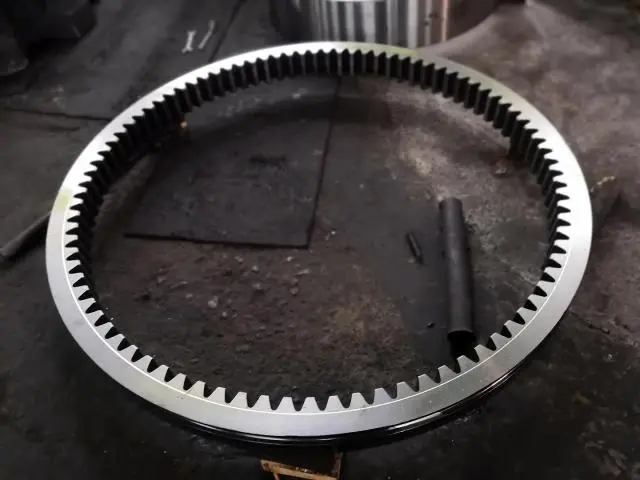
Understanding the Inner Ring Gear: Function and Design Essentials
The Core Role of Annular Gears in Planetary Systems
The Inner Ring Gear is at the center of every planetary gearbox. It forms the outer border of the gear train and can either stay still or rotate. Unlike external gears, this part has teeth that face inward and connect with gears that move around planets in orbit. The inner mesh makes a conformal contact design that lowers Hertzian stress and increases the wear life. This arrangement lets several contact points share the load, which is very helpful when dealing with shock loads in mine conveyors or changing thrust in aircraft actuators.
It is very important to pay close attention to the involute tooth shapes and helical angles when designing these parts. Different torque needs can be met by modules ranging from 0.5 to 50, and helix angles between 5° and 45° make the best use of contact ratios and reduce noise. We use high-tech materials like 20CrMnTi and 42CrMo to make our Inner Ring Gears because they are better at hardening and being tough in the middle. The carburizing heat treatment gives the surfaces of these alloy steels a toughness of 58 to 62 HRC. This makes them resistant to wear while keeping the cores flexible enough to absorb impact energy.
Critical Design Parameters for Optimal Performance
Precision grade ISO 6 is the standard for how our planetary gear parts are made. To meet this requirement, the hobbing and grinding processes must be carefully managed so that the tooth-to-tooth composite variation stays within micrometers. Coordinate Measuring Machines (CMM) check the accuracy of measurements by measuring things like dimension over pins (DOP) to make sure that cables that have been put together have the right amount of blowback. We finish all of our production units by grinding the teeth, which gets rid of any microgeometry mistakes that could cause vibrations or wear that happens too soon.
Heat cleaning methods have a direct effect on how reliable something is in use. Carburizing adds carbon atoms to the top layer, making a harder case depth of 0.8 to 1.2 mm that doesn't easily pit or score. The next steps are quenching and hardening, which balance stiffness and hardness. Magnetic Particle Inspection (MPI) finds cracks below the surface that form when temperatures change, and nital etch testing finds grinding burns that weaken teeth. These quality control steps keep breakdowns in the field from happening, which could stop production lines or put flight-critical systems at risk.
Comparing Inner Ring Gears with Other Gear Types: Making the Right Choice
Load Capacity and Efficiency Advantages
Procurement teams need to think about how different shapes handle torque when they look at gear choices for planetary reducers. When sun gears are in the middle of planetary systems, they experience higher moving speeds and more stress. When compared to external gear pairs, Inner Ring Gears lower the bending stress on each tooth by 40–60% because they spread the load across more than one mesh point. This device for sharing the load is very important in winches and lifting equipment, where sudden increases in load happen all the time.
Spur gears are easy to use, but they make more noise and axial thrust. Our Inner Ring Gears have helical configurations that make power transfer smooth by engaging teeth gradually. This lowers sound pressure levels by 5–10 dB, which is a big deal in tight industrial spaces. Bevel gears can change the direction of power, but they are not as small as planetary setups. Inner Ring Gear systems can reduce ratios of up to 10:1 in a single pass, and they take up 30% less axial room than traditional designs with parallel shafts.
Durability Under Harsh Operating Conditions
Transmission parts used in mining can get dirty from abrasive dust and go through heat cycles from running for short periods of time. This is because internal gears naturally protects itself, and the concave tooth shape keeps contact areas cleaner from outside contaminants than open exterior meshes. Surface treatments, such as induction hardening, create leftover compressive forces that stop cracks from spreading. This makes the tools last longer in tough extraction situations.
When it comes to aerospace motors, they need to work reliably at all temperatures and with little weight gain. When we use AISI 8620 and SAE 4320 metals, we get strength-to-weight ratios that meet aircraft standards while still being able to be machined into complex tooth shapes. Engineers can find the best contact ratios for different duty cycles by changing the helix angle. This is useful for both continuous loads in satellite navigation systems and cyclic loads in landing gear mechanisms.
Material and Maintenance Considerations for Inner Ring Gears
Advanced Metallurgy for Extended Service Life
Understanding operating pressures is the first step in choosing materials. Low-carbon alloy steels, such as 20CrMnTi, are great for shock-loaded uses because they have a good case-hardening reaction and a tough core. Medium-carbon grades like AISI 4140 and 42CrMo can be through-hardened to make parts that need a constant hardness. We make sure that buyers get Inner Ring Gears that are best for their individual duty cycles by matching material specs to application profiles.
Surface strengthening methods have a big effect on how resistant something is to wear. Our main way, carburizing, spreads carbon into the surface, making the case hardness 58–62 HRC while keeping the core stiffness at 30–45 HRC. This structure has two different hardnesses, so it can prevent contact wear and absorb shock loads. Induction hardening makes hardened zones with exact depth control and speeds up the processing of bigger modules. When compared to steels that haven't been treated, both ways make rolling contact wear life three to five times longer.
Proactive Maintenance Strategies
Lubrication schedules have a direct effect on how long gears last. Planetary systems need oils with a high viscosity that can form elastohydrodynamic films at high Hertzian pressures. For mine equipment that works in hot conditions, we suggest synthetic gear oils with extreme-pressure additives. Fire-resistant fluids that meet MIL-PRF-23699 standards are often needed in aerospace uses. Oil research tools find wear particles early, so they can be fixed before they cause major problems.
As part of regular inspections, vibration tracking should be used to find tooth problems that are starting to form. When certain frequency bands related to gear mesh rates go up, it means that there is limited cracking or spalling. Borescope inspections through drain holes show how the surface is without having to take anything apart. If pitting covers more than 5% of the working tooth surfaces, the teeth need to be replaced to stop failures from spreading. Our design for manufacturability includes datum features that make alignment easier during installation. This cuts down on setup time and the chance of mistakes happening during assembly.
Procurement Guide: Buying Inner Ring Gears for Planetary Gearboxes
Evaluating Supplier Capabilities
For buying to work, you have to look at more than just the manufacturer's basic machining skills. To make gears, you need special tools like CNC hobbing machines that can keep their temperature stable, grinding centers that can get surface finishes of Ra < 0.8µm, and heat treatment facilities with controlled atmosphere furnaces. We take care of the whole production chain, so we don't have to rely on outside suppliers to keep the quality high. Our ISO-compliant processes keep track of materials from the time they are certified at the mill all the way through to the final inspection. This gives us paperwork that meets the needs of aerospace AS9100 and automobile IATF 16949.
The ability to customize sets commodity sellers apart from technical partners. Our design team works together to make changes to teeth, shape shifts, and non-standard pressure angles that are suited to different load ranges. Rapid prototyping is possible with CAD integration; we can make model gears in 20 days for proof testing. Production freedom allows for order numbers ranging from a single test unit to batch runs of more than 500 pieces, meeting the needs of both OEM development programs and repair needs in the aftermarket.
Lead Times and Pricing Structures
Standard setups with 1.0–10 modules and 60–120 tooth counts usually ship 35–45 days after the order is confirmed. Custom specs that need special tools push back the dates to 50–60 days, which includes hob manufacturing and setup approval. We keep strategic stocks of popular alloy types of raw materials, which cuts down on delivery times. For urgent needs, air freight choices shorten arrival times, but sea freight is still the most cost-effective way to build planned equipment.
Prices depend on the type of material, the level of accuracy needed, and the number of orders. Because they take longer to make, carburized parts with ground teeth cost more, but they work better, so the extra money is worth it. When you make a volume promise, you can get tiered prices. For orders over 100 pieces, you get discounts that take into account setup amortization. Our quote process is still clear; we list item prices, processing fees, and inspection fees separately so that you can compare suppliers on an even playing field.
Enhancing Planetary Gearbox Performance with Quality Inner Ring Gears
Real-World Performance Gains
Case studies from mine operations show that expensive components make a difference that can be measured. In the final drives of haul trucks, a copper extraction plant switched from competitor gears to our carburized 20CrMnTi units. Failure intervals went from 8,000 to 14,000 working hours, which cut down on unplanned repair by 42%. The vibration spectrum showed that the teeth were engaging more smoothly. This is because we tightened the profile tolerances and made the lead adjustments better. Investing in quality paid off because the total cost of ownership went down even though the original prices of the parts went up.
Zero-failure dependability is needed for aerospace applications. Our AISI 8620 Inner Ring Gears were used in satellite tracking devices that went through 50,000 thermal cycles between -40°C and +120°C without showing any signs of wear. Precision grinding to ISO 6 standards kept the backlash stable within 0.02 mm during the whole test run. These results show that high-quality manufacturing leads to mission assurance, which is very important in situations where repairs aren't possible.
Emerging Technologies and Future Trends
As material science progresses, efficiency limits are being pushed even further. Powder metallurgy methods make blanks that are almost perfectly round and have controlled microstructures. This cuts down on waste from cutting and improves the alignment of the grains. Diamond-like carbon (DLC) and other surface compounds lower friction rates by 30%, which makes things work better in situations where lubrication isn't possible. We keep a close eye on these changes and test new ideas that really help customers before deciding to use them in production.
Engineers can guess where stress will be concentrated and change profiles properly by using finite element analysis (FEA) to optimize gear shape. Topological micro-corrections, which involve removing material in designs of a few microns, even out the load across the lengths of the faces, which increases the life of the contact fatigue. These methods need high-tech cutting centers with control over multiple axes, which we've bought to stay on top of technology. When procurement teams work with makers who use these methods, they gain a competitive edge because the transmissions are more reliable and efficient.
Conclusion
The success of a planetary gearbox depends on the quality of its Inner Ring Gear. This is true for industrial tools, mining activities, and aerospace systems. Precision production with advanced metals, strict heat treatment methods, and close quality control are what separate transmissions that work well from those that don't. Instead of just looking at the original price, procurement choices need to take into account the material specifications, the supplier's skills, and the total cost of ownership. Buying high-quality parts from reputable companies pays off in the long run by extending service times, lowering downtime, and increasing business efficiency. As transportation technology changes, working with providers that focus on engineering gives you access to new ideas that give you an edge in tough situations.
FAQ
1. How Do I Determine the Correct Dimensions for Replacement Gears?
To meet OEM requirements, you need to know the module, tooth count, helix angle, and hole measurements. These factors are usually listed in the original equipment paperwork. We offer reverse engineering services when drawings aren't available. Just send us a sample or specific measurements, and our expert team will make manufacturing prints within five business days. Some important measurements are the pitch diameter, the face width, and, if needed, the spline shapes. Before shipping, our quality staff checks all measurements against your instructions. This takes away any worries about fitment.
2. What Maintenance Practices Prevent Premature Failures?
Setting up regular times for oil analysis can help you catch problems early—we suggest collecting every three months. Keep an eye on the number of ferrous particles and changes in viscosity that could mean pollution or heat breakdown. Vibration analysis finds problems with teeth before they break completely, and rising mesh frequency amplitudes shows how wear happens over time. Installing things correctly is important; make sure the backlash settings and tooth contact patterns are correct according to the manufacturer's instructions. Misalignment speeds up edge loading and cracking that starts too soon. Our installation guides explain how to set up everything, and expert support helps with starting and fixing problems.
3. Can You Accommodate Custom Specifications and What Are Typical Lead Times?
Yes, absolutely. Customization is what we do best. We often have to change standard designs to fit different mounting connections, pressure angles, and material needs. Engineering talks help us understand the details of your application, which lets us suggest the best solutions. Usually, prototyping takes 20 to 25 days, and final orders ship in 35 to 60 days, based on how complicated they are and how many are ordered. When schedules require fast arrival, rush orders are given priority scheduling. Our manufacturing is flexible enough to handle orders for as few as one unit or as many as 500 pieces in a batch. This means that we can support both development projects and ongoing supply deals.
Partner with YIZHI MACHINERY for Superior Inner Ring Gear Solutions
YIZHI MACHINERY has been making Inner Ring Gears for 15 years and is an expert at making precision-engineered parts that improve the performance of planetary gearboxes in the mining, aircraft, and industry sectors. Our production methods are ISO-compliant and use advanced CNC cutting along with strict quality control to make sure that every Inner Ring Gear meets the highest standards for size and metal quality. Contact us at sales@yizmachinery.com to talk about your unique transmission needs, whether you need prototype samples in 20 days or large quantities with custom specs. We offer full technical support from the first design meeting all the way through global shipping. Our prices are reasonable, and we guarantee delivery within 35 to 60 days. Find out how our custom packing and real-time tracking of shipments give you peace of mind during the whole buying process.
References
1. Dudley, D. W. (2020). Handbook of Practical Gear Design and Manufacture. CRC Press.
2. ISO 1328-1:2013. Cylindrical Gears – ISO System of Flank Tolerance Classification.
3. AGMA 2001-D04. Fundamental Rating Factors and Calculation Methods for Involute Spur and Helical Gear Teeth.
4. Lynwander, P. (2019). Gear Drive Systems: Design and Application. Marcel Dekker.
5. Society of Automotive Engineers. (2018). SAE J429 – Mechanical and Material Requirements for Externally Threaded Fasteners.
6. Budynas, R. G., & Nisbett, J. K. (2021). Shigley's Mechanical Engineering Design (11th ed.). McGraw-Hill Education.

USER EVALUATE
Here is the customer's evaluation of us