


What Is Spiral Bevel Gear Grinding and Why Does It Matter?
Spiral Bevel Gear Grinding is the most precise way to finish hardened gears that work in right-angle power transfer systems with high force. CNC grinding tools with cubic boron nitride (CBN) or corundum wheels are used in this advanced production method to remove material from heat-treated gear sides (58–62 HRC). This gets rid of heat treatment distortions and makes the surface roughness values between 0.2 µm and 0.4 µm. Grinding, not hobbing or milling, fixes warping, lowers noise, vibration, and harshness (NVH) problems, and makes sure that load is evenly distributed across tooth surfaces. This is very important for industrial machinery, mining equipment, and aerospace applications where failure is not an option.
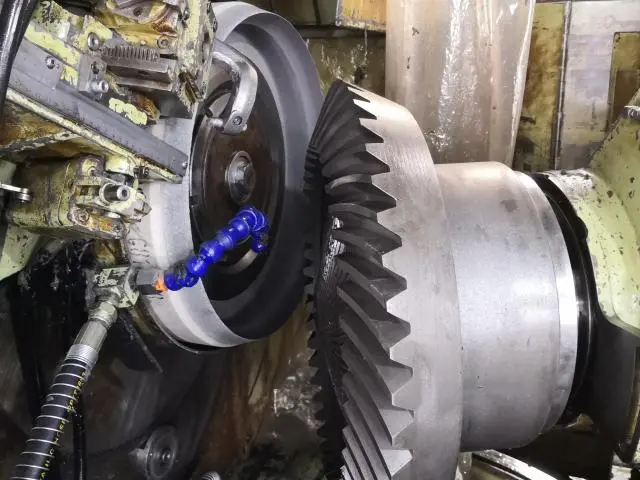
Understanding Spiral Bevel Gear Grinding
What Defines This Specialized Process
Grinding is different from preliminary gear cutting processes because it finishes hard after being heated. While hobbing makes the first tooth shape on soft blocks and lapping pairs gears together using abrasive compounds, Spiral Bevel Gear Grinding works on each part separately after it has been hardened. Using spinning abrasive wheels, the process removes tiny layers from the sides of gears. This fixes any physical errors that happened during carburising, quenching and tempering, or induction hardening. Some materials, such as 20CrMnTi, 42CrMo, AISI4140, and SAE4340, change so that their surfaces become 58–62 HRC. This means that they can't be cut with regular tools; only grinding wheels that are harder than the workpiece can shape these surfaces.
At YIZHI MACHINERY, we use gear grinding tools that are fully automatic and reach ISO 8–9 precision grades. The machine's five-axis CNC feature lets it make complex changes to the tooth surface, like crowning and relief tweaks, that can't be done with standard tools. Our process can handle modules ranging from 0.5 to 50, so it can work with both small precision parts and big mining equipment gears.
Step-by-Step Grinding Workflow
The first step in the methodical process is to place heat-treated gear blanks on precise supports inside the grinding room. The CNC processor is programmed by the operators with the wheel speed (30–50 m/s), feed rate (0.02-0.1 mm/rev), and depth of cut (0.005-0.02 mm per pass). Coolant supply systems fill the area where the metal is being ground. This stops thermal damage and gets rid of the swarf.
During use, the vitrified bond CBN wheel strikes the tooth flank at angles that are designed to match the spiral shape. The machine moves back and forth between each tooth spot, grinding over and over again until the desired measurements are reached. During intermediate dressing processes, the wheel outline is changed while the surface texture stays the same. In-process measurement tools check tolerances and make automatic changes for corrections when differences are bigger than 0.01mm.
Important factors have a direct effect on results. Too much grinding speed creates heat, which changes the microstructure and leads to grinding burn, which is shown by blue coloring and a loss of sharpness. Similar thermal damage is caused by not enough cooling flow rate. We manage the Specific Material Removal Rate (Q-prime) by placing the nozzles in the best way possible and keeping the water temperature below 30°C. This keeps the grinding zone below the steel's tempering level.
Common Defects and Practical Solutions
Chatter lines, which are repeated surface waves, are caused by machine vibrations or grinding wheels that aren't balanced. During gear function, these make high-frequency transmission noise, also known as "ghost noise." To find the resonance frequencies, our techs use FFT tremor analysis. They then use dynamic compensation by making changes to the software or changing the dressing processes.
Dimensional errors are caused by workpieces expanding when they get hot or by bad fixturing. Temperature-controlled areas (20°C ±2°C) keep the sizes of materials stable while they are being processed. When using hydraulic locking systems, the pressure stays the same during multiple production runs, so there are no changes in position.
When energy from grinding is turned into heat faster than coolant can clear it, burn lines show up. When you dress your wheels regularly, you expose new rough grains, which lowers the friction coefficients. We plan cleaning times based on how much material has been taken instead of how much time has passed. For 42CrMo alloy steel parts, this is usually done every 15 to 20 gear teeth.
Why Spiral Bevel Gear Grinding Matters in Modern Manufacturing
Advantages Over Traditional Manufacturing Methods
Usually, soft-cutting methods make gears that need to be matched pairs after grinding, which is an expensive limitation that makes the supply chain less flexible. Because Spiral Bevel Gear Grinding is mathematically repeatable, any ground pinion will fit properly with any ground gear that meets the same standards. Because of this interchangeability, it's easier for OEM makers to manage their global delivery networks and keep track of their inventory.
Here are the main ways that precise grinding improves performance:
- Enhanced Dimensional Accuracy: Getting a DIN 4 quality class instead of a DIN 7-9 quality class for lapped gears means better backlash control (0.02- 0.05 mm) and more stable kinematic behavior under changing loads. This is very important for machine tool spindle drives where positioning accuracy affects the tolerances of the final part.
- Superior Surface Finish: The 0.2–0.4µm Ra values lower friction coefficients by 15-20% compared to hobbed surfaces (1.6µm Ra average), which lowers working temperatures and increases the life of lubricants in mining equipment gears that are exposed to rough materials.
- Extended Service Life: Residual compressive forces added by controlled grinding processes raise the contact failure strength by 30–40%. This delays the start of pitting in high-cycle applications like military helicopter transmissions, where gears are loaded and unloaded 10⁸ times before they need to be overhauled.
In a direct way, these benefits solve problems in buying. Instead of changing differential gears every 8,000 hours with hobbed parts, miners can wait 12,000 hours or more with ground alternatives, which saves them 50% on downtime costs. Manufacturers of agricultural equipment say that guarantee claims dropped by more than 35% after tractors switched to ground bevel gears in their turning systems.
Real-World Impact on Gear Efficiency
A European aerospace supplier found that replacing lapped gears with precision-ground units in helicopter tail rotor gearboxes cut noise from 78 dB to 62 dB. The better surface finish got rid of micro-impacts that happened when the teeth touched, which directly met NVH standards set by flight officials.
Similarly, a mining company in North America that used haul truck differentials with constant 500 kW loads saw a 22% rise in load capacity after adding ground spiral bevel gears. When grinding, topological changes were made, especially diagonal bias adjustments, which stopped the case from bending under peak torque. This stopped edge loading, which used to cause terrible tooth chipping.
Cost-Benefit Analysis for Strategic Decisions
It looks like a big investment up front is needed in grinding technology: CNC grinding machines cost $800K to $2M, based on their size, while hobbing equipment costs $150K to $400K. Cycle times for production range from 8 to 12 minutes per gear for hobbing to 25 to 40 minutes for grinding. Lifecycle study, on the other hand, shows a different economy.
Ground gears get rid of the need for post-process lapping, which saves $15 to $30 per part. They also cut down on failures in the field, which saves money on insurance costs (about $5,000 per incident), and they make predictive maintenance scheduling possible by revealing uniform wear patterns. Total cost per gear drops 18–25% over a normal 60,000-unit production run for industrial machinery OEMs. This is because scrap rates drop from 4.8% to 1.2%, tool life increases, and rework processes are removed.
When purchasing managers look at a supplier's skills, they should give more weight to partners who can show controlled Spiral Bevel Gear Grinding processes. YIZHI MACHINERY has been making things for 15 years and has built up parameter databases for 12+ alloy steel grades. This lets us make things in 35 to 60 days with quality that is always the same thanks to statistical process control, and with damage rates during shipping below 0.1% thanks to custom packaging protocols.
Choosing the Right Spiral Bevel Gear Grinding Solution
Manual Versus CNC Grinding Approaches
Older manual grinding machines need skilled workers who can change the position of the wheels using handwheels and dial gauges. This is a very time-consuming process that should only be done in prototype development or repair shops that only handle single-unit orders. Dimensional gaps of up to ±0.08mm between runs make it hard to repeat. This is because people are different.
CNC grinding machines change the costs of making 100 or more units a year or more. Software-driven tool tracks get rid of the need for operators to have certain skills and allow for advanced features that would not be possible by hand. Topological changes, which involve straying from a perfect involute shape on purpose, make up for misaligned assemblies and deflections caused by loads. When a customer places an order more than once, our CNC systems save change programs that cut down on setup time from 4 hours to 45 minutes.
Technology choices are based on how scalable they are. Aerospace companies that make 20 to 50 units of specialized helicopter gearbox components every month can justify spending money on CNC machines by showing consistent quality and providing the paperwork needed for AS9100 approval. Agricultural equipment companies that make 500-unit runs of tractor transmission gears break even in 18 months by cutting down on waste and labor.
Strategic Make-or-Buy Decisions
Setting up in-house grinding skills requires more than just buying tools. Controlling environmental factors like temperature, humidity, and vibration, training programs for skilled technicians, and ongoing improvement of wheel consumables are all secret costs that add up to 40 to 60 percent of the initial machine investment over three years.
Other options include contract manufacturing partnerships with well-known companies like YIZHI MACHINERY. Our all-in-one technical services include communicating needs through design plans, processing production with high-precision CNC gear machining centers, inspecting quality with coordinate measuring machines, and managing logistics around the world. Clients keep control of the engineering while using our specialized knowledge and equipment costs that are spread out over time.
Quality control methods let you tell which partners you can trust. We use synced production progress updates to keep track of orders in real time, from the time they are loaded into the plant until they are signed by the customer. Before it is approved, each gear is measured in terms of its tooth shape, lead accuracy, and surface finish. Inspection records are kept so that they can be found later. Our ISO-compliant methods and long-term relationships with well-known mechanical engineering companies show that we can do what we say we can do as a reliable Spiral Bevel Gear Grinding provider.
Best Practices and Maintenance for Spiral Bevel Gear Grinding
Machine Setup and Operator Competencies
Careful planning is needed for Spiral Bevel Gear Grinding processes to go smoothly. When wheels are balanced to within 0.5 gram-millimeter, vibrations are less likely to reach the tooth surfaces. Coolant contamination tracking stops the movement of rough particles that damage sides. We filter systems down to 10-micron particles and use refractometers to check the concentration every week.
Operator training includes more than just machine code. It also includes basic material science. Technicians can make changes to factors before they happen if they know how different alloys (20CrNiMo vs. AISI8620) react to grinding heat. Our team goes through 120-hour licensing classes that teach them how to choose the right wheel specifications, make the best dressing strategies, and use statistical tools to find the root causes of defects.
Advanced software collaboration makes what can be done even better. Simulation units guess the grinding forces and heat loads before they are used in production. They do this by finding the parameter combinations that could cause burn damage. Adaptive control methods keep an eye on the spindle's power use and lower feed rates automatically when hardness changes occur that weren't expected. This is a typical problem with carburized gears that have inconsistent case depths.
Preventive Maintenance Protocols
How often you dress the wheels has a direct effect on the accuracy of the finish. We plan dressing based on how much material has been removed, not on random intervals. In 42CrMo steel, dressing usually happens after grinding 15 to 20 teeth. Single-point diamond dressers make the wheel shape flat while opening up the structure to let new abrasive grains in. This makes cutting more effective again.
Schedules for lubrication strictly follow OEM instructions. Changing the oil in the slides every 2,000 hours keeps them from sticking and slipping, which can affect how accurately they are placed. Spindle bearings that work at 3,000 RPM and have axial loads of more than 2 kN need oil-air lubrication systems that keep delivery rates of 0.3 ml/min. Deviations in these rates cause temperature spikes that can be seen by sensors built into the bearings.
Our detailed repair logs keep track of how parts wear over time, which lets us replace them before they break. Every three months, readings of the backlash of the ballscrews show any wear and tear that needs to be fixed or replaced. This keeps the setting accuracy within ±0.003mm over years of use.
Conclusion
Precision finishing with advanced Spiral Bevel Gear Grinding technology changes how well spiral bevel gears perform in mining equipment, helicopter systems, and industrial machinery. The process offers significant advantages, including accurate dimensions that ensure part interchangeability, smooth surface finishes that reduce friction losses, and extended service life that lowers the total cost of ownership. When deciding how to balance in-house capabilities with partnership models, long-term business goals, production volumes, and quality standards all play a role. Proper implementation of Spiral Bevel Gear Grinding requires strict process control, regular maintenance, and continuous technology development, but the benefits make the investment worthwhile for companies aiming for top-tier performance.
FAQ
1. How does grinding differ from hobbing in gear manufacturing?
Hobbing is a continuous indexing method that makes tooth shapes on soft blanks by cutting away material before heat treatment, while the steel is still workable (180–220 HB hardness). Grinding is a form of post-hardening that fixes flaws and gets surfaces over 58 HRC to their finished dimensions. Hobbing sets up basic shape, and grinding makes it perfect.
2. When should manufacturers invest in CNC grinding technology?
When you need to make more than 100 units a year, and the tolerances need to be tighter than ISO 9 grade, you should invest in a CNC. Precision grinding is needed in places where speed is important (pinion speeds >3,000 RPM), shock loads are present, or noise levels are low (automotive, aircraft). Please feel free to contact sales@yizmachinery.com to get a free chat with our engineering team about whether grinding is useful for certain tasks.
3. What maintenance practices extend grinding machine accuracy?
Thermal expansion mistakes can't happen in places where the temperature is managed. A uniform surface finish is kept by cleaning the wheels once a week. Laser interferometers are used for geometric correction every three months to check the accuracy of placement on all axes. Maintenance on the coolant system, such as filtering, checking for concentration, and stopping biological contamination, saves both the workpieces and the machine parts. We provide professional help and training programs to make sure that your team keeps up quality standards throughout the lifecycles of your equipment.
Partner With YIZHI MACHINERY for Superior Gear Solutions
YIZHI MACHINERY makes precise-ground spiral bevel gears, grinding to strict ISO 8-9 standards. These gears are used in mining, aerospace, and industrial machines all over the world. We have been making things for 15 years and have modern CNC grinding tools that can handle a wide range of materials, from 45# steel to SAE4340, and modules that range from 0.5 to 50. We have low minimum order amounts and can even make a single item. Delivery times range from 35 to 60 days, and we offer custom packing that keeps damage to goods during shipping to a minimum. As a reliable Spiral Bevel Gear Grinding provider, we offer a full range of technical services, from helping with design to keeping track of global shipping. Contact us at sales@yizmachinery.com to talk about how precision-ground gears can improve the performance and stability of your product.
References
1. Klingelnberg, J. (2016). Bevel Gear: Fundamentals and Applications. Springer Vieweg.
2. Stadtfeld, H.J. (2014). Gleason Bevel Gear Technology: Manufacturing, Inspection and Optimization. The Gleason Works.
3. Radzevich, S.P. (2018). Theory of Gearing: Kinematics, Geometry, and Synthesis (2nd ed.). CRC Press.
4. ISO 17485:2006. Bevel Gears — ISO System of Accuracy. International Organization for Standardization.
5. AGMA 2009-B01. (2009). Bevel Gear Classification, Tolerances, and Measuring Methods. American Gear Manufacturers Association.
6. Litvin, F.L., & Fuentes, A. (2004). Gear Geometry and Applied Theory (2nd ed.). Cambridge University Press.

USER EVALUATE
Here is the customer's evaluation of us