


Internal Gear Cutting: Everything You Need To Know
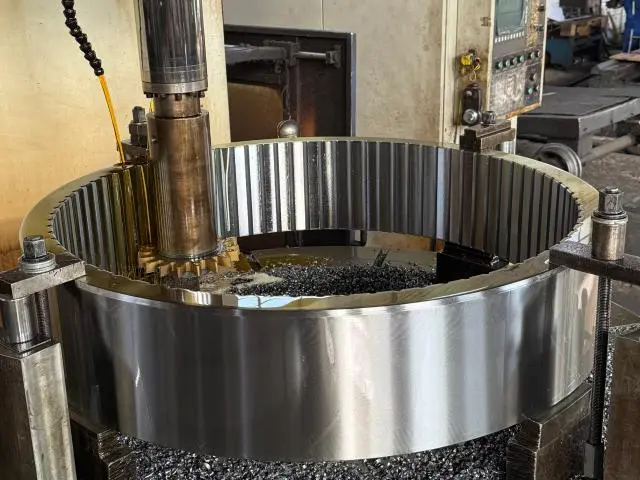
Internal Gear Cutting refers to the specialized machining process that generates gear teeth on the inner circumference of cylindrical components, enabling compact planetary transmission systems where the input and output shafts remain coaxially aligned. Unlike external gears manufactured primarily through hobbing, internal gears require distinct techniques such as gear shaping, power skiving, broaching, and internal grinding due to geometric interference constraints. This process solves critical engineering challenges related to space optimization, torque density, and noise reduction in industrial machinery, mining equipment, aerospace actuators, and advanced transmission systems where concave-convex tooth contact delivers superior load-sharing characteristics.
Understanding Internal Gear Cutting
Having a clear definition of the process helps procurement workers understand what part it plays in modern manufacturing. This method addresses fundamental challenges that external gear cutting cannot solve because it's hard to get to and has limits on how it moves.
What Makes Internal Gear Cutting Different from External Gear Cutting?
External gears have teeth on the outside circumference, while internal gears feature teeth cut into the inner surface. Traditional hobbing cannot produce internal profiles due to cutter interference. Manufacturers use alternative methods accommodating concave geometry. Planetary gear reducers, winches, and machine tool feed mechanisms use internal gears to enable compact designs. Concave-convex contact raises contact ratio, lowering friction and extending component life in mining and aerospace applications.
Step-by-Step Workflow in Manufacturing Internal Gears
Production begins with material selection and blank preparation using steels like 45#, 20CrMnTi, 42CrMo, and AISI8620. Rough cutting establishes outer diameter and hole dimensions. Core tooth-forming uses shaping, skiving, broaching, or milling. Heat treatment achieves 45-62 HRC surface hardness. Finishing operations like tooth grinding correct heat treatment distortion to ISO 8-9 grade. Final inspection, deburring, and rust prevention complete the workflow.
Key Methods: Shaping, Skiving, Broaching, and Grinding
Gear Shaping uses reciprocating cutter motion for modules 0.5-50, handling blind holes with limited runout. Power Skiving combines hobbing speed with shaping geometry, reducing cycle times 3-5× for high-volume EV transmissions. Broaching enables fast mass production of standard profiles with single-pass cutting. Internal Grinding corrects thermal distortion on hardened parts to ISO 5-6 accuracy with rigid machine frames.
Comparing Internal Gear Cutting Methods for Informed Decisions
To make the best decisions about how to make things and keep prices down, procurement managers need to be able to clearly compare Internal Gear Cutting methods. Knowing about speed metrics makes it easier to match methods to the needs of a program.
Performance Metrics: Accuracy, Speed, and Cost-Effectiveness
Shaping achieves ISO 7-9 in soft state; grinding achieves ISO 5-6 post-hardening. Power skiving delivers ISO 6-8 with combined speed and accuracy. Broaching gives consistent ISO 7-8 but cannot adapt to design changes without expensive tooling. Shaping takes 8-12 minutes; skiving takes 2-4 minutes; broaching under 60 seconds. Shaping has lower startup costs; skiving needs higher investment but better unit economics above 500 pieces. Broaching only makes financial sense at high annual volumes.
Material Compatibility and Batch Size Considerations
Soft materials below 35 HRC accept any cutting method. Pre-hardened materials 35-45 HRC challenge tool life; carbide tools still work. Above 45 HRC requires skiving or grinding. Shaping suits prototypes and low-volume runs (1-50 pieces). Skiving benefits medium volumes (50-1000 pieces). Broaching justifies investment for high-volume production above 1000 pieces annually. Decision framework: determine accuracy needs, assess material specs, estimate annual volume, evaluate design stability.
Decision-Making Framework for Engineers
Define accuracy requirements—aerospace needs ISO 5-6; industrial winches work at ISO 8-9. Check material specs and heat treatment needs; post-hardening operations require grinding or hard skiving. Estimate annual volume and design stability. Flexible methods like shaping suit frequent design changes. YIZHI MACHINERY guides customers through this selection matrix based on 15 years experience across industrial, mining, and aerospace sectors. We analyse technical plans and quality goals to determine most cost-effective manufacturing approach.
Internal Gear Cutting Accuracy and Standards
Quality assurance separates reliable providers from those who cause costly delays in production and problems in the field. Understanding Internal Gear Cutting standards helps hiring teams be clear about what they need.
International Standards: ISO and AGMA
ISO 1328 and AGMA 2000 define gear quality classes based on pitch variation, profile deviation, helix error, and runout. ISO Class 5 serves aerospace gears with tooth-to-tooth variation under 8 microns. ISO 6-7 balances precision and cost for automotive applications. ISO 8-9 suits general industrial gearing. AGMA Q12-Q14 corresponds to ISO 5-6; AGMA Q8-Q10 corresponds to ISO 8-9. North American buyers often specify AGMA grades; European and Asian suppliers use ISO standards.
Factors Influencing Accuracy
Machine rigidity, thermal stability, and bearing quality determine tolerance consistency. YIZHI MACHINERY maintains positioning accuracy within 3 microns using high-precision CNC centers. Tool quality affects profile accuracy; predictive life tracking prevents quality drift. Advanced AlTiN and TiAlN coatings extend tool life 40-60%. Real-time process control identifies problems before scrap accumulation. Hydraulic expansion arbors and floating clamping systems prevent thin-wall distortion during machining.
Best Practices for Procurement Teams
Specify clear quality standards using ISO or AGMA classes in purchase orders. Request material certificates showing chemical composition and mechanical properties. Ask for inspection records verifying pitch variation, profile accuracy, and surface hardness. Verify supplier compliance through third-party inspection reports. YIZHI MACHINERY provides comprehensive inspection records including CMM reports, surface hardness mappings, and tooth contact pattern analysis. Custom packaging with shock-absorbing covers keeps transport damage below 0.1%.
Procurement Guide: Buying Internal Gear Cutting Machines and Services
Strategic sourcing choices weigh the cost of capital investment against the freedom of outsourcing. Purchasing managers can get the best total cost of ownership for Internal Gear Cutting by understanding the trade-offs.
Evaluating In-House Production Versus Outsourcing
In-house manufacturing offers schedule control and IP protection but requires significant investment—gear shapers cost $150,000-$400,000; skiving systems exceed $600,000. Operator training and maintenance add hidden costs. Cost-effectiveness drops below 60% machine utilisation. Outsourcing to specialised contract manufacturers like YIZHI MACHINERY avoids capital expenditure and transfers capacity risk. Full customisation services include requirements discussion, design, production, quality inspection, packaging, and shipping.
Criteria for Selecting Manufacturing Partners
Verify maximum module capacity, bore diameter range, and helix angle capability. YIZHI MACHINERY handles modules 0.5-50, helix angles 5°-45°, and both spur and helical internal gears. Tooling inventory shows flexibility for design changes—stocked cutters cover standard pressure angles and modules. After-sales support distinguishes reliable partners. YIZHI MACHINERY provides one-year warranties, rapid response protocols, and application engineering support with pre-sales design review and logistics tracking.
Balancing Price with Quality and Reliability
Low-cost suppliers often compromise material quality or reduce inspection. Short-term savings lost through premature failures and warranty claims. Evaluate unit price against total cost including inspection, replacement risk, and reliability. YIZHI MACHINERY uses high-quality materials like 20CrMnTi, AISI8620, and 18CrNiMo7 with carburising and induction hardening achieving consistent case depth and core hardness. Tooth grinding corrects heat treatment distortion to ISO 8-9 grade standards. Delivery completes in 35-60 days.
Advantages and Future Outlook of Internal Gear Cutting
Engineers are increasingly choosing Internal Gear Cutting solutions because they have a lot of great benefits. Planetary designs are possible because the structure is so small. This is something that regular external gear trains can't do. When space is limited, it's important to use planetary reducers with internal gears because they can achieve the same ratios in 40–60% less room than countershaft designs—critical where space limitations constrain machine design.
Core Advantages Driving Adoption
Internal-external gear meshes have a higher contact ratio, which makes the transmission very stable. Multiple teeth share loads at the same time, which lowers stress levels and makes parts last longer. This feature is very important for mining equipment that has to deal with shock loads and constant job cycles. Excellent load-bearing capacity stems from the concave-convex tooth contact geometry. Spreading the load over bigger contact areas lowers surface forces compared to external gear pairs of the same size. Applications like transmissions for lifting equipment and slew drives for big building equipment rely on this robustness.
Flexible gear ratio design using planetary setups makes it possible for complicated transmission features like multiple speeds, the ability to reverse, and differential functions to fit into small spaces. At YIZHI MACHINERY, custom services meet specific needs that can't be met by normal stock parts. We have low minimum order numbers and can even make prototypes and specialized tools one at a time. This gives our customers the freedom to choose batch sizes that aren't cost-effective while we work with them on development projects and one-off, low-volume apps.
Technological Trends: CNC Integration and Industry 4.0
Modern Internal Gear Cutting uses CNC control systems more and more, which makes it possible to make complicated spiral curves, crowning changes, and tip relief shapes that improve noise levels and load distribution. Machines that shape things now use electronic guides instead of mechanical ones. This makes them more flexible and cuts down on the time it takes to set up when moving between part families. New finishes and materials for tools make them more productive. Compared to traditional TiN-coated tools, cemented carbide surfaces with nanocomposite AlCrN coats keep the cutting edge sharp over long production runs, lowering the cost of each part by 35–50%.
Forward-Looking Procurement Strategies
When you work with suppliers who are on the cutting edge of new technologies, your company can take advantage of them without having to pay for their full development. We at YIZHI MACHINERY have invested in some of the world's best precision manufacturing and inspection equipment, including high-precision CNC gear machining centers and fully automated gear grinding machines. Our long-term relationships with many well-known mechanical engineering companies in the mining, aircraft, and industrial machinery sectors show that we are reliable and skilled.
Our proven OEM customization approach uses standardized processes to make sure that orders are filled quickly and correctly. From initial requirements discussion through design plans, production machining, quality inspection, packaging, and transportation, each step is done according to written instructions that have been improved over 15 years. This stability cuts down on variations in lead times and quality issues, which helps you plan your production and make the best use of your goods.
Conclusion
Internal Gear Cutting is an advanced production technique that solves difficult technical problems in high-torque, limited-space situations. Knowing about different ways of doing things, standards for accuracy, and buying strategies lets you make smart choices that improve performance and cut costs. Different techniques, from basic gear shape to advanced power skiving, each have their own benefits that make them better for certain production situations. Adhering to ISO and AGMA standards for quality control makes sure that parts work reliably in demanding situations like industrial tools, mining equipment, and aircraft systems. Competitiveness and operating flexibility are decided by strategic sourcing choices that compare in-house capabilities to those of specialized manufacturing partners. As CNC integration, advanced materials, and Industry 4.0 continue to change the way things are made, companies that work with new sources will be able to keep doing well.
FAQ
1. Why choose Power Skiving over Gear Shaping for high-volume production?
By mixing crossed-axis kinematics with continuous cutting motion, Power Skiving speeds up cycle times by three to five times. Because of this speed benefit, skiving is a better way to make things that are used in large amounts, like automotive ring gears and EV transmission parts that are made more than 1000 times a year. For low-volume runs, prototypes, and blind holes with little room, shaping is still better than skiving, which needs more axial space for the cutter to slow down and retreat.
2. Can internal gears be machined after heat treatment?
Of course. Hard skiving and internal gear grinding are two specific methods used to work on hardened parts that have a surface hardness of 58 to 62 HRC. Heat treatment always changes the dimensions of the material because of thermal growth and phase changes. These steps after hardening fix mistakes in the profile, bringing the accuracy back to ISO Class 5–6, which is needed for aerospace actuators, high-performance race gears, and precise industrial uses. The high cutting forces are handled by rigid machine frames and specialized tools that don't bend or shake.
3. What quality challenges affect internal gear accuracy most significantly?
Tool deflection and thin-wall warping are the main things that can go wrong with precision. Internal ring gears usually have structures with thin walls that can bend when pressing pressure and cutting forces act on them. Specialized hydraulic expansion arbors and flexible clamping systems keep the item from warping too much while it is being machined. Also, accurate calculations of the cutter-to-workpiece tooth ratios are needed to avoid trochoidal interference, which happens when there are too many cutter teeth compared to workpiece teeth and the profile is clipped. YIZHI MACHINERY's process control and checking procedures are designed to deal with these issues head-on, making sure that all of our production batches meet ISO 8–9 grade quality standards.
Partner with a Trusted Internal Gear Cutting Supplier
YIZHI MACHINERY specializes in making precision internal gears that are exactly what you need. They have been making these gears for 15 years and have experience making them for industrial tools, mining, and aircraft. We can give you advice on design, use advanced production techniques on materials ranging from 45# steel to SAE4320, heat treat them to make the surface 58–62 HRC hard, and grind their teeth to ISO 8–9 grade accuracy. We work with modules ranging from 0.5 to 50, unique tooth counts, and helix angles from 5° to 45°. We can make prototypes and large numbers, and our minimum order sizes are low enough that we can even make a single item.
Our visual tracking from start to finish, customized packaging that keeps damage rates below 0.1%, 35–60 day delivery windows, and multi-channel transport choices give you peace of mind throughout the whole purchase process. Email us at sales@yizmachinery.com to talk about your internal gear cutting requirements and discover how our technical consultation and one-year warranty support your success.
References
1. American Gear Manufacturers Association. (2022). AGMA 2000-A88: Gear Classification and Inspection Handbook - Tolerances and Measuring Methods for Unassembled Gears. Alexandria: AGMA Publications.
2. International Organization for Standardization. (2020). ISO 1328-1:2013 - Cylindrical Gears - ISO System of Flank Tolerance Classification - Part 1: Definitions and Allowable Values of Deviations Relevant to Flanks of Gear Teeth. Geneva: ISO Standards.
3. Stadtfeld, H.J. (2021). Advanced Gear Engineering: Manufacturing Methods and Applications. Gleason Works Technical Publications, Rochester.
4. Klocke, F., Brecher, C., & Löpenhaus, C. (2019). "Power Skiving: High-Performance Cutting for Internal Gears in Automotive Transmissions." Production Engineering Research and Development, 13(4), 453-461.
5. Radzevich, S.P. (2018). Theory of Gearing: Kinematics, Geometry, and Synthesis (2nd ed.). Boca Raton: CRC Press.
6. Linke, H., Börner, J., & Heß, R. (2020). Cylindrical Gears: Calculation, Materials, Manufacturing. Munich: Hanser Publications.

USER EVALUATE
Here is the customer's evaluation of us