


How Internal Planetary Gear Ratio Affects Performance in Transmission Systems
In an Internal Planetary Gear system, the gear ratio is what really controls how well the transmission works in terms of power multiplication, speed reduction, and mechanical economy. The Internal Planetary Gear, which is also called the ring gear or annulus, connects to planet gears that circle a center sun gear to make a tight epicyclic pattern. To find the ratio, you need to know how the number of teeth on the ring gear, sun gear, and carrier design relate to each other. Higher gear ratios increase power output but slow down rotational speed, which is important for heavy-duty uses like mine machines and aircraft actuators. On the other hand, smaller ratios put speed ahead of power, which works well for high-rpm industrial automation. When engineers and procurement managers understand this balance, they can choose parts that have the best load capacity, the least amount of noise, and the longest service life across a wide range of transmission systems.
Understanding Internal Planetary Gears and Gear Ratios
What Makes Internal Planetary Gears Unique?
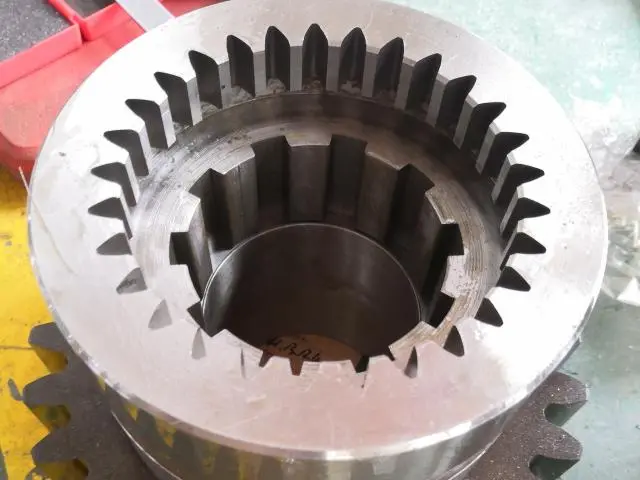
Internal Planetary Gears feature a central sun gear ringed by planet gears meshing with an internal ring gear. This internal meshing creates concave-convex contact reducing Hertzian stress by 15-20% versus external meshes, improving wear life and load capacity. Multiple planet gears share rotational loads simultaneously, distributing stress evenly and preventing premature failure. The concentric layout enables compact packaging ideal for space-constrained aerospace and robotics applications.
Defining Gear Ratios in Planetary Systems
Gear ratio depends on which component remains stationary, which drives, and which outputs. With ring gear fixed and sun gear driving, ratio equals (Ring Teeth + Sun Teeth) / Sun Teeth. With sun gear fixed and carrier as input, ratio is (Ring Teeth / Sun Teeth) + 1. Custom applications offer modules from 0.5 to 50 and helix angles 5° to 45°. Ratios range from 3:1 for modest reduction to 100:1 for extreme torque multiplication.
How Internal Planetary Gear Ratio Impacts Transmission System Performance?
Torque Output and Speed Relationships
Gear ratio directly controls torque multiplication in transmission systems. Higher ratios exponentially increase output torque while proportionally decreasing rotational speed. A 10:1 ratio multiplies input torque tenfold while reducing speed tenfold. This proves critical for mining dragline excavators requiring high torque at low speeds. Lower ratios of 3:1 to 5:1 suit CNC feed mechanisms requiring accurate positioning with adequate cutting force. Transmission errors are naturally lower in internal planetary designs.
Mechanical Efficiency and Heat Generation
Gear ratio selection affects mechanical efficiency through meshing losses and lubricant film formation. Systems with 4:1 to 8:1 ratios typically achieve 95-98% efficiency per stage, dropping to 90-93% above 15:1 due to increased sliding friction. Heat generation directly correlates with efficiency losses, accelerating lubricant degradation and component wear. Carburizing alloy steels like 20CrMnTi achieve 58-62 HRC surfaces with 30-40 HRC tough cores for shock resistance.
Noise, Vibration, and Harshness Characteristics
Gear ratio selection affects acoustic performance by altering mesh frequency and transmission error. Lower ratios produce higher frequency noise that attenuates quickly, while higher ratios generate lower frequencies travelling through machinery. Internal Planetary Gears produce 5-8 decibels less noise than equivalent external systems through distributed loading and reduced sliding speeds. Advanced manufacturers use single-flank testing to identify ghost noise frequencies before production. ISO 5-6 grinding accuracy meets strict NVH standards.
Selecting the Right Internal Planetary Gear Ratio for Your Application
Industry-Specific Requirements Analysis
Ratio selection strategies reflect industry-specific performance priorities. Aerospace applications require lightweight designs with maximum power density, using high-strength nickel-chromium alloys and advanced heat treatment. Mining equipment prioritises durability and shock resistance over weight optimisation, using 40:1 to 80:1 ratios in excavator end drives. Industrial automation requires perfect matching to servo motor torque curves, requiring custom tooth counts and helix angles aligning mechanical advantage with duty cycles.
Evaluating Supplier Capabilities and Certifications
Successful procurement extends beyond part specifications to include supplier reliability and quality systems. Manufacturers using Gleason or Klingelnberg measuring equipment demonstrate commitment to dimensional accuracy. Nondestructive testing verifies material uniformity and heat treatment effectiveness. Nital etch testing identifies grinding burns affecting tensile strength. Complete material certificates and heat treatment records demonstrate transparency building long-term purchasing partnerships. Quantity requirements and lead time constraints equally influence supplier selection.
Maintenance and Longevity of Internal Planetary Gears in Transmission Systems
Proactive Inspection and Lubrication Strategies
Regular inspection prevents wear progression before catastrophic failure. Vibration analysis detects changes in mesh frequency sidebands indicating tooth breakage, bearing wear, or lubricant contamination. Establishing baseline vibration signatures enables condition-based maintenance based on actual equipment state. Synthetic gear oils with extreme pressure additives maintain protective films at contact pressures exceeding 1500 MPa. Oil analysis determines fluid replacement intervals based on contamination and additive depletion.
Troubleshooting Common Failure Modes
Pitting occurs from contact fatigue when surface hardness insufficient for load cycles. Accelerated pitting indicates specification errors or unexpected load increases. Tooth breakage results from shock loading or fatigue crack propagation from stress concentrations. Root fillet geometry critically affects stress distribution. Heat treatment ensuring adequate core toughness prevents brittle fracture even with surface cracks. Increasing operational noise indicates progressive wear, while sudden changes signal catastrophic failures like tooth chipping.
Procurement Guide: Buying Internal Planetary Gears with Optimal Ratios
Understanding Pricing Structures and Customization Options
The prices of buying Internal Planetary Gears depend a lot on their specs, number, and level of customization needed. Standard stock items with common ratios and materials have lower per-unit costs because of economies of scale in manufacturing. Custom designs, on the other hand, have higher setup costs, engineering costs, and equipment costs that are spread out over fewer production runs. Buyers who want to optimize both cost and performance should work with providers early on in the design process. Making small changes to the specifications can save a lot of money without affecting the functionality standards.
Volume pricing models usually offer discounts that get bigger as the number goes up. For example, discounts of 5–15% are popular at 10–50–100-unit breaks, which show that the manufacturing process is becoming more efficient. Blanket purchase orders that agree to yearly amounts help suppliers make the best use of their production schedules and material purchases. Suppliers and buyers often share the savings by negotiating prices. When you look at the total cost of ownership instead of just the unit price, you can see how things like warranty coverage, technical help access, and a past of reliability affect the overall cost over the product's lifetime.
Customization options are a big part of what sets one provider apart from another. Modern companies let you choose from different tooth count choices, module sizes ranging from 0.5 to 50, helix angles ranging from 5° to 45°, and materials ranging from normal carbon steels to aerospace-grade alloys. Cutting, hobbing, milling, and grinding are some of the processing techniques that can be used to meet different accuracy needs and price limits. Suppliers with a wide range of tools can work on projects that require as few as one prototype or as many as a thousand units. This allows for scalability as product plans grow from research to full-rate production.
Initiating Supplier Engagement and Technical Discussions
For procurement to work well, there must be detailed documentation of all the requirements, including application factors, performance standards, and information about the operating environment. When asking for technical information, you should include load profiles like the highest constant torque, peak shock loads, duty cycles, and the projected service life in hours. Material choices and closing needs are affected by things like the temperature range, the amount of dirt, and the cleaning methods used. When you give providers all the information they need, they can suggest the best designs instead of generic ones that need expensive rethink iterations.
When sending out a request for quotes, companies should include thorough breakdowns of costs like material costs, processing costs, quality inspection processes, and lead time promises. Being able to see prices clearly lets you compare costs between sellers in a useful way and find possible value engineering opportunities. Quotes should come with technical data packages that have dimensional models, material certifications, heat treatment specs, and quality control paperwork that shows the product meets all standards and customer requirements.
In addition to price, suppliers are also judged on their scientific know-how, manufacturing skills, and quality control systems. Visits to production sites show signs of how well the relationship will work in the long run in terms of the level of sophistication of the equipment, the controls used in the process, and the organizational culture. Looking at customer examples and case studies shows that the product has worked well in similar situations before. This lowers the risk of buying from unknown companies that offer good deals but don't have any records to back up their claims.
Conclusion
To choose the right Internal Planetary Gear ratios, you have to balance a lot of different performance factors, such as the torque needs, the speed limits, the economy goals, and the noise levels that need to be kept within certain limits for each business. To make a good purchase, you need to know how gear ratios affect the properties of a transmission system and check that the seller can do things like being flexible with customization, ensuring quality, and delivering on time. The technical information in this guide gives engineers and buying managers the tools they need to choose parts that will make machines work better and last longer, all while keeping the total cost of ownership low. When you involve skilled makers early on in the design process, you can make changes that meet the specific needs of your application that normal catalog parts can't.
FAQ
1. How do I calculate the required gear ratio for my specific application?
To find the right gear ratio, you must first know what your input speed is, what your desired end speed is, and how much power you need. To find the ratio, the basic method splits the input speed by the output speed. But you should also think about the efficiency losses, which are usually between 2% and 5% per planetary stage, and make sure that the ratio you choose keeps the motor running in the best power range. Talking to knowledgeable gear makers who know the needs of your industry will help you choose the right ratio that matches all performance factors instead of focusing on improving just one factor at the cost of the system's overall effectiveness.
2. What performance differences exist between internal and external planetary gear configurations?
Because the ring gear fits the entire system inside a smaller cylindrical shell, Internal Planetary Gears are more compact and have a higher power density than exterior designs. In internal systems, the concave-convex tooth contact shape lowers contact stress by about 15–20%, which makes parts last longer under the same loads. The sound quality gets better by 5 to 8 decibels because the load is spread out better across more planet gears and the sliding speeds slow down. Because of these benefits, internal configurations are better for uses where design decisions are based on room, weight, or noise needs.
3. Can gear ratios be customized for specialized industrial applications?
Internal Planetary Gears can be changed in many ways to meet the needs of specific applications thanks to advances in modern production. For engineers to exactly optimize ratios, module specs can range from 0.5 to 50 teeth, and helix angles can be set between 5° and 45°. Different strength, weight, and environmental needs can be met by a wide range of materials, from normal alloy steels to aerospace-grade formulas. Leading suppliers have low minimum order amounts, which means that customization is affordable even for prototype development and small production runs. Customization choices aren't just available for high-volume uses.
Partner with YIZHI MACHINERY for Superior Internal Planetary Gear Solutions
YIZHI MACHINERY has been making custom Internal Planetary Gears for 15 years, working with difficult industries like mining, aircraft, and industrial machines. Our precision-ground parts are accurate to an ISO 5–6 level thanks to advanced processing methods like cutting, hobbing, milling, and grinding, along with full quality control using coordinate measuring tools and gear measuring centers. We can make changes to module ranges from 0.5 to 50, helix angles from 5° to 45°, and high-quality materials like 20CrMnTi, 42CrMo, and AISI 8620. The surface hardness can be between 45 and 50 HRC or 58 and 62 HRC, based on the needs of the application.
As a reputable Internal Planetary Gear seller, we offer fast delivery times (35 to 60 days) and don't require large minimum orders—even for single units—so we can support your prototype development and unique production needs. Our full range of services includes figuring out what you need, making design drawings, keeping up with production, checking for quality issues at all times, custom packing with guarantees against damage, and real-time logistics tracking to make sure the integrity of your goods during shipping around the world. Contact us at sales@yizmachinery.com to talk about your exact gear ratio needs and get full quotes that fit your application.
References
1. Müller, H.W. (2020). Epicyclic Drive Trains: Analysis, Synthesis, and Applications. Detroit: Society of Automotive Engineers International.
2. Stadtfeld, H.J. (2019). "Advanced Gear Engineering: Materials, Manufacturing, and Performance Optimization." Gear Technology Magazine, Vol. 36, No. 4, pp. 42-51.
3. Lynwander, P. (2018). Gear Drive Systems: Design and Application. New York: Marcel Dekker Technical Publications.
4. Radzevich, S.P. (2021). Theory of Gearing: Kinematics, Geometry, and Synthesis (2nd ed.). Boca Raton: CRC Press.
5. AGMA Technical Committee (2022). "AGMA 6123-C22: Design Manual for Enclosed Epicyclic Metric Module Gear Drives." Alexandria: American Gear Manufacturers Association.
6. ISO Standards Committee (2021). "ISO 1328-1:2021 Cylindrical Gears – ISO System of Flank Tolerance Classification." Geneva: International Organization for Standardization.

USER EVALUATE
Here is the customer's evaluation of us