


How do internal planetary gears improve torque in industrial machinery?
Through clever load sharing and a small, concentric design, Internal Planetary Gears greatly increase torque in industrial machines. The Internal Planetary Gear is different from other gear systems because it has teeth cut into the inside of a ring. These teeth mesh with various planet gears that circle a center sun gear. This setup spreads rotational loads across several contact points at the same time, which lowers stress on each tooth while increasing power output. The internal meshing design makes a higher contact ratio and torque density within a very small size. This makes these gears essential in mining equipment, aerospace actuators, and heavy industrial machinery that needs to be space-efficient and have high torque demands.
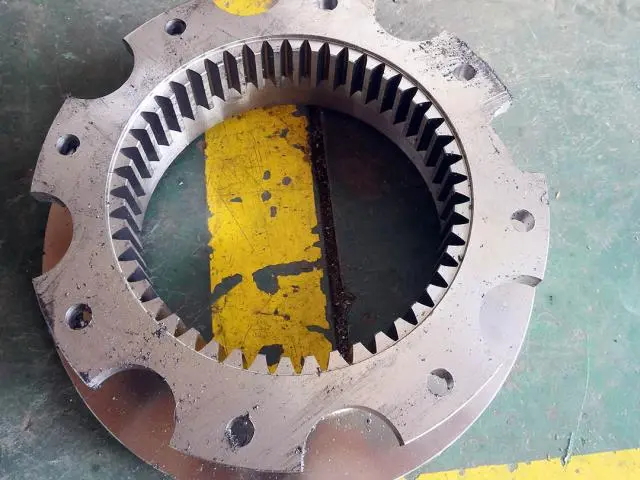
Understanding Internal Planetary Gears and Their Torque Mechanism
Planetary gear systems are different from standard parallel-shaft setups because of how they are built. An Internal Planetary Gear is like the outer border or ring gear in an epicyclic gear train. It limits the structure in a way that lets torque be multiplied by mechanical advantage.
How Internal Meshing Creates Torque Advantages?
The inner ring gear meshes with planet gears on its inner circle, making a tooth contact surface that is both concave and convex. This shape lowers Hertzian contact stress compared to external-external gear meshes, which directly improves torque capacity and wear life. When three to six planet gears engage at the same time, which is common in industrial settings, the power load is spread out evenly across all mesh points. The system can handle a lot more power than a single gear pair of the same size because of this load-sharing device.
Torque Pathways and Mechanical Leverage
There are three possible ways for torque to move through planetary systems. If you hold the ring gear still while moving the sun gear, you get high reduction ratios and torque multiplication at the carrier output. Based on the ratio between the diameters of the ring gear and the sun gear, the lever arm effect that comes with planetary shape makes the input force stronger. We've seen that this mechanical edge can make torque multiplication factors higher than 10:1 in single-stage designs while still being very small.
Compact Design and Torque Density Benefits
Area-limited uses in mine excavators and aircraft actuators need to get the most torque out of the smallest possible area. When planetary parts are arranged in a circular pattern, torque density values are often 30 to 50 percent higher than with parallel-shaft gears. The internal teeth of the ring gear use room that would otherwise be empty. This helps achieve the high power-to-weight ratios needed for mobile equipment and airplane systems.
The Design Principles Behind Torque Optimization in Internal Planetary Gears
For the best torque performance, design factors, material science, and production accuracy must all be carefully considered. Each part works with the others to make the power capacity as high as possible while also making sure the life under tough operating conditions.
Gear Geometry and Ratio Calculations
How well torque multiplication works depends on how precisely the gears are shaped. Radial and axial force components are balanced by the pressure angle, which is usually 20° in industrial planetary gears. Tooth shapes with helix angles between 5° and 45° lower axial thrust while spreading loads over a wider tooth face, which increases torque capacity. Module choice has a direct effect on tooth strength. We can make modules ranging from 0.5 to 50, which works for everything from high-precision robots to big mining equipment. When you figure out gear ratios, you have to make sure that the number of teeth on the sun, planet, and ring gears are all balanced so that you get the torque multiplication you want while also making sure that the mesh interference and load distribution are correct across all planets.
Material Selection for High-Torque Applications
Choice of material has a big effect on power capacity and longevity. We use high-quality alloy steels like 20CrMnTi, 40CrNiMo, AISI 8620, 18CrNiMo7, and SAE4340 to make our Internal Planetary Gears. These materials have the right metallurgy to handle high Hertzian contact loads while they are being used continuously. The alloy's make-up makes sure that the core is tough enough (30–40 HRC) to handle the shock loads that are common in building and mining equipment. Surface treatments make the metal hard enough to prevent wear.
Heat treatment changes the qualities of materials to make torque transfer better. When you carburize something, you make a harder case layer that has a surface hardness of 58 to 62 HRC. This makes it very resistant to wear and cracking. Care must be taken to control the effective case depth. If it's not deep enough, the case will fail early, and if it's too deep, it will become weak. When you quench and temper materials like 42CrMo and AISI 4140, you get balanced qualities that are good for high-torque aircraft uses. Induction hardening can harden only the surface where teeth touch, keeping the body flexible while making the surface last longer.
Manufacturing Precision and Torque Efficiency
Today's production methods make sure that the tolerances are very tight, which is important for torque economy and noise reduction. We use high-precision CNC gear machining centers to do cutting, hobbing, milling, and grinding as part of our production process. Controlling profile deviation (Fa), helix deviation (fHb), and total cumulative pitch variation (Fp) to within microns is needed to reach ISO 5-6 grade accuracy. Tooth grinding is the last step in making things perfectly accurate. It gives the surface a smooth finish and makes sure that the shapes are perfect so that the teeth can fit together perfectly. Radial runout of internal teeth relative to bearing surfaces should be kept to a minimum. Too much runout causes cyclic vibrations that slow down power transfer and speed up wear. Coordinate measuring tools and gear measuring centers are used by quality control to check the accuracy of the dimensions, and single flank testing checks for transmission error to make sure that the power is delivered smoothly and efficiently across the entire operating envelope.
Comparing Internal Planetary Gears with Alternative Gear Systems for Torque Performance
To choose the best gear system for uses that require a lot of torque, you need to know how different combinations work. Depending on the job, each type of gear has its own unique benefits.
Internal vs. External Planetary Configurations
Internal and external planetary systems both spread loads across many mesh points, but internal versions offer higher power density. In internal systems, the ring gear makes good use of the outer envelope, so no room is lost. External planetary designs put the ring gear outside the orbit of the planet, which makes the total diameter bigger for the same amount of force. Because of the concave-convex meshing geometry, Internal Planetary Gears have less contact stress, which increases their useful life in mining and industry uses that use them constantly.
Performance Against Spur and Bevel Gears
Spur gears offer simplicity and cost-effectiveness for modest torque but require more space for equivalent capacity. A single-stage spur gearbox handling 40-60% of planetary power requires similar envelope dimensions. Bevel gears change power direction but introduce axial forces and complex installation. Planetary configurations maintain aligned input-output shafts while achieving higher reduction ratios, simplifying machine design in space-constrained applications like winches and feed systems.
Harmonic and Cycloidal Alternatives
Harmonic drives provide exceptional precision and zero backlash for robotic positioning where accuracy outweighs torque demands. Their torque capability remains limited by flexible spline material constraints. Cycloidal gears handle shock loads well through multiple tooth engagement, suiting impact-prone applications. Internal Planetary Gears balance high torque capacity, good accuracy, and robust shock resistance, making them versatile across industrial gearbox applications, mobile equipment, and automated production lines.
Real-World Torque Improvements
A big company that makes construction equipment switched from traditional parallel-shaft gears to internal planetary units in the swing drives of excavators. This made the torque 35% higher while keeping the same mounting space. Mining companies that used haul trucks with planetary end drives said that they could go 20% longer between service times because the better load distribution cut down on wear rates. When compared to older spur gear designs, aerospace actuator systems with precision-ground Internal Planetary Gears showed 15% higher efficiency, which immediately translated to lower energy use and heat production in mission-critical applications.
Procurement Considerations: How to Source High-Quality Internal Planetary Gears?
To buy Internal Planetary Gears successfully, you need to find a mix between technical requirements, the supplier's skills, and the total cost of ownership. By understanding these factors, you can be sure that your investment will give you solid performance for the entire duration of the equipment.
Evaluating Technical Specifications
Procurement starts with defining application requirements including peak loads exceeding steady-state values by 200-300% in mining equipment. Module ranges from 0.5 to 50 accommodate precision instruments to heavy machinery. Surface hardness of 45-50 HRC suits general industrial use, while 58-62 HRC through advanced carburizing serves aerospace and mining. Helix angles from 5° to 45° optimise noise, efficiency, and thrust characteristics for specific applications.
Price, Lead Times, and Customization
Standard planetary gears offer faster delivery but may compromise application-specific performance for Internal Planetary Gear systems. Custom designs optimise power transmission for unique duty cycles and mounting constraints of Internal Planetary Gear applications. Our 35-60 day schedule enables thorough design verification and quality inspection for Internal Planetary Gear production. Low minimum order quantities support prototyping and small-batch production of Internal Planetary Gear units. Bulk purchasing leverages economies of scale for OEM relationships involving Internal Planetary Gear components. Custom manufacturing addresses technical challenges unique to aerospace and advanced industrial systems requiring specialised Internal Planetary Gear solutions.
Supplier Credibility and Technical Support
Supplier credibility assessment protects investment and ensures ongoing support. Established brands like Falk, Siemens, SEW, Bosch, Rexnord, Bonfiglioli, and Sumitomo deliver consistent quality. YIZHI MACHINERY brings 15 years precision gear manufacturing experience with ISO-compliant processes for mining, aerospace, and industrial sectors. Technical support spans pre-sale design analysis, production updates, quality documentation, and post-delivery warranty support with rapid issue resolution.
Leveraging Technical Resources
Complete technical documentation simplifies integration and accelerates commissioning. CAD models enable precise fit verification during planning, preventing costly modifications. Installation guidelines specify proper fastening, torque values, and alignment procedures for expected performance. Performance datasheets provide load capacity curves, efficiency characteristics, and temperature ranges for accurate system modelling. Full metallurgical reports verify material composition and heat treatment correctness, ensuring traceability for aerospace quality systems.
Optimizing Torque Performance through Installation and Maintenance
Poor fitting or lack of upkeep can't make up for bad gear design. To get the most power and service life out of a motor, it needs to be mounted correctly and maintained regularly.
Installation Best Practices
Proper alignment of mounting interfaces prevents uneven load distribution reducing torque capacity. High-precision measurement tools ensure coaxiality within 0.02-0.05mm for industrial applications and tighter tolerances for aerospace. Correct mounting bolt torque prevents fretting wear from movement and distortion altering tooth contact. Common installation errors include contamination during assembly, inadequate surface cleaning, and improper planet gear positioning causing uneven loading and premature failure.
Diagnosing Torque Loss
Torque loss during service indicates progressive problems requiring immediate attention. Tooth flank wear patterns suggest misalignment or lubrication deficiencies. Pitting and spalling indicate excessive contact stress from overloading or material defects. Abnormal operational noises with load-dependent frequency changes may signal geometric errors or worn bearings. Temperature excursions beyond normal ranges indicate friction from inadequate lubrication or misalignment. Regular monitoring detects these indicators early, preventing catastrophic failures.
Maintenance Protocols for Sustained Performance
Inspection frequency depends on application severity. Mining equipment in contaminated environments needs monthly visual checks and quarterly thorough inspections. Aerospace systems require less frequent but strictly scheduled interventions. Lubrication must match operating conditions: synthetic high-stability oils for high-temperature mining, food-grade lubricants for processing equipment. Predictive maintenance techniques including acoustic monitoring detect developing problems before failure. Regular programs extend Internal Planetary Gear life by 40-60% versus run-to-failure approaches.
Conclusion
For torque multiplication in challenging manufacturing settings, Internal Planetary Gears offer a complex answer. Their concentric design evenly spreads loads across many contact points, making torque levels that can't be matched by other designs. The right choice of materials, careful manufacturing, and the right heat treatment are what make metallurgy work reliably in harsh circumstances. To make execution work, you need to pay close attention to the criteria for buying things, the reliability of the suppliers, and the installation steps. Maintaining your tools on a regular basis will keep its torque ability over a longer period of time, saving your investment. Whether you're using mine drills, aerospace actuators, or automated production systems, knowing how Internal Planetary Gears improve torque transmission lets you make smart choices that raise machine performance while keeping costs low.
FAQ
1. What makes internal planetary gears better for high-torque applications than other gear types?
Internal Planetary Gears share torque loads across several planet gears at the same time. This spreads the load and lowers the stress on each tooth. The concentric setup gets higher power density within small spaces—usually 30–50% more than designs with parallel shafts. The concave-convex shape of the meshing geometry between the ring and planet gears lowers the Hertzian contact stress. This makes the fatigue life longer when the gears are constantly under high pressure, which is necessary for big industrial and mining equipment.
2. How does material selection affect torque capacity in planetary gear systems?
Material choice has a direct effect on how much weight it can hold and how long it will last. Premium alloy steels, such as 18CrNiMo7 and AISI 8620, are tough at the heart and can handle shock loads. They can also be hardened on the outside by carburizing. Reaching a surface hardness of 58 to 62 HRC stops cracking and wear even when there are high contact forces. This keeps the torque transmission working well over long periods of time. For consistent high-torque performance, the right heat treatment provides the metallurgical balance between tough cores that can bend and hard surfaces that don't wear down.
3. What precision grade should I specify for industrial planetary gears?
Most industrial gear uses ISO 5–6 grade precision, which gives the necessary geometric accuracy for smooth torque transfer and low noise levels. For less backlash and transfer mistake, aerospace and precision robotic systems may need tighter tolerances. The cost of making things with higher precise grades is higher, but they work better, make less noise, and last longer. The right precision standard is based on the torque stability needs of your product and the operating conditions.
Your Trusted Internal Planetary Gear Supplier: YIZHI MACHINERY
YIZHI MACHINERY makes Internal Planetary Gear solutions that are precisely designed to meet your most difficult torque transfer needs. With 15 years of experience in specialty manufacturing, we make ISO 5–6 grade precise parts for the mining, aerospace, and industrial machinery industries. We use high-quality metals like 20CrMnTi, AISI 8620, 18CrNiMo7, and 42CrMo to make Internal Planetary Gears. To get a surface hardness of 58 to 62 HRC, we use advanced carburizing and grinding techniques. Customization options for modules 0.5 to 50 and helix angles 5° to 45° make sure that the product works best for your needs. We can deliver quickly (35–60 days), keep track of your order in real time, and offer full technical support, from design advice to a one-year guarantee. This makes us a trusted partner. Contact us at sales@yizmachinery.com to talk to a reputable Internal Planetary Gear maker about your torque transmission needs.
References
1. Lynwander, P. (1983). Gear Drive Systems: Design and Application. Marcel Dekker, Inc., New York.
2. Müller, H.W. (1982). Epicyclic Drive Trains: Analysis, Synthesis, and Applications. Wayne State University Press, Detroit.
3. Dudley, D.W. (1994). Handbook of Practical Gear Design and Manufacture. CRC Press, Boca Raton.
4. Stadtfeld, H.J. (2014). Advanced Bevel Gear Technology. The Gleason Works, Rochester.
5. ISO 6336-1:2019. Calculation of load capacity of spur and helical gears – Part 1: Basic principles, introduction and general influence factors. International Organization for Standardization.
6. AGMA 6123-B06. (2006). Design Manual for Enclosed Epicyclic Gear Drives. American Gear Manufacturers Association, Alexandria.

USER EVALUATE
Here is the customer's evaluation of us