


Gear Cutting:Everything You Need To Know
Gear cutting is the most important part of making precise power transmissions. It turns pieces of metal into working mechanical parts that move businesses forward. Gear Teeth Cutting is a specific type of subtractive manufacturing that makes exact tooth profiles on cylinder or cone-shaped gear blanks. These profiles can have involute, cycloidal, or spline shapes. This process figures out important performance factors like how well the transmission works, how loud it is, how much weight it can hold, and how long it will last. Industrial machinery, mining, and aircraft experts can make choices that affect their bottom line and product reliability if they understand the basics, methods, procurement strategies, and optimization techniques.
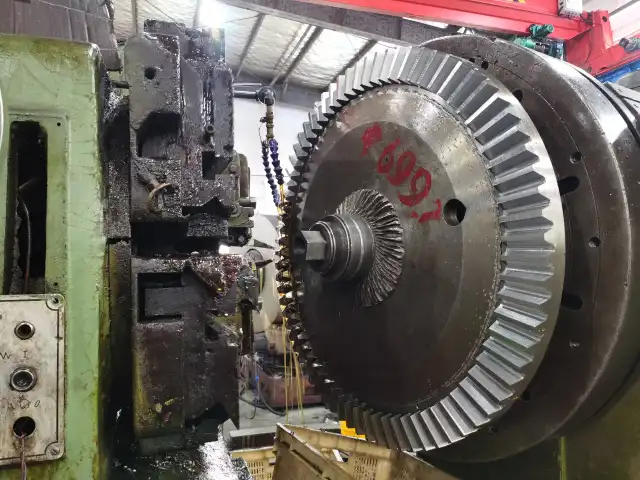
Understanding Gear Teeth Cutting: Fundamentals and Techniques
What Makes Gear Teeth Cutting Essential for Modern Manufacturing?
Gear Teeth Cutting provides the precision necessary for modern transmission systems operating under heavy loads and high rotational speeds. Accurate tooth geometry ensures smooth engagement, minimizes friction, and distributes loads evenly across the tooth surface. Industrial applications such as electric vehicle drivetrains, wind turbine gearboxes, and mining equipment require gears capable of maintaining stable operation in severe environments. Precision cutting methods reduce transmission error and improve durability, helping prevent failures such as spalling or micropitting. Despite advancements in alternative manufacturing technologies, Gear Teeth Cutting remains critical for achieving high-performance and long-lasting gear systems.
Core Cutting Methods and Their Applications
Manufacturers use several Gear Teeth Cutting methods depending on production volume, gear geometry, and accuracy requirements. Hobbing is highly efficient for external spur and helical gears, making it ideal for medium and large production runs. Shaping is suitable for internal gears and components with shoulder interference that prevents hob access. Milling offers flexibility for prototypes and small-batch production, especially for larger module gears. Grinding becomes necessary after heat treatment to correct distortion and achieve fine surface finishes below Ra 0.4 µm. Production workflows generally include design validation, rough machining, cutting, heat treatment, and final finishing operations.
Tooth Profiles and Material Considerations
Tooth profile design and material selection strongly influence Gear Teeth Cutting performance and machining strategy. Involute tooth profiles dominate modern gear manufacturing because they maintain constant velocity ratios and tolerate minor center distance variations. Cycloidal profiles are less common but useful in low-wear applications requiring minimal sliding. Materials such as 20CrMnTi, SAE4340, 42CrMo, and 18CrNiMo7 provide different hardness, toughness, and machinability characteristics. Carburized steels offer hard wear-resistant surfaces with tough cores, while through-hardened alloys provide uniform strength. Material properties directly affect cutting tool selection, machining parameters, achievable surface finish, and heat treatment performance.
Comparing Gear Teeth Cutting Methods: Making the Right Choice
Evaluating Process Capabilities and Limitations
Hobbing is one of the most productive Gear Teeth Cutting methods for external gears with modules ranging from 0.5 mm to 50 mm. It delivers stable tooth geometry and high production efficiency for industrial and aerospace applications. However, hobbing cannot process internal gears or components with shoulder interference. Shaping offers greater flexibility for these restricted geometries but operates at slower production speeds. Grinding provides the highest dimensional accuracy and surface finish after heat treatment, especially for hardened gears between 58 and 62 HRC. Although grinding equipment and cycle times are more expensive, its precision justifies the cost in demanding applications.
Material-Specific Selection Guidance
Material hardness and machinability directly affect the choice of Gear Teeth Cutting methods and tooling. Softer materials below 30 HRC can be efficiently processed using hobbing or shaping with standard carbide or high-speed steel tools. Materials with hardness between 30 and 45 HRC often require coated carbide tools to maintain productivity and tool life. For hardened materials exceeding 50 HRC, grinding or hard skiving becomes necessary to achieve precision tolerances and correct heat treatment distortion. Production volume also influences process selection, with flexible methods preferred for prototypes and automated production lines favored for large-scale manufacturing applications.
The Application Case Studies
Real-world Gear Teeth Cutting applications demonstrate how manufacturing methods adapt to different industrial requirements. Aerospace actuators require zero-backlash gears produced through shaping and profile grinding to ensure accurate load distribution and operational safety. Mining machinery uses large-module gears manufactured through heavy-duty hobbing and induction hardening for durability in abrasive environments. Industrial machinery applications balance precision and efficiency by combining hobbing, carburizing, and finish grinding to achieve ISO 5–6 accuracy grades and low transmission error. These manufacturing strategies improve reliability, reduce wear, and maintain stable performance under varying operating conditions and production demands.
Procuring Gear Teeth Cutting Equipment and Services: A B2B Guide
Strategic Supplier Evaluation Framework
Evaluating Gear Teeth Cutting suppliers requires analyzing machine capability, engineering support, quality systems, and production flexibility. Modern CNC hobbing centers with thermal compensation and integrated inspection systems provide more stable dimensional control across production runs. Suppliers offering pre-sales engineering assistance can identify manufacturing risks early and improve product design for manufacturability. Facilities with integrated processes such as hobbing, shaping, grinding, and heat treatment provide stronger supply chain control and faster turnaround. High-precision CNC machining centers and automated grinding systems also improve process consistency, helping suppliers maintain strict aerospace and industrial quality requirements throughout production operations.
Building Long-Term Supply Partnerships
Long-term partnerships with Gear Teeth Cutting suppliers create benefits beyond simple purchasing transactions. Reliable suppliers provide stable quality, faster technical support, and priority production scheduling during periods of high demand. ISO-compliant quality systems ensure traceability, process control, and consistent production performance through documented procedures and calibrated inspection equipment. Coordinate measuring machine inspections and contact pattern analysis support high-precision manufacturing standards required in aerospace and industrial applications. Strong after-sales support, warranty coverage, and rapid response systems also strengthen customer confidence by minimizing downtime and helping solve technical issues quickly when operational problems occur.
Outsourcing Custom Gear Production
Outsourcing Gear Teeth Cutting allows companies to access advanced manufacturing technologies and specialized expertise without major capital investment. Custom gear manufacturers offer processes such as hobbing, shaping, grinding, heat treatment, and inspection within a single production system. Understanding total ownership cost is important when planning outsourced production because factors such as lead time, tooling, minimum order quantity, and transportation affect overall project economics. Prototype production and low-volume orders become more practical through flexible manufacturing services. Reliable suppliers also reduce quality-related risks by maintaining strict process control, material traceability, and protective international packaging systems.
Optimizing Gear Teeth Cutting Performance and Maintenance
Preventive Maintenance and Equipment Longevity
The state of the machines and how well they are maintained have a big impact on how well they produce. To keep its accuracy over its useful life, high-precision gear cutting equipment needs to be calibrated, its greasing system checked, and worn parts replaced on a frequent basis. Spindle runout, table tracking accuracy, and temperature stability all have a direct effect on the shape of the teeth and the quality of the surface finish.Setting up preventive maintenance plans based on what the machine maker says and how it is actually being used cuts down on unexpected downtime. Before production starts, the operator should check the coolant concentration, the state of the tools, and the soundness of the workholding every day. Checks are done once a week to check for backlash in the machine tracks, the performance of the hydraulic system, and how well the chips are being evacuated. As part of the monthly reviews, the calibration of the measurement system is checked, and the machine's shape is checked with laser interferometry or ballbar tests.
Troubleshooting Common Cutting Defects
Inaccurate tooth profiles show up as transmission mistake, noise, and early wear while the machine is in use. Root reasons include worn-out cutting tools, thermal distortion during grinding, or setting the machine up incorrectly. Systematic fixing starts with analyzing measurement data. To do this, gear measuring centers are used to make topology maps that show specific patterns of variation. Profile slope mistakes can mean that the machine settings or tool geometry are wrong, while localized variations can mean that there are problems with the workholding or thermal effects.Surface finish flaws lower the load capacity and speed up the failure of micropits. Optimizing the feed rate, choosing the right cutting fluid, and keeping an eye on the state of the tool can stop most surface quality problems. For precise uses, getting Ra 0.8–1.6µm finishes needs sharp cutting edges, enough lube, and machining conditions that don't cause vibrations. Our high-tech production processes keep surface quality standards high by constantly checking and replacing tools before they stop working properly.
Leveraging Technology for Continuous Improvement
Digital technologies help modern Gear Teeth Cutting operations manage the process better and make sure the quality of the work. During machining, in-process measurement devices check the dimensions. This lets changes be made in real time, which stops the production of scrap. Statistical process control software finds patterns before they get too big, which lets proactive changes be made that keep capability scores high.Developing operators' skills is an important investment in operational success. Production teams can quickly find and fix problems thanks to training programs that cover everything from how to operate machines to quality principles and fixing techniques. Our standard OEM customization workflow includes talking about requirements, designing, producing, inspecting for quality, packing, and shipping. It makes sure that orders are filled quickly and correctly by following recorded steps and always improving skills.
Conclusion
To become an expert at Gear Teeth Cutting, you need to understand basic concepts, choose the right manufacturing methods, work with reliable providers, and strictly enforce quality control. The process turns raw materials into precise mechanical parts that make power transfer reliable in mining equipment, industrial machinery, and spacecraft. To be successful, you need to find a balance between technical needs and economic facts. You also need to pick methods that work for the size of the production and the performance standards. When businesses use specialized suppliers, they can get access to advanced skills without having to spend a lot of money on them, and they can focus their own resources on their core strengths. Precision gear manufacturing is still necessary because businesses need more and more efficiency and dependability. This is made possible by constantly improving processes and making technology advances that push the limits of performance.
FAQ
1. What distinguishes hobbing from other gear cutting methods?
Hobbing is a continuous producing process that works well with external spur and helix gears. It is very productive because the cutting tool and workpiece rotate at the same time. Shaping, on the other hand, uses short bursts of moving motion that works well for internal gears or parts with shoulders that get in the way of hobs. For milling, formed cuts that match tooth space shapes are used, which is good for making prototypes or large-module gears. Grinding gives hardened materials the best precision and surface finish. It fixes distortions caused by heat treatment and achieves Ra 0.2–0.4µm texture for uses that need to be very quiet.
2. Can gear cutting processes work on hardened steel components?
Gear Teeth Cutting can be done on materials with a surface hardness of up to 62 HRC using hard machining techniques like hard skiving and grinding. These steps fix the distortion in dimensions caused by heat treatment while keeping the ISO 5-6 precision grades. Abrasive wheels are used in grinding to remove only the smallest amount of material from sharpened surfaces, which results in a better finish. Hard skiving uses special cutting shapes on rigid machine frames to be more productive than grinding for middle to large-scale production while still meeting DIN 6-7 quality standards.
3. How frequently should gear cutting machines receive maintenance?
How often maintenance is done relies on how busy the business is and how precise the needs are. Before production starts, operators check the cooling systems, tools, and workholding every day to make sure they are in good shape. Every week, the machine's axis backlash, hydraulic function, and chip removal are checked. As part of the monthly routine, the machine's shape and measurement system calibration are checked. Every year, thorough checks are done on the state of the spindle bearings, the thermal compensation calibration, and the whole machine's accuracy mapping. This makes sure that the machine can keep making parts that meet specifications for as long as it is in use.
Partner with YIZHI MACHINERY for Precision Gear Manufacturing Solutions
YIZHI MACHINERY offers a wide range of Gear Teeth Cutting services, backed by 15 years of experience making high-quality products and quality systems that meet ISO standards. We can make modules from 0.5 mm to 50 mm in high-quality materials like 20CrMnTi, SAE4340, and AISI4140. We can also heat treat and clean the surfaces of these modules using advanced techniques. We keep up-to-date the most advanced precision tools in the world, such as CNC gear machining centers and automated grinding systems that meet ISO 5-6 standards for tough industry and aerospace uses. Competitive lead times of 35 to 60 days, customized technical support, and flexible minimum order amounts, including production of a single piece, meet a wide range of procurement needs. As a reliable provider of Gear Teeth Cutting, we offer technical know-how along with quick and helpful customer service. We also offer real-time order tracking and damage-prevention shipping to make sure the integrity of your products. Contact us at sales@yizmachinery.com to talk about your unique needs and find out how our customization options can help you with even the most difficult transmission part requirements.
References
1. American Gear Manufacturers Association. (2019). AGMA 2015-1-A01: Accuracy Classification System - Tangential Measurements for Cylindrical Gears. Alexandria, VA: AGMA Publications.
2. Klingelnberg GmbH. (2016). Cylindrical Gears: Calculation, Materials, Manufacturing. Berlin: Springer-Verlag.
3. Radzevich, S.P. (2018). Theory of Gearing: Kinematics, Geometry, and Synthesis. Boca Raton, FL: CRC Press.
4. International Organization for Standardization. (2015). ISO 1328-1:2013 - Cylindrical Gears - ISO System of Flank Tolerance Classification. Geneva: ISO Standards.
5. Society of Automotive Engineers. (2017). Gear Cutting Processes and Methods for Automotive Transmissions. Warrendale, PA: SAE International Technical Papers.
6. Dudley, D.W. (2020). Handbook of Practical Gear Design and Manufacture (3rd Edition). Boca Raton, FL: CRC Press.

USER EVALUATE
Here is the customer's evaluation of us