


Bevel Gear: Precision for Smooth Power Transfer
Precision Bevel Gears are the engineering answer that changes operational efficiency when machinery needs perfect power transfer between shafts that cross each other. There is a lot more to a Precision Bevel Gear than just a mechanical part. It's a promise of low friction, great load distribution, and long life in tough circumstances. Standard parts just can't match the level of accuracy that these special gears can. This makes them necessary in fields where every micron of error affects safety and profit. Precision Bevel Gears, which are made to ISO 8-9 grade standards, allow angular power transfer with efficiency rates of over 98%. They directly solve problems in industrial machinery, mining operations, and military uses.
Introduction
Modern manufacturers use power transfer systems with bevel gears for directional force transfer. We've observed how purchasing these parts affects production uptime, maintenance intervals, and equipment performance at YIZHI MACHINERY. Since 2016, we've made specialised gears for global markets. Our IT staff has 15 years of expertise.
Bevel gear grade may affect performance and reliability. Mining machinery faces extreme shock loads and gritty pollutants. Aerospace components must be precise from -50°C to 150°C. Normal industrial gears buckle under these scenarios, causing early wear, increased energy usage, and unexpectedly costly repairs.
When purchasing staff understand Precision Bevel Gear technology, they may pick application-specific items. Top gear is distinguished by its technological qualities, high-quality construction, and purchasing considerations. Our purpose is to provide relevant information to assist you in choosing mission-critical gearbox parts.
Understanding Precision Bevel Gears
Defining Precision in Gear Manufacturing
Precision Bevel Gears are different because the tolerances used in their production are much tighter than those used in normal industrial grades. Standard bevel gears might be accurate to an ISO 10-11 level, but precise versions always meet ISO 8-9 level standards. This difference means that there is less kinematic transmission error, more consistent power delivery, and a lot less noise, vibration, and roughness during operation. Advanced grinding methods make sure that tooth contact patterns stay optimal across the whole working range by achieving high geometric accuracy.
Core Design Principles and Working Mechanics
These gears simplify power transfer between shafts that cross at angles, generally 90 degrees, although other angles may be utilised if space is constrained. Spirals form teeth at high speeds and torque, whereas straight lines form them at low speeds. Because they link gradually, spiral designs are quieter and distribute loads more evenly across tooth surfaces than straight ones.
Our Gleason profile is the industry standard for tooth form. It boosts contact ratio and ensures product compatibility with global standards. This profile form is optimised by introducing crowning adjustments to reduce edge loading when shafts flex under strong strain during design. Small topological adjustments are the hidden engineering that makes excellent gears outstanding.
Material Selection and Heat Treatment Protocols
Material choice affects gear durability and weight capacity. Precision Bevel Gears are made from high-quality alloy steels like 20CrMnTi, 18CrNiMo7, AISI8620, and SAE4340. Each material has advantages. TwentyCrMnTi has a good carburising reaction for surface strength, whereas 42CrMo has a stronger core strength for shock resistance. Working temperatures, expected load rates, and environmental exposure are considered before choosing.
These raw materials are heat treated to make engineering parts that can survive millions of load cycles. The exterior becomes tougher after carburising at 58–62 HRC. The flexible core can withstand impact loads without breaking. Through-hardened gears have 45-50 HRC hardness profiles after quenching and tempering. This makes them suitable for applications that don't need great surface hardness. Induction hardening improves performance and reduces warping by hardening just selected sections of a tooth.
Varieties of Precision Bevel Gears
Straight bevel gears have teeth that are lined up straight to the gear axis. This makes them good for uses below 1000 RPM where ease of use and low cost are more important than noise reduction. Because spiral bevel gears have curved teeth that connect gradually, they are perfect for high-speed uses that need to run smoothly at speeds over 3000 RPM. With hypoid gears, the pinion is placed away from the centerline of the gear. This allows for smaller packing and better reduction ratios in limited areas. Mitre gears make sure that both parts that fit together have the same number of teeth. This creates a 1:1 ratio that lets you change direction without changing speed.
Comparing Precision Bevel Gears to Other Gear Types
Performance Distinctions Across Gear Categories
When looking at different transmission choices, it's important to know how they compare in terms of performance. Precision Bevel Gears work better than regular business grades in a number of areas that have a direct effect on costs. Grinding processes improve tooth contact, which lowers friction coefficients. This means that working temperatures are lower and lubricant service times are longer. Compared to standard gears working in the same conditions, noise outputs drop by 8 to 12 decibels. This is a big plus in places where noise is a problem.
Selection Criteria for High-Precision Applications
Zero slack is essential for robots to maintain position accuracy while changing directions fast. Split-gear designs or accurate shimming during assembly may meet the 0.05- 0.10 mm space needed for servo-driven systems. Gears must remain precise during thermal expansion for CNC machine tool wheel drives to operate. Materials must have the same thermal expansion factors and be heat treated to relieve stress.
Mining equipment has significant impact shock, mineral dust pollution, and restricted maintenance access. AISI4140 or 42CrMo through-hardened gears have the core strength to sustain impact loads and the surface hardness to avoid mechanical wear. Bigger teeth and stronger fillets allow the gear design to tolerate sudden overloads without catastrophic failure.
Torque Density and Efficiency Considerations
Precision Bevel Gears have a very high power density, which lets designers make gearboxes that are smaller and lighter, which means they take up less space when they're installed. This property is especially useful in aerospace uses, where each kilogram changes the amount of fuel used and the amount of cargo that can be carried. When properly oiled and adjusted, the efficiency per gear stage regularly exceeds 98%. This means that very little energy is lost during power conversion and very little heat is produced that needs to be removed.
Manufacturing and Design Principles of Precision Bevel Gears
Advanced Machining Processes
Precision Bevel Gears need certain operations. Each step boosts accuracy and performance. The blank must be ready. Over-machined bar stock blanks, forging aligns material flow patterns with stress lines, enhancing wear resistance. Rough turning generates outside diameter, end faces, and hole diameter reference surfaces, leaving enough material for completion.
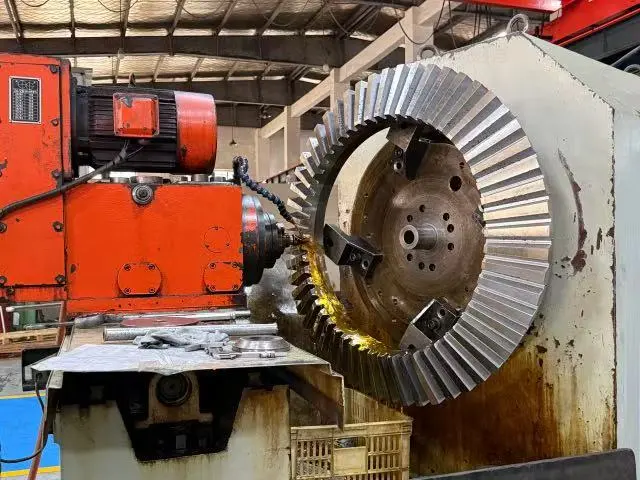
Gear cutting—the main manufacturing phase—forms teeth. Hobbing quickly and accurately cuts tooth shapes comparable to the final shape while leaving grinding stock. Milling with special equipment provides precise tooth spacing. A few microns of consistent tooth shape and profile fit are achieved using Gleason cutting.
Grinding turns fine-cut gear teeth. Adjusting grinding wheels to precise involute shapes reduces stiffening distortion and achieves 0.4μm or less surface roughness. Mirror-smooth finish. Precision gears are quieter, friction is decreased, and wear particles are avoided. Profile and lead grinding preserve tooth contact patterns by eliminating prior errors.
Heat Treatment as a Differentiating Factor
Heat treatment during production greatly affects product accuracy. Carburising follows rough cutting but before grinding. Grinding corrects the 0.1 to 0.3 mm distortion caused by cooling and carburising. The carburising environment's precisely regulated carbon potential, temperature homogeneity, and quenching medium determine case depth uniformity and end hardness profiles.
For aviation components, we vacuum carburise to remove oxidation and regulate case depth to 0.8 to 1.2 mm, depending on module size. A regulated environment produces clean surfaces, which reduces grinding time and removes deep oxidation that lowers wear strength.
Quality Assurance Protocols
For every Precision Bevel Gear, thorough verification methods ensure accurate dimensions, surface integrity, and metal quality. Coordinate measurement instruments assess tooth runout, profile deviation, lead deviation, and pitch variation. Magnetic particle screening detects invisible surface and near-surface defects. This is crucial for touch-stressed sections.
Before shipping, gear rolling testing simulates meshing circumstances to discover noise, shaking, and contact pattern problems. Functional testing reveals issues that physical examination may overlook, so you can be confident the gears will perform properly in your equipment.
Maintenance Practices Extending Service Life
Performing regular upkeep on your Precision Bevel Gear will greatly increase its useful life, saving your investment in the part. Choosing the right lubricant is very important. For example, spiral and hypoid gears need high-pressure additives that form protection films that keep metals from touching each other when they slide, which is how their teeth are designed. When synthetic oils are used at the right temperatures and speeds, they make sure that the film thickness is right across the whole working range.
Load spread and lifespan are directly affected by how well the installation is aligned. Using precision shims to change the mounting distance places gears at the best mesh depth, getting the desired backlash while avoiding binding. Even a small misalignment of 0.05 mm can cause edge loading that increases stresses and speeds up the failing processes of pitting and spalling. Our professional installation services make sure that everything is aligned correctly from the start, so problems that could have been avoided during installation don't happen.
Procurement Guide for Precision Bevel Gears
Evaluating Supplier Capabilities
Buying Precision Bevel Gears starts with supplier research. Technical datasheets should include ISO 1328, AGMA 2009, or DIN 3965 accuracy ratings instead of "high precision." Manufacturing capability descriptions should include procedures, notably finishing operations like grinding and lapping that distinguish precision components from commercial grades.
Accuracy depends on manufacturing tools. Suppliers that employ innovative CNC gear grinding tools from Gleason, Klingelnberg, or Mitsubishi demonstrate precision. Inspection tools also reveal much. Coordinate measurement equipment with gear-specific software, gear rolling tests, and metallurgical laboratories demonstrate a complete quality control system.
Certifications are third-party confirmation of consistency in production. ISO 9001 certification shows basic quality management, whereas AS9100 certification shows aerospace-grade quality systems and monitoring requirements. Industry-specific certifications relevant to your application area boost seller credibility.
Understanding Lead Times and Customisation Options
Standard catalogue gears arrive in 15–25 days, although they may not be suitable for your needs. Custom gears for your tools take longer but operate better and last longer. Production takes 35–60 days at YIZHI MACHINERY from order approval to shipping. Precision manufacturing requires meticulous techniques.
Size isn't the only customisation choice. They also involve material selection, heat treatment, surface treatments, and tooth modifications. We may use modules from 0.5 to 50, 14.5° or 20° pressure angles, and teeth numbers that fit your ratio demands. This ensures gears function with existing tools and helps designers create new designs without catalogue constraints.
Cost Factors and Minimum Order Considerations
Cost of materials, difficulty of machining, heating time, and accuracy determine the price of a Precision Bevel Gear. Higher precision grades need more grinding runs and tighter inspection, increasing manufacturing costs. Material type determines pricing. Even while unusual metals like SAE4340 cost more than 45# steel, their higher performance frequently makes the price difference worthwhile.
We can create one-piece runs for prototype development or additional parts with minimal minimum order numbers. This versatility simplifies product development and eliminates the necessity for slow-moving maintenance components. Prices reflect batch processing economies of scale and volume savings depending on output.
Logistics and Delivery Considerations
Logistics get trickier when you buy things around the world, but trusted sellers take care of these problems ahead of time. Our custom packing uses shock-absorbing padding layers and wooden boxes that are made just for us to protect the surfaces of the gear teeth while they're being shipped. This care with packing lowers the number of damaged shipments during transport to less than 0.1%. This cuts down on replacement costs and shipping delays caused by damaged shipments.
We use a variety of shipping methods, including sea freight for cheap bulk packages, air freight for pressing needs, and China-Europe freight trains that balance speed and cost-effectiveness. Online tracking services let you see your package from the time it's loaded at the plant until it's delivered to the customer. This lets you handle problems before they happen and plan your deliveries more accurately.
Real-World Applications and Benefits
Industrial Machinery Applications
Precision Bevel Gears are used in places like machine tool spindle drives where precision has a direct effect on the quality of the result. To keep the surface finish requirements for machined parts, CNC milling heads that send power to cutting tools need to have no blowback. The gears are always turning at high speeds and are exposed to coolants that are toxic. This means that the surfaces need to be treated precisely and in a way that prevents rust.
Precision Bevel Gears are used in big industrial equipment's steering systems to turn spinning input into directional control. The gears have to be able to handle shock loads from rough ground while still feeling sensitive to control inputs. Because steering column systems need to be small and have a high power density, precision spiral bevel gears are the best choice.
Mining Industry Requirements
Abrasive rock dust, moisture, high temperatures, and heavy impact loads are all things that can damage mechanical parts in mining tools. Precision Bevel Gears used in mines have strong tooth shapes, strengthened fillets, and a through-hardened design that makes them resistant to impact. Surface treatments, such as phosphate coats or special paints, keep mine air from corroding metals.
Precision Bevel Gears are used in material handling units to transfer angular power through conveyor drive systems. The gears are used nonstop for long shifts, which adds up to millions of load cycles every year. The right choice of materials and heat treatment makes sure that these parts last longer than 50,000 hours of use before they need to be overhauled.
Aerospace Applications Demanding Extreme Reliability
Precision Bevel Gears are used in aerospace propulsion systems that control flying surfaces because failure would be catastrophic. These parts are inspected with 100% magnetic particles, which can find flaws that are so small that they can't be seen with other methods. Material tracking goes down to individual heat lots, which lets failure analysis happen if problems happen in service.
Huge amounts of power are sent by helicopter transmission systems through small, light gears. Precision Bevel Gears allow changes in direction within limited areas. The gears have to be able to handle sudden changes in temperature and G-forces while moving, and they have to keep working even after being damaged in battle. Because of these strict standards, material specs move toward high-end metals like SAE4340 and heat treatments that remove carbon from the air.
Quantifiable Performance Benefits
The operational benefits of Precision Bevel Gears directly lead to cash benefits. Lower vibration levels increase the service life of bearings by 30 to 50 per cent, which lowers the need for upkeep and the cost of replacing. If noise levels go down, places that are sensitive to noise won't need to buy expensive sound barriers. Improvements to energy economy cut the amount of electricity used by gears by 2 to 4 per cent compared to normal gears. This saves a lot of money over the life of the equipment.
When equipment makers switch from commercial to precision-grade bevel gears, warranty claims drop by more than 60%. Over five-year review periods, end users report that upkeep costs have gone down by an average of 35%. There is strong evidence that the extra money spent on precision parts pays off, as shown by these recorded gains.
Conclusion
Material science, outstanding manufacturing, and mechanical advancement meet in Precision Bevel Gears. These parts stabilise power transmission in demanding industrial gear, mining, and aircraft environments. If procurement staff understand the technological distinctions between precision gears and commercial choices, they may pick parts that satisfy application demands rather than settling for less-than-ideal solutions.
Manufacturing gears that last millions of cycles requires sophisticated cutting, precise heat treatment, and careful quality control. By using materials that match load profiles, weather exposure, and operating temperatures, you can ensure parts survive and need minimum maintenance.
You must also consider logistics, customisation, and vendor reliability while making a purchase. Working with manufacturers that have technical expertise, manufacturing capabilities, and customer service can safeguard your equipment investment and boost performance.
FAQ
1. What makes Precision Bevel Gears different from regular business grades?
Precision Bevel Gears can be made with tighter standards, usually ISO 8-9 grade instead of ISO 10-11 grade for industrial gears. This difference in accuracy leads to better operation, less noise, and a longer service life. As part of the manufacturing process, finish grinding is used to fix distortions caused by heat treatment. This makes it possible to get tooth contact patterns that are better than those possible with cut-only gears.
2. How do the choices of materials affect how well gears work in tough situations?
The choice of material strikes a balance between the need for top hardness and the need for core toughness. Carburising grades like 20CrMnTi make surfaces that are hard and don't wear down, while keeping tough cores that can take pressure loads. For moderate-duty uses, materials that have been through-hardened, such as 42CrMo, offer appropriate qualities. Specifications for aerospace often call for high-end metals like SAE4340, which has better wear resistance.
3. What tailoring choices are there to meet the specific needs of each application?
We make sure that the number of teeth, module sizes (0.5 to 50), pressure angles (14.5° or 20°), and hole lengths are all exactly what you want. The working conditions affect the choice of materials, the way they are heated, and the way they are treated on the outside. Tooth changes, like crowning and profile shifts, improve performance for certain load situations and displacement tolerance needs.
Partner with YIZHI MACHINERY for Superior Precision Bevel Gear Solutions
YIZHI MACHINERY can help you with your most difficult power transfer needs because they have been making gears for 15 years. We are a Precision Bevel Gear seller that makes custom solutions to meet the exact needs of industrial tools, mining equipment, and aircraft use. Our production methods are in line with ISO standards. They use advanced CNC machining centres, automatic gear grinding systems, and smart heat treatment lines to make parts that meet ISO 8-9 grade requirements.
We know that procurement problems aren't just about the specs of the parts; they also have to do with shipping reliability, expert help, and building long-term partnerships. Our 35–60-day production schedule is based on careful quality control, not rushed output. Customised packing with damage-prevention guarantees keeps your investment safe during global shipping, and real-time tracking lets you see where your box is at all times.
Our full-service model supports your success from the first design meeting to help with installation and guarantee claims. Every package comes with technical drawings, material certifications, and inspection records that meet the requirements of your quality systems. Engineers pay the same amount of attention to one-piece orders as they do to production numbers. This helps with developing prototypes and meeting the needs for repair spares.
Contact our technical team at sales@yizmachinery.com to discuss your precision bevel gear requirements. We'll analyse your application conditions, recommend optimal specifications, and provide detailed quotations reflecting our commitment to transparent pricing. Discover how partnering with an experienced precision bevel gear manufacturer transforms component procurement from a transactional necessity into a strategic advantage driving equipment performance and operational reliability.
References
1. American Gear Manufacturers Association. (2019). AGMA 2009-D03: Bevel Gear Classification, Tolerances, and Measuring Methods. Alexandria, VA: AGMA Technical Publications.
2. Stadtfeld, H.J. (2021). Advanced Bevel Gear Technology: Manufacturing, Inspection, and Optimisation. Gear Technology Magazine Press.
3. International Organisation for Standardisation. (2020). ISO 1328-1:2020: Cylindrical Gears — ISO System of Flank Tolerance Classification. Geneva: ISO Standards Catalogue.
4. Dudley, D.W. (2018). Handbook of Practical Gear Design and Manufacture (3rd ed.). CRC Press.
5. Klingelnberg GmbH. (2022). Bevel Gear Manufacturing: Precision Grinding Processes and Quality Assurance Protocols. Technical White Paper Series.
6. Society of Automotive Engineers. (2020). SAE J1141: Gear Material and Heat Treatment Standards for Aerospace Applications. Warrendale, PA: SAE International.

USER EVALUATE
Here is the customer's evaluation of us