


Spiral Bevel vs. Straight Bevel Gears: Which one suits you?
Choosing between spiral and straight bevel gears depends heavily on your operational context. Straight Tooth Bevel Gears are ideal when you need cost-effective, robust transmission for medium-to-low speed applications with simpler bearing arrangements and easier maintenance protocols. Spiral bevel gears suit high-speed, precision-driven environments requiring minimal noise and vibration. Your decision hinges on load characteristics, speed demands, noise tolerance, spatial constraints, and budget realities within industrial machinery, mining, or aerospace sectors.
Introduction
For industrial machinery, mining equipment, and aerospace systems, bevel gears are essential transmission parts that make it easy for power to move between shafts that cross each other, usually at right angles. A problem that procurement managers, design engineers, and original equipment manufacturers (OEMs) all over the world have to deal with is choosing the best type of bevel gear that matches performance, reliability, and cost-effectiveness. This study of spiral and straight bevel gears immediately answers that question. In order to help you make smart choices, we look at performance traits, manufacturing issues, industrial uses, and how procurement works. Understanding these differences helps machines last longer, keeps operations running smoothly, and makes sure that technology requirements are met within the limits of available funds in a variety of business-to-business settings.
Understanding Bevel Gears: Straight Tooth vs. Spiral Tooth
Bevel gears move rotational motion between shafts that cross each other, usually at 90-degree angles, but there are other possible arrangements. Straight and spiral patterns are basically different in how the teeth fit together and how they connect.
Fundamental Design Differences
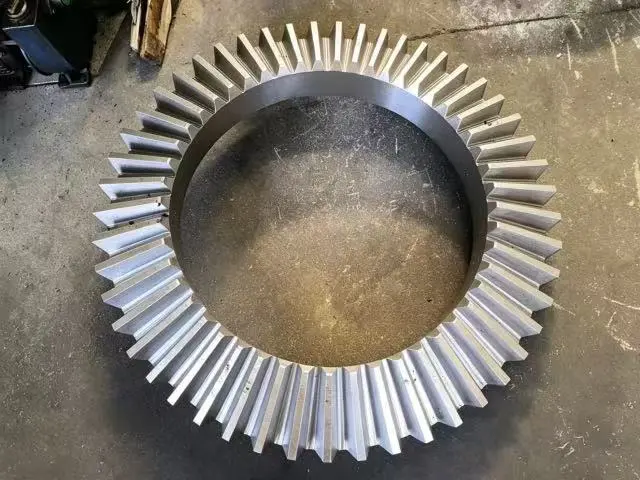
Straight Tooth Bevel Gears have teeth that are cut straight across the conical pitch surface and taper toward a shared tip where the shaft axes should meet. This shape makes a simple, strong outline that can be made using normal methods like drilling, milling, hobbing, and cutting. Alloy steels like 20CrMnTi, AISI 8620, 42CrMo, and SAE4340 are often selected because they are tough and can be hardened at the same time. Depending on the load, different heat treatment methods, such as carburizing, cooling and tempering, or induction hardening, can make the surface hardness range from 45 to 50 HRC to 58 to 62 HRC.
Spiral bevel gears have curved teeth that are angled along the width of the face, making a spiral design. This arrangement lets teeth connect gradually, moving from one end to the other, instead of all of them touching at the same time. Because the shape is bent, it requires more advanced tools and methods for production, usually cutting machines made by companies like Gleason or Klingelnberg.
Working Mechanics and Load Distribution
When Straight Tooth Bevel Gears are used, they make rapid, full-width line contact across the whole tooth face. This immediate interaction creates areas of high stress and the usual operational noise, especially at faster peripheral speeds. The zero helix angle gets rid of any axial thrust components that aren't caused by natural separation forces. This makes choosing bearings and designing housings easier. Because there is minimal sliding friction during mesh cycles, mechanical efficiency is usually between 98 and 99%.
As the teeth move into the mesh zone, spiral configurations change from point contact to progressive line contact. This slow contact spreads the load more evenly across the tooth surfaces, which lowers the peak pressures and vibration amplitudes. When the helix angle is between 15° and 35°, it creates axial thrust forces that need thrust bearings or angular contact bearing setups. This makes the design of the housing more difficult, but it makes the operation easier and quieter, making it good for precision applications.
Comparison of Straight Tooth and Spiral Bevel Gears for Industrial Use
To choose between these types of gear, you need to weigh the trade-offs in performance against the specific needs of your industry.
Performance Characteristics and Operational Efficiency
Spiral bevel gears work better in high-speed situations where the peripheral velocity is more than 10 meters per second. The slow engagement of the teeth reduces dynamic loading, shock, and noise, all of which are important in aerospace actuator systems or precision machine tool spindles. When it comes to the same material and heat treatment, spiral designs are better for small, high-torque transmission needs because they can carry more weight per unit face width than Straight Tooth Bevel Gears by 15 to 25 percent.
Advantages and Limitations in Industrial Context
Knowing the strengths and weaknesses of each type of gear helps you choose the right one for the job. Different types of straight teeth have a lot of great benefits in certain business situations. The costs of making them are still 20–35% less than spiral versions because they require easier tools and take less time to machine. Maintenance staff can use basic dial indicators to do visible checks and backlash measurements, as well as marking compounds to look at contact patterns and judge the quality of the pattern. When correctly defined, load capacity stays high, allowing for strong power transmission in small packages. Because bearing arrangements and housing designs are easier, there is more installation freedom.
One problem is that they make a lot of noise—usually 8 to 12 dB more than spiral versions at the same speed—so they can't be used in places where noise is a problem. When peripheral speeds go above 8–10 m/s, vibration transfer goes up. This could shorten the life of gears and affect machinery that is linked. Because full-face contact happens instantly, shock load sensitivity is higher than in spiral forms.
Spiral bevel gears work quietly and smoothly, making them good for high-speed and precision-driven machines. Their better load spread makes them last longer in tough situations. The controlled contact lowers the vibrations that reach supporting structures, keeping delicate instruments and bearings safe. These benefits make it worth paying more for aerospace actuators, car differentials, and high-precision machine tools where improving performance is more important than saving money.
Sector-Specific Applications
Different industries use industrial tools in very different ways. When it comes to crusher drives, conveyor systems, and loader slew drives, where durability, shock resistance, and ease of maintenance are more important than noise levels, mining companies use Straight Tooth Bevel Gear designs. The fact that they can handle abrasive dust and short periods of overload makes them perfect for these tough settings.
Spiral bevel gears are almost always used in flight control devices, auxiliary power unit gearboxes, and helicopter main rotor shafts. Because of the need for vibration-sensitive instruments and the ability to save weight through higher load capacity per unit mass, the higher cost and complexity of production are justified.
Agricultural equipment fits into both groups. Straight Tooth Bevel Gear designs are often used in tractor Power Take-Off systems and differential drives because they have a good power capacity, are easy to maintain, and are cost-effective enough for farming operations that are spread out and have different levels of expert support.
How to Choose the Right Bevel Gear for Your Application
To pick the right bevel gear configurations, you need to carefully look at operational factors, environmental restrictions, and lifetime costs.
Assessment Framework for Procurement Teams
The qualities of the load determine which gear to use. Figure out the duty cycle patterns, transferred torque, and service factors that take shock loading into account.Straight Tooth Bevel Gears works well with medium-to-low loads in situations where they need to work continuously with some overload peaks. This type of machine works well for mining conveyors, agricultural tools, and general industrial gear. Spiral shapes are needed when peak loads often go over 150% of nominal values or when tight designs need to get the most torque density possible.
Comparative Analysis with Alternative Gear Types
The required speed has a direct effect on the gear type that can be used. When the peripheral speed is less than 8 m/s, Straight Tooth Bevel Gear application can be done without worrying about noise or vibration issues. Between 8 and 15 m/s is a transitional speed range where noise tolerance, bearing robustness, and cost limits decide the best choice. When the outer velocity is more than 15 m/s, spiral shapes are needed to keep the vibration levels low and the gear life expectancy high.
Selection is affected by limitations on space and the size of the housing. Straight Tooth Bevel Gear designs let housing shapes be easier because they don't need to have any extra features to keep axial thrust in place besides the natural separating forces. Spiral shapes need more complex bearing arrangements, usually tapered roller bearings or angular contact ball bearings. This makes the housing more complicated and increases the axial dimensions, but it also lets the power capacity go up within the same diameter limits.
Supplier Certification and Customization Capabilities
The decision matrix finds a mix between technical performance and procurement realities. Straight Tooth Bevel Gears from companies like YIZHI MACHINERY can be customized to fit module ranges from 0.5 to 50, pressure angles of 14.5° or 20°, and a variety of materials, such as 45# steel, 20CrMnTi, 40CrNiMo, and AISI 8620. This adaptability makes sure that specifications are properly matched across a wide range of industrial requirements without causing standard offerings to be compromised to meet real working needs.
Successful procurement includes evaluating the suppliers. Check to see if the quality meets international standards; for industrial applications, ISO 8-9 precision grades are the norm. Ask for proof of the inspection steps, such as checking the tooth contact pattern, backlash measurement methods, and the ability to track the material certification. Reputable manufacturers use coordinate measuring machines to check for runout and magnetic particle inspection to find surface cracks after heat treatment cycles. Production flexibility—including low minimum order quantities—supports lean industrial operations.
Procurement Considerations for Straight Tooth Bevel Gears
To get high-quality Straight Tooth Bevel Gears, you need to know how the supply chain works, how to check the quality of the gears, and how much they will cost over their entire life, not just the initial purchase price.
Identifying Qualified Manufacturers and OEM Partners
Global manufacturing concentrations exist across North America, Europe, and Asia, each offering distinct advantages. Established makers keep the engineering expertise they've gained from decades of use in a wide range of businesses. When evaluating providers, assess production equipment capabilities—precision CNC gear machining centers, automatic gear grinding machines, and controlled atmosphere heat treatment lines represent the baseline infrastructure for consistent quality.
YIZHI MACHINERY exemplifies a company that combines production scale with customization flexibility. Established in 2016, the company specializes in precision machined components, Straight Tooth Bevel Gears, and double helical gears for the mining, aerospace, and industrial machinery sectors. Their 15 years of production experience ensure process maturity, while ISO-compliant quality management systems provide confidence in consistency across production batches.
Pricing Structures and Lead Time Expectations
Understanding cost drivers is important for realistic budgeting and vendor negotiation. Raw material quality significantly impacts pricing—premium alloy steels like 20CrMnTi or AISI 8620 command 15-25% premiums over standard carbon steel but deliver substantially extended service life. Heat treatment specifications, particularly carburizing and grinding operations, are major cost components, with case-hardened, ground gears costing 40-60% more than cut-only variants.
For custom specifications, production lead times typically span 35-60 days from order confirmation through delivery. This duration encompasses requirement communication, engineering drawing preparation, material procurement, machining, heat treatment, quality inspection, and packaging. Rush orders may compress timelines by 15-20% with corresponding cost premiums, while annual contract arrangements enable inventory pre-positioning that reduces lead times to days. Minimum order quantities vary, but suppliers like YIZHI MACHINERY accept single-item production runs for prototypes.
Logistics Considerations for Global Procurement
International gear procurement introduces shipping complexities. Gear tooth surfaces remain vulnerable to damage from shock and vibration during transit. Quality suppliers employ customized packaging incorporating shock-absorbing cushioning liners and wooden pallet stabilization systems. YIZHI MACHINERY's damage prevention protocols reduce transport damage rates below 0.1% through end-to-end protection measures validated across thousands of international shipments.
Multi-modal transportation options—sea freight, air cargo, and rail alternatives like China-Europe freight trains—enable cost-time optimization matching shipment urgency with budget constraints. Real-time tracking systems provide visibility throughout the logistics chain, with status updates pushed at loading, transit waypoints, customs clearance, and delivery stages. This transparency enables production scheduling coordination and reduces uncertainty inherent in international supply chains.
Maintenance Best Practices and Lifecycle Management
Proper maintenance extends gear service life and prevents catastrophic failures. Lubrication selection and interval management are critical factors. Straight Tooth Bevel Gears typically specify ISO VG 220-320 industrial gear oils for enclosed housings, with change intervals of 2,000-5,000 operating hours depending on contamination and temperature. Open gear applications require adhesive compounds reapplied at 500-1,000 hour intervals.
Routine inspection protocols include backlash verification at 500-hour intervals to detect wear progression before tooth damage occurs. Contact pattern evaluation during scheduled maintenance windows identifies misalignment requiring shim adjustment or bearing replacement. Magnetic chip detectors in lubrication systems provide early warning of spalling or tooth fracture initiation, enabling planned maintenance before secondary damage propagates.
Conclusion
Selecting between spiral and straight bevel gears requires balancing technical performance requirements against economic and operational realities specific to your industrial application. Straight Tooth Bevel Gears deliver robust, cost-effective transmission for medium-speed, medium-load scenarios prioritizing maintainability and bearing simplicity—ideal for mining equipment, agricultural machinery, and general industrial systems. Spiral configurations excel in high-speed, precision applications where acoustic refinement and maximum torque density justify increased manufacturing complexity and cost. Successful procurement demands evaluating load characteristics, speed requirements, noise tolerance, and spatial constraints within a comprehensive lifecycle cost framework. Partnering with experienced manufacturers offering customization capabilities, quality certifications, and global logistics support ensures optimal gear selection matching your specific operational demands.
FAQ
1. How significant is the noise difference between straight and spiral bevel gears?
Straight Tooth Bevel Gear designs typically generate 8-12 dB higher sound levels than spiral equivalents at comparable speeds and loads. At peripheral velocities below 5 m/s, noise differences remain negligible in industrial settings. Above 8 m/s, the acoustic gap widens substantially, making spiral configurations preferable for noise-sensitive environments or applications near occupied workspaces.
2. Can straight tooth bevel gears handle high-speed applications effectively?
Straight Tooth Bevel Gear configurations perform adequately at peripheral speeds up to 8-10 m/s with proper balancing and precision manufacturing. Beyond this threshold, vibration and noise increase significantly, potentially reducing bearing life and gear durability. High-speed applications exceeding 12 m/s generally require spiral bevel designs to maintain acceptable operational characteristics and component longevity.
3. What methods verify gear supplier quality standards reliably?
Request ISO certification documentation and inspect tooth contact patterns through rolling test demonstrations. Quality suppliers provide material certifications with heat treatment reports documenting achieved hardness values. Coordinate measuring machine inspection reports for critical dimensions and magnetic particle inspection results confirming surface integrity establish manufacturing process capability and quality consistency.
Partner with YIZHI MACHINERY for Your Straight Tooth Bevel Gear Requirements
YIZHI MACHINERY stands ready to support your bevel gear procurement needs with comprehensive engineering consultation, customized manufacturing capabilities, and global logistics expertise. As an experienced Straight Tooth Bevel Gears supplier, we deliver precision components manufactured to ISO 8-9 grade standards using advanced CNC machining centers, automated grinding equipment, and controlled heat treatment lines. Our material portfolio spans 45# steel, 20CrMnTi, 40CrNiMo, AISI 8620, and specialized alloys tailored to demanding industrial machinery, mining, and aerospace applications. Customization capabilities accommodate module ranges from 0.5 to 50, pressure angles of 14.5° or 20°, and surface hardness specifications from 45-62 HRC. Production flexibility supports low minimum order quantities—even single-piece orders—with delivery timelines of 35-60 days. Our multi-channel logistics solutions incorporate customized packaging, real-time tracking, and damage rates below 0.1%. Contact our team at sales@yizmachinery.com for technical datasheets, application consultation, and personalized quotations aligned with your specific transmission requirements.
References
1. Dudley, D.W. (1994). Handbook of Practical Gear Design and Manufacture. CRC Press, Boca Raton, Florida.
2. Townsend, D.P. (1991). Dudley's Gear Handbook: The Design, Manufacture, and Application of Gears. McGraw-Hill Professional, New York.
3. American Gear Manufacturers Association (2005). ANSI/AGMA 2005-D03: Design Manual for Bevel Gears. Alexandria, Virginia.
4. International Organization for Standardization (2006). ISO 17485:2006 Bevel Gears — ISO System of Accuracy. Geneva, Switzerland.
5. Litvin, F.L. & Fuentes, A. (2004). Gear Geometry and Applied Theory. Cambridge University Press, Cambridge, United Kingdom.
6. Stadtfeld, H.J. (2014). Gleason Bevel Gear Technology: The Science of Gear Engineering and Modern Manufacturing Methods for Angular Transmissions. The Gleason Works, Rochester, New York.

USER EVALUATE
Here is the customer's evaluation of us