


Where to Import Industrial Reduction Gearbox
When buying precise mechanical parts for tough jobs, purchasing managers in the mining, aircraft, and industrial machinery sectors often ask: "Where can I import industrial reduction gearbox units that are both high quality and affordable?" The answer lies mostly in well-established manufacturing hubs in Asia, Europe, and North America. Each of these hubs has its own benefits when it comes to technology, the ability to customize products, and pricing. China has become a competitive place to buy goods because it combines advanced manufacturing methods with flexible customization and low prices. This is especially true for specialized manufacturers like YIZHI MACHINERY that follow ISO-compliant production standards and offer custom gear transmission solutions to markets around the world.
Introduction
Heavy machinery depends on industrial reduction gears converting high-speed motor rotation into controlled high-torque output for conveyors, flight mechanisms, and crushers. Choosing the right procurement partner requires evaluating professional skills, compliance standards, shipping reliability, and after-sales support. Global B2B teams face pressure to maintain uptime in mission-critical operations while optimizing supply chains. A single broken gearbox in a mine crusher can halt production worth thousands per hour. This guide covers technical requirements, sourcing landscapes, and procurement best practices.
Understanding Industrial Reduction Gearboxes
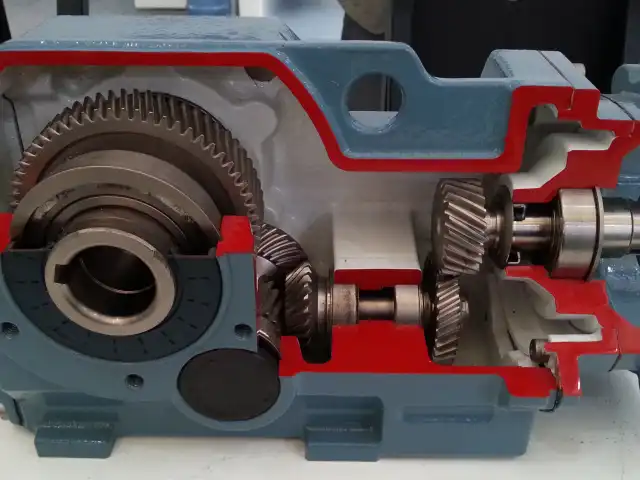
In its most basic form, an Industrial Reduction Gearbox is a well-designed device for moving power from prime movers to driven equipment. The basic idea is based on gear mesh setups that slow down the rotational speed while boosting the torque output in a proportional way. This is because of the laws of mechanical advantage and energy conservation, which can't be changed.
Working Principles and Key Design Elements
Modern gearboxes use high-quality alloy steels like 20CrMnTi, 42CrMo, and AISI4140 optimizing surface hardness with core stiffness. Forging, hobbing, milling, and precision grinding produce tooth shapes conforming to ISO 5-6 Grade tolerances. Carburizing and quenching achieve 58–62 HRC surface hardness for wear resistance under cyclic loading while maintaining core toughness for shock loads. Cast iron GG25 or GGG40 housings naturally dampen vibrations and dissipate heat. Precision bearings handle radial and axial loads; sealed lubrication protects against contaminants.
Comparative Overview of Common Gearbox Types
Helical gears excel in continuous-duty applications with 94–98% efficiency per stage and quiet operation. Planetary designs offer high torque density in compact packages for aerospace actuators and robotic joints with space constraints. Worm gear units provide high reduction ratios and self-locking features—ideal for lifting systems. Bevel-helical pairs handle directional changes while transmitting power efficiently, commonly used in mining conveyors and agitators where robust power transmission requires orientation changes.
Typical Use Cases Across Industrial Sectors
In factories, precise gears power CNC machine tool spindles and automatic assembly lines. The quality of the products made depends on how accurately the parts are placed. Heavy-duty planetary and helix units are used in crushers and dragline systems in mining. Service factors greater than 2.0 are needed to handle shock loads from uneven material feed. In flight control actuators and auxiliary power systems, aerospace applications need lightweight, high-precision units that can't fail and must follow strict AS9100 standards for tracking paperwork.
Key Considerations When Importing Industrial Reduction Gearboxes
Decisions about purchases affect a lot more than just the original buy price. We've seen operations teams deal with units that are too small and fail too soon, and we've also seen solutions that are too complicated and cost more than they're worth without improving performance. An Industrial Reduction Gearbox procurement strategy must account for total cost of ownership.
Evaluating Supplier Reputation and Technical Capability
Established manufacturers maintain long industrial client relationships by solving application-specific problems. Reputation indicators include ISO 9001 certification, compliance with AGMA 2001-D04 power rating standards, and proven success in your field. Since 2016, YIZHI MACHINERY has built global relationships through consistent quality standards and comprehensive technical documentation with every shipment. This transparency demonstrates manufacturing capability and commitment to customer support throughout the procurement and equipment lifecycle.
Balancing Price, Quality, and Lead Times
Total ownership costs must inform cost analysis—a cheaper unit requiring 18-month replacement costs more than a quality product delivering five years reliable service. Lead times matter: standard catalog items may ship within weeks; custom configurations need technical approval and production scheduling. Precision gear production cycles typically last 35–60 days including material acquisition, machining, heat treatment, and quality inspection. This timeline must be factored into project planning to avoid production delays and unplanned downtime.
Customization Capacity and Volume Flexibility
Off-the-shelf options don't always meet the exact needs of a program. Specialized makers are different from commodity sellers because they can customize their products. Some important factors that need specific specs are the number of teeth, the range of modules (0.5 to 50), the pressure angles (14.5° or 20°), the shape of the shaft, how it is mounted, and any special surface treatments like hard chrome plating for places that are prone to corrosion. It doesn't matter what the volume is—some projects only need one prototype unit for testing, while production operations need batch stability across hundreds of similar assemblies.
These are the main benefits that come from buying a handmade gearbox from a specialized manufacturer:
- Material Selection Expertise: Having access to high-quality alloy steels like SAE4340, 18CrNiMo7, and 20CrNi2Mo guarantees the best mechanical qualities for different load scenarios and working conditions.
- Advanced Manufacturing Processes: Using advanced manufacturing techniques, like combining casting, precise hobbing, and multi-axis grinding, makes tooth shapes that meet DIN Quality Class 5-6 standards, while also reducing noise and increasing contact ratios.
- Heat Treatment Precision: Managed quench rates and controlled carburizing atmospheres keep case depths and hardness gradients constant, which stops early pitting and subsurface wear.
- Surface Finishing Options: Blackening, phosphating, and hard chrome finishing all offer different levels of corrosion protection and friction modification that can be used in different chemical and thermal environments.
- Low Minimum Order Quantities: Some manufacturers, like YIZHI MACHINERY, can make just one unit at a time. This saves money on inventory costs and makes it easier to handle prototypes and extra parts.
These features directly address problems in production, such as the need for precise measurements, the need for material tracking in regulated industries, and quick expert help during installation and commissioning.
Where to Import Industrial Reduction Gearboxes: Regional and Supplier Insights
Geographical sourcing choices affect not only unit prices but also the difficulty of logistics, the need to follow rules, and the ability to get ongoing technical help. Choosing where to source an Industrial Reduction Gearbox impacts the entire lifecycle of the machinery.
Major Manufacturing Hubs and Their Comparative Advantages
European manufacturers (Germany, Italy) excel in custom gear modifications for niche applications requiring rare materials. Higher production costs reflect strict environmental regulations and labor wages. North American sources reduce shipping times and simplify warranty service but face production capacity constraints. Asian manufacturing centers, particularly China, have transformed into high-tech facilities with advanced CNC machining. YIZHI MACHINERY offers ISO-compliant manufacturing with flexible customization and competitive total-cost-of-ownership for global buyers.
Reputable B2B Platforms and Supplier Verification
Digital procurement platforms like Alibaba aggregate thousands of potential sources requiring careful screening. Verification methods include requesting business licenses, reviewing third-party audit reports, and conducting virtual facility tours assessing equipment capability. Communication responsiveness during initial inquiries often indicates ongoing project support quality. Manufacturers with specialized export teams provide English technical documentation and demonstrate understanding of Western quality standards. This due diligence separates reliable manufacturers from trading intermediaries effectively.
Value of Authorized Distributors and OEM Partnerships
Direct manufacturer relationships offer easier technical support during specification development, transparent production scheduling, and streamlined warranty claims. OEM partnerships ensure authentic components with traceable material certifications—critical for equipment service records and regulatory compliance. Although distributor margins increase landed costs versus direct buying, they add value through local inventory and consolidated shipping from multiple suppliers. This trade-off suits operations needing rapid fulfillment of common replacement parts without long lead times.
Import Process Best Practices for B2B Procurement
For foreign procurement to go smoothly, compliance paperwork, logistics planning, and receiving inspection processes need to be carefully thought out and followed.
Compliance with International Standards
Product certifications verify design formulas and production quality. ISO standards establish dimensional and material requirements. CE mark demonstrates European safety compliance. ATEX approvals confirm suitability for explosive atmospheres in mines and chemical plants. Request noise level test results per ISO 8579-2—aim for below 75–80 dB(A) at one meter. Critical applications require spectrometric analysis for material composition verification and magnetic particle inspection detecting surface cracks before equipment commissioning and installation.
Logistics Management and Lead Time Optimization
Transportation choice balances cost versus urgency. Ocean freight economically serves scheduled equipment with 4–6 week delivery from Asian ports. Air freight accelerates urgent repairs but higher rates suit small, high-value units only. China-Europe freight trains offer moderate transit times with heavier load capacities. Packaging specifications protect precision tooth surfaces—custom wooden boxes with shock-absorbing cushioning minimize shipping damage. Real-time tracking enables proactive installation schedule communication with operations teams, reducing unexpected delays.
Systematic Inspection and Testing Protocols
Receiving inspection processes make sure that the equipment meets the requirements of the buy before it is put into service. Visual inspection makes sure that the surfaces are finished correctly and that there is no damage from shipping. Measuring with coordinate measuring machines proves that the mounting measurements are correct. Using a bluing solution to look at tooth contact patterns shows how contacts are spread out across the sides of the gear. Healthy patterns show more than 80% coverage to avoid stress building up in one area. Run-in testing with no load finds strange noises or vibrations that point to problems with the assembly that need to be fixed before the part is put into production machinery.
Maintenance and After-Sales Support to Maximize Your Investment
The longevity of a gearbox—specifically an Industrial Reduction Gearbox—relies on both choosing the right specifications and keeping up with upkeep throughout its working life.
Preventive Maintenance and Performance Monitoring
As part of regular cleaning plans, oil should be analyzed at regular times to look for wear particles that show the tooth surface is getting worse. Using accelerometers to measure vibrations sets standard signatures during launching, and trending analysis finds problems that are starting to show up before they break down completely. Lubrication management makes sure that the right viscosity grades are used at the right temperatures. For example, synthetic oils can be used for longer periods of time in high-temperature situations, and food-grade lubricants can be used in processing areas to meet clean standards.
Troubleshooting Common Issues and Repair Options
Some common ways things go wrong are bearings wearing out because the fixing isn't lined up right, seals failing and letting contaminants in, and tooth surfaces getting pits because the grease film isn't thick enough. When manufacturers provide detailed service paperwork, it's easier for maintenance teams to figure out what's wrong by looking at the symptoms and taking preventative actions like replacing bearings, retrofitting seals, and refurbishing gears at specialized repair shops. If you can get new parts directly from the maker, they will be dimensionally compatible and your warranty will still be valid. On the other hand, generic aftermarket parts may bring tolerance stack-ups that affect performance and reliability.
Building Robust After-Sales Relationships
Strong relationships with suppliers go beyond just delivering tools. YIZHI MACHINERY offers a one-year warranty and quick response methods to deal with problems in the field by providing expert advice and fast shipping of parts. Having access to tech help during troubleshooting cuts down on the costs of downtime, and getting reports on the progress of custom orders makes it easier to keep up with project schedules. Manufacturers with whom you've had a long-term relationship know how application needs change over time and can suggest upgrades that take into account design improvements and lessons learned from working with a wide range of installations.
Conclusion
When you import an Industrial Reduction Gearbox, you need to carefully look at the technical specs, the supplier's skills, and the overall cost of the equipment over its entire lifecycle. Geographic sourcing choices weigh the original cost against the difficulty of logistics, the need to follow rules, and the availability of continued assistance. More and more, Asian manufacturing centers offer great value by using cutting-edge production technology, letting customers make their own choices, and keeping costs low while still meeting international quality standards. Thoroughly checking out suppliers, keeping an eye on compliance paperwork, careful planning of processes, and building long-term partnerships that support business continuity are all things that lead to successful procurement. By using the tips in this guide, procurement professionals will be able to easily handle the complicated process of finding gearboxes around the world while reducing risk and increasing equipment reliability.
FAQ
1. How Do I Ensure Gearbox Compatibility with Existing Machinery?
For compatibility testing, specific information is needed, such as the sizes of the input and output shafts, how they will be mounted, the reduction ratios, and the torque values. Give makers the model numbers of the equipment, its working speeds, and the types of loads it can handle so that the right sizes can be calculated. Before placing an order, make sure the fit is correct by asking for dimensional models that show the designs of mounting holes and shaft details.
2. What Are the Key Cost Drivers Beyond Purchase Price?
Base unit prices, foreign shipping fees, customs taxes, port handling fees, and interior transportation are all part of the total landed costs. Tariff rates change based on the type of product and the place where it comes from, which could make FOB costs 5–15% higher. Inspection services, holding fees during customs clearance, and changes in the exchange rate during long lead times are all examples of hidden costs.
3. How Can I Verify Product Authenticity and Quality Pre-Purchase?
Ask for material approvals that list the alloys that were used and heat treatment records that show the results of hardness tests. Reports from third-party inspection services that check factories confirm that they can make things and that their quality systems are working properly. Before committing to large-scale production, sample units let you physically check the quality of the cutting, the finish on the surface, and the accuracy of the measurements.
Partner with YIZHI MACHINERY for Your Industrial Gearbox Supply Needs
It takes more than looking through catalogs to find a reliable industrial reduction gearbox provider. You need a partner who knows the difficulties of your application and provides consistent quality. YIZHI MACHINERY has been making precision gears for 15 years and works with companies around the world in the mining, aircraft, and industrial machinery fields. Our ISO-certified factory uses cutting-edge CNC machining centers and automatic grinding tools to make custom gears out of high-quality materials like 42CrMo, AISI4140, and 18CrNiMo7, which have a surface hardness of 58 to 62 HRC. We have flexible minimum order amounts, so we can make prototypes with just one unit and then increase production to meet the needs of large-scale rollout. Customized packing that promises not to damage the parts and real-time tracking of the package make sure they get to you ready to be installed. Our technical team offers design advice before the sale, reports on production that happen at the same time, and a one-year guarantee with fast problem resolution. Contact us with sales@yizmachinery.com right away to talk about your unique needs and get full quotes for your precision gear transmission projects.
References
1. American Gear Manufacturers Association (AGMA). "AGMA 2001-D04: Fundamental Rating Factors and Calculation Methods for Involute Spur and Helical Gear Teeth." Alexandria: AGMA Publications, 2004.
2. International Organization for Standardization. "ISO 6336-1:2019 Calculation of Load Capacity of Spur and Helical Gears – Part 1: Basic Principles, Introduction and General Influence Factors." Geneva: ISO Standards, 2019.
3. Deutsches Institut für Normung. "DIN 3961: Tolerances for Cylindrical Gear Teeth – Tolerances for Deviations of Individual Parameters." Berlin: Beuth Verlag, 1978.
4. Society of Automotive Engineers. "SAE AMS 6414: Steel, Carburizing, Bars, Forgings, and Tubing 0.80Cr – 1.8Ni – 0.25Mo (0.18 – 0.23C)." Warrendale: SAE International, 2018.
5. Budynas, Richard G., and J. Keith Nisbett. "Shigley's Mechanical Engineering Design, 10th Edition." New York: McGraw-Hill Education, 2015.
6. Errichello, Robert, and Jane Muller. "Gearbox Reliability Collaborative: Gearbox Typical Failure Modes, Detection, and Mitigation Methods." Golden: National Renewable Energy Laboratory Technical Report, 2012.

USER EVALUATE
Here is the customer's evaluation of us