


Where to buy high-quality bevel pinion shafts
When you need high-quality parts to keep your production lines running, it's important to find a reliable source for Bevel Pinion Shaft products. Partnering with experienced manufacturers who use cutting-edge production methods and strict quality control rules is the answer. Along with well-known global brands, companies like YIZHI MACHINERY offer custom solutions made just for mining equipment, gearbox assemblies, and precision gearbox systems. By choosing a provider with ISO-grade precision, full customisation services, and clear buying processes, you can be sure that the parts your operations get will meet the highest performance standards while still being cost-effective.
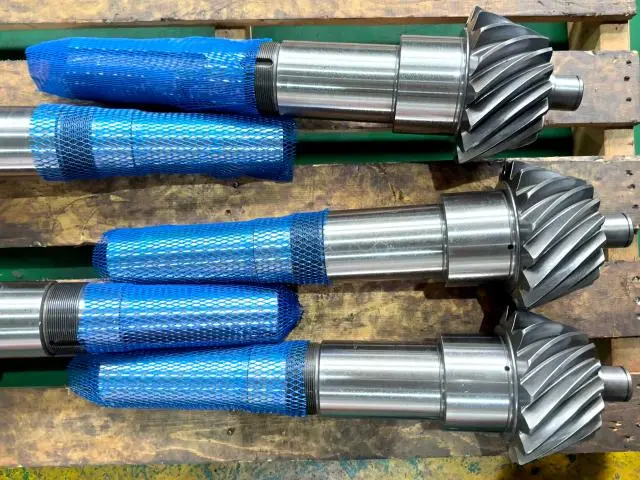
Understanding Bevel Pinion Shafts: Key Features & Applications
Power transmission engineering has a special group of parts called Bevel Pinion Shaft components. A precisely machined pinion gear is attached directly to a driveshaft in these integrated assemblies, making a single structure that can transfer rotational forces between axes that cross. Unlike normal parallel-axis gears, these parts allow torque to be transferred at angles, usually 90 degrees. This is very important in small machinery setups where room limits require quick changes in direction.
Engineering Principles Behind Bevel Pinion Design
The main benefit of these parts is that they can change the paths of rotational motion without the need for extra coupling mechanisms. When a motor or engine turns something horizontally, a Bevel Pinion Shaft assembly quickly moves that energy vertically or at precise angles, keeping the power intact the whole time. For this feature to work, the tooth geometry must be just right. Spiral or straight-cut profiles must engage with matching crown gears in order to spread loads across multiple contact points at the same time. The built-in Bevel Pinion Shaft design gets rid of the weak spots that come with keyed joints, where backlash, fretting corrosion, and rust can make them less effective when heavy loads are applied.
Materials and Manufacturing Standards
Case-hardening alloy steels like 18CrNiMo7, SAE4340, and AISI8620 are used in high-end parts. Specialised heat treatments, such as carburising and quenching, are used on these materials to make the surfaces hard (58–62 HRC) while keeping the core tough (30–45 HRC). This two-hardness shape protects the edges of the teeth from wear while keeping the core structure's ability to absorb shock. Precision grinding, casting, and hobbing are used in the manufacturing process to make sure that the dimensions are accurate enough to meet ISO 6 Grade standards. This is important for keeping the right mesh shape under operating stress.
Industrial Application Scenarios
In heavy mining, these assemblies are used in cone crushers and other drive systems. They have to be able to handle huge torque loads and constant shock impacts, so the parts have to be strong enough not to break down over time. Hypoid variants are used in automotive differentials to lower the center of gravity of the car while keeping the process quiet over a wide range of load cycles. The small size and zero-backlash gearbox make it possible for robotic joints and machine tool spindles to move precisely in automated manufacturing environments. For each application, the module range (0.5 to 50 degrees), helix angle (5° to 45°), and surface treatments need to be customised to meet the needs of the job.
How to Choose the Right Bevel Pinion Shaft for Your Business Needs
When buying gearbox parts, it's important to think carefully about both the technical and financial aspects. Your selection process should weigh the need for immediate performance against the cost of running the business in the long term. It's also important to make sure that the parts you choose meet both engineering requirements and the realities of the supply chain.
Technical Specifications and Load Requirements
Calculating torque ability is the first step in choosing the right parts. Find out the highest steady load and peak shock loads for your system to figure out what size module and tooth count you need. When used in mining tools, a Bevel Pinion Shaft usually needs higher module rates (10–50) than when used in precision instruments (0.5–5 module). Surface hardness specifications have a direct effect on wear resistance. The 58–62 HRC range is best for environments with abrasive dust or poor lubrication, while 45–50 HRC standards may be enough for lighter-duty environments.
Customization Capabilities and Dimensional Tolerances
Standard catalogue parts don't always perfectly match the needs of specialised machinery. Check out providers based on how flexible they are when it comes to customisation, such as non-standard tooth counts, changed helix angles, and built-in shaft features like keyways or spline profiles. YIZHI MACHINERY is able to handle a wide range of order numbers without lowering quality standards because it can make samples of single items as well as large orders. When working at high speeds, where pitch mistakes of more than 10 microns cause vibrations and early bearing failure, dimension limits become very important.
Supplier Evaluation Criteria
Evaluations of suppliers should include more than just product specifications. They should also look at how well the supplier can make things and provide services. Check to see if possible partners have high-precision CNC gear machining centers and automatic grinding machines that can achieve ISO 6 Grade accuracy. Coordinate measure machine proof, magnetic particle inspection for surface flaws, and ultrasonic testing for flaws inside the material should all be part of the inspection process. Dependable lead times are very important. Suppliers with 35–60 day production cycles and clear progress tracking make it easier to plan production than suppliers whose delivery schedules are hard to predict.
Material Selection for Environmental Conditions
Operating conditions have a big effect on what materials are needed. Stainless metal or special finishes that don't rust are needed for parts that will be used in marine environments. For high-temperature uses like kiln drives, you need materials that don't change size when heated, so the mesh shape doesn't get messed up. When buying different kinds of tools, you might want to stick to flexible materials like 42CrMo or AISI4140. These materials have balanced properties in a range of situations, which makes inventory management easier while keeping performance reliable.
Where to Buy High-Quality Bevel Pinion Shafts: Supplier Landscape Overview
The global market has many ways to buy things, and each one has its own benefits that depend on your buying goals. Knowing the different types of suppliers out there helps you find partners who can meet your technical needs and business goals.
Established International Manufacturers
Global brands like SKF, Timken, and NTN have built their reputations over many years by consistently providing high-quality products. These companies are great at making standard parts that come with easy-to-find paperwork and large networks of distributors. Their strength is that they can meet common requirements right away and have a well-established technical help system. But there may not be a lot of room for customisation, and prices are usually set based on how premium the brand is rather than how much it costs to make.
Specialized Precision Gear Manufacturers
Companies that only make custom gear, like YIZHI MACHINERY, can help with difficult sourcing issues because they have the right kind of specialised knowledge. These companies were started in 2016 and have been making things for a total of 15 years. They learn a lot about precision cutting techniques and how to get the most out of heat treatment. Their main selling point is custom solutions; their engineering teams work directly with your designers to make Bevel Pinion Shaft assemblies that meet your exact needs, from choosing the materials to following the rules for final inspection. Using this method is especially helpful when standard catalogue parts can't meet specific performance or size requirements.
Wholesale and Bulk Procurement Strategies
By negotiating prices and making sure that production runs are optimised, buying in bulk can save you a lot of money. When you need to combine needs for different types of equipment or facilities, you should work with suppliers who can handle different specifications in a single purchase order. Minimum order number flexibility is very important—manufacturers that accept single-item sales make prototyping and trial programs possible without having to commit to too much inventory. Set up framework agreements that lock in prices for set periods of time while allowing call-offs based on actual consumption patterns. This will keep costs predictable while also making the best use of your inventory.
Custom Order Processes and Communication Protocols
Clear communication of requirements is the first step to successful custom procurement. Make thorough drawings that show the important measurements, acceptable amounts of error, material needs, and expected surface finishes. Ask for design review meetings so that the engineering teams of your suppliers can look for possible problems during production and offer ways to make things better at a lower cost without affecting performance. Sample production is a good way to lower your risk because you can test the usefulness of physical prototypes in real-world working conditions before committing to large orders. Plan your deliveries so that they work with your production schedules, taking into account the 35–60 day lead times that are usually needed for precision manufacturing and quality checks.
Ensuring Quality and Reliability: Maintenance, Troubleshooting & Lifecycle Management
How long a component lasts depends on both how well it was made and how it was used. Putting in place proactive repair plans and learning about typical failure modes can help you get the most out of your procurement investment.
Routine Inspection and Preventive Maintenance
Set up inspection schedules based on operating hours instead of calendar dates, since load cycles directly affect how worn out a component is. When you look at your teeth, you should look for surface pitting, scoring, or discolouration that could mean they've been overheated. Check the backlash every three months using dial indicators; gradual increases show that the bearings or mountings are wearing out or degrading, which needs to be fixed before a catastrophic failure happens. By taking samples of the oil and analysing it, metallic bits that show strange wear patterns can be found. This lets the problem be fixed before it spreads to other parts of the gear train.
Common Failure Modes and Diagnostic Techniques
Whining sounds during operation usually mean that the backlash settings are wrong or that the tooth shape is off because the machine wasn't installed correctly. Overheating in one area shows that the load is not being evenly distributed across all tooth surfaces, but rather that there are concentrated touch patterns. When Bevel Pinion Shaft assemblies show fast wear, check the alignment of the mating parts. An angle misalignment of more than 0.5 degrees causes edge loading that breaks down tooth flanks quickly. Material fatigue shows up as tooth root cracks that can be seen with a magnetic particle inspection. This is usually caused by shock loads that are too high or not enough heat treatment depth.
Design Considerations Affecting Durability
When there is a lot of shaking, integrated shaft-pinion forgings work much better than options that are put together. The one-piece design stops fretting rust at important surfaces and gives the mesh better stiffness so that its shape stays the same when it bends. Spiral tooth profiles make interaction easier than straight-cut designs, which lowers noise and spreads loads across more than one point of contact at the same time. Effective case depth specifications have a direct effect on fatigue resistance. For heavy-duty applications, industrial standards require a minimum depth of 0.8 mm, which makes sure that hardened surfaces go beyond the maximum Hertzian stress zone.
Cost vs Quality: Making the Procurement Decision with Confidence
Professionals in procurement are always juggling the competing goals of minimising original costs and maximising total lifecycle value. Knowing what makes component prices go up or down helps you make better strategic decisions that improve long-term operational economics.
Price Drivers and Manufacturing Complexity
The price of raw materials changes depending on the alloy they are made of. For example, nickel-chromium-molybdenum steels are more expensive but can be hardened better for large cross-sections. The level of precision needed affects how hard it is to make something. For example, to meet ISO 6 Grade tolerances, more grinding and inspection time is needed than for ISO 8 Grade standards. Customisation adds costs for technical fees and tools, but these costs usually go down as more than 50 units are made. Heat treatment methods have a big effect on costs. For example, carburising needs longer burner cycles than induction hardening, which can be used for localised surface treatment.
Long-Term Value Assessment
How long a part lasts directly affects how often it needs to be replaced and how much it costs for downtime. When you think about replacement labour, production interruptions, and secondary damage to mating components, a Bevel Pinion Shaft that costs 30% more but lasts twice as long is a better deal. Transmission efficiency differences of 2% to 3% add up to big energy costs over years of continuous use. Higher-precision parts with optimised tooth geometry cut down on frictional losses, which leads to real savings in power use. Warranty coverage lowers the risk, and companies that are sure of their products offer one-year promises backed by quick problem-solving procedures.
Case Study: Mining Equipment Upgrade
A mining company in North America had problems with cheap foreign parts used in their crusher drive systems that kept breaking down. The analysis showed that the case wasn't deep enough and the heat treatment wasn't done right, which caused the teeth to break under shock loads. Switching to precisely manufactured Bevel Pinion Shaft assemblies with confirmed metallurgical properties raised unit costs by 40% but got rid of unplanned downtime that was happening every year for an average of 120 hours. Over three years, maintenance records showed that replacements happened 85% less often, and the total cost of ownership went down 32%, even though the initial costs were higher. This result shows that buying choices based on engineering lead to measured operational changes and financial returns.
Conclusion
To find high-quality gearbox parts, you need to carefully consider technical specs, source skills, and the overall cost of ownership. Bevel Pinion Shaft assemblies are big investments that depend on the engineering accuracy and production skill of the people who make them. When you buy something, you should think about both how much it costs now and how well it will work in the long run. This is because high-quality parts from well-known brands are more valuable because they last longer and require less maintenance. Partnering with providers that offer full customisation, clear quality standards, and quick expert support will help your equipment work at its best in a wide range of tough industrial settings.
FAQ
1.What material should I choose for my Bevel Pinion Shaft application?
The main things that determine which material to use are the load characteristics and the environmental conditions. For heavy-duty uses that involve shock loading, case-hardening alloys like 18CrNiMo7 or SAE4340 are needed. These alloys have tough cores and surfaces that don't wear down easily. For moderate loads, 42CrMo or AISI4140 can be used because they have balanced properties and are cheaper. Corrosive settings need stainless steel or finishes that are made for that purpose. Talk to the engineering teams at suppliers like YIZHI MACHINERY to make sure that the properties of the material match your requirements for torque, speed, and contamination exposure.
2.What are typical lead times for custom Bevel Pinion Shaft orders?
It usually takes 35 to 60 days from the time an order is confirmed until the custom precise Bevel Pinion Shaft parts are delivered. This time frame includes reviewing the engineering, getting the raw materials, forging, heat treatment processes, precision machining, quality checks, and safe packing. Complex specs that call for non-standard materials or custom shapes may make deadlines longer. Manufacturers who keep a large inventory of materials and a lot of production capacity can sometimes meet urgent needs faster, but they usually charge more for rush orders because they cause schedule problems.
3.Can I obtain samples before committing to bulk purchases?
Reputable manufacturers will usually give samples to new customers or people who want to try new things. Before committing to a large order, sample production lets you check that the dimensions, material features, and quality of the surface finish meet your needs. This method lowers the risk of procurement, especially for important uses where a failed part could have major practical effects. During the first round of discussions, talk about example terms and make it clear if costs apply and how they can be used to offset future production orders.
Partner with YIZHI MACHINERY for Premium Bevel Pinion Shaft Solutions
Getting the gearbox parts you need requires more than just buying them. You need to form strategic partnerships with manufacturers who have a lot of technical knowledge and a track record of producing high-quality parts. YIZHI MACHINERY has 15 years of experience in its field, quality methods that are in line with ISO standards, and a wide range of customisation options. Our precision grinding skills and knowledge of many industries allow us to make Bevel Pinion Shaft options that are exactly what you need, for everything from mining equipment to high-precision tools. We offer cheap lead times of 35 to 60 days and custom packing that keeps shipping damage rates below 0.1%. Our one-year guarantee and clear tracking from start to finish show that we care about the success of your operations. Contact us at sales@yizmachinery.com to talk about your needs with experienced Bevel Pinion Shaft manufacturers who are committed to providing high quality products and dependable supply chain performance.
References
1. American Gear Manufacturers Association. (2019). AGMA 2005-D03: Design Manual for Bevel Gears. Alexandria: AGMA Publications.
2. Stadtfeld, H. J. (2014). Gleason Bevel Gear Technology: Manufacturing, Inspection and Optimization. Rochester: The Gleason Works.
3. Davis, J. R. (2005). Gear Materials, Properties, and Manufacture. Materials Park: ASM International.
4. Dudley, D. W. (1994). Handbook of Practical Gear Design and Manufacture. Boca Raton: CRC Press.
5. International Organization for Standardization. (2013). ISO 17485: Bevel Gears — ISO System of Accuracy. Geneva: ISO Standards.
6. Lynwander, P. (1983). Gear Drive Systems: Design and Application. New York: Marcel Dekker Inc.

USER EVALUATE
Here is the customer's evaluation of us