


What to Know About Bevel Gear Grinding
It is important to know about the finishing methods that ensure success when looking for precision-engineered parts for industrial machinery, mining operations, or aerospace uses. After heat treatment, Bevel Gear Grinding is a very precise way to finish the hardness of spiral bevel, hypoid, and Zerol gears. It gets rid of any flaws and makes sure they have the exact micro-geometry they need. Grinding is not like traditional lapping, which makes matched pairs. Instead, it is a predictable process that cuts each gear member separately to mathematical perfection. This feature directly addresses important problems in the industry, like lowering noise and shaking in high-speed differentials, fixing deformations caused by heat treatment, and greatly increasing load-carrying capacity by making contact patterns more efficient. For procurement workers who have to choose suppliers and make sure the quality of the products they buy, understanding these technical basics turns guesswork into strategic advantage when making buying decisions.
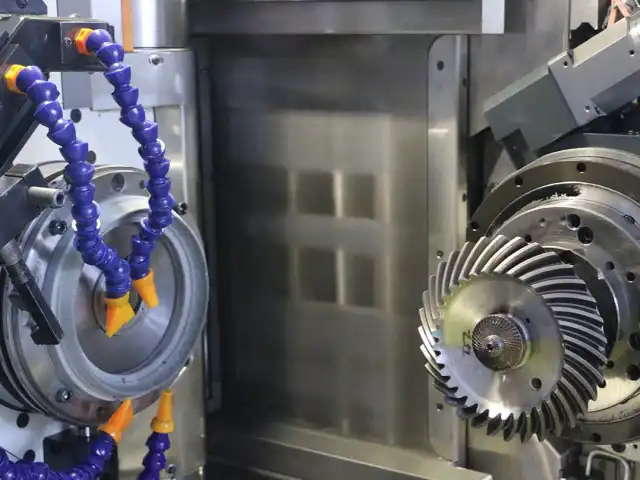
Understanding Bevel Gear Grinding: Principles and Process
Precision grinding is all about taking away material from the sides of hardened gear teeth to recover their shape and make a controlled surface texture. Parts that have been carburized, cooled, and tempered, or induction hardened, will always twist. Bevel Gear Grinding gets rid of these flaws while keeping the hardened case's structure, which is important for longevity.
How the Grinding Workflow Operates
These days, grinding processes include more than one step. The workers put blanks that have been heated on precise supports and then place them in relation to grinding wheels, which are usually made of vitrified cubic boron nitride (CBN) to make them hard and stable at high temperatures. CNC systems change axes by programming toolpaths from CAD models. This makes sure that the same thing is done every time the process runs. The process cuts both convex and concave sides, changing things like wheel speed, feed rate, and depth of cut to balance how much material is removed with how smooth the surface needs to be.
Machine Types and Their Capabilities
Because skilled workers can change the settings on the fly, manual grinding machines are good for making small amounts and prototypes. CNC grinding centers are the most common type of machine used for high-volume production. They get uniform results by changing tools automatically and using closed-loop feedback systems. More advanced robotic cells increase productivity even more by combining loading, grinding, inspecting, and emptying into one work area. Which of these configurations to use relies on the amount of work to be done, the precision grade goals, and the available funds.
Critical Parameters Affecting Final Accuracy
To get to ISO 8 Grade precision, or even tighter limits for aircraft use, you have to keep a close eye on Bevel Gear Grinding parameters. Wheel speed affects how well it cuts and how much heat it puts on the material. If the speed is too high, grinding burn can happen, which is a flaw in metalwork where burning in one area re-hardens the surface. Feed rates control how quickly and forcefully material is removed, matching cycle time with surface roughness. The depth of cut must stay within the case-hardened layer; going beyond this removes the protective hardness, which breaks the part. The supply of coolant is also very important. High-pressure streams aimed at the Bevel Gear Grinding contact zone stop heat damage and flush away swarf.
Common Defects and Prevention Strategies
Grinding burn shows up as darkened spots or failed Nital etch tests, which mean the material is less hard and won't last as long. To avoid problems, you should make sure the specific material removal rate (Q-prime) is as high as it can be, use sharp wheels by dressing them often, and keep the water flow going well. Chatter, which is waviness on the sides of teeth caused by vibration, happens when the machine isn't stiff enough or doesn't have enough dampening. To stop chatter, wheel speeds need to be balanced, fixturing needs to be made more stable, and sometimes toolpaths need to be redesigned to reduce vibration. When purchasing teams look at different sources, they should make sure that their quality control procedures include Nital etch inspections and coordinate measuring machine (CMM) inspection to find these flaws before the goods are shipped.
Comparing Bevel Gear Grinding to Other Gear Manufacturing Methods
Knowing how Bevel Gear Grinding fits into the bigger picture of making gears helps buyers match methods to the needs of their applications. There are different ways to trade off cost, speed, accuracy, and surface finish.
Cutting and Hobbing for Initial Shaping
Gear cutting and hobbing are the main forming processes that take away bulky material from blanks to make tooth shapes. Hobbing is great for making circular gears quickly, but it's not as good at making gears with sharp shapes. These methods produce moderate accuracy, usually between ISO 6 and ISO 7 levels. This is fine for most industry uses, but not when high precision transmission or low noise are needed. Because cycle times are short, the cost per part stays low. This makes these methods perfect for industries that need to accept wider tolerances, like automotive and farming machines.
Skiving as a Versatile Alternative
Skiving is a combination of hobbing and shaping. To make tooth shapes, the tool and material must rotate at the same time. New technologies allow for the skiving of internal gears and fine-pitch components, which gives manufacturers more options for how they make things. In some situations, surface finishes are almost as good as grinding quality. However, skiving usually can't match the sub-micron form accuracy that grinding provides. Skiving works well for medium-volume production where the costs of tools need to be spread out over a number of different part groups.
Lapping Versus Grinding: Critical Distinctions
Lapping is an older way to finish something. It involves running a set of mated gears together with an abrasive substance, which wears down high spots until the contact patterns meet inspection standards. This random process makes matched pairs that can't be switched with other sets. This makes it harder to handle supplies and provide service in the field. These problems can't happen with grinding because it uses predictable machining to make fully replaceable parts that match exact digital models. Grinding is still the only option for aircraft and precise robotics uses that need zero-backlash performance and predictable noise levels, even though it costs more per part.
Cost Versus Accuracy Trade-Offs
People who want to save money often have to choose between soft cutting, which is cheaper, and quality grinding, which costs more. Soft-finished gears that were cut before they were heated cost less, but they are less precise, so they can only be used in low-speed, moderate-load settings. Grinding costs more, both in terms of the tools you need to buy and the time it takes to do the job, but the performance gains are huge. Electric car drivetrains that go over 15,000 RPM need ground gears to get rid of the whine that can be heard. Helicopter main rotor drives also need ground gears to keep them from failing, which would be very bad. Along with the initial purchase price, procurement professionals must look at the total cost of ownership, which includes insurance claims, downtime, and the risk to the company's image.
Why Bevel Gear Grinding Is Important for Precision and Performance
Precision finishing has a direct effect on the strength, operating life, and effectiveness of the system. Bevel Gear Grinding creates surfaces with better contact properties because they spread loads evenly across the tooth sides and stop stress clusters that cause pitting or fracture.
Enhancing Load Capacity and Durability
When you grind something, you add good leftover compressive stresses to the top layers. These stresses counteract the tensile stresses that make cracks spread during cyclic loading. Engineers make sure that contact patterns are centered under full-load movement by fine-tuning the side terrain, which includes crowning, bias correction, and tip relief. This stops edge loading, a common way for teeth to break where contact moves toward the ends of the teeth, putting more stress on them and causing them to break. These improvements in durability are especially helpful for mining equipment gears that have to deal with shock loads and abrasive contamination. They make replacement times longer and lower upkeep costs.
Noise Reduction and Smooth Operation
Transmission error, which is the difference between the ideal and real position of the spin, causes noise and vibrations that can be heard. Ground gears reduce transmission error by having an exact involute shape and a controlled surface finish. This makes the process quieter, which is important in vehicles and industrial equipment where the comfort of the user is important. Surface roughness values below Ra 0.4µm lower friction, which lowers the rate at which heat is produced and lubrication wears off. When it comes to machine tool spindle drives that need to move smoothly and have little slack, these traits directly affect the accuracy of the cutting and the quality of the parts.
Industry-Specific Applications Demanding Grinding
Helicopter drives in aerospace have to meet very strict standards, such as high power density, harsh thermal cycles, and safety-critical dependability. Ground bevel gears that meet the quality standards of AGMA Q14 or DIN 4 give you the accurate measurements and smooth surface you need. They are backed up by strict testing procedures that include Barkhausen noise analysis to check for leftover stress. Commercial vehicles' steering systems depend on ground gears to make them easy to control and last a long time, even when they're running at low speeds with changing loads. Grinding is a good way to get high precision in small modules (sometimes 0.5 to 2 mm), which is hard to do with other finishing methods. This is helpful for compact mechanical transmission systems.
Maintenance Practices Protecting Investment
To keep producing precise results, grinding tools need to be carefully maintained. Wheel dressing should be done at the times suggested by the maker, since glazed wheels produce too much heat and a rough surface finish. To keep thermal management working well and to stop rust, coolant systems need to be filtered and their concentrations checked on a frequent basis. Every three months, the CNC axes and feedback encoders should be calibrated, and laser interferometry should be used to check the accuracy of the placement. These procedures keep downtime to a minimum and protect the large amount of money that modern grinding centers cost, which can be anywhere from $500,000 to over $2 million based on the setup.
Technological Advancements Boosting Efficiency
Adaptive control systems are new inventions that change parameters in real time based on what sound emission sensors find when they notice grinding conditions. Simulation software suggests the best toolpaths, so setting doesn't have to be done by trial and error. By finishing more than one tooth at the same time, multi-axis simultaneous cutting cuts down on cycle times. Because of these improvements, grinding is becoming more cost-effective while still having quality benefits. This means that it can be used in more areas than just high-end ones.
Choosing and Procuring Bevel Gear Grinding Solutions
When making a purchase choice, it's important to make sure that the technical needs are met by the supplier's skills and that the cost is balanced with quality assurance and delivery efficiency for Bevel Gear Grinding.
Evaluating Machine Types for In-House Capability
Companies that want to do their own grinding need to think about their production numbers, part mixes, and accuracy needs. Basic CNC grinders can work with modules up to 10 mm thick and can handle ISO 6-7 levels, making them good for most industry uses. Premium machines can handle modules up to 50 mm wide, get ISO 4-5 grades, and have built-in testing tools for closed-loop correction. When throughput goes over 10,000 gears a year and worker supply limits operations, robotic cells are worth the extra cost—often twice as much as standalone machines. In addition to the price, buyers should look at the machine's size, how much power it uses, how to get rid of the coolant, and how much training the user needs.
Selection Criteria Beyond Technical Specifications
Ratings are true, but they only tell part of the story. Real-world performance is affected by things like being able to repeat over long production runs, staying stable at different temperatures, and blocking out vibrations. It's important to have manufacturer support services because the total cost of ownership is affected by things like the availability of new parts, how quickly expert help is provided, and how software updates are handled. By going to reference sites and evaluating real production environments, you can find problems that the specs might not include.
In-House Grinding Versus Outsourcing Decisions
Controlling production plans, protecting intellectual property, and keeping an eye on quality directly are all benefits of having the power to do things in-house. But the capital investment is high. Aside from the machine itself, extras like cooling systems, wheel dressers, and testing tools cost money. When jobs are scarce, skilled workers get paid more. Outsourcing to specialized service providers saves money on capital costs and moves operational risk to the service provider. However, wait times can change and design details must be shared. These trade-offs are balanced by hybrid methods, which keep in-house capacity for prototype and low-volume work while outsourcing high demand.
Pricing Structures and Contract Negotiations
Prices for grinding services are usually based on models for each part, and rates change based on complexity, module size, and precise grade. Committing to buy a lot of something usually gets you a discount. For annual deals that include more than 5,000 pieces, savings of 10% to 20% are common. The terms of the contract should include quality standards (based on ISO 17485 or AGMA 2009), testing procedures, how to handle nonconformances, and when the goods should be delivered. To avoid disagreements, it's important to be clear about payment terms, who owns the tools, and how to handle change orders.
Supplier Verification Methods
Due diligence separates sellers who are qualified from those who aren't. Requesting example parts for outside review, such as Nital etch testing and CMM analysis, proves that the process works. Looking at customer case studies from related industries can help you figure out how well you can solve problems. Third-party certifications like ISO 9001 or AS9100 for aircraft show that a company is committed to structured quality management. However, certification by itself doesn't mean that a company is technically competent. The most thorough verification is done through on-site checks that look at machine state, calibration records, and operator qualifications. This is especially true for strategic partnerships involving secret designs or expensive parts.
Conclusion
Professionals in procurement can make smart choices about where to buy things that meet performance needs and price limits if they understand the technical and business sides of precision Bevel Gear Grinding. When you mix the precise nature of grinding with CNC automation and high-tech tooling materials, you get interchangeable parts that meet the highest quality standards and are used in aircraft, mining, and industrial machines. When buyers are thinking about buying tools for their own use or choosing service partners, it helps them to know how the process works, what problems are common, and how this method is better than others. Suppliers keep their promises by checking the quality of their work with CMM analysis, Nital etch tests, and Barkhausen noise measures. As the use of electric drivetrains, precision robotics, and safety-critical systems grows, so will the need for ground gears. This means that strategic relationships with suppliers and technical understanding will become more and more useful competitive benefits for procurement organizations around the world.
FAQ
1. What industries benefit most from precision grinding?
Ground components are very important to the aerospace, automobile, mining, and industrial robots industries. For safety reasons, helicopter main rotor drives need the best grades, while electric car makers put a lot of emphasis on grinding to get rid of gear whine at high speeds. Better resistance to shock loads and abrasive pollution makes mining tools last longer.
2. How does CNC technology improve grinding outcomes?
CNC systems get rid of human error by following pre-programmed tracks that are repeatable to the micron level. Closed-loop feedback adjusts for wheel wear and temperature expansion in real time, making sure that the quality of thousands of parts stays the same. Automated inspection tools check measurements without taking parts off of fixtures. This cuts down on cycle time and improves quality control.
3. What maintenance practices extend grinding machine life?
Dressing the wheel regularly keeps it working well and stops grinding burn. Coolant filter gets rid of impurities that hurt pumps and valves, and concentration tracking keeps the thermal and corrosion qualities stable. Laser interferometry is used to calibrate CNC machines every three months. This finds positioning mistakes before they affect the quality of the part. Comprehensive preventive repair plans keep investments safe and cut down on unnecessary downtime.
Partner with YIZHI MACHINERY for Expert Grinding Solutions
Buying fine gear is hard, and you need a partner with both technical know-how and the ability to make things in a variety of ways. YIZHI MACHINERY creates unique solutions using 20CrMnTi, SAE4340, and AISI8620 materials. These materials are cut, honed, milled, and ground to achieve ISO 8 Grade accuracy. Our Gleason profile gears can handle tough jobs in steering systems, machine tool spindles, and farm equipment. They can be heat treated in a number of ways, such as carburising or induction hardening, to make the surface hard up to 58–62 HRC. We have been making things for 15 years and can deliver in 35 to 60 days. Our thorough customization process lets us handle both large orders and prototypes made of a single piece. Our logistics services, which include shock-absorbing packing that keeps damage rates below 0.1%, multi-channel transfer that combines air and sea cargo, and real-time tracking, make sure that your parts get to you on time and in good shape. Our team is ready to help you reach your buying goals, whether you need expert advice before the sale, updates on production that happen at the same time, or our one-year warranty with fast problem resolution. Contact us at sales@yizmachinery.com to talk about your Bevel Gear Grinding needs with a reputable company that is dedicated to providing accurate, dependable, and quick service to customers in the mining, aerospace, and industrial machinery industries around the world.
References
1. American Gear Manufacturers Association (2019). AGMA 2009: Bevel Gear Classification, Tolerances, and Measuring Methods. Alexandria: AGMA Publications.
2. Klingelnberg GmbH (2021). Precision Grinding of Bevel and Hypoid Gears: Technology and Applications. Hückeswagen: Klingelnberg Technical Press.
3. ISO Technical Committee 60 (2018). ISO 17485: Bevel Gears - ISO System of Accuracy. Geneva: International Organization for Standardization.
4. Stadtfeld, H.J. (2020). Advanced Bevel Gear Technology: Manufacturing, Inspection and Optimization. Rochester: The Gleason Works Research Institute.
5. DIN German Institute for Standardization (2017). DIN 3965: Tolerances for Bevel Gears - Tolerances for Working Deviations. Berlin: Beuth Verlag.
6. Society of Automotive Engineers (2022). Heat Treatment and Surface Engineering of Transmission Gears. Warrendale: SAE International Journal of Materials and Manufacturing.

USER EVALUATE
Here is the customer's evaluation of us