


What is the planet carrier in a planetary gear?
When dependability is needed under high loads, precision power transmission operators must grasp planetary gear system design. Epicyclic gear assemblies' rotating cage, the Planet Gear Carrier, holds and accurately places the planet gears relative to the sun gear and ring gear. This component transfers torque from several planet gears to the output shaft while preserving vital alignment under torsional pressures. This carrier must manage centrifugal loads, resist deflection, and distribute load evenly across all meshing gears, making it essential in mining excavators, aerospace actuators, and heavy industrial machinery where failure isn't an option.
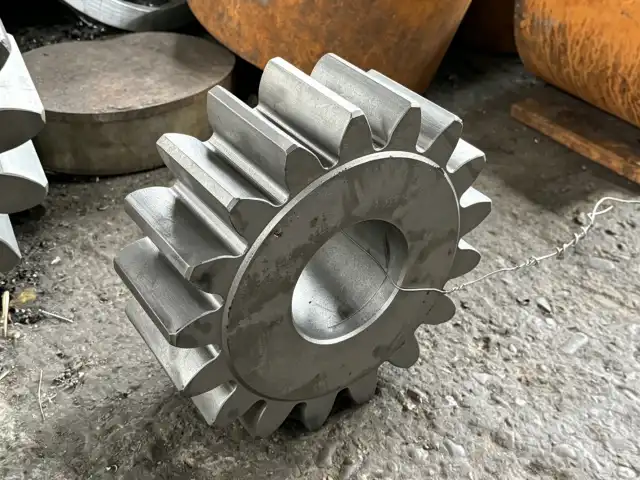
Understanding the Planet Carrier in a Planetary Gear System
Core Function and Load Distribution Mechanics
The Planet Gear Carrier holds planet gears at correct radial lengths and spins to deliver or receive mechanical power. Each planet gear links to the central sun gear and outer ring gear, allowing loads to traverse many ways. Uneven loads may stress a planet gear and shatter its teeth, therefore the Planet Gear Carrier spreads these stresses. According to gear tribology studies, Planet Gear Carrier rigidity may boost load sharing efficiency by 30%. This significantly increases component life in difficult environments like underground mining equipment, where downtime costs thousands per hour to fix.
Essential Components and Their Interactions
Planet Gear Carrier has multiple precision-machined elements that function together. Cage bodies are commonly composed of 42CrMo or AISI 4140 alloy steel. ±0.015mm tolerances are utilized to manufacture pin bores for stronger planet pins. Planet pins support needle or roller bearings, allowing the planet gear to revolve smoothly. Mounting splines or flanges connect the Planet Gear Carrier to output shafts. Torque is transferred when bearings are centered. Phosphating and strong chrome plating prevent corrosion in severe industrial situations. This is crucial for coastal and undersea mining, where seawater accelerates disintegration.
Application-Specific Design Variations
Each industry's demands influence Planet Gear Carrier design. In aircraft, weight reduction is crucial, therefore skeleton designs remove material from non-critical places while maintaining stiffness. These Planet Gear Carriers have 58–62 HRC surfaces at stress concentration sites due to induction hardening. Mining equipment Planet Gear Carriers use heat-treated 40CrNiMo steel to withstand stress loads from digging and breaking rocks. How the Planet Gear Carrier will be utilized should inform its design. For example, a wind turbine yaw drive Planet Gear Carrier requires floating mounting systems to accommodate for tower wobble, while an electric car transmission needs oil galleries for centrifugal lubrication at 15,000 RPM.
Engineering Principles and Design Considerations of Planet Gear Carriers
Force Analysis and Kinematic Relationships
Planet Gear Carrier utilizes three force vectors during action. Planet pins flex due to torque transfer. Pins will flex and misalign gear teeth if the pin diameter or Planet Gear Carrier wall thickness is too small. Gear mesh compresses bearing surfaces. Choosing the appropriate bearings is critical because axial forces, particularly in spiral planetary systems, impart thrust strains on them. The gear ratio relationship R = 1 + (Ring Teeth / Sun Teeth) sets spinning speeds, which affects Planet Gear Carrier centrifugal forces at high RPM. By understanding these kinematic linkages, purchasing teams may determine whether a Planet Gear Carrier fits their torque density requirements. When replacing outdated equipment with more powerful ones, this is crucial.
Material Selection Trade-offs
Material selection for the Planet Gear Carrier greatly impacts cost and performance. Forged steel alloys like SAE 4340 are ideal for shock-loaded equipment since they may achieve 1600 MPa of tensile strength after cooling and tempering. YIZHI MACHINERY aligns grain flow with stress patterns using precision casting and CNC machining. This makes Planet Gear Carrier wear-resistant. Nodular cast iron (GGG70 grade) is an inexpensive solution for moderate-load industrial gears and Planet Gear Carrier applications that reduces vibration and noise, which factory automation systems appreciate. Aluminum alloys are being used in electric vehicle gearboxes to extend battery range, but the Planet Gear Carrier needs particular surface treatments to protect the bearing connections.
Solid Versus Skeletal Design Philosophy
Solid Planet Gear Carriers' continuous disc form makes them firm under tension and easy to spin and grind. This approach works effectively for high-power, low-speed applications where rotational inertia is not an issue. The efficient elimination of material between pin bosses in skeleton Planet Gear Carriers makes them 20–35% lighter than solid ones while maintaining structural integrity using finite element analysis optimal designs. These designs reduce drag in aviation actuation systems and high-speed industrial spindles, improving acceleration and dynamic responsiveness. Remote field repairs are simpler with modular Planet Gear Carriers with changeable pin plates affixed to a hub. Mines in Australia's outback or Alaska's North Slope oilfields, where parts are scarce, need this.
Maintenance, Performance, and Problem Diagnosis
Recognizing Common Wear Indicators
Often, abnormal sound signals are the first sign that a Planet Gear Carrier is in trouble. If the usual whine of a gear changes to mechanical grinding or knocking that happens every so often, it means that the bearings or pins are wearing out, which lets the planet gear move too much. Using accelerometers for vibration research can find imbalances or cracks before they show any obvious signs. In our experience, vibration amplitude increases of 40% usually happen before measurable changes in dimensions. During routine maintenance, a visual check should focus on pin bore extension, and bore gauges should be used to look for oval distortion. Surface pitting on the bearing plates means that the lubrication has failed or is contaminated, while blue coloring patterns mean that the bearing has overheated because the oil flow isn't good enough or it's being loaded too much beyond what was intended.
Lubrication Strategies and Bearing Care
Proper oil makes the service life of a Planet Gear Carrier go by a huge amount. Splash lubrication works well for low speeds below 500 RPM, but forced circulation systems are needed for faster speeds. Modern Planet Gear Carriers often have internal tubes that send pressurized oil straight to the planet needle bearings. At working speeds, centrifugal force makes sure that the oil penetrates the bearings. Oil analysis tools should keep an eye on the levels of wear metals. High iron levels mean that gears or bearings are breaking down, and silicon spikes mean that a seal has failed, letting dirt in. We make a Planet Gear Carrier assembly at YIZHI MACHINERY that can hold both normal API GL-5 gear oils and synthetic PAO-based lubricants for high temperatures. The surface treatments are also suitable with phosphate-ester hydraulic fluids that are used in aerospace systems.
Maintenance Schedules and Replacement Criteria
Short maintenance periods depend on task cycle and environment. Underground mining equipment may require Planet Gear Carrier checks every 2,000 hours in dusty environments. Clean-room automation systems may do this every 10,000 hours. Dimensional wear limitations normally require part replacement when pin holes are 0.5 mm wider than the original width or bearing journal surfaces have more than 15% surface area pitting. Many industrial workers stock essential spares to reduce downtime. Our production expertise enable 35–60-day lead times, compared to the industry average of approximately 90 days. Condition-based replacement techniques that enhance reliability and cost are available with predictive maintenance systems that incorporate vibration trends and thermography. These methods prevent unexpected failures and prevent throwing away working components.
Procurement and Selection Guide for Planet Gear Carriers
Critical Specification Parameters
Most important is load capacity, generally the greatest input torque or transmitted horsepower. The Planet Gear Carrier must endure strong transient loads during machine startup and shutdown. Mine excavators sometimes receive 200% of their maximum torque during bucket breakout. Climate affects material choice. Indoor industry uses phosphating to prevent corrosion, whereas marine and chemical processes need strong chrome plating. varying purposes need varying precision. Construction equipment can use standard ISO 6 Grade, but aerospace actuators and precision robotic joints need ISO 5 Grade with location tolerances of less than 0.02mm to keep backlash to a minimum and make sure reliability. Type of bearing impacts initial cost and maintenance frequency. Needle bearings can carry more in fewer places than bushing-style planet supports, but they need more oiling.
OEM Versus Aftermarket Considerations
Original equipment makers (OEMs) like Dana, Eaton, and ZF offer guaranteed compatibility and a history of good performance. This makes them the best choice for demanding uses that are covered by warranty or are being closely watched by regulators. Most of the time, these cases cost 30–50% more than aftermarket options. Aftermarket experts with a lot of experience, like YIZHI MACHINERY, can custom-engineer solutions that offer great value. For example, our ISO 5-6 Grade precision manufacturing uses the same advanced CNC grinding and CMM inspection protocols as tier-one suppliers, and our flexible minimum order quantities can be used for both prototype development and production volumes. We've worked with mining companies that need drop-in replacements for old European gearbox models. We do this by reverse-engineering Planet Gear Carriers from worn samples and sending them fully comparable parts at 40% less cost and in 40% less time than OEM channels.
Evaluating Supplier Capabilities
When picking a supplier, consider manufacturing depth and quality systems as well as product requirements. Find out whether the company heat treats in-house. Outsourcing increases unpredictability and wait times. Our facility has carburizing ovens, quenching systems, and induction hardening equipment, so we manage metallurgical properties. Quality certifications matter. ISO 9001 certification provides basic process control, whereas AS9100 certification shows aircraft-level quality management for mission-critical application. Request inspection data from a coordinate measuring machine (CMM) showing pin bore positions. A must-do test for load sharing effectiveness. Global challenges impact material supply, making supply chain transparency increasingly crucial. We have strong relationships with Asian and European steel mills. This allows us to provide alloys even in unpredictable markets, unlike our competitors who utilize one supplier.
Future Trends and Innovations in Planet Gear Carrier Technology
Advanced Materials and Surface Engineering
Traditional machining cannot create Planet Gear Carrier geometries with the optimal structure. Additive manufacturing can. Selectively laser melting maraging steel creates Planet Gear Carriers with internal lattice structures that save weight by 25% while maintaining rigidity. This is beneficial for airplanes when weight matters. New surface engineering techniques include diamond-like carbon coatings that reduce friction to 0.1 (compared to 0.15 for standard hardening). This minimizes gear train power losses by 3–5%, which is significant for battery-electric cars where every percentage point enhances range. Steel-ceramic hybrid materials are promising for high-temperature applications such gas turbine starting drives at 300°C.
Industry 4.0 Integration and Smart Monitoring
Embedded sensor technology turns Planet Gear Carriers from simple parts into smart parts of the system. Real-time thermal data is sent by wireless temperature sensors that are built in during production. This lets predictive algorithms find early signs of bearing failure 200 to 300 hours before standard vibration analysis. With strain gauge instruments, you can find out how the real load is distributed across planet gears. This gives you data to back up your finite element models and lets you limit the dynamic load to keep damage from happening. YIZHI MACHINERY works with makers of industrial IoT platforms to offer sensor-ready Planet Gear Carrier designs that come with sealed feedthrough ports and mounting holes that have already been made. This makes retrofitting easier. Digital twin technology makes virtual copies of physical Planet Gear Carriers. It does this by combining sensor data with physics-based models to accurately predict how much longer something will be useful (85% of the time). This makes it possible for truly condition-based maintenance strategies that improve both uptime and running costs.
Customization and Rapid Manufacturing Advances
Flexible manufacturing techniques with robotic tool change and automated inspection reduce custom Planet Gear Carrier lead times from 12 weeks to 6 weeks. Our manufacturing method uses CAD/CAM technology to automate machining from client models. This eliminates human programming errors and accelerates quotation retrieval. This flexibility is useful for refurbishing existing equipment without Planet Gear Carriers. We reverse-engineered Planet Gear Carriers for 1980s German mining shovels used in South American copper mines, incorporating current metallurgy modifications that improve performance. As mass customisation grows, purchasing teams may request features for particular applications without paying extra for one-time manufacture. This makes precise gear technology more affordable for medium-sized industries.
Conclusion
Planet Gear Carrier is more than a mechanical casing. It regulates load distribution, reliability, and cost of planetary gear transmissions in mining, industrial, and aviation systems. Understanding the product's engineering, material qualities, and maintenance demands helps procurement professionals balance performance, lifespan, and budget. Planet Gear Carriers become increasingly complicated, sensor-enabled parts that aid proactive maintenance planning and system optimization when manufacturing technology advances and Industry 4.0 is completely integrated. Strategically selecting suppliers with precise manufacturing capabilities, material expertise, and helpful customer service creates reliable, low-cost gear transmission systems for severe industrial applications.
FAQ
1. How can I determine when a planet carrier requires replacement?
Keep an eye out for more noise during operation, especially grinding or regular knocking sounds that can mean the bearings are wearing out or the pin hole is getting longer. Vibration research that shows amplitude jumps above 40% of the baseline says that problems are getting worse. Pin bore width should be measured physically; replacement is needed when wear goes beyond 0.5 mm of the original specs. An oil study that shows high levels of iron wear particles is an early sign of internal damage. Temperature rises of 15°C or more above the usual working range are a sign of lubrication failure that needs to be looked into right away.
2. What materials work best for heavy-duty mining applications?
Forged alloy steels like 42CrMo, AISI 4140, or SAE 4340 have the impact protection and tensile strength needed for mining settings that are high in shock loads. When properly heat-treated by cooling and tempering to a core hardness of 280 to 320 HB, these materials can handle the repeated loads of digging and moving materials. Surface processes, such as carburizing, make the surfaces between bearings more resistant to wear. YIZHI MACHINERY is an expert at making Planet Gear Carriers out of these strong metals. They do their own heat treatment in-house to make sure that the metallurgical qualities stay the same from batch to batch.
3. Does custom manufacturing justify the investment compared to standard carriers?
Custom planning lets you get the best results for your unique application factors, such as load profiles, room limitations, and environmental conditions. Standard Planet Gear Carriers might have extra parts that aren't needed and add to the cost and weight, or they might not have important parts like special greasing channels. Through application-matched material selection and shape optimization, our experience shows that unique solutions often give 20–30% longer service life. The investment pays off big time when replacing old equipment with new parts because OEM parts become obsolete or take too long to get. With YIZHI MACHINERY's ability to make just one unit at a time, customization is possible even for prototypes or small fleets.
Partner with YIZHI MACHINERY for Precision-Engineered Carriers
Since 2016, YIZHI MACHINERY has been a renowned Planet Gear Carrier maker. They make custom transmission parts that meet the strict needs of mining, aerospace, and industrial machines. Our production methods are ISO-compliant and include advanced CNC machining, precise grinding, and a wide range of heat treatment options. These allow us to make Planet Gear Carriers from high-quality materials like 42CrMo, AISI 4140, and SAE 4340 metals. No matter if you need a single sample or a lot of them, our method is flexible enough to meet your needs while still meeting ISO 5-6 Grade precision standards. We offer full technical support from the first design plans to quality control and global logistics. Our services are backed by a one-year guarantee and quick after-sales service. With production wait times of 35 to 60 days and real-time order tracking, we make sure that your important parts get to you exactly when they're needed. Contact us at sales@yizmachinery.com to talk about your Planet Gear Carrier needs and find out how unique solutions can make your equipment more reliable and effective.
References
1. Müller, H.W. (2006). Epicyclic Drive Trains: Analysis, Synthesis and Applications. Detroit: Wayne State University Press.
2. Stadtfeld, H.J. (2014). Gleason Bevel Gear Technology: Manufacturing, Inspection and Optimization. Rochester: The Gleason Works.
3. American Gear Manufacturers Association (2015). AGMA 6123-B06: Design Manual for Enclosed Epicyclic Gear Drives. Alexandria: AGMA.
4. Lynwander, P. (1983). Gear Drive Systems: Design and Application. New York: Marcel Dekker, Inc.
5. Dudley, D.W. (1994). Handbook of Practical Gear Design and Manufacture. Boca Raton: CRC Press.
6. International Organization for Standardization (2013). ISO 1328-1: Cylindrical Gears—ISO System of Flank Tolerance Classification. Geneva: ISO.

USER EVALUATE
Here is the customer's evaluation of us