


What is a Transmission Gear Shaft How to Choose One
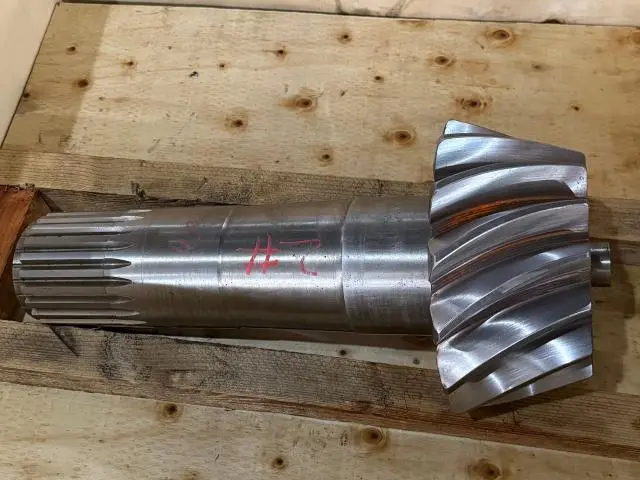
Transmission gear shafts are the most important part of a power transmission system. They are designed to send high torque and spinning motion from a power source, like an engine or motor, to machinery that is being moved by them through gears that fit together perfectly. This part is different from simple connecting rods because it has splines, keyways, or gear profiles machined directly onto the shaft body to make it easier to engage. The right shaft must be chosen based on the type of material used, the level of accuracy in manufacturing, the load capacity, and the needs of the specific application in fields such as mining, aerospace, and industrial machinery.
Understanding Transmission Gear Shafts
Definition and Core Functionality
A gearbox gear shaft is what holds the load and makes sure that mechanical systems that slow down and increase power work together. These shafts move rotating energy between parts that are driving and parts that are being driven. They also keep the alignment and structural integrity of the structure when dynamic loads are applied. They work together with input shafts, output shafts, and countershafts inside gearbox systems to make sure that power is delivered reliably. Their design takes into account rotational misalignment, twisting wear, and noise caused by vibrations at high speeds.
How well these parts work depends a lot on how well they can handle reverse loads without cracks spreading. For engineers who are making industry or mining tools, these pipes are important because they connect the power to the moving parts. Precision in the tooth profiles and shaft geometry has a direct effect on how well the system works and how long it lasts.
Types and Classifications
Gear shafts come in a number of different shapes and sizes to fit different types of transmissions. The prime mover sends power to the input shafts, which start the torque transfer. Output shafts send power that has been processed to the final drive mechanisms. Countershafts are the connecting parts that allow for multiple stages of speed change. Each type needs a different set of material qualities and ways to heat treat it.
Splined shafts are often used in mobile equipment of transmission gear shafts because they let the equipment move in one direction while still rotating. Keyed shafts keep the angle between the shaft and hub fixed, which is important for industrial applications that stay in one place. Knowing these differences helps people who work in buying choose the right part to repair or improve a system.
Critical Factors to Consider When Choosing a Transmission Gear Shaft
Material Selection and Metallurgical Properties
The choice of material has a big impact on how well a shaft works under operational stress. Case-hardening works best with low-carbon alloy steels like SAE 8620 and 20CrMnTi, which have a tough but bendable center and a hardened shell. Medium-carbon alloys like SAE 4340, 42CrMo, and AISI 4140 can go through through-hardening processes and still have the same amount of hardness and tensile strength across the whole cross-section.
To meet the needs of a wide range of industries, YIZHI MACHINERY uses high-quality products such as 45# steel, 40CrNiMo, 18CrNiMo7, and 20CrNi2Mo. The choice is based on the expected torque loads, the operating temperatures, and the need for resistance to fatigue. Materials that are very strong for their weight are needed in aerospace applications, while mining equipment needs materials that can handle impact and wear. On contact surfaces, the surface hardness is usually between 58 and 62 HRC, and the core hardness is kept between 30 and 45 HRC so that shock loads can be absorbed without breaking into small pieces.
Manufacturing Processes and Precision Standards
Forging is the first step in the manufacturing process. It aligns the grain flow with the load paths, which makes the material more resistant to fatigue. After that, the gear teeth and shaft features are shaped to basic measurements by cutting, hobbing, and grinding. Grinding processes get the final size and finish of the surface that is needed for bearing journals and gear sides.
The needed hardness gradient is made by heat treatment methods like carburizing, cooling and tempering, or induction hardening. When you carburize metal, you create a hard case that is compressed and stops cracks from starting. Through-hardening, on the other hand, gives shafts that have uniform properties under bending loads. To get the ISO 6 precision grade, you need to use advanced metrology and strict process control. Dimensional limits of IT6 to IT7 make sure that the bearing journals fit properly with other parts, and surface roughness values below Ra 0.4µm keep friction and wear to a minimum.
Design Specifications and Geometric Considerations
Load distribution and mesh properties are directly affected by the number of teeth, the size of the modules, and the angle of the helix. Modules from 0.5 to 50 can hold a wide range of devices, from small instruments to large industrial machinery. Between 5° and 45°, the helix angles balance the axial thrust forces with better contact ratios. Engineers can get exact speed ratios and torque multiplication factors when they can change the number of teeth.
Stress concentration and fatigue life of the Transmission Gear Shaft are affected by the shape of the shaft, which includes changes in diameter, fillet radii, and keyway dimensions. The right changes to the shape, like capping, can fix bending under load, which lowers edge stress and noise production. When choosing these design features, they need to be carefully looked at to make sure they work in real-world situations. Our engineering team at YIZHI MACHINERY can help you figure out how to make these parameters work best for your application.
Comparing Transmission Gear Shafts: Making an Informed Decision
Evaluating Supplier Capabilities and Certifications
A supplier's technical knowledge and quality assurance systems are very important when making decisions about what to buy. Manufacturing that follows ISO standards makes sure that all production batches have the same level of accuracy in measurements and material qualities. Suppliers who have CNC gear machining centers, automatic grinding systems, and clever heat treatment lines show that they have the technology to make high-precision parts.
YIZHI MACHINERY uses high-precision CNC gear machining centers and fully automated gear grinding machines, two of the best precision manufacturing tools in the world. Our smart heat treatment production lines keep exact temperature profiles that are needed to reach certain hardness slopes. We started in 2016 and have 15 years of experience between us in the field. Since then, we've formed long-term relationships with well-known mechanical engineering companies in the mining, aerospace, and industrial machinery sectors. Our reputation for working together shows that we are dedicated to providing dependable parts that meet strict operational needs.
Quality Control and Inspection Protocols
Critical applications don't have catastrophic gearbox failures because of strict quality control. Coordinate measuring tools (CMM) check the physical sizes and tolerances, especially the bearing seats' concentricity, runout, and straightness with respect to the gear axis. Magnetic particle inspection (MPI) finds tiny cracks on the surface that happen because of heat treatment, and ultrasound testing makes sure that raw forgings don't have any holes inside them.
Micro-hardness tests and metallographic analysis are used in metallurgical audits to check the effective case depth and residual austenite levels. In gear measurement centers, DIN/ISO standards are used to check the accuracy of the profile, the lead errors, and the pitch deviations. Nital etch testing finds grinding burns that can soften rigid surfaces in certain places. Transport damage rates are kept to less than 0.1% by these thorough inspection protocols. Our custom packaging, which includes shock-absorbing cushioning liners and protective wooden pallets, is proof of this.
Cost Analysis: OEM vs. Aftermarket Options
To find the best balance between price and performance, you need to know the differences between OEM (original equipment manufacturer) parts and aftermarket alternatives. OEM parts make sure that the dimensions and material requirements are the same as the original designs, so there are no risks when putting them together. Aftermarket choices might save you money, but you need to be very careful about licenses and being able to track down materials.
Buying in bulk from well-known suppliers saves money through economies of scale. YIZHI MACHINERY has low minimum order amounts and can even make a single item, which gives you options for testing or keeping a collection on hand. Our standard OEM customisation workflow includes talking about requirements, drawing up designs, manufacturing, checking for quality, packing, and shipping. This makes sure that orders are filled quickly and correctly within 35 to 60 days. This steady lead time helps just-in-time inventory plans work while keeping quality standards high.
Maintenance, Troubleshooting, and Installation Insights
Routine Inspection and Lubrication Practices
Preventive maintenance keeps things running smoothly and extends the life of equipment. Visual checks should be done on a regular basis to find surface discolouration, which means the part is too hot, pitting from contact fatigue, or scoring from lubricant that isn't clean. By taking regular readings of shaking levels, you can find imbalances or wear on bearings before they cause a catastrophic failure.
When you use the right lubricant, you keep an elastohydrodynamic film between two surfaces that are joining, which keeps metal from touching metal. The thickness of the lubricant needs to fit the temperature and load factors of the machine. Contaminated oil speeds up wear by moving abrasive particles around, which makes maintenance of the filtration system just as important. Setting up check times based on load cycles and working hours makes a strategic maintenance plan that cuts down on the need for emergency fixes.
Identifying Warning Signs and Common Failures
During operation, strange noises often mean that the mesh isn't lined up right or that the tooth surface is wearing down. When the gears whine at certain speeds, it means that the profile is wrong or there isn't enough crowning. Grinding sounds mean that the bearings are worn out or have failed. If the working temperature goes up, it means that the bearings aren't properly oiled or are being loaded too much beyond what was intended.
When two connected shafts are not lined up correctly, bending stresses are introduced that speed up the development of fatigue cracks. Both the shaft and the gear teeth are damaged by torsional vibration caused by uneven loading. If you notice these signs early, you can fix the problem before it gets worse. At YIZHI MACHINERY, our after-sales service includes quick response times and problem-solving backed by a one-year warranty. This helps customers take care of their concerns quickly.
Installation Best Practices
Accurate installation makes sure that the performance promised by the design works in real life. To make sure that the alignment of the shaft stays within certain limits, laser alignment tools are usually needed for important jobs. The right torque values on fasteners keep them from coming loose during use and keep stress concentrations from happening when they are over-tightened. Adjusting the bearing preload changes both how the load is distributed and how strong the system is.
Keeping things clean during assembly stops the introduction of contaminants that speed up wear. Protective coatings or preservation oils that were used during production need to be taken off and operational lubricants put in their place. Hiring skilled workers with the right tools can help you avoid making mistakes that cost a lot of money when the installation is too complicated or needs to be done with too much accuracy. During the procurement process, our technical team helps with installation and sends synchronised updates on the progress of production.
How to Purchase Transmission Gear Shafts: A B2B Buying Guide
Defining Operational Requirements
Successful procurement of the transmission gear shaft begins with accurately specifying performance parameters. Load capacity calculations must account for peak torque conditions, not merely nominal operating loads. Speed range definitions establish the basis for fatigue analysis and dynamic balancing requirements. Environmental factors, including temperature extremes, corrosive atmospheres, and contamination exposure, influence material selection and protective treatments.
Application context drives specification details. Machine tool spindles demand exceptional concentricity and surface finish for vibration-free operation. Robotic joints require compact designs with zero backlash for positioning accuracy. Mining equipment prioritizes impact resistance and field repairability. Aerospace applications necessitate weight optimization and extensive material traceability documentation. Clearly communicating these requirements to potential suppliers enables accurate quotations and reduces revision cycles.
Supplier Evaluation Criteria
Beyond basic manufacturing capability, evaluate suppliers on technical support depth and responsiveness. Pre-sales engineering assistance, including design drawing review and material recommendations, adds value beyond component supply. During production, transparency through progress updates and quality inspection documentation builds confidence in on-time delivery.
Logistics capabilities significantly impact the total cost of ownership. YIZHI MACHINERY integrates multiple transport channels—sea freight, air freight, and China-Europe freight trains—flexibly matching solutions to order volume and delivery urgency. Our end-to-end visual tracking provides real-time order status updates from factory loading through customer signature, enabling proactive exception management. These capabilities ensure precise and controllable transit times regardless of destination.
Customization vs. Standard Components
Standard catalog components offer shorter lead times and lower per-unit costs for common configurations. Customization becomes necessary when operational requirements exceed standard ratings or space constraints demand unique geometries. Custom gear shafts accommodate specific module sizes, non-standard tooth counts, or specialized heat treatment zones.
At YIZHI MACHINERY, our comprehensive customization capabilities span requirement communication through final transportation. We manufacture transmission gear shafts with modules from 0.5 to 50, helix angles between 5° and 45°, and fully customized tooth counts. Our production equipment handles forging, cutting, hobbing, milling, and grinding operations in-house, maintaining quality control throughout the manufacturing sequence. This vertical integration supports both prototype quantities and volume production without compromising precision standards.
Conclusion
Selecting the appropriate transmission gear shaft requires balancing material properties, manufacturing precision, and application-specific demands across industrial machinery, mining, and aerospace sectors. Understanding the distinctions between shaft types, evaluating supplier capabilities through certifications and quality protocols, and implementing proper maintenance practices collectively ensure reliable power transmission and extended service life. Strategic procurement partnerships with manufacturers offering comprehensive technical support, flexible customization, and transparent logistics create competitive advantages through reduced downtime and optimized total cost of ownership for critical mechanical systems.
FAQ
1. What prevents shaft failure under high torque conditions?
The combination of proper material selection and heat treatment creates the necessary strength. Carburizing or induction hardening produces a compressively stressed hard outer layer while maintaining a ductile core. This gradient prevents crack propagation by absorbing shock loads internally while resisting surface wear and pitting. Proper design, including adequate shaft diameter and stress-relieving fillet radii, further enhances fatigue resistance.
2. How do you minimize gear noise in transmission systems?
Noise reduction requires improving tooth profile accuracy to DIN Class 6 or better precision grades. Applying crowning to tooth flanks compensates for shaft deflection under load, maintaining optimal contact patterns. Surface finish on mating components below Ra 0.4µm reduces friction-generated vibration. Proper lubrication, viscosity, and alignment within specified tolerances complete the noise control strategy.
3. Can worn gear shafts be repaired, or must they be replaced?
Minor wear on bearing journals sometimes allows repair through chrome plating and subsequent regrinding to restore dimensions. When gear teeth show significant wear, pitting, or when fatigue cracks appear anywhere on the shaft, replacement becomes mandatory to maintain structural integrity and prevent catastrophic failure. The decision depends on the extent of wear and component criticality within the overall system.
Partner With a Trusted Transmission Gear Shaft Manufacturer
YIZHI MACHINERY specializes in customized gear production and precision mechanical component manufacturing backed by ISO-compliant quality systems and 15 years of industry expertise. Our transmission gear shafts feature high transmission rigidity with zero connection backlash, compact structures reducing installation footprint, and exceptional efficiency, minimizing power loss. We manufacture components from premium materials, including SAE 4340, 42CrMo, AISI 4140, and specialized alloys, processed through forging, precision grinding, and controlled heat treatment to achieve a surface hardness of 58–62 HRC.
As a reliable transmission gear shaft supplier serving industrial machinery, mining, and aerospace sectors globally, we deliver comprehensive solutions from design consultation through global logistics support. Our standardized workflow ensures 35–60 day delivery with real-time tracking and customized protective packaging. Whether you require prototype quantities or volume production, our technical team provides design drawings, sample provision, and one-year warranty coverage.
Contact us at sales@yizmachinery.com to discuss your specific requirements and discover how our precision components enhance your operational reliability.
References
1. American Gear Manufacturers Association. (2019). AGMA 2000-A88: Gear Classification and Inspection Handbook—Tolerances and Measuring Methods for Unassembled Spur and Helical Gears. Alexandria, VA: AGMA Publications.
2. Deutsches Institut für Normung. (2017). DIN 3962: Tolerances for Cylindrical Gear Teeth—Tolerances for Deviations of Individual Parameters. Berlin: Beuth Verlag.
3. International Organization for Standardization. (2020). ISO 6336: Calculation of Load Capacity of Spur and Helical Gears—Part 1-5. Geneva: ISO Standards.
4. Shigley, J. E., Mischke, C. R., & Budynas, R. G. (2021). Mechanical Engineering Design (11th ed.). New York: McGraw-Hill Education.
5. Society of Automotive Engineers. (2018). SAE J1123: Surface Texture for Gear Teeth. Warrendale, PA: SAE International.
6. Townsend, D. P. (2020). Dudley's Handbook of Practical Gear Design and Manufacture (3rd ed.). Boca Raton, FL: CRC Press.

USER EVALUATE
Here is the customer's evaluation of us