


What Is a Straight and Spiral Bevel Gear? Complete Guide
Straight and Spiral Bevel Gears are special mechanical parts that are designed to transfer power and spinning motion between shafts that cross each other at right angles. For low-cost options in moderate-speed situations, Straight Bevel Gears have teeth that are made straight along the gear cone. Spiral Bevel Gears have curved, angled teeth that connect more gradually, making the action smoother and less noisy and jerky. When angular power redirection is very important, these gears are a must-have for industrial tools, mining operations, and aircraft systems. By knowing what makes them different, engineers and procurement workers can choose the best transmission options for tough operational conditions.
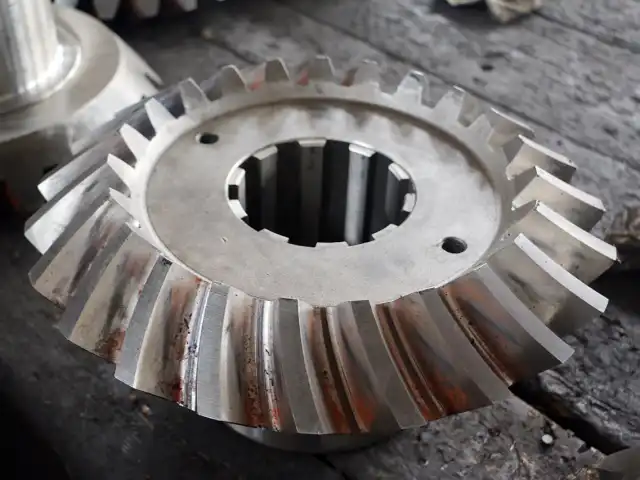
Understanding Bevel Gears: Basics and Design Principles
Bevel Gears are very important in mechanical power transfer because they move force between shafts that cross at different angles. Spur or Helical Gears connect shafts that are straight to each other. Bevel Gears, on the other hand, work in spaces where the direction of the shafts changes. Because of this, they are necessary in many situations, from car differentials to chopper rotor systems.
How Bevel Gears Transmit Power
Because Bevel Gears are shaped like cones, the teeth can connect along directions that cross. When the driving gear turns, its teeth mesh with the teeth of the driven gear. This changes the rotating motion into angular movement. This mechanical contact spreads the load across several teeth at the same time, transferring torque while changing the flow direction. The pitch cone angle sets the speed ratio between the input and output shafts, which lets the designer use a variety of mechanical setups.
Fundamental Design Elements
The performance of a Bevel Gear is affected by a number of important design factors. The shape of the tooth profile affects how the loads are distributed and how the contacts form during operation. The module sets the tooth size in relation to the pitch diameter, which affects the accuracy and power. How force moves between teeth that mesh is determined by pressure angles, which are usually 14.5° or 20°. When figuring out the gear ratio, you have to think about how many teeth are on each gear to get the required speed increase or decrease. Engineers have to find a balance between these factors and practical needs such as power capacity, rotational speed, and room limitations.
Material Selection for Durability
The choice of material has a big effect on how long Straight and Spiral Bevel Gears last and how well they work under stress. High-quality alloy steels like 20CrMnTi, 40CrNiMo, SAE4340, and AISI8620 are very strong for their weight and don't wear down easily. These materials can handle repeated loads without breaking too soon. Through heat treatments like carburizing and quenching, the surface of Straight and Spiral Bevel Gears can reach hardness levels of 58 to 62 HRC while the core stays tough. This is necessary for shock loads in mine breakers or aircraft transmissions. Straight and Spiral Bevel Gears can withstand tough conditions in a wide range of industrial settings if the right materials are used.
Straight Bevel Gears vs Spiral Bevel Gears: Key Differences and Performance Comparison
Knowing the differences in structure and function between Straight and Spiral Bevel Gears helps buying teams match the right gear type for the job.
Structural Characteristics
Straight Bevel Gears have teeth that are cut straight to the gear shaft and get thinner toward the cone's tip. Because of its simple form, this shape is easy to make using shaping or cutting techniques. Spiral Bevel Gears are like Helical Gears, but they are made for circular surfaces and have bent teeth set at an angle across the face of the gear. This form of curved teeth comes from complicated face milling methods that use special Gleason or Klingelnberg equipment.
Operational Performance Factors
The way these different types of gears engage is very different. When teeth on a Straight Bevel Gear suddenly touch, they cause impact loading and force transfer that happens on and off. This makes more noise and shaking, especially when the speed is high. Contact ratios stay below 1.4 most of the time, which means that fewer teeth share the load at the same time. Because they are bent, Spiral Bevel Gears allow contact ratios higher than 2.0. This is because the teeth connect gradually. At any given time, more than one tooth carries the load. This spreads the stress more evenly and makes the process easier and quieter. Noise, Vibration, and Harshness (NVH) are greatly reduced by this constant contact, which is a very important benefit in precision machinery.
Load Capacity and Efficiency
When it comes to the same size, spiral patterns can handle more force than straight designs. The tooth contact at an angle makes the tooth face slide, which needs better greasing but lets more load be transferred. Straight Bevel Gears produce little axial pressure, which makes it easier to set up bearings and build housings. This does, however, come at the cost of less power and slower speeds. In perfect conditions, Spiral Bevel Gears can transmit power at a rate of 95% to 98%, while straight gears usually only manage 90 to 95% because of impact losses.
Cost Considerations
The price is directly affected by how hard it is to make something. Straight Bevel Gears are cheaper because they are easier to make and take less time to machine. To get the right tooth surface quality on Spiral Bevel Gears, you need precise tools and extra finishing steps like polishing or grinding. As a result, production takes longer; for special orders, the average wait time is 35 to 60 days. Even though they cost more at first, spiral gears usually end up being cheaper in the long run because they last longer and need less upkeep in high-performance settings.
Choosing the Right Bevel Gear for Your Application
To choose between Straight and Spiral Bevel Gears, you need to carefully look at working factors and business needs.
Application-Specific Requirements
Speed is one of the main criteria used for choosing. Straight and Spiral Bevel Gears work well in situations where the pitch line velocity is less than 1,000 feet per minute. For example, they can be used in manual gate openers or low-speed conveyors. Spiral Bevel Gears work great in places with speeds over 10,000 feet per minute, like spindle drives for machine tools and propulsion systems in spacecraft. Choice is also affected by the type of load. For example, spiral designs work best with heavy loads that happen over and over, while shock loads or irregular loads that stay within reasonable limits can make straight gears work well.
Noise Sensitivity Matters
Spiral Bevel Gears are very useful in places that need to be quiet, like airplane cabins, accurate measurement equipment, and factories that are closed off. Compared to straight designs, the smooth engagement cuts noise pollution by a huge amount. Noise levels may be higher in mining activities or when farming equipment is used outside. In these cases, cost-effective Straight Bevel Gears can be used for secondary drives.
Procurement and Customization
Making custom gears meets specific application needs that normal catalog items can't meet. Customized tooth numbers, module ranges from 0.5 to 50, and certain material grades make it possible to match performance perfectly. When looking at different providers, make sure they can do fine grinding, know how to do heat treatment, and meet ISO 8-9 grade quality standards. Well-known makers offer expert advice during the design process, turning practical needs into exact gear specs. Single-item production lets you work on prototypes and make changes to specialized tools without having to meet a minimum order quantity.
Manufacturing Process and Quality Assurance of Bevel Gears
To make sure that the Bevel Gears are reliable, they need to be made using complex techniques and strict quality controls.
Raw Material Preparation
The first step in making something is choosing the right type of alloy steel. For general use, 45# steel is fine, but for heavy loads, 18CrNiMo7 and 17CrNiMo6 are better. Before going into production, raw materials are tested for their chemical makeup and mechanical properties. The forging process smooths out the grain structure, which increases the wear strength. During rough turning, the outer diameters, bore sizes, and end face shapes are set to within the initial limits.
Precision Tooth Cutting
The most important part of production is making correct tooth profiles. Continuous indexing is how hobbing machines make teeth on Spiral Bevel Gears, and special grinding equipment is used to make Straight Bevel Gear teeth. Gleason-type cutting tools make sure that the teeth are the right shape according to the plan. CNC gear cutting centers can change many teeth at once to make the best contact patterns when the gear is loaded. Feed rates, depth of cut, and tool shape are all factors that affect the end quality of the teeth, so they need to be carefully controlled.
Heat Treatment Excellence
After the first round of grinding, gears are heated to get the hardness patterns that are wanted. By spreading carbon into the top layers, carburizing makes a shell that doesn't break down and keeps the core flexible. After quenching, the parts are quickly cooled to lock in their hardness, and then they are tempered to ease internal stresses. For certain uses, induction hardening can treat only a small area of the surface. When heat treatment is done right, the surface hardness is between 58 and 62 HRC, and the case levels are set to match the expected pressure conditions. Temperature control and management of the cooling rate stop warping that would make teeth less accurate.
Finishing and Quality Verification
Precision grinding smooths out the sides of teeth of Straight and Spiral Bevel Gears to the final limits for size, getting rid of any warping from heat treatment and achieving ISO 8–9 grade accuracy. When you hone or lap Straight and Spiral Bevel Gears, you make sure that the teeth touch properly and that the surface is finished well. Coordinate measuring machine (CMM) checks of tooth shape, surface roughness measurements, and hardness tests at different depths are all part of thorough inspection routines. Gear testers look at how the teeth of Straight and Spiral Bevel Gears touch each other when loads are generated. Before packing, noise testing makes sure that the sound quality is good enough.
Maximizing Bevel Gear Performance and Maintenance Tips
Proper upkeep methods increase the life of Bevel Gears and keep them from breaking down, which can be very expensive.
Lubrication Strategies
Proper greasing is the key to making gears last a long time. Extreme Pressure (EP) lubricants of the highest quality are needed for Spiral Bevel Gears so that metal doesn't touch metal during the moving action that comes with curved tooth interaction. The choice of viscosity relies on the speed and temperature of the operation. Lighter oils work better at high speeds and slow speeds with high loads, while oils with higher viscosities work better at high speeds with low loads. In harsh settings, synthetic lubricants are better at staying stable at high temperatures and resisting rust. Oil research tools find wear particles early, so they can be fixed before they cause a major problem.
Alignment and Installation Best Practices
Accurate positioning during installation stops noise and wear problems before they happen. The quality of the gear mesh is directly affected by how flat and straight the mounting area is. Depending on the module and the working temperature, backlash sets are usually between 0.003 and 0.010 inches. This gives enough room for a lubricant film to form and for the module to expand when it heats up. Lack of backlash leads to binding and fast overheating. In circular shapes, the bearing preload needs to balance the axial thrust loads without making too much friction. Verification of the dial gauge during building makes sure that it is in the right place.
Monitoring and Troubleshooting
Vibration analysis finds problems before they get bad enough to be seen. Strange noise patterns can be a sign of imbalance, poor lubricant, or tooth surface wear. Visual checks of the tooth sides on a regular basis look for pitting, scoring, or cracks. Pitting usually happens when the surface gets worn down from multiple loading cycles, while scuffing means that the grease has broken down. Temperature tracking finds spikes that could mean a bearing is failing or there isn't enough oil. Maintenance intervals that are based on working hours or load cycles allow for planned replacement, which keeps production settings from having to deal with unexpected downtime.
Conclusion
In conclusion, Straight and Spiral Bevel Gears are important for moving rotational power in many different types of industries. For moderate-speed tasks with light axial loads, Straight Bevel Gears work well and don't cost much. But for higher speeds, Spiral Bevel Gears can handle more weight, make less noise, and run more smoothly. The reliability of gears in tough situations depends on how well the materials are chosen, how precisely they are manufactured, and how well they are checked for quality. To choose the right gear, you need to think about both practical factors like speed, load characteristics, and noise tolerance, as well as purchase factors like lead time and the ability to customize. The engineering and procurement teams make smart decisions and work together with experienced makers to find the best transmission solutions that improve the performance of tools and the efficiency of operations.
FAQ
1. Can straight bevel gears be replaced with spiral bevel gears to reduce noise?
Even though noise reduction is a gain, direct replacement is not possible. Spiral Bevel Gears create large axial thrust loads that don't happen in straight designs. To make sure that these axial forces don't cause premature bearing failure and that the system works safely, technical changes need to be made to the housing structures and bearing assemblies.
2. What causes most spiral bevel gear failures?
The most common type of failure is surface wear, which shows up as pitting or scuffing. Wear from metal-on-metal contact is sped up by not enough grease or a mismatch. When something slides along curved teeth, it needs to be installed correctly and with high-quality Extreme Pressure lubrication so that it doesn't break down too quickly under operating loads.
3. How do manufacturing processes differ between gear types?
Straight Bevel production uses Gleason or Coniflex tools for shaping or planing, which makes production faster and cheaper. To make Spiral Bevel Gears, you have to do difficult face cutting or hobbing first, then lapping or grinding. This adds to the time and cost of production but results in better precision and performance.
Partner with YIZHI MACHINERY for Premium Bevel Gear Solutions
YIZHI MACHINERY has been making machine parts for 15 years and can offer specialized transmission parts. We make our Straight and Spiral Bevel Gears for sale from high-quality alloy steels like 20CrMnTi, SAE4340, and AISI8620 by carefully cutting, hobbing, and grinding them into modules that range from 0.5 to 50. We get surface hardness levels between 45 and 50 HRC and 58 and 62 HRC, which is accurate to an ISO 8-9 grade and meets the strict requirements for industrial tools, mining equipment, and aerospace uses.
As a Bevel Gear maker with a lot of experience, we offer full customization services with low minimum order numbers. Single-item production lets us make prototypes and do specialized retrofits. Production times of 35 to 60 days include strict quality checks and special packing that makes sure the goods arrive undamaged. Our global transportation know-how combines choices for shipping goods by sea, air, and rail, with real-time tracking to keep damage rates in transit below 0.1%. Contact us at sales@yizmachinery.com about your transmission needs and get full quotes for precision-engineered Bevel Gear options.
References
1. Dudley, Darle W. Handbook of Practical Gear Design and Manufacture. CRC Press, 2012.
2. American Gear Manufacturers Association. AGMA 2005-D03: Design Manual for Bevel Gears. Alexandria: AGMA, 2003.
3. Stadtfeld, Hermann J. Gleason Bevel Gear Technology: Manufacturing, Inspection and Optimization. Rochester: Gleason Works, 2014.
4. International Organization for Standardization. ISO 23509:2016 Bevel and Hypoid Gear Geometry. Geneva: ISO, 2016.
5. Litvin, Faydor L., and Alfonso Fuentes. Gear Geometry and Applied Theory. Cambridge University Press, 2004.
6. Klingelnberg GmbH. Bevel Gear Technology: Design, Manufacturing and Inspection. Hückeswagen: Klingelnberg Technical Publications, 2016.

USER EVALUATE
Here is the customer's evaluation of us