


What Are Gleason Spiral Bevel Gears and How Do They Work?
Gleason Spiral Bevel Gears are the best way to transmit power between crossing axes. These precision-engineered parts have curved teeth placed at an angle, and they were made using special Gleason methods, such as Face Milling and Face Hobbing. In contrast to straight bevel gears, spiral tooth geometry provides gradual engagement, starting at one tooth end and moving easily to the other, making sure that there is constant contact. This design cuts down on noise and shaking by up to 30% while still being able to handle high power loads well. These gears solve important practical problems that regular bevel gears can't handle in the mining, aircraft, and industrial machinery sectors.
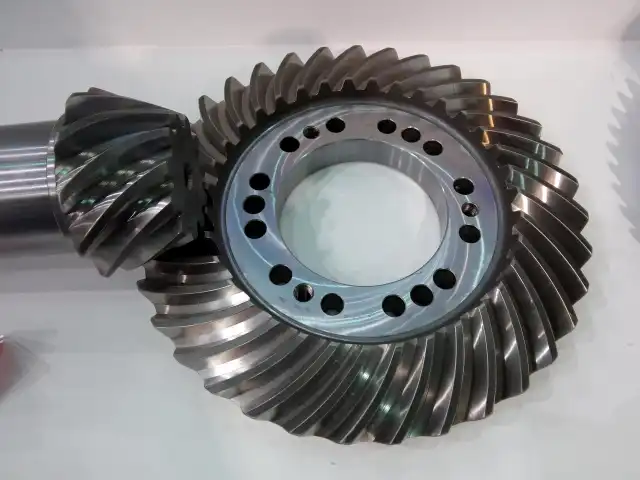
Knowing a lot about these parts can change how you choose a drivetrain, especially when you're looking for answers for tough uses that need right-angle power transfer. We've spent years making these systems better, and I can't wait to share the information that engineers and buying experts need to make smart choices.
Understanding Gleason Spiral Bevel Gears
The Core Design Principle
Gleason Spiral Bevel Gears are a special type of bevel gear that can be told apart from other types by their bent, pointed teeth. Straight bevel gears have teeth that line up with the gear axis in a straight line. Spiral bevel gears, on the other hand, have teeth that curve across the face of the gear. Because of this basic difference, the contact ratio is usually higher than 1.25, which means that the Hertzian contact stress is spread over a larger surface area. Instead of the sudden touch that happens with straight bevel setups, this design lets the teeth connect gradually.
The spiral angle is usually around 35 degrees, which is the best range for managing power loads and maximising transmission efficiency. This shape lets several teeth share the load at the same time, which greatly improves load distribution and lowers stress levels that cause early failure.
How They Work: Motion and Torque Transmission
The way it works is based on the bent tooth path crossing with matching gear teeth at points that change over time. As the driving gear turns, its spiral teeth slowly meet the driven gear teeth, starting to touch at the toe (the inner end) and moving easily toward the heel (the outer end). When you compare this to straight bevel gears, this moving motion makes less impact shock.
When the spiral angle is present, axial thrust forces must be controlled by choosing the right bearings and designing the frame correctly. However, this trade-off makes them much quieter to run—decibel levels drop by a lot at speeds above 1000 RPM—which makes them perfect for situations where controlling noise, vibration, and harshness (NVH) is very important.
Gleason's Proprietary Innovations
Patented casting and cutting methods in the Gleason manufacturing system changed the way spiral bevel gears were made. Face Milling uses spinning cutter heads with carefully placed blades that make the tooth surfaces at the same time, making sure that the shape stays the same. Face Hobbing uses constant referencing while cutting, which makes surfaces that are very smooth and have very little variation.
These ways of making things let you make "crowned" tooth surfaces, which are slightly curved along the length of the tooth. Crowning lowers the chance of edge loading from a deflected shaft or an assembly that isn't lined up correctly, so small changes in position don't have to cause catastrophic failure. This ability to be flexible is very useful in real-life setups where keeping everything perfectly aligned is hard to do.
Key Advantages and Applications of Gleason Spiral Bevel Gears
Primary Performance Benefits
When it comes to operations, Gleason Spiral Bevel Gears are better in many ways because of their technical benefits. Let me go over the main benefits that buying professionals look at when they are choosing engine parts.
One of the most obvious benefits is that there is less noise and shaking. The gradual contact of the teeth gets rid of the impact shock that comes with straight bevel designs. This makes the operation smoother and saves nearby parts from wearing out from vibrations. This feature makes all the parts in the drivetrain system last longer, which is useful for everything from aircraft gearboxes to mining tools.
The higher contact ratio and better load spread lead to a higher load capacity. When compared to straight bevel gears, these can send more power within the same envelope size thanks to their spiral tooth shape. This edge in strength-to-weight makes it possible to make gearboxes smaller or boost power density, which are important factors in aerospace applications that need to be light or industrial machinery that needs to take up little room.
When case-hardened areas (usually 58–62 HRC) are paired with a tough core material, the durability goes up. This two-hardness structure keeps the surface from wearing down while still being flexible enough to handle shock loads. The result is a longer service life, even in tough situations where temperature changes, pollution, or changing loading patterns happen.
Critical Application Sectors
Transmissions in aerospace and helicopters need to be very precise and reliable. The main and tail rotor gears work at very high speeds—often more than 10,000 RPM—where transmission error must be kept to a minimum to avoid vibrations that weaken the structure of the plane. These gears' profile-ground sides make sure they are very precise, which is needed in places with zero failure tolerance.
Gears in heavy-duty mining tools are subject to huge shock loads and rough pollution. Some of the worst working conditions you can imagine are found in cone crushers and pulverisers, where quick impact forces and particle ingress risk the integrity of the gear. The case-hardened surfaces don't wear down easily, and the spiral shape keeps the drive going even when the shafts bend from crushing forces.
Marine power systems, like Z-drives and boat motors, need gears that work well even when there isn't a lot of oil available. Pitting, rust, and heat buildup inside sealed housings are two problems that only happen in submerged situations. The better surface finish and tight feedback control keep heat and friction to a minimum.
It is used in turning systems, machine tool spindle drives, and small mechanical motion systems, among other things. Agricultural equipment depends on these parts to reliably send power during variable-duty-cycle activities. The small size and variety of installation choices make light manufacturing tools more useful.
Material, Manufacturing Process, and Maintenance Insights
Premium Materials and Heat Treatment
At YIZHI MACHINERY, we produce Gleason Spiral Bevel Gears using only high-grade steels that have been chosen for their ability to resist wear and strengthen. We can use 45# steel, 20CrMnTi, 40CrNiMo, SAE4340, 42CrMo, AISI4140, 18CrNiMo7, 17CrNiMo6, 20CrNiMo, AISI8620, 20CrNi2Mo, and SAE4320 as materials. Each material has its own unique properties that make it best for a certain set of circumstances.
Steels that harden over time, such as AISI 8620 and 18CrNiMo7-6, have tough, shock-absorbing cores and hard, wear-resistant surfaces. Carbon is spread out into the top layer during the carburising process. This lets the metal strengthen to 58–62 HRC while keeping its core toughness. The core properties are improved by quenching and heating, and the surface properties can be targeted for specific uses with induction hardening.
Manufacturing Excellence and Quality Standards
Our production process is organised in a way that makes sure the quality is always the same. Setting the starting shape is done by sawing or forging the blank. Rough turning makes the outside diameter, end sides, and hole diameter almost the same size. The tooth profile is made to exact specs during the gear cutting step, which can use hobbing, milling, or other specialised gear cutting tools.
Heat treatment transforms the metallurgical structure, creating the desired hardness gradient. The tooth surfaces are finished by grinding them down to AGMA Q9–Q13 precision classes, which meet ISO 17485 and AGMA 2005–D03 standards for accuracy. Our ISO 8–9 Grade accuracy is maintained across all of our products, thanks to the world's best precision production and inspection equipment.
The production cycle is finished with rustproofing, deburring, and dimensional checking using a Coordinate Measuring Machine (CMM). As part of our quality control procedures, we use blueing tests to look for Tooth Contact Analysis. These tests make sure that contact patterns stay in the middle over 50 to 60 per cent of the length of the tooth. Barkhausen Noise Analysis finds grinding burn, and Magnetic Particle Inspection finds cracks below the surface after heat treatment.
Maintenance Protocols for Extended Service Life
With regular repair, gears last longer and don't break down when they're least expected. Lubrication is the most important thing. Using the right viscosity grade and keeping the oil amounts right will stop wear from speeding up. We suggest synthetic gear oils that meet or go beyond the requirements of AGMA 9005-E02 for most uses.
Visual checks for odd wear patterns, tooth damage, or oil contamination should be part of regular checking procedures. Spectral analysis used for vibration tracking can find problems that are starting to happen before they become too big to fix. Temperature tracking finds problems with lubrication or balance that are causing too much friction.
Some common wear problems are pitting (surface damage caused by fatigue), scoring (adhesive wear from not enough lubricant), and spalling (subsurface fatigue). If you fix these problems quickly, like by lubricating better, realigning the wheels, or lowering the load, you can stop failures that affect the whole motor system.
Gleason Spiral Bevel Gears in Comparison to Other Gear Solutions
Performance Differentiation from Alternative Designs
There are big changes in how well Gleason Spiral Bevel Gears and straight bevel gears work when you compare them. Straight bevel gears are very simple and cheap to make, but they make a lot of noise and sound when they're moving fast. Because the teeth engage quickly, they create impact loading that means they can only be used at speeds below 1000 RPM and in mild load situations.
When compared to straight bevels, hypoid gears can handle more weight and make less noise because the pinion axis is removed from the gear axis. Hypoid meshing, on the other hand, loses more heat and friction because it slides more than spiral bevel gears. The efficiency penalty is between 2% and 4%, which is a big deal in high-power situations where energy costs add up over time.
Zero bevel gears are in the middle. They have bent teeth at a zero spiral angle. In addition to reducing noise, they also put very little vertical thrust on the system. However, they can't handle as much weight or noise as well as real spiral bevel designs.
Procurement Through Authorised Channels
Getting real Gleason Spiral Bevel Gears from approved manufacturers makes sure that strict quality standards are met. When used in critical situations, fake or low-quality gears can be very dangerous and even cause system crashes that are very expensive and dangerous.
Credentials of the manufacturer are very important. Look for providers who have detailed quality management systems, especially those that are ISO 9001 certified, and who can show they know how to make precision gears. Warranty protections keep your long-term investment safe. Reliable sellers back their goods with full warranties that cover both material flaws and mistakes in production.
At YIZHI MACHINERY, we've made long-term relationships with many well-known mechanical engineering companies by consistently delivering high-quality goods that meet their exact needs. Because we've been in business for 15 years, we know a lot about how things work and can solve problems.
Procurement Guide for Gleason Spiral Bevel Gears
Ordering Methods and Supply Chain Planning
Flexible Gleason Spiral Bevel Gears procurement satisfies several business demands. Bulk purchases save money via economies of scale. Basic designs utilised in numerous devices are significantly affected. OEM connections enable you to collaborate on the finest gear solutions for your ideas. Custom manufacture addresses application demands that regular items can't.
Complex orders and plant busyness determine lead time. Custom designs that need new tools may delay delivery, whereas regular setups may be manufactured using existing equipment. We make single items and huge quantities without a minimum order quantity. We know that prototyping and getting extra parts require small quantities.
The delivery logistics include freight trains between China and Europe, marine freight, and air freight. We match shipping choices to order size and significance so you know when it will arrive. Custom timber pallets with shock-absorbing cushioning liners reduce transportation damage to less than 0.1%. You can track your orders from plant loading to delivery in real time.
Cost Factors and Investment Optimisation
Pricing goes beyond unit cost. Material selection greatly affects pricing. Premium alloys like SAE4340 cost more than carbon steels but perform better. Customisation increases engineering and labour expenses, although they are distributed over more items.
The number of units acquired influences price per unit via setup cost dispersion. Surface hardness affects heat treatment costs (45–50 HRC vs. 58–62 HRC). The module range (0.5 to 50), pressure angle (14.5° or 20°), and customised teeth count determine the pricing.
Real economic worth is discovered by considering the complete cost of ownership, not simply the purchase price. Longer lifespans provide longer replacement intervals, reducing downtime costs. Increasing efficiency reduces energy usage over time. Improving dependability prevents costly breakdowns and lost output.
Supplier Support and Service Infrastructure
Professional sellers provide comprehensive after-sales support, unlike commodity merchants. Technical guidance before the sale lets you pick the right gear for your needs. Design drawing services clarify performance requirements. We provide coordinated project status and quality check reports throughout production.
Our one-year warranty covers material and manufacturing defects with fast response. Technical guidance encompasses installation, problem-solving, and performance improvements. Samples allow proof testing before mass production.
Common OEM customisation steps include conveying demands, generating design drawings, processing orders, evaluating quality, packing, and shipping. This expedites order fulfilment. This organised strategy reduces misunderstanding and guarantees consistency.
Conclusion
In conclusion, when it comes to right-angle power transfer uses that need precision, dependability, and durability, Gleason Spiral Bevel Gears are the best. Their spiral tooth shape makes slow impact, which lowers noise and vibration while spreading loads evenly over bigger contact areas. High-quality materials, modern manufacturing methods, and strict quality control work together to make parts that can handle the tough requirements of the aircraft, mining, and industrial machinery industries. Knowing the technical design, material requirements, and operating features lets you make smart purchasing choices that improve both short-term performance and overall cost of ownership over time. When you work with experienced makers, you get access to the knowledge, customisation options, and support systems you need for a successful application.
FAQ
1. What distinguishes spiral bevel gears from standard straight bevel gears?
The main difference between Gleason Spiral Bevel Gears and straight bevel gears is in the shape of the teeth and how they interact with each other. Spiral bevel gears have curved teeth that are placed at an angle. This makes slow contact between the teeth, which spreads the load across several teeth at the same time. Straight bevel gears have teeth that are aligned radially and connect quickly, creating impact shock. The spiral design cuts down on noise by as much as 30% and boosts load capacity by making contact ratios higher than 1.25, compared to the normal straight bevel ratios below 1.0.
2. What maintenance protocols extend gear lifespan most effectively?
The most important thing is to use the right oil. Use synthetic motor oils that meet the requirements of AGMA 9005-E02 at the right viscosity levels for the temperature ranges you will be using them in. Visually check the teeth regularly for damage, cracking, or wear patterns that don't seem normal. Use sound tracking to find problems early on as they arise. Keep things in the right place and within the manufacturer's limits to stop edge loading, which speeds up wear.
3. What are typical lead times for custom orders?
Standard custom setups usually take 35 to 60 days from the time the order is confirmed until it is delivered. Complex designs that need new tools may cause production to take longer, while orders that use current tools speed up the process. We give you synchronised updates on the progress of the manufacturing process, which lets you plan your installation times accurately.
Partner with YIZHI MACHINERY for Superior Spiral Bevel Gear Solutions
YIZHI MACHINERY makes Gleason Spiral Bevel Gears to strict Gleason standards using advanced engineering. Our ISO-compliant quality systems and 15 years of specialised knowledge make sure that we always send parts that meet your strictest requirements. When it comes to your specific application needs, we can customise everything, from the choice of material to the best way to use heat treatment. Our flexible minimum order amounts can be used for projects of any size, from making a few samples to mass production. Contact us at sales@yizmachinery.com to talk about your needs with a reputable manufacturer that is dedicated to technical quality and on-time delivery around the world.
References
1. American Gear Manufacturers Association. (2019). AGMA 2005-D03: Design Manual for Bevel Gears. Alexandria, VA: AGMA Publications.
2. Stadtfeld, H.J. (2014). Gleason Bevel Gear Technology: Manufacturing, Inspection and Optimization. Rochester, NY: The Gleason Works Technical Library.
3. Dudley, D.W. (1994). Handbook of Practical Gear Design and Manufacture. Lancaster, PA: Technomic Publishing Company.
4. International Organization for Standardization. (2012). ISO 17485: Bevel Gears — ISO System of Accuracy. Geneva: ISO Standards Press.
5. Litvin, F.L. & Fuentes, A. (2004). Gear Geometry and Applied Theory (2nd ed.). Cambridge: Cambridge University Press.
6. Klingelnberg GmbH. (2016). Bevel Gear Technology: Principles and Applications in Modern Manufacturing. Hückeswagen, Germany: Klingelnberg Technical Publications.

USER EVALUATE
Here is the customer's evaluation of us