


What Are The Advantages Of Choosing Large Worm Gears?
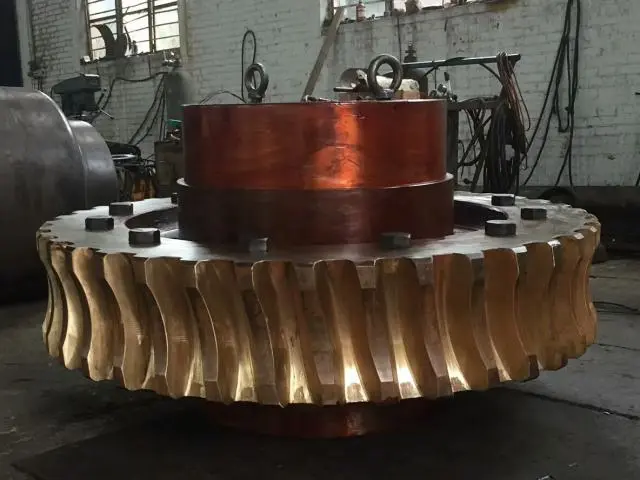
When it comes to heavy-duty industrial machinery, using Large Worm Gear systems has a lot of benefits that directly meet current operating difficulties. These strong parts transmit high power very well in small packages. This makes them perfect for mining equipment, aircraft actuation systems, and industrial gear that needs to be compact and handle a lot of weight. The built-in self-locking feature stops back-driving when the power goes out, which makes lifting tools and lift traction machines safer. Large Worm Gear sets are reliable and cost-effective solutions for challenging uses in a wide range of global industries. They can run smoothly and quietly, and their designs can be changed thanks to ISO 8-9 grade precision manufacturing.
Introduction
Heavy industrial tasks need gearbox parts that are precisely designed to be able to handle huge amounts while still being reliable. Large Worm Gear systems are becoming more and more important in industries like mining, aircraft, and making industrial machinery, where broken equipment directly leads to lost production and safety risks. At YIZHI MACHINERY, we've seen more and more procurement teams looking for gearbox solutions that can handle a lot of torque while still taking up little space.
This blog post looks at why worm gear technology is still the best for some industrial uses, even though helical, bevel, and planetary gears are also available. This article will talk about the basic design principles that make these parts perfect for heavy-duty settings. It will also compare their performance to other options and give engineering teams that are looking at gearbox options useful buying advice. Knowing the strategic benefits of worm gear technology helps you make smarter, more cost-effective equipment purchases, whether you're looking for parts for material processing equipment or military actuation systems.
Understanding Large Worm Gears: Design and Functionality
Operating Principles and Motion Transfer
Worm gear systems have a threaded worm shaft that fits into a cylinder-shaped gear wheel. The two parts are usually angled 90 degrees away from each other. The worm's helical threads slide against the gear teeth instead of rolling against them, changing the motion from rolling to sliding, which greatly slows down the speed and increases the torque. When compared to multi-stage spur or helical gear trains, this slide contact makes it possible for very small setups with very high reduction ratios (from 5:1 to 100:1).
The reduction ratio is found by dividing the number of teeth on the worm wheel by the number of worm threads. Single-start worms have the best ratios but are less efficient. Multi-start versions, on the other hand, are more efficient at lower reduction values. This adaptability lets engineers get the best gearbox performance for each application, ranging from machine tool indexing systems to mine mill auxiliary drives.
Critical Design Elements
Tooth profile shape has a big effect on how loads are distributed and how well the machine works. Modern designs for Large Worm Gear use involute or modified trapezoidal profiles that work best with heavy loads. Different size needs can be met by modules ranging from M1 to M50. For example, in industrial machinery uses, bigger modules can handle more power gearbox. Precision manufacturing to ISO 8-9 grade standards makes sure that the teeth contact in the right way, which is important for maximising load capacity and reducing early wear.
Material Selection for Industrial Durability
The performance and durability are directly affected by the materials that are used for the worm and the wheel. Case-hardened alloy steels like 20CrMnTi, AISI 8620, or 42CrMo are often used for the worm shaft. These steels are hardened to a surface hardness of 58 to 62 HRC using methods like carburising or induction hardening. These ways of treating metal with heat make the surfaces resistant to wear while keeping the cores flexible enough to handle the shock loads that come from mining and moving tools.
The joint worm wheel is usually made of brass alloys or materials that are cast centrifugally and have great sliding properties against hardened steel worms. This mix of materials lowers the coefficients of friction and makes them more resistant to galling and seizure when there is boundary lubrication. In bigger sets, cast iron or manufactured steel hubs hold up the bronze rim, matching the cost of the materials with the needs of the structure.
Key Advantages of Large Worm Gears for Industrial Applications
Exceptional Load Capacity and Torque Multiplication
When worm threads and gear teeth slide against each other, loads are spread across many teeth at once. This makes it possible for higher shock load absorption than with point-contact gear types. This feature is very useful in mining, where sudden changes in load happen while materials are being processed. Large Worm Gears made of materials like SAE4340 or 40CrNiMo and processed through hobbing, milling, and precision grinding are frequently used in machinery like rotating kilns and heavy winch systems to transmit continuous high power.
Because torque multiplication works, small designs that would need many reduction steps with different types of gears are possible. A single worm gear set can do the work of a three-stage spiral gearbox, making the system simpler and lowering the number of places it could fail. This makes things easier, which directly leads to less upkeep needs and higher system reliability throughout the whole operating lifecycle.
Space-Efficient Compact Design
Manufacturers of equipment are always under pressure to make their products as useful as possible within limited limits. Compared to straight gear arrangements, worm gear arrangements allow for very small machine plans because the shafts are set up perpendicular to each other. This use of space effectively is especially useful in aircraft, where weight and volume directly affect performance factors, and in industrial machinery, where equipment footprint affects the cost of layout.
Modern automatic production line reducers and elevator traction machines take advantage of this advantage by being small by putting strong transmissions into housings that don't have a lot of room. The reduction ratio that can be reached in a single stage gets rid of the length and weight problems that come with multi-stage options. Compared to planetary or spiral systems of the same capacity, installation sizes are often 30–40% smaller.
Self-Locking Safety Feature
One of the best things about this product is that it automatically locks itself when the angle of the leads stays below a certain level, usually less than 5 degrees. This mechanical feature stops the driven side from turning in the opposite direction, so it can hold in place without the need for extra stopping systems. Lifting equipment makers really like this feature because it keeps the load in place even when the power goes out without the need for extra electromechanical stop parts.
This passive holding feature is helpful for safety-critical applications like machine tool indexing systems because it eliminates worries about setting drifting while the machine is under load. It is better for engineers to use multiple safety systems instead of just self-locking, but this feature itself adds an important layer of safety at no extra cost or complexity.
Smooth Operation with Reduced Noise
Even though the slide contact system makes more heat than rolling-contact gears, it transfers motion more smoothly and with less vibration. This improvement to the way things work is very important in precise industrial machinery where vibrations can hurt the quality of the product or the control of the process. This smooth working property is useful for a wide range of applications, from making semiconductors to making medical devices.
Getting rid of noise is another useful feature in places where environmental factors affect the choice of equipment. When properly oiled, worm gear assemblies work at 10-15 dB lower noise levels than similar spur or helical gear systems when the loads are the same. This makes the workplace better while lowering the need for acoustic enclosures. This benefit makes it easier to follow health and safety rules at work while also lowering the cost of building the facility.
Comparing Large Worm Gears with Alternative Gear Solutions
Performance Against Spur and Helical Gears
When it comes to mechanical efficiency, spur gears are usually 95–98% per stage while worm gears are only 50–90% per stage, based on the ratio and lead angle. But they need more than one reduction stage to get the same ratios, which takes away a lot of their economic edge and makes things more complicated. Helical gears are better than spur designs because they engage more smoothly and can hold more weight, but they also need multiple stages to work in high reduction situations.
Worm gears are less efficient than other types of gears, but this is less of a problem in situations where duty cycles include long times of holding instead of constant spinning. A lot of the time that lifting and positioning systems are used, they are under a static load, which means that holding efficiency is more important than dynamic gearbox efficiency. When this happens, the self-locking feature saves energy because it doesn't use the power of the brake coil to hold position with reversed gear types.
Evaluation Against Bevel Gears
Bevel gears change the direction of power transmission while keeping efficiency at about 95% per stage. They work great in situations where they need to work both ways at modest reduction rates. But because of size and production issues, bevel gear sets can't be used for ratios higher than 6:1. Large Worm Gears can handle ratios of up to 100:1 in a single stage, and their tooth counts can be changed to meet special application needs that can't be met with bevel designs.
Manufacturing complexity also factors into total cost comparisons. Bevel gears need complex cutting tools and skilled setup, which drives up the cost of production, especially for custom orders. Using standard CNC tools to cut, hob, and grind worm gears makes custom manufacturing more cost-effective, especially for specialised modules between M10 and M50 that are popular in heavy industrial settings.
Planetary Gearbox Considerations
Planetary gearboxes provide high ratios, compact size, and 90–95% efficiency, but their higher initial cost and complex maintenance increase ownership expenses. Worm gear systems offer better shock-load resistance due to smoother engagement and larger contact areas. For mining and industrial equipment, worm gears can provide greater reliability, reduced downtime, and fewer replacement needs over time.
Maintenance, Durability, and Material Considerations for Large Worm Gears
Material Specifications and Performance
Advanced metal steels are used to build worm shafts that last a long time. Some materials, like 20CrNiMo, 18CrNiMo7, and AISI 4140, have the best mix of core toughness and surface hardenability. Carburising, quenching and tempering, and induction hardening are all types of heat treatment that make case depths between 1.5 and 3.0 mm that keep shock-absorbing cores and resist contact fatigue. This mechanical engineering makes it possible for heavy load gearbox to work reliably even when there are high contact pressures.
Lubrication Strategies for Longevity
Worm wheel material choice strikes a mix between resistance to wear and prevention of seizures. Bronze metals, especially tin bronzes like CuSn12, are very flexible and can handle small misalignments while still being strong enough. Centrifugally cast bronze has better density and mechanical qualities than sand-cast options, which makes up for the small price increase by providing longer service life. Composite designs combine bronze rims with cast iron or made steel hubs to save money on materials in big diameter uses while keeping important surface qualities.
Failure Prevention and Maintenance Intervals
Proper lubrication is essential for worm gear durability, with synthetic polyglycol lubricants providing stable viscosity and protection under high-speed, high-pressure conditions. Predictive maintenance uses oil analysis and wear particle monitoring to detect damage early. Establishing contamination baselines during commissioning helps optimize replacement timing, preventing failures while avoiding unnecessary part replacement.
Procurement Considerations: Sourcing Large Worm Gears for Your Business
Specification Development and Requirements Definition
Effective procurement requires clear definition of technical requirements, including torque loads, materials, operating conditions, and environmental factors. Housing and sealing needs depend on exposure risks, while module selection balances strength and size limitations. Custom designs, such as optimized tooth counts, can improve efficiency. Working with flexible suppliers enables solutions beyond standard catalogue products.
Supplier Evaluation Criteria
The skills of the manufacturer have a big effect on the quality of the product and the success of the project. It is technically possible to make high-precision parts if suppliers have modern CNC gear machining centers, precision grinding equipment, and heat treatment facilities. Inspection tools, such as coordinate measure machines and tooth contact pattern analysis, make sure that quality standards are met.
When making unique gear, production knowledge is very important. Suppliers who have worked with heavy industrial uses for a long time know the exact tolerances and material qualities that are needed for stable operation in tough circumstances. For 15 years, YIZHI MACHINERY has been specialising in custom gear production for mining, aerospace, and industrial machinery. This gives them the knowledge to handle complicated specification requirements and suggest the best design solutions.
Delivery reliability has a direct effect on project schedules and the times needed to commission equipment. Industry-standard lead times for custom Large Worm Gears are 35 to 60 days, but rush services may be available for important applications. When suppliers make their production schedules and progress reports clear, it's easier to coordinate projects and keep the supply chain from being unclear.
Cost Optimization and Support Services
Although many uses only need single units or small batches, volume price systems encourage bulk purchases. Suppliers who are ready to accept low minimum order numbers, even for one-piece production, give you a lot of freedom when it comes to making prototypes, getting spare parts and building specialised equipment. This accommodation gets rid of the waste and extra costs that come with having too high of a minimum order quantity, which forces buyers to buy more units than they actually need.
Technical help services are very useful in addition to supplying parts. A pre-sales engineering advice can help you choose the right gears and integrate them in the best way possible. This could help you find cheaper options or ones that work better. During production, synchronised progress updates and quality documentation make it possible to see how things are going. After installation, quick expert help speeds up troubleshooting if operational problems happen. This cuts down on downtime costs, which are often much higher than the cost of the parts.
Warranty coverage shows that the company that made the product is confident in its quality. One-year warranties protect against problems with the way the product was made and encourage good application engineering and installation practices. Procurement teams should make sure that the guarantee covers both material flaws and problems with the work, and they should also know what kinds of problems aren't covered, like wrong use or poor upkeep.
Conclusion
Large Worm Gear systems have strong benefits for heavy industrial uses where a small size, high torque capacity, and operating dependability are more important than economy. Their ability to self-lock makes them safer, and their smooth operation keeps noise and vibration to a minimum in sensitive areas. Modern worm gear assemblies are becoming more and more competitive against other transmission technologies as material science and precision production methods keep making them work better and last longer. To be successful at procurement, you need to carefully write specifications, carefully evaluate suppliers, and work with manufacturers who offer full customisation and technical support. When industrial buyers match the needs of the application with the strengths of the worm gear, they get the best value because the system is simpler, it needs less maintenance, and it lasts longer.
FAQ
1.What materials work best for heavy load worm gear applications?
Case-hardened alloy steels like 20CrMnTi, AISI 8620, and 42CrMo work best for worm shafts because they have tough, flexible cores and surfaces that are 58 to 62 HRC. When two worm wheels are paired, they should be made of centrifugally cast bronze alloys like CuSn12, which are very good at resisting wear and stopping seizures when the surfaces are oiled. This combination of materials strikes a good balance between load capacity and moving friction, which is important for heavy-duty performance that you can depend on.
2.How often should worm gear lubrication be changed?
The amount of time between lubrication changes depends on the load, speed, and temperature of the environment. Industrial applications usually need oil changes every 2,000 hours under normal conditions, and they need them more often when they are under a lot of stress. Regular oil analysis using ferrography gives data-driven advice on how to best schedule oil changes, finding contamination or wear particle rises that mean the machine is breaking down faster and needs attention.
3.Can custom worm gear designs meet specialized requirements?
With full customisation options, solutions can be made to work best for each application. Custom tooth numbers allow for exact ratio matching, and module options ranging from M1 to M50 meet a range of size and power needs. You can choose the right materials, heat treat them in the right way, and make exact grades that meet the needs of your business. Engineers who work for experienced manufacturers can help you figure out how to make the best design choices so that you can get the best performance within your budget and time frame.
Partner with YIZHI MACHINERY for Superior Worm Gear Solutions
Precision-engineered worm gear sets made by YIZHI MACHINERY are used in challenging industrial, mining, and aerospace settings. Our manufacturing processes are in line with ISO standards, and we use high-quality materials like 20CrMnTi, AISI 8620, and 42CrMo alloys. These are put through advanced heat treatment and grinding methods to get ISO 8-9 precision grades. With 15 years of experience in this field, we offer full customisation, from the first engineering advice to production, quality control, and shipping around the world. Our production methods are flexible enough to handle both large orders and requests for a single piece. We also offer cheap delivery times of 35 to 60 days. As a reputable maker of Large Worm Gear, we stand behind every part with a one-year guarantee and quick expert help. Contact us at sales@yizmachinery.com to talk about your gearbox needs and find out how our custom solutions can improve performance while lowering the total cost of ownership.
References
1. Dudley, D.W. (1994). Handbook of Practical Gear Design and Manufacture. CRC Press, Boca Raton, Florida.
2. American Gear Manufacturers Association. (2006). AGMA 6034-B92: Practice for Enclosed Cylindrical Wormgear Speed Reducers and Gearmotors. Alexandria, Virginia.
3. Deutsches Institut für Normung. (2012). DIN 3996: Calculation of Load Capacity of Cylindrical Worm Gear Pairs with Rectangular Crossing Axes. Berlin, Germany.
4. Townsend, D.P. (1991). Dudley's Gear Handbook: The Design, Manufacture, and Application of Gears. McGraw-Hill Professional, New York.
5. Wilcox, L.E. & Coleman, W. (1973). "Application of Finite Elements to the Analysis of Gear Tooth Stresses." Journal of Engineering for Industry, Volume 95, Series B, Number 4.
6. Osakue, E.E. (2012). "Simplified Spur Gear Design." Proceedings of the 2012 ASEE North Central Section Conference, Grand Rapids, Michigan.

USER EVALUATE
Here is the customer's evaluation of us