


Industrial Bevel Gears: A Deeper Look at Their Applications
Industrial Bevel Gears are a specific type of mechanical power transfer part that is designed to change the direction of spinning motion between shafts that cross each other, usually at 90-degree angles. These gears have conical pitch surfaces that make it easy to transfer torque across angular directions. This is why they are so important in mining equipment, aircraft systems, and industrial tools. Their special shape lets them be installed in small spaces while still being able to handle high loads and send power efficiently. This solves important engineering problems in places with limited space where power needs to be sent in different directions.
Understanding Industrial Bevel Gears: Fundamentals and Design
Core Working Principles and Geometric Features
To the core of every Industrial Bevel Gear is a complex design idea. In contrast to parallel-axis gears, bevel gears have pitch surfaces that are made like cones and meet at a certain fixing angle. This cone shape makes it possible to transmit rotational power smoothly while handling complex force directions. The teeth connect along a contact pattern that is always changing. This spreads the stress across the tooth face instead of collecting it in one place. This basic feature makes it possible for these parts to handle large pressure loads with little wear.
The working physics depend on the pinion and ring gear having exact angle relationships with each other. When installed correctly, the pitch cones meet at the point where the centerlines of both shafts pass, which makes for the best load distribution. Misalignment that goes beyond what the maker says is acceptable (usually less than 0.05 mm for precision uses) can greatly lower efficiency and speed up the wear and tear on parts.
Types of Industrial Bevel Gears and Their Structural Differences
Business has several configurations, each suited for a certain set of demands. Straight bevel gears feature base-straight teeth that taper to the tip. Easy to build and cost-effective at medium speeds below 1,000 RPM. However, impulsive stresses from tooth contact increase noise and restrict high-speed capabilities.
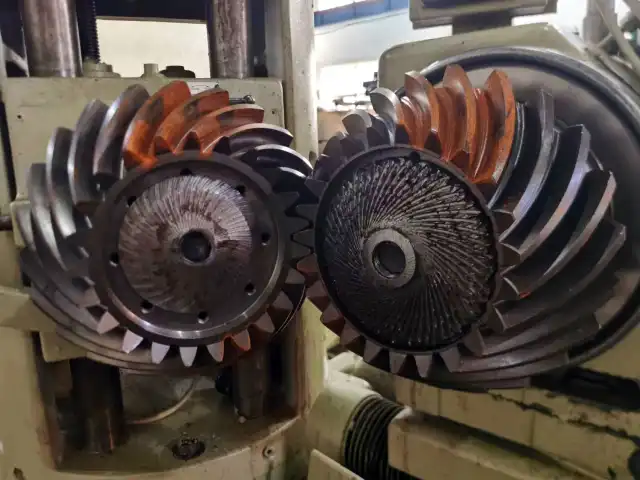
Spiral bevel gears feature inclined teeth that join slowly. Progressive connections reduce vibration, enabling smooth operation over 3,000 RPM and better power capacity. Overlapping tooth attachments disperse contact stresses, extending component life in difficult environments. YIZHI MACHINERY spiral bevel gear designs employ Gleason cutting to ensure accurate tooth form and ISO 8-9 grade criteria.
The centre has zero bevel gears. The spiral angle of their bent teeth is zero degrees. They combine the benefits of spiral patterns with straight bevels' ease of fitting. Hypoid bevel gears may be offset in various vehicle and marine applications since their shaft axes don't intersect.
Material Selection and Design Principles
Material choice affects Industrial Bevel Gear performance, durability, and suitability for particular operating circumstances. Industry uses high-grade alloy steels like 20CrMnTi, 18CrNiMo7, and SAE4340 for their hardness and strength. Complex heat treatments include carburising, which adds carbon to the top layer, and chilling creates the case hardness between 58 and 62 HRC while maintaining a flexible core that can bear shock loads.
YIZHI MACHINERY uses 42CrMo and AISI4140 for high-tensile activities and 40CrNiMo for large weights. When selecting a material, projected operating temperature range, corrosion, and fatigue cycles are considered. Its 0.5 to 50 module range makes it appropriate for anything from high-precision sensors to heavy mining equipment.
Performance attributes still depend on heat treatment. Quenching and tempering balance stiffness and hardness, whereas induction hardening treats just particular tooth surfaces. These metal treatments work well with precision machining like hobbing, milling, and grinding to create tooth forms within size constraints.
Applications and Advantages of Industrial Bevel Gears
Industrial Sectors Relying on Bevel Gear Technology
Different uses make Industrial Bevel Gears valuable in numerous sectors. These parts endure harsh cone crusher and conveyor conditions in mines. Large-module spiral designs may function in dusty conditions despite rock fracture stress loads. The gears must perform dependably even when the load changes and torque spikes reach 300% of their typical levels.
Aerospace applications need precision and weight reduction. Helicopter main rotor shafts feature aerospace-grade bevel gears. This item must fulfil high safety criteria and be as light as possible since every kilogram reduces fuel usage and carrying capacity. Following tight quality standards and monitoring requirements, our manufacturing expertise aid the aerospace sector.
Machine tool spindle drives are also crucial. Small milling and drill machines use bevel gears for right-angle power transmission. Extreme accuracy is required. To maintain location accuracy while cutting, backlash must be between 0.15-0.30 mm. Surface finish affects machine performance; therefore, grinding must obtain Ra values below 0.8 micrometres.
Key Performance Advantages and Operational Benefits
To understand why procurement personnel choose bevel gears, consider their advantages. The tiny structural design allows direction changing in a limited area. This intelligent use of space helps equipment layouts with numerous pieces and multiple power transfer lines operate together. Conical geometry allows settings that parallel-axis systems cannot.
Its load-bearing flexibility is exceptional. The contact ratio, or average number of teeth involved, is frequently greater than 1.5 in spiral patterns. Multiple-tooth contact reduces contact stress and wear by spreading forces across a greater surface area. These gears may transmit continuous torque with 95–98% efficiency when manufactured and greased properly, minimising powertrain energy loss.
High-quality Industrial Bevel Gears decrease noise, making them unique. Spiral engagement characteristics are smoother and quieter when helix angles are altered. When workplace noise regulations are restrictive, this sound performance is crucial. Spiral designs eliminate clicking noises from straight bevel gears under load due to sluggish tooth contact.
Precision manufacturing faults balance gearbox efficiency. Our ISO 8–9 manufacturing standards provide little runout and precise tooth spacing. Physical precision immediately reduces vibration and improves power transmission. Eliminating vibrations extends bearing life and enhances stability beyond gears.
Maintenance Guidelines for Maximising Lifecycle
Buying options go beyond price. They include all ownership expenses. The appropriate repair techniques greatly impact Industrial Bevel Gear lifespan and system performance. Regular lubrication is still very important. For instance, Industrial Bevel Gear needs extreme pressure (EP) gear oils to maintain the distinct films under boundary lubrication conditions. The viscosity of the lubricant needs to meet the operating speeds and environmental temperatures. Low viscosity causes metals to contact and wear quicker.
The severity of the operation should determine inspection frequency. Mining in unclean regions requires monthly visual inspections for tooth damage, unusual wear patterns, and oil levels. Vibration analysis may detect imbalance or worn bearings early. Temperature monitoring detects lubrication issues early (before damage).
Checking for backlash during normal maintenance ensures gear alignment. Too much backlash indicates worsening wear or heat-induced mounting changes. However, insufficient reactivity causes binding and rapid tooth deterioration. Precision shimming keeps the clearances set by the maker, which keeps the performance at its best during the repair interval.
Comparing Industrial Bevel Gears with Other Gear Types
Performance Comparison with Spur and Worm Gears
Buyers should know how bevel gears compare to other drives. Spur gears are simple to construct and operate well with equal shafts, but they can't transfer power at an angle. Idler gears and chain drives complicate, cost more, and reduce efficiency when direction changes are required.
Worm gears naturally lock and have large reduction ratios in compact packaging, making them handy for certain lifting jobs. However, their rolling contact mechanics produce friction, limiting their effectiveness to 50–90% depending on lead angle. Because friction generates heat, robust cooling systems are required. Worm gear systems have less power and reversibility than bevel versions.
Industrial Bevel Gears are more efficient for rotation. Because they don't move much, rolling contact gears generate less frictional heat than worm drives. When spinning must be reversed, its two-way functionality is beneficial. Properly designed spiral bevels are quieter than spur gears. The spur gear teeth' impact is audible over 1,000 RPM.
Nuanced Differences Between Helical and Straight Bevel Designs
Bevel gears' performance depends on their straight or helical (spiral) design. Straight bevel gears are cheap and straightforward to build for moderate-speed usage. Their quick full-width tooth contact increases loads but simplifies stress monitoring. These qualities function well in low-speed, intermittent-duty circumstances when cost is the main design consideration.
The improved performance of spiral bevel gears justifies their higher price. Gradual contact reduces stress and loudness by slowing tooth loading. This seamless procedure increases rotational speed and power. Higher contact ratios and load distribution over several teeth are also possible with spiral teeth. Sharing the load reduces tooth twisting stresses, increasing load capacity by 30–50% over straight bevel designs with the same load.
Precision usage highlights operational ease disparities. Due to reduced vibration transmission, spiral bevel machine tool gears improve surface finishes. Lower vibration reduces stress on neighbouring buildings and improves rotorcraft passenger comfort.
Procurement Guide for Industrial Bevel Gears
Critical Specifications and Material Considerations
Good purchasing starts with defining technical requirements. The module determines tooth size and strength. Larger modules can handle large mining and industrial equipment, while smaller modules are excellent for precision jobs with modest loads. The pressure angle, generally 14.5°–20°, affects tooth strength and load distribution. Twenty-degree pressure angles make teeth tougher and better for high-load conditions.
Material demands should meet activity needs. Quenching and tempering 45# steel to 45–50 HRC works for most industrial tool usage. Case-carburised alloy steels like 20CrMnTi or 40CrNiMo are required for harsher circumstances. These steels feature shock-resistant cores and 58–62 HRC surfaces.
Reduced speed and gear size are balanced by ratio and tooth count. More teeth distribute stress over more contact points, but also increase gear size. Custom tooth parameters include size, strength, and cost to provide you with the greatest results.
Lead Times and Custom Manufacturing Advantages
Good Industrial Bevel Gears take 35–60 days to make. Forging or blank preparation, rough machining, heat treatment cycles with regulated cooling rates, precision grinding, and careful quality checking are all covered by this timetable. Speeding up manufacturing frequently reduces quality control.
Custom production provides advantages over store-bought items. Application-specific designs ensure the tooth shape is optimal for the loading circumstances. Materials might be selected based on poisonous air or high temperatures. Because mounting configurations may be altered to match equipment plans, expensive system redesigns are unnecessary.
Our customisation at YIZHI MACHINERY includes all requirements. We can create one-off goods for prototypes or specialised usage, so you don't have to worry about minimum order numbers from larger makers. This adaptability is useful for replacing parts or developing new machines with customised drives.
Evaluating Suppliers and Ensuring Quality
Siemens, Bosch, and SKF are global providers. These brands are reliable. But gear specialists like YIZHI MACHINERY have an advantage since they are fast and adept at meeting client requests. Handiwork and CNC gear cutting centres and fully automated gear grinding equipment have been used in our 15-year production.
Check quality assurance measures before picking a supplier. Following ISO standards builds confidence, but procurement staff should verify quality control methods. Premium providers analyse tooth contact patterns, verify measurements using coordinate measuring instruments, and retain material certification records.
Production tool power affects precision. CNC equipment and precise cutting tools provide tighter restrictions for demanding work. Intelligent heat treatment manufacturing lines in our industrial infrastructure provide consistent metallic characteristics across batches. This eliminates performance fluctuations in simpler processes.
Enhancing Industrial Bevel Gear Performance and Longevity
Noise Reduction Methods and Lubrication Practices
Due to operational noise concerns, gear technology is always improving. Simple spiral tooth designs and more elaborate adjustments like profile crowning and lead upgrades increase tooth contact when loaded. These micrometre-scale geometry changes prevent edges from contacting, causing high-frequency noise and accelerated wear. Computer-aided design technologies provide precise tooth contact calculations that account for structural flex under load.
How Industrial Bevel Gear parts are lubricated affects their noise and lifespan. When picking a lubrication, consider its viscosity grade, chemical package, and seal material compatibility. Mineral-based gear lubricants degrade at high temperatures, whereas synthetic oils stay longer. Extreme pressure additives provide safe chemical coatings on tooth surfaces to prevent metals from contacting during high-load boundary lubrication.
Oil drainage systems stabilise temperatures and remove wear particles that accelerate breakdown. Filtration requirements should collect 25-micron particles to protect tooth surfaces. Temperature monitoring alerts you to grease shortages or overloads.
Modern Manufacturing Techniques and Quality Assurance
As manufacturing technology advances, gear quality and durability increase. Computer numerical control hobbing tools can achieve tooth space accuracy of a few micrometres. Multi-axis grinding centres produce tooth profiles that match theoretical geometry with minimum variance. More accurate transmissions with less shaking result from these precision manufacturing procedures.
Finishing procedures determine surface quality. Grinding decreases surface hardness to less than 0.8μm, reducing friction and facilitating grease film formation. For smoother finishes, honing and grinding are other methods. The finishing talents of YIZHI MACHINERY aid in creating anything from industrial gear to precision aviation components.
Quality inspections ensure manufacturing requirements are met. Coordinate measuring equipment verifies measurements in many ways. Gear rolling tests simulate real-world work situations to assess tooth spacing and runout. For critical purposes that need material tracking, material certificates detail the alloy's composition and heat treatment.
Forward-Looking Trends in Materials and Design
New materials and surface treatments are employed as industries change. Powder metallurgy can recreate objects close to their original form, reducing cutting and waste. Physical vapour deposition and other coating processes place hard layers on surfaces to increase wear resistance without compromising the core. These coatings are useful in filthy regions with abrasive pieces that accelerate gear wear.
Design optimisation increasingly employs finite element analysis to model stress distribution under complicated pressure circumstances. These computer algorithms allow lightweighting that reduces spinning inertia without reducing strength. Weight loss reduces bearing load and accelerates movement response in all mechanical systems.
Additive manufacturing makes fast prototypes of unique designs simpler, but it's not suitable for scale production of power transmission equipment. This capability lets designers test modifications before using regular production methods, speeding up development for specialised needs.
Conclusion
In conclusion, Industrial Bevel Gears are still very important parts that make it possible to transfer angular power efficiently in mining, aircraft, and industrial machines. Their unique conical shape makes it possible for small changes in direction while keeping their high efficiency and load capacity. Knowing the differences between straight and spiral designs, how to choose the right materials, and how to keep them in good shape helps you make smart buying choices. When accurate machining, the right heat treatment, and strict checking methods are used in quality manufacturing, the product will work reliably and last longer. As businesses move toward higher standards for efficiency and dependability, it becomes more important to work with experienced manufacturers who can offer customisation options and technical help in order to stay ahead of the competition.
FAQ
1. What distinguishes straight bevel gears from spiral bevel gears in practical applications?
When you engage a straight bevel gear, all of its teeth are pointing radially toward the top of the pitch cone. This makes quick full-width contact. This sudden contact causes impulse loading and high noise levels, which means they can only be used at speeds below 1,000 RPM and for tasks with mild power. Spiral bevel gears have curved teeth that are at an angle to the gear face. This allows for slow contact, which lowers noise and vibration while allowing speeds over 3,000 RPM and a much higher load capacity.
2. How does material selection affect Industrial Bevel Gear performance in harsh environments?
The choice of material has a direct effect on how well it resists rust, how strong it is, and what temperatures it can work at. Standard carbon steels, like 45# steel, work well in mild settings with light loads. Alloy steels, like 18CrNiMo7 and 40CrNiMo, are better at hardening and are tougher, which is important for mining and heavy industry uses that involve shock loads and pollution. Carburising is one type of heat treatment that makes surfaces hard and resistant to wear while keeping cores flexible so they don't break easily when hit.
3. What maintenance intervals and practices maximise bevel gear service life?
How often maintenance is done relies on how bad the process is. Continuous-duty use in dirty settings needs to have their oil level, condition, and teeth inspected visually every month. Monitoring iron particles in lubrication oil can find early signs of wear. During routine maintenance, measuring backlash proves that the parts are in the right place and shows how the wear is progressing. Monitoring temperature and vibrations gives real-time information about an operation's health, which lets maintenance plans plan ahead and stop failures before they happen.
Partner with YIZHI MACHINERY for Premium Industrial Bevel Gear Solutions
Work with YIZHI MACHINERY to get the best Industrial Bevel Gear solutions. YIZHI MACHINERY has been making specialised products for 15 years and has advanced production tools that allow them to make high-quality Industrial Bevel Gear solutions that are exactly what you need. Industrial gear, mining, and aerospace industries can use our full customisation services for modules running from 0.5 to 50 and materials such as 20CrMnTi, 40CrNiMo, and aerospace-grade alloys. We keep quality standards that are in line with ISO, and our accuracy grades go up to ISO 8 and 9. This means that your most demanding uses will work reliably. Our production method is very flexible, so we can take orders for just one thing or make a lot of them at once. There are no minimum order quantities. With production lead times between 35 and 60 days and custom packing that keeps goods safe during shipping, we give the supply chain full trust. Contact us about your needs by emailing our technical team at sales@yizmachinery.com. They will be happy to turn your specs into precision-engineered transmission solutions.
References
1. Budynas, R. G., & Nisbett, J. K. (2020). Shigley's Mechanical Engineering Design (11th ed.). McGraw-Hill Education.
2. Jelaska, D. T. (2012). Gears and Gear Drives. John Wiley & Sons.
3. Stadtfeld, H. J. (2014). Gleason Bevel Gear Technology: Manufacturing, Inspection and Optimization. The Gleason Works.
4. International Organization for Standardization. (2013). ISO 17485:2006 - Bevel Gears — ISO System of Accuracy. ISO Standards Catalogue.
5. American Gear Manufacturers Association. (2018). AGMA 2003-C10: Rating the Pitting Resistance and Bending Strength of Generated Straight Bevel, Zerol Bevel, and Spiral Bevel Gear Teeth. AGMA Technical Publications.
6. Litvin, F. L., & Fuentes, A. (2004). Gear Geometry and Applied Theory (2nd ed.). Cambridge University Press.

USER EVALUATE
Here is the customer's evaluation of us