


Uses of Straight Bevel Gears
When it comes to effective torque transfer between colliding shafts, Straight Tooth Bevel Gears are still the gold standard for power transmission. When modest speeds and high loads are needed, these conical gears with straight-cut teeth work great in industrial tools, mining equipment, and aircraft systems. Straight Tooth Bevel Gears are easier to set up than spiral setups that create axial thrust, and they have a mechanical efficiency of almost 98–99%. Because they are strong and don't cost much, they are essential in steering systems, differential drives, machine tool spindles, and valve actuators. At YIZHI MACHINERY, we've seen a rise in the number of buying teams looking for flexible solutions that balance performance with supply chain predictability in a wide range of working settings.
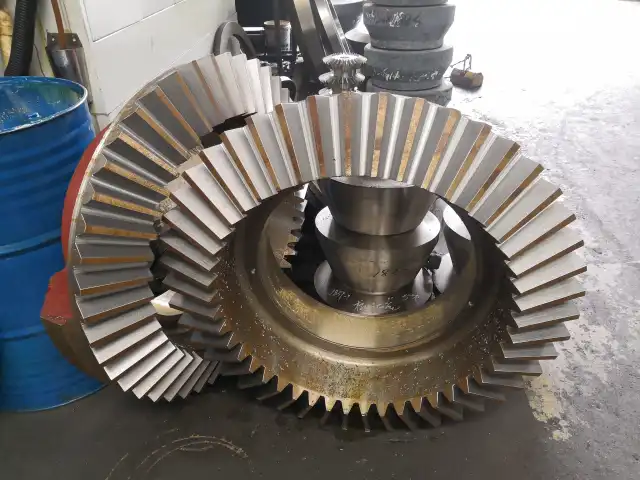
Understanding Straight Bevel Gears: Design and Function
Fundamental Geometry and Mechanical Principles
The Straight Tooth Bevel Gear design has teeth that are cut straight along the conical pitch surface and come together at a place where the shaft axes meet. This shape allows for direct power transfer, usually at 90-degree angles, but other arrangements can be used for different angle needs. These parts are different from cylinder spur gears because they are conical, and they are different from helical and spiral types because their teeth are straight. Cutting, hobbing, milling, and grinding are some of the manufacturing methods used to shape teeth according to Gleason profile standards. This makes sure that the mesh structure is always the same. The pitch cone angle, the module range from 0.5 to 50, and the pressure angles of 14.5° or 20° determine important dimensions that affect how the load is distributed and how the contacts are made.
Material Selection and Heat Treatment Processes
In challenging situations, the structure of a material directly affects how long it lasts and how much weight it can hold. We use high-quality alloy steels like 20CrMnTi, 40CrNiMo, SAE4340, and AISI8620 to make Straight Tooth Bevel Gears. These steels were chosen because they are both tough inside and easy to harden on the outside. Using heat treatments like carburising, cooling and tempering, and induction hardening can raise the surface hardness of metals from 45 to 50 HRC for everyday use to 58 to 62 HRC for heavy-duty situations. Carburising makes the case deeper and harder, which protects the tooth sides from wear while keeping the core flexible and able to handle shock loads. This metalworking method works really well for mining tools and other machines that are loaded and unloaded in different ways. Magnetic particle screening for quality control finds surface flaws after treatment, making sure that the structure meets ISO 8-9 accuracy grades.
Design Advantages Over Alternative Gear Types
Straight Tooth Bevel Gears are better than spiral, helical, and hypoid gears in a number of ways. Since there are no spiral angles, there are no axial thrust forces other than natural separation forces. This makes it easier to choose bearings and makes the housing less complicated. This feature lowers the cost of production and makes upkeep easier. This is especially helpful when the equipment is used in mining sites or factories that are far away and don't have a lot of expert support. Installation freedom comes from their small size, which lets them fit into tight areas where directions change. The balanced transmission effectiveness blends accuracy with useful load-bearing capacity, able to handle medium- to low-speed tasks at speeds below 10 m/s. For simple spiral geometries, design engineers like the simple tooth contact proof processes that let them check bearing patterns using standard testing methods and without the need for special tools.
Primary Applications and Industrial Uses of Straight Bevel Gears
Industrial Machinery and Manufacturing Equipment
Straight Tooth Bevel Gears are very important for machine tool shaft drives and right-angle motion systems in manufacturing. These parts are used in milling machine heads to change the rotating input from horizontal motor shafts to vertical cutting spindles. This keeps the force constant while the material is being removed. Material handling equipment's steering systems use pairs of bevel gears to turn what the user does into control of direction, with mechanical advantage ratios that allow for accurate movement. Small mechanical transmission systems can use angular transfer to save room, which is especially helpful in automatic assembly lines where the size of the equipment affects how the production floor is laid out. These gears are used in light industrial equipment like conveyor belts, packaging machines, and textile processing units where modest speeds and irregular job cycles match their design strengths. The high load capacity can handle shock loading, which happens when machinery starts up while under load or runs into material resistance.
Mining and Heavy-Duty Operations
Extreme conditions, such as abrasive contaminants, temperature changes, and impact loads, are common in mining settings. Straight Tooth Bevel Gears work great in differential systems in haul trucks, loaders, and excavators because their tough construction can handle the pressures of heavy use. Power take-off units in mobile mining equipment send engine output to extra systems like hydraulic pumps and air fans. This needs to be done reliably and without problems like vibration and misalignment. The simpler bearing arrangements make upkeep easier, which is very helpful for equipment that works underground where it's hard to get to. These gears give valve actuators that control slurry pipes and material handling systems a mechanical edge that can be used for either human or motorised control. Specifications for surface hardness up to 62 HRC stop wear from particles getting in, so gears that are harder to damage by abrasion can last longer between overhauls.
Aerospace and Precision Applications
Parts for aerospace systems have to meet strict standards for weight, dependability, and accuracy. Where proven technology lowers approval risks compared to younger designs, Straight Tooth Bevel Gears are used in extra power units, accessory gearboxes, and actuation mechanisms. The predictable tooth contact pattern makes it easier to check the quality in many ways, such as using a coordinate measuring machine to look for flaws and running tests with realistic operating loads. When fail-safe operation calls for cautious design, these gears are used in landing gear retraction systems and flap activation mechanisms. Tractor differentials and harvester drive systems are examples of agricultural gear that have to last for a long time. They have to be able to work in dirty settings and keep performing well at all temperatures. Because custom production is possible, module specs, tooth counts, and material choices can be made to fit the specific loads and environmental conditions that will be met in these different uses.
Comparing Straight Tooth Bevel Gears with Alternative Gear Types
Performance Trade-Offs Against Spiral Bevel Gears
Spiral bevel gears have curved teeth with helix angles between 15 and 35 degrees. This lets the teeth connect gradually, which lowers noise and increases load capacity compared to straight designs. This benefit is important in car differentials and high-speed transmissions where noise levels can make the user uncomfortable. When compared to this, Straight Tooth Bevel Gears have easier production methods and lower costs, which makes them more cost-effective for uses that can handle some noise. In straight designs, the quick full-face contact makes certain sounds and makes sure that the load is spread evenly across the tooth width as soon as it engages. Different types of spirals need slightly different maintenance. Spiral types need exact axial placement because they have thrust loads that need thrust bearings, while straight types make assembly easier. The procurement teams need to decide if faster application speeds are worth the higher prices or if straight configurations give enough performance for less money.
Efficiency and Maintenance Considerations
Well-oiled straight and spiral bevel gears score 98–99% in mechanical efficiency testing. When peripheral speeds are below 10 m/s, which is usual for straight designs, tooth movement friction heat remains constant. Maintenance is easier with straight tooth designs since they demand less exact alterations during installation and refurbishment. Dial indicators can assess backlash levels between 0.1 and 0.20 mm for thermal development without binding, without specific instruments. Lubrication demands are comparable, although straight gears may withstand filthy oils better due to their stronger teeth and ability to pass tiny particles. Because centred bearing patterns verify mesh accuracy without considering helical engagement features, simplified contact pattern analysis simplifies inspection. All of these reduce equipment's lifetime cost of ownership. This is particularly advantageous for budget-conscious mining companies and industrial facilities with huge equipment crews.
Procurement Insights for Straight Tooth Bevel Gears
Identifying Qualified Manufacturing Partners
When shopping for Straight Tooth Bevel Gears, you must evaluate vendors' technical expertise, quality methods, and delivery reliability. CNC gear machining machines, automated grinding equipment, and innovative heat treatment lines help manufacturers maintain high standards throughout production runs. ISO compliance is a fundamental quality check, whereas AGMA 2005-D03 or ISO 17485 conformity shows precise manufacturing competence. Custom OEM solutions need cooperative engineering throughout specification development. Design drawing and technical guidance suppliers boost project success. From raw material preparation to product inspection, manufacturing tool stocks should cover the whole process. You won't have to depend on several freelancers whose work varies in quality. Long-term partnerships with well-known mechanical engineering businesses indicate they can handle complex work, reducing the risk of purchasing from new companies.
Pricing Dynamics and Lead Time Management
Material cost, difficulty, and order volume determine the pricing of custom Straight Tooth Bevel Gears. Module specifications affect pricing; larger modules with longer cutting and heat treatment periods cost more. Buy in bulk to save money. Depending on order size and complexity, number breaks occur at 10, 50, and 100 units. Production takes 35–60 days from order confirmation to delivery. This time involves collecting supplies, producing them, heat treating them, and final quality checks. When manufacturing timeframes match priority orders, accelerated plans are feasible at additional expense. Varied vendors have varied minimum order quantities; however, single-unit manufacturers allow for prototypes and emergency component replacement. Full bids should include material kinds, heating, inspection, and packing instructions to minimise shipment damage. Clear pricing boosts source review confidence.
Quality Verification and Supplier Vetting
Procurement professionals must establish criteria for ensuring supplied Straight Tooth Bevel Gear components are practical. Tooth contact pattern data confirms mesh shape, and centred bearing patterns under mild loads confirm mounting distance and alignment. Backlash inspection data indicate clearance values within limits, preventing binding or too much play. Material certifications that verify an alloy's composition and heat treatment confirm it fulfils criteria. This is crucial for aerospace and mining applications that need material proof. Coordinate measuring machine data for Straight and Spiral Bevel Gears includes tooth profiles, pitch widths, and runout figures for accuracy. Magnetic particle inspection papers find surface cracks or grinding burns that weaken wear. Full test data shows suppliers care about quality, whereas closed data raises concerns that require greater research or new procurement methods.
Maintenance and Optimisation Tips for Straight Tooth Bevel Gears
Lubrication and Inspection Best Practices
The correct lubricant may extend the life of a Straight Tooth Bevel Gear by minimising tooth surface wear and operating temperatures. Mineral gear oils with high-pressure additives are used in most industries. Viscosity types depend on rotation speed and temperature. Sealed housings with peripheral velocity less than 5 m/s benefit from splash lubrication. Higher speeds and outside temperatures need forced circulation systems. Lubricants should be replaced every 2,000–4,000 hours, depending on contamination and temperature stress. Oil analysis determines replacement time by measuring wear particles and additives. Inspections should include tooth contact pattern checks before and after high loads. This keeps bearing patterns in the centre and prevents them from moving toward the heel or toe, which would misalign them. Backlash readings identify fast-wearing items that require adjustment or replacement before breaking.
Early Failure Detection and Corrective Actions
Vibration tracking detects issues before they quit operating. Accelerometers near gear meshes detect frequency variations that may indicate tooth damage, bearing wear, or looseness. Ultrasonic tracking demonstrates that contact pattern issues and lack of lubrication cause distinct sound profiles in acoustic fingerprints. Temperature trends indicate a faulty cooling system or excessive friction from misalignment or crowding. Addressing warning indicators immediately prevents further harm. Fixing mounting distance errors prevents tooth wear, and changing tainted lubricants prevents abrasion. How components are installed matters. To avoid warping, tighten the mounting nuts to the manufacturer's requirements, and keep the shaft's runout to 0.05 mm for smooth spin. Handle objects to avoid contacting the tooth surfaces and store them in protective coverings to prevent corrosion and physical damage that decreases the surface hardness.
Performance Optimisation Strategies
Systematic performance fixes boost operational efficiency. To reduce noise, teeth are ground or lapped to improve contact. Upgrades to higher-alloy steels with enhanced hardenability allow for higher load ratings as usage changes. High-cycle wear is reduced by adding compressive residual stresses through coating processes like physical vapour deposition or shot peening. Optimising the bearing system reduces friction and stabilises alignment, improving engine performance. These solutions are particularly useful for prolonging the life of mining equipment, since replacement costs include lost production time and problems procuring spares. Recording performance changes helps with future purchasing decisions and creates institutional knowledge that supports repair organisations' ongoing improvement.
Conclusion
Straight Tooth Bevel Gears are effective at transmitting angles in industrial machinery, mining equipment, and aircraft systems where the needs of the job match their design strengths. Their simple bearing setups, low cost of production, and high load capacity make them the best choice for medium- to low-speed uses that need to work reliably for long periods of time. What materials are used, how they are heated, and how precisely they are manufactured all affect how long a part lasts in harsh settings with shock loads and contamination. Figuring out the trade-offs in performance between different types of gear lets you make smart purchasing choices that balance the costs of capital with the needs of operations. Systematic lubrication, inspection routines, and early failure spotting are all examples of good maintenance practices that keep equipment available and costs low over its lifetime. As long as businesses want flexible solutions with reliable supply chains, Straight Tooth Bevel Gears will still be useful because they can be changed to fit different needs and specs.
FAQ
1. What advantages do straight tooth bevel gears offer over spiral bevel designs?
Straight Tooth Bevel Gears get rid of the axial thrust forces that need complicated thrust bearing setups. This makes housing designs easier and lowers the precision needs for assembly. The cost of making them stays low because the teeth are easier and the machines used are not as specialised. These benefits make them good for situations where moderate noise levels are okay, and operating speeds stay below 10 m/s. This makes them cost-effective for mining and industry equipment.
2. Can straight tooth bevel gears handle high-torque applications?
These gears work great in situations with a lot of power because they have strong tooth profiles and case-hardened sides that are 58 to 62 HRC hard. Some of the materials available, like 40CrNiMo and SAE4340, are very tough and can handle the shock loads that are common in mine differentials and heavy machinery drives. The right heat treatment makes sure that the case is deep enough to protect the tooth sides from contact stress and that the cores stay flexible so that they don't break easily.
3. What are typical lead times for custom straight tooth bevel gear orders?
Standard production plans include getting materials, precision machining, heat treatment processes, and checks to make sure the quality is good. Custom specs, such as specific module needs or special materials, may make delivery times longer, but well-known makers keep an inventory of parts, which cuts down on delays. Clear communication during the creation of specifications and fair expectations about when the project will be finished help the project go smoothly.
Partner with YIZHI MACHINERY for Reliable Straight Tooth Bevel Gear Solutions
YIZHI MACHINERY makes custom Straight Tooth Bevel Gears for the mining, aircraft, and industrial gear industries all over the United States. Our production methods are ISO-compliant and use modern CNC machine centres and smart heat treatment systems to make parts that meet AGMA quality standards for module ranges from 0.5 to 50. We offer a wide range of materials, such as 20CrMnTi, SAE4340, and AISI8620, to meet the needs of a wide range of applications. Our engineering team also provides expert advice from the planning stage through delivery. We know how hard it is to find the right balance between quality, wait times, and costs when you're buying something. Our standardised process guarantees 35–60-day production schedules, and our custom packing guarantees damage-free shipping. As a Straight Tooth Bevel Gear seller with 15 years of experience in precision manufacturing, we can take low minimum order amounts, even if it's just one unit for a prototype or an emergency replacement. Contact our team at sales@yizmachinery.com to discuss your specific transmission requirements and discover how our proven capabilities support your operational success.
References
1. Dudley, Darle W. Handbook of Practical Gear Design and Manufacture. CRC Press, 2019.
2. American Gear Manufacturers Association. AGMA 2005-D03: Design Manual for Bevel Gears. American Gear Manufacturers Association, 2003.
3. Townsend, Dennis P. Dudley's Gear Handbook: The Design, Manufacture, and Application of Gears. McGraw-Hill Education, 2019.
4. Litvin, Faydor L., and Alfonso Fuentes. Gear Geometry and Applied Theory. Cambridge University Press, 2004.
5. Budynas, Richard G., and J. Keith Nisbett. Shigley's Mechanical Engineering Design. McGraw-Hill Education, 2020.
6. International Organization for Standardization. ISO 17485: Bevel Gears — ISO System of Accuracy. International Organization for Standardization, 2012.

USER EVALUATE
Here is the customer's evaluation of us