


Spiral Miter Gear vs Bevel Gear: Key Differences Explained
Picking between a Spiral Miter Gear and a normal bevel gear for precise power transmission in mining, aircraft, and industrial machinery can have a big effect on how well your equipment works, how long it lasts, and how much it costs to maintain. Both types of gears make it possible to transfer an angled shaft, usually at a 90-degree angle, but their designs, tooth shapes, and how they work are very different. The curved, spiral teeth of a Spiral Miter Gear gradually connect, resulting in quieter, more fluid operation at high speeds and loads. When engineers and procurement managers understand these differences, they can make decisions that improve the efficiency of tools while keeping costs low across global B2B supply chains.
Introduction
In industrial operations, power transfer parts and bevel gears are crucial for transferring rotational torque between shafts that intersect. Technically, spiral mitre gears and straight bevel gears are built differently and have distinct performance ratings. The gears you choose for industrial machinery, mining excavators, or aviation actuation systems affect how smoothly they function, how loud they are, how much power they can manage, and how frequently they need to be repaired.
Gear selection is crucial for more than technical reasons. It impacts total cost of ownership, downtime, and product quality. Engineers must consider speed, load capacity, and environment when choosing drive systems for robotic joints or machine tool wheels. This comprehensive guide outlines the fundamental distinctions and helps you pick gears that fulfil technical and commercial objectives in today's competitive industrial environment.
Understanding Spiral Miter Gears and Bevel Gears
Fundamental Design Principles
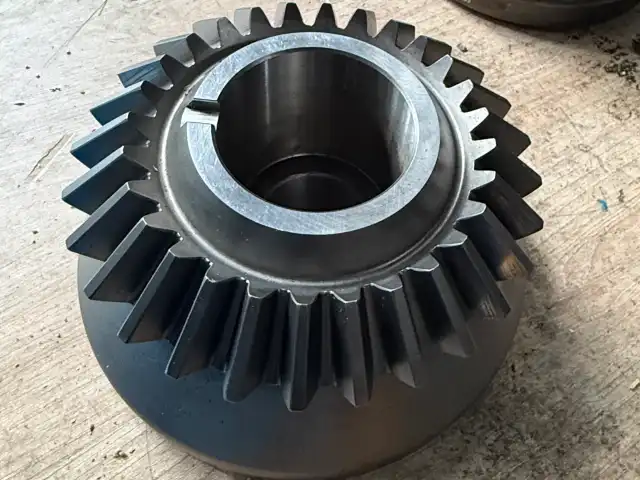
Cone-shaped bevel gears transfer power between right-angle shafts. Different bevel gears exist. Straight bevel gears feature straight, axis-aligned teeth, whereas spiral bevel gears have bent, spiral-angled teeth. Spiral Mitre Gears are 1:1 spiral bevel gears. This implies that fitting gears have the same number of teeth and transmit motion without speed change.
Spiral Mitre Gears are distinguished by their curved teeth. Straight teeth establish full-face contact immediately, whereas spiral teeth do so gradually. Slow engagement increases the mesh's contact ratio, or the number of teeth in contact. It distributes load more evenly over the tooth surface. Helix angle, generally 35 degrees, determines the spiral degree. Smoothness and rotational thrust depend on this angle.
Operating Mechanism Differences
Straight bevel gears roll and move with simultaneous tooth contact across all teeth widths. This quick contact causes impact loads, which generate noise and vibration at high speeds. In contrast, spiral mitre gears touch one end of the tooth and move it across the tooth face as they turn. Spiral shapes are superior for noise reduction since their rolling contact pattern reduces shock loads and runs softly.
Curved teeth increase axial thrust in spiral miter gears. Spiral teeth mesh to provide radial and axial stresses on the output shaft and gear shaft. Engineers must consider this thrust when selecting tapered roller or angular contact ball bearings that can manage horizontal and axial stresses. Straight bevel gears provide little axial force, making bearing selection simpler but removing spiral engagement's performance advantages.
Key Differences Between Spiral Miter Gears and Bevel Gears
Tooth Geometry and Design
The tooth form is the most noticeable difference between these gears. Straight bevel gears feature straight sides and pitch cone-aligned teeth that slope equally from outside to inside. Cutting and grinding are common manufacturing procedures that lack precision. However, spiral mitre gears feature curved teeth that round the cone. Face hobbing or grinding is needed to cut them accurately.
Efficiency is directly affected by geometry. The spiral angle enhances the load-carrying surface area by 20–30% compared to straight designs since the useable face width in contact is always larger. Slow contact reduces localised stress that might cause pitting or tooth fracture when the load is cycled. Carburising often uses AISI 8620 or 20CrMnTi alloy steels. These steels are heated to 58–62 HRC to make the core robust and the surface wear-resistant.
Performance Metrics Analysis
Efficiency is crucial to success. Greased Spiral Mitre Gears provide 95–98% mechanical efficiency due to low sliding friction during rolling contact. Somewhat higher than straight bevel gears. The efficiency gain is particularly crucial in high-speed settings where frictional losses accumulate over time. It uses less energy and produces less heat.
Noise distinguishes spiral patterns from straight ones. Spiral Mitre Gears' progressive tooth contact reduces gear whining from meshing impulses. On average, this reduces industrial noise by 5-10 dB. This acoustic advantage is important in food processing, medical equipment, and precision machine manufacturing where silent operation improves worker comfort and safety. The spread-out contact pattern lowers wear and increases service gaps, making spiral forms preferable for large industrial loads.
Application Suitability
Spiral Mitre Gear Applications: These gears operate well in high-speed conveyor reversal machines with belt speeds exceeding 3000 RPM and smooth, vibration-free operation to protect items. Ground Spiral Mitre Gears are ideal for precision robotic arm joints because they have little backlash. Spiral machine tool spindle drives can handle a lot of strain and transfer power at a 90-degree angle in a tiny size. When load changes, agricultural equipment steering systems employ spiral mitre gears for rapid, silent direction adjustment.
Concrete mixers and earth-moving equipment employ straight bevel gears because they are simpler to produce and function well in moderate-speed, high-shock settings. When price trumps noise, hand-powered angle grinders employ straight bevels. Light-duty industrial equipment that only runs sometimes may safely employ straight designs instead of spiral cutting, which requires precision.
These uses show the key trade-off: straight bevel gears are simple and economical when their limitations are accepted, whereas spiral mitre gears are more efficient but more complicated to manufacture. By understanding this balance, procurement teams may better match equipment specifications to operations demands and prevent over-specificating items.
Comparative Benefits for B2B Procurement and Engineering Decisions
Torque Transmission and High-Speed Performance
Different types of gear have very different torque capacities. Due to their higher contact ratio and spread loading pattern, Spiral Miter Gears can handle 20 to 30 percent more torque loads than straight bevel gears of the same module and face width. Because of this benefit, engineers can choose smaller, lighter gear sets that still meet the power transfer needs. This lowers the total weight and inertia of the assembly, which are important factors in the design of aerospace actuators and mobile equipment.
Another difference can be seen in high-speed behavior. As rotary speed goes up, straight bevel gears make more noise and shaking. For many industrial uses, the fastest speed that works is between 1500 and 2000 RPM, before dynamic forces start to cause problems. Spiral Miter Gears are ideal for high-speed automation equipment and precision machining centers where spindle speeds require superior dynamic balance because they keep smooth operation well beyond 3000 RPM due to their gradual tooth contact.
Maintenance and Lubrication Requirements
What you need for lubrication affects the total cost of equipment. Due to the moving action of the helical teeth, Spiral Miter Gears require careful attention to lubricant selection and upkeep plans. Extreme pressure ingredients in synthetic gear oils make the gears last longer by reducing the higher contact loads and heat that are created. Sealed housings with oil bath or splash lubrication systems work well, but engineers need to make sure there is enough cooling for uses that run all the time.
When it comes to greasing, straight bevel gears don't need anything fancy. They usually work fine with grease packing in sealed housings. Because of less thermal loading and easier bearing setups, maintenance can be put off for longer periods of time. But the trade-off is that the parts wear out faster over time, which could mean they need to be replaced sooner even though they don't need to be serviced as often. When considering choices, procurement managers who are looking at lifecycle costs should include both the prices of maintenance work and replacement parts.
Cost Considerations and Supply Chain Factors
Different prices show how complicated the production process is. Standard Spiral Miter Gears are 30–50% more expensive than similar straight bevel gears because they need special cutting tools, take longer to make, and have strict quality control rules to meet ISO 8–9 precision grades. Prices are higher for custom spiral gears that have specific module, tooth count, or material requirements. It can take 35 to 60 days for production, heat treatment, and precise cutting.
These problems can be lessened by working with sellers who have a lot of experience. Reliable makers keep in touch with gear experts around the world, which gives them access to both standard stock items and solutions that are specially designed for their needs. Suppliers who can do everything, from helping with the design to checking the final product, make the buying process easier by combining contacts with multiple vendors and making sure that all the parts work together. Knowing the minimum order quantity and samples available helps buyers control their inventory costs and make sure the equipment works well before committing to large production runs.
How to Choose Between Spiral Miter Gear and Bevel Gear for Your Business Needs
Selection Criteria Framework
Setting clear criteria for selection makes sure that the gear you choose meets the needs of your business. Speed is the most important thing to think about. For uses going over 2000 RPM, Spiral Miter Gears are highly recommended to avoid breakdowns caused by vibration. Next are the torque needs. Figure out the transmitted power and compare it to the manufacturer's ratings. Keep in mind that spiral designs have 20–30% more capacity than other types. There are rules about noise levels that matter in places where people are working or where noise can mess up quality control.
Material and heat treatment choices are affected by how long people expect things to last. For parts that have to work continuously in rough conditions, heat-treated carburized alloy steels like 20CrMnTi or AISI 8620 with tough cores that can handle impact loads are best. Through-hardened carbon steels like AISI 4140 can be used in intermittent-duty tasks and are less expensive. Material choices are based on things like corrosive atmospheres or high temperatures. Stainless steel can be used when chemical protection is more important than hardness.
Industry-Specific Application Guidance
Different sectors value different success elements. Aerospace Spiral Mitre Gears are robust, light, and constructed of SAE 4340 or 18CrNiMo7. These gears must be traceable and have non-destructive test results. High torque density and reliability justify the greater price since failure impacts are harsher than part costs.
Mining equipment must survive, withstand stress loads, and be serviceable under severe conditions. Spiral Mitre Gears are excellent for conveyor drive systems that demand smoothness, while straight bevel gears perform well for slower applications like crusher drives that need durability. Customisation lets you change tooth profiles, pressure angles, and protective coatings to suit your working conditions.
Industrial equipment has several uses. Precision-ground Spiral Mitre Gears are precise and have no slack, making them ideal for robotic automation. Packaging equipment is stainless steel and smooth to prevent germs. Buyers may better communicate with suppliers by understanding these sector-specific demands.
Best Practices for Supplier Engagement
Clear specifications are the first step to a successful purchase. Inform providers of speed ranges, torque loads, job cycles, and environmental considerations. Share the mount setup and space constraints to ensure a good fit. Ask for design advice for complex usage. Experienced gear builders can help you choose the right gear characteristics.
Include more than the unit price when requesting a quotation. Discover the minimum order quantity, wait periods for standard and bespoke configurations, materials, heat treatment options, precise grades, and testing and inspection documents. Genuine partners manage warranty conditions and professional support after the sale, whereas part sellers don't.
Evaluating samples is crucial when testing new sources or distinctive designs. Request test quantities, full-dimensional inspection documents, and material certificates. Test performance with normal loads and speeds for noise, temperature increase, and efficiency. This approval expenditure prevents costly production interruptions due to substandard parts.
Case Studies and Real-World Applications
High-Speed Conveyor Systems Enhancement
The 90-degree conveyor belt reversal drives at a large food processing plant kept breaking down. The first Spiral Miter Gears made too much noise (85+ dB), which made workers unhappy, and vibrations caused bearings to break down every 8–10 months, so they had to be replaced. The repair pause messed up production plans and caused the packaging line to get stuck.
An engineering study showed that speeds of conveyor belts close to 2800 RPM were too fast for straight bevel gear designs to work. Changing to precision-ground Spiral Miter Gears made from AISI 8620 alloy steel that has been hardened to 60 HRC changed how well the system worked. The noise level dropped to 72 dB, which is safe for the workplace and doesn't need any extra sound barriers. Vibration-related bearing stress was removed by smooth operation, which increased the time between service intervals beyond 24 months. At first, the Spiral Miter Gears were 40% more expensive, but the facility got its money back in 14 months because of less repair work and downtime. Since then, ongoing operational savings have helped the profit margins.
Robotic Joint Precision Application
A car company that was using shared robots for assembly needed right-angle drives for robotic wrist joints that were small and accurate. Positioning accuracy of within ±0.05mm was needed to make sure that the part was placed correctly. There was too much backlash (0.15- 0.20 mm) in the straight bevel gears, which built up along the kinematic chain and led to placement mistakes and parts being thrown away.
It was easy to solve the problem by ordering handmade Spiral Miter Gears with an ISO 8 accuracy grade. Backlash was less than 0.03mm thanks to the helix tooth shape and precise grinding methods. Within the small joint area, Module 2.5 gears with 25 teeth on each mesh sent enough force. The 42CrMo alloy steel that was cooled and hardened to 45–50 HRC was chosen because it has the right amount of wear resistance and impact toughness to handle acceleration loads during fast joint movements. The execution made the assembly more accurate, which cut the number of mistakes by 60% and allowed for higher production flow that made the investment in higher-quality parts worth it.
Lessons Learned and Operational Improvements
These case studies bring out a few important lessons. Instead of going with the cheapest choice, it's better to match the type of gear to the real operating conditions. This keeps failures from happening too soon and makes repairs more expensive. Maintenance work, lost time, and energy use must all be included in the total cost of ownership figure, not just the price of the parts. When Spiral Miter Gears are properly defined, they can increase efficiency and save energy in continuous-operation applications. This helps meet sustainability goals while lowering running costs.
Choosing the right supplier is also very important. By working with makers who offer design help, custom manufacturing, and detailed quality paperwork, you can be sure that the parts will work as expected. Custom Spiral Miter Gears have a 35–60 day lead time, so you need to plan ahead. However, the customized solutions they provide are more reliable than off-the-shelf options.
Conclusion
When choosing between Spiral Miter Gears and straight bevel gears, you have to weigh the cost of each against the performance needs. When high speed and high torque are needed, Spiral Miter Gears perform admirably. Because they can hold more weight, work more efficiently, and last longer, they are perfect for demanding industrial tools, high-precision robotics, and aircraft use. Straight bevel gears are still a good deal for moderate-speed, intermittent-duty jobs where their flaws aren't a big deal. When procurement managers and engineers know these differences, from the shape of the teeth to the upkeep needed, they can choose parts that make tools work better while keeping costs down across global supply lines.
FAQ
1. Can spiral miter gears and straight bevel gears be interchanged directly?
Direct interchangeability is still limited because of differences in how things are built. Spiral Miter Gears create axial thrust forces that need bearings that can handle both radial and axial loads. Straight bevel gear assemblies, on the other hand, may only need simple radial bearings. Different types of gears usually have different mounting measurements, shaft specs, and housing shapes. If you try to substitute something without first doing a full technical analysis, you could end up with premature bearing failure, too much noise, or catastrophic component damage. Talk to the gear makers to find out if the repair is possible and what changes need to be made.
2. What maintenance practices extend spiral miter gear service life?
The most important part of upkeep is making sure there is enough oil. Synthetic gear oils with the right viscosity grades for the temperatures and speeds you'll be using should be used. Maintain oil levels and change intervals based on job cycles. For example, if you use the machine continuously in a tough environment, you should change the oil more often than if you only use it occasionally in a clean environment. Keep an eye on the working temperatures; readings that are higher than usual could mean that the bearings aren't properly oiled or aligned. Do sound analysis on a regular basis to find early signs of bearing wear or gear damage before they cause a catastrophic failure.
3. How do I determine appropriate gear specifications for my machinery?
First, figure out how much power needs to be transferred. To do this, multiply the torque by the speed of spin. Figure out the direction of the shaft and the gear ratio that you need. Miter gears keep ratios at 1:1, while other bevel setups slow things down. Figure out how limited room affects the size of the gear and how it is mounted. Think about how the surroundings, such as temperature changes, contamination, and corrosive conditions, might affect the choice of material. Get manufacturers involved early in the planning process so that you can use their technical know-how to find the best module, pressure angle, and face width for your application.
Partner with YIZHI MACHINERY for Custom Gear Solutions
At YIZHI MACHINERY, we specialize in engineering and manufacturing precision Spiral Miter Gears tailored to demanding industrial machinery, mining, and aerospace applications. Our 15 years of production experience, combined with advanced CNC gear machining centers and precision grinding equipment, enables us to deliver ISO-compliant components that meet your exact specifications. We manufacture Spiral Miter Gears from premium materials including AISI 8620, 20CrMnTi, and SAE 4340 alloy steels, with carburizing and heat treatment processes achieving 58-62 HRC surface hardness for exceptional wear resistance and load capacity.
One thing that makes us stand out as a Spiral Miter Gear manufacturer is our comprehensive customization capability. We accommodate custom tooth counts, modules ranging from 0.5 to 50, pressure angles of 14.5° or 20°, and tailored heat treatment specifications to match your operational requirements. Our low minimum order quantities—accepting even single-item production—provide flexibility for prototyping and specialized applications. With production lead times of 35-60 days and end-to-end visual tracking throughout manufacturing and global logistics, you maintain complete visibility from order placement through delivery.
Contact our technical team at sales@yizmachinery.com to discuss your gear transmission challenges. We provide complimentary design consultation, technical drawings review, and quotations tailored to your project specifications. Discover how partnering with an experienced gear supplier can enhance your equipment performance, reduce maintenance costs, and improve operational reliability.
References
1. Dudley, Darle W. Handbook of Practical Gear Design and Manufacture. CRC Press, 2021.
2. Stadtfeld, Hermann J. Advanced Bevel Gear Technology: Manufacturing and Application. American Gear Manufacturers Association Technical Paper, 2019.
3. Litvin, Faydor L., and Alfonso Fuentes. Gear Geometry and Applied Theory. Cambridge University Press, 2020.
4. Radzevich, Stephen P. Theory of Gearing: Kinematics, Geometry, and Synthesis. CRC Press, 2018.
5. American Gear Manufacturers Association. AGMA 2005-D03: Design Manual for Bevel Gears. AGMA Standards, 2019.
6. Linke, Heinz, and Jörg Börner. Cylindrical Gears: Calculation, Materials, Manufacturing. Hanser Publications, 2020.

USER EVALUATE
Here is the customer's evaluation of us