


Comprehensive Analysis of Straight Bevel Gears
Straight bevel gears, especially the Straight Tooth Bevel Gear type, are basic mechanical parts that are designed to transfer rotational motion between shafts that cross each other, usually at 90-degree angles. Along the conical pitch surface of these gears, the teeth are cut in straight lines that taper toward a shared apex point where the shaft axes should meet. Straight Tooth Bevel Gears, unlike their spiral counterparts, engage with sudden line contact across the full face width. This makes them suitable for medium to low speed applications where cost-effectiveness and mechanical simplicity are more important than noise in mining equipment, industrial machinery, and aerospace ground support systems.
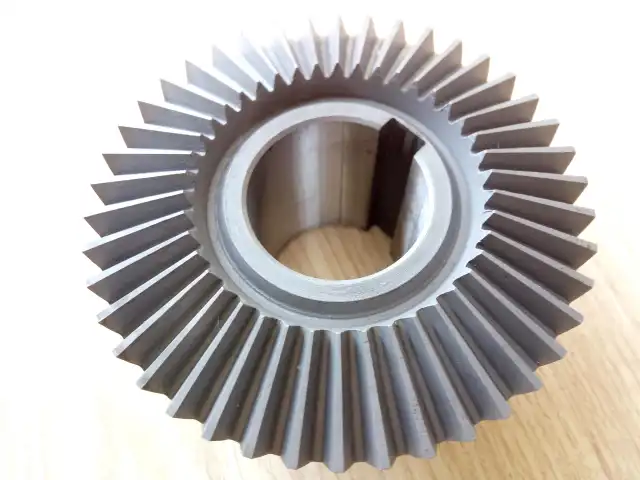
Understanding Straight Tooth Bevel Gears: Design and Functionality
For Straight Tooth Bevel Gears, the most important parts are their conical shape and straight tooth outline, which determine what they can and can't do when it comes to power transfer. The pitch surface is shaped like a cone instead of a cylinder, and the teeth spread out from the top of the cone. This geometric design lets torque be redirected between rods that cross at certain angles, though most industrial uses are for 90-degree setups.
Core Design Principles and Tooth Geometry
To get ISO 8–9 grade accuracy when making a Straight Tooth Bevel Gear, you have to use precise machine techniques like cutting, hobbing, milling, and grinding. The tooth shape usually follows the Gleason system standards, which spell out the involute curve needed for power transfer to go smoothly. Some important geometric factors are the module (which can be any size from 0.5 to 50 units), the number of teeth (which is based on application-specific gear ratios), and the pressure angle (which is usually 14.5° or 20°). The cone angle, addendum, and dedendum sizes all work together to make sure that the meshing is correct. This keeps the parts from sticking together and keeps enough backlash (0.10 mm to 0.20 mm) for heat expansion and the formation of a grease film.
Material Selection and Heat Treatment Protocols
Material science is very important for how well gears work when they are under a lot of stress. For moderate-duty jobs, we usually work with alloy steels like 45# steel. But for tough situations like mining and aircraft, we need more advanced materials like 20CrMnTi, 40CrNiMo, SAE4340, AISI4140, and 18CrNiMo7. These metals go through tough heat treatments like carburizing, cooling and tempering, or induction hardening to get their surface hardness to between 58 and 62 HRC. They also keep their tough cores that can handle shock loading. This two-part structure stops both surface wear and catastrophic tooth breaking, which increases the service life in rough environments like those found in mine conveyors or industrial presses.
Mechanical Advantages of Straight Tooth Configuration
Because the Straight Tooth Bevel Gear design doesn't use helix angles, it has lower axial thrust forces than spiral bevel options. This feature makes it easier to choose bearings and create housings, which lowers the cost of production and makes upkeep easier. Due to mostly rolling contact and little sliding friction, mechanical efficiency usually ranges from 98 to 99%, which is close to the theoretical maximum for gear systems. The small size makes it easy to place in tight spaces like machine tool spindle drives and agricultural equipment gearboxes, where right-angle power transfer needs to happen within small space limits.
Comparative Analysis: Straight Tooth Bevel Gear vs Other Gear Types
To choose the right gear technology, you need to know how Straight Tooth Bevel Gears stack up against other options in terms of measurable performance factors. Buying things depends on finding the right gear for the job and weighing the costs of the original investment against the costs over its lifetime.
Performance Benchmarking Against Spiral and Hypoid Gears
In comparison to the sudden contact of Straight Tooth Bevel Gears, spiral bevel gears introduce curved teeth with helix angles ranging from 15° to 35°, resulting in gradual engagement that greatly lowers noise and shaking. This makes circular shapes better for high-speed tasks going faster than 10 m/s or places that are sensitive to noise. But the circular shape creates a lot of axial thrust, which means that the bearings need to be stronger, which makes the system more complicated and expensive. Hypoid gears go even further by moving the shaft axes away from each other. This makes the operation even quieter and increases the power capacity, but it also requires special manufacturing tools and tighter assembly tolerances. The Straight Tooth Bevel Gear, on the other hand, is easier to make, costs less, and works well enough for medium- to low-speed tasks with acceptable noise levels. These are all qualities that are highly valued when buying expensive industrial machinery and mining equipment.
Cost-Benefit Analysis Across Gear Technologies
The difficulty of manufacturing has a direct effect on how prices are set. Straight Tooth Bevel Gears can be made using standard gear cutting and grinding methods that most machine shops have access to. However, spiral bevel production needs special generators and skilled workers, which drives up unit costs by 30 to 50 percent. Worm gear sets have high reduction ratios in small sizes, but they are less efficient (70–90%) and produce a lot of heat, so they need better lubrication systems. Helical gears work smoothly on shafts that are parallel to each other, but they can't handle the intersecting shaft shapes that make up bevel gear uses. Straight Tooth Bevel Gears are the best choice when a project needs to transmit rotational power without having to pay a lot or meet high performance standards.
Procurement and Specification Guide for Straight Tooth Bevel Gears
For procurement to work well, there must be clear technical specs that tell possible suppliers exactly what is needed. When specs aren't clear, parts don't match, projects take longer than planned, and costs go up. This is especially bad for mining and military projects that need a lot of money to complete. Selecting a reliable Straight Tooth Bevel Gear manufacturer ensures these specifications are met with technical precision.
Essential Technical Parameters for Procurement Documentation
Your design papers need to include information about the module's size, the number of teeth on the pinion and gear, the pressure angle, the material grade, the heat treatment needs, and the ranges of surface hardness. When choosing modules, you have to balance the load capacity with the module's actual size. Bigger modules are stronger, but they take up more space. The tooth count relationship tells you what gear ratio you need for your application. It must match your needs for speed decrease or power multiplication. The choice of pressure angle affects the strength of the teeth and the contact ratios. For example, 20° pressure angles can handle more weight than 14.5° angles while still allowing for decent moving speeds. Instead of using unclear terms, material specs should list industry-standard alloys like AISI8620, 20CrNi2Mo, and SAE4320. This will help sellers find the right stock. Surface hardness requirements are usually between 45 and 50 HRC for regular industrial use and between 58 and 62 HRC for heavy-duty mining uses that are subject to shock loads and abrasive contamination.
Supplier Evaluation and Quality Assurance Criteria
Checking out possible Straight Tooth Bevel Gear suppliers means looking at their production skills, quality control methods, and name in the industry. Basic quality management systems are shown by ISO 9001 certification, while ISO/TS 16949 or AS9100 certifications show skills that can be used in aerospace and car applications. CNC gear cutting centers, precise grinding tools, and automated heat treatment lines that can keep process controls tight should all be in the inventory of production equipment. Inspection tools like coordinate measuring machines (CMM), gear rolling tests, and magnetic particle inspection equipment are all important. They check important things like tooth contact patterns, runout limits, and the quality of the material. Established makers usually offer production times between 35 and 60 days, balancing the need to optimize tasks with the need to meet customer shipping standards. Minimum order numbers depend on how complicated the product is, but some specialized providers can make one unit for testing prototypes or fixing things.
Customization Pathways and Technical Support
Standard stock gears don't always perfectly fit the needs of a specific application. This is why the ability to customize is such an important way for sellers to stand out. Usually, the customization process goes through stages like communicating needs, making design drawings, production machining, quality checking, packing, and shipping. Technical teams should talk about working conditions like speed, torque, task cycles, environmental factors, and room limitations when they talk about requirements. These inputs are turned into specifications that can be manufactured using design drawings. Often, these drawings need to be improved over and over again to find the best mix between performance goals, production feasibility, and cost goals. Having access to engineering help throughout this process speeds up development and cuts down on costly mistakes in the specifications.
Maintenance and Performance Optimization for Straight Tooth Bevel Gears
Even Straight Tooth Bevel Gears that are properly designed and built need to be maintained in an orderly way in order to last as long as they are supposed to. Early breakdowns are usually caused by not enough lubrication, imbalance, or contamination, all of which can be avoided with regular upkeep.
Lubrication Strategies and Contamination Control
When you lubricate properly, you keep the oil films that split metal surfaces in good shape. This stops adhesive wear and gets rid of frictional heat. Straight Tooth Bevel Gears usually work inside of sealed housings that have splash lubrication for slower speeds or forced circulation systems for tough jobs. Choosing the right lubricant relies on the temperatures, loads, and speeds of the machine. Industrial gear oils between ISO VG 220 and VG 680 are good for most uses, and extreme pressure additives keep mine equipment safe from shock loading. Oil research tools find wear particles and contamination early on, so they can be fixed before they cause major problems. Regular checks of housing seals are needed to make sure that dust, wetness, or process materials don't get in and speed up abrasive wear. This is especially important in mining settings where coal dust or mineral particles are common.
Alignment Verification and Vibration Monitoring
When joint gears aren't lined up correctly, contact forces build up on the edges of the teeth, which leads to early pitting and, eventually, tooth breakage. As part of the installation process, the mounting lengths, alignment of the shaft within acceptable angles, and backlash must all be checked. Precision measurements can be made during building with the help of dial markers and special fixtures. Once the machine is up and running, it uses vibration tracking to find problems as they happen. The standard vibration signatures that are set up during commissioning are used as a starting point for condition-based maintenance plans. Changes in frequency bands or big increases in sound amplitude are signs of problems that need to be looked into, like worn-out bearings, broken teeth, or fasteners that are coming loose.
Surface Treatment Technologies for Extended Service Life
Advanced surface treatments make surfaces more resistant to wear than simple heat treatment can. Shot peening adds good leftover compressive stresses that boost fatigue strength by up to 30%. This is especially helpful in aircraft uses that need smaller gear sections to work at higher stress levels to save weight. Specialized coatings, like phosphate conversion layers, make it easier for things to break in and stop rusting while they are being stored or in chemically harsh conditions like those found in some mine operations. These methods don't add much to the cost of ownership, but they do make the service life longer in difficult situations, which lowers the total cost of ownership.
Applications and Industry Use Cases of Straight Tooth Bevel Gears
Straight Tooth Bevel Gears are useful for fixing problems with angular power transfer because they can be used in many different industries. Real-life examples show how choosing the right gear and integrating it correctly can lead to measured operational gains.
Industrial Machinery and Manufacturing Equipment
Straight Tooth Bevel Gears are often used in machine tool spindle drives to move power from horizontal motors to vertical grinding spindles. This lets machines be set up in small spaces that make the most of the space on the factory floor. The zero helix angle gets rid of the axial forces that would prime spindle bearings. This keeps the accuracy even after longer service intervals. In the same way, these gears are used in material handling systems in conveyor drive units and transfer mechanisms, where right-angle drives move equipment around building restrictions or structural problems. The strong load-bearing ability can handle the shock loads that happen during start-stop operations and emergency stops.
Mining Equipment and Heavy-Duty Operations
In mines, mechanical parts have to deal with harsh conditions like big loads, abrasive contaminants, shock impacts, and constant job cycles. Straight Tooth Bevel Gears are used in equipment that processes materials, drives for crushers, and conveyor systems because they are simple and easy to keep. The simple bearing arrangements can handle errors better than more complicated gear types when the structure bends or the base settles. Mineral dust can cause abrasive wear, but materials that are through-hardened or case-carburized can prevent this. This means that maintenance times can be extended and downtime can be cut down in situations where production stops cost a lot of money.
Aerospace Ground Support and Specialized Applications
Ground support equipment benefits from Straight Tooth Bevel Gear economy, while aircraft flight systems primarily use spiral bevel gears for weight savings and smooth operation. When operating speeds are low and cost is important, these gears are used in hydraulic power units, cargo handling systems, and repair tools. The easier production and inspection processes cut down on wait times for buying parts and the cost of keeping extra parts in stock, which are both important for equipment support companies that have to manage a variety of fleets that are only used sometimes.
Conclusion
In industries like mining, aircraft, and industrial gear, Straight Tooth Bevel Gears continue to play important parts in the transfer of angular power. This is because their natural benefits match the needs of the job. The straight-toothed design makes it easier to make, saves money, and has strong mechanical efficiency that can hit 98–99% in well-maintained systems. Improvements in material science and precise production techniques have made it possible to get ISO 8–9 grade accuracy and surface hardness of up to 62 HRC, which meets strict performance requirements. When making strategic purchasing choices, you have to compare practical factors like speed ranges, torque loads, duty cycles, and environmental conditions to gear characteristics. This is to make sure that the capabilities of the parts are perfectly matched to the needs of the application. Careful maintenance, such as regular greasing, alignment checks, and pollution removal, extends the life of an asset while lowering the total cost of ownership.
FAQ
1. What materials work best for heavy-duty straight tooth bevel gear applications?
Low-carbon alloy steels that go through a carburizing heat treatment, like AISI8620, 20CrMnTi, or SAE4320, work well in heavy-duty mining and industry machines. This process makes surfaces that are hard and won't wear down (58–62 HRC), while keeping cores that are tough and won't break easily. This mix stops both surface wear from rough contaminants and tooth breakage from contact loads. When choosing a material, it's important to think about the working temperature, the amount of corrosion it will be exposed to, and the availability of heat treatment facilities that can keep accurate process controls for a heavy-duty Straight Tooth Bevel Gear.
2. How do I determine appropriate gear size and specifications for my application?
When writing specifications, the first thing that comes to mind is the practical factors, such as the input and output speeds, torque needs, shaft intersection angle, available space, and projected service life. Figure out how many teeth are needed to get the gear ratio you want by figuring out the required module based on the transferred force and the strength of the material. To make sure that contact strains and bending loads stay within safe limits, look at AGMA guidelines or work with engineering teams. Before committing to production numbers, prototype testing makes sure that designs work. This is especially important for unique uses that don't have any previous examples.
3. Can straight tooth bevel gears be manufactured to custom specifications?
Of course. Because applications have such different needs, customization is normal for these parts. The process usually includes talking about what needs to be done, making technical drawings, cutting for production, a strict quality check, and carefully packing the item to be sent. Different needs can be met by modules ranging from 0.5 to 50, custom tooth numbers, and different material grades. For prototyping or repairs, many providers will take low minimum order numbers, even one unit at a time. Production times range from 35 to 60 days, based on how complicated the job is and how much work needs to be done.
Partner with YIZHI MACHINERY for Your Straight Tooth Bevel Gear Requirements
YIZHI MACHINERY has been making custom gears for 15 years and provides high-quality Straight Tooth Bevel Gear options to the mining, aircraft, and industrial machinery industries. Our manufacturing methods are ISO-compliant and use cutting edge CNC gear cutting centers, automated grinding machines, and smart heat treatment lines to make sure that the parts we give meet strict requirements. We use high-quality materials like 20CrMnTi, AISI8620, and SAE4340. These are heated and cooled to achieve a surface hardness of 58 to 62 HRC while keeping the core stiffness. The technical abilities cover modules from 0.5 to 50, with Gleason profile standards and tooth configurations that can be changed to fit your exact operating needs. As a Straight Tooth Bevel Gear maker with a lot of experience, we offer full support from design advice to production, quality control, and global logistics with real-time tracking. Customized packing with shock-absorbing liners and scratch-resistant materials keeps goods safe during multiple modes of travel. Delivery times between 35 and 60 days can be adjusted to fit project plans, and our flexible method allows for low minimum amounts and even production of a single unit. Contact us at sales@yizmachinery.com to talk about your needs and find out how our technical knowledge can help you get the best performance from your tools and save you time on purchases.
References
1. Dudley, D.W. (1994). Handbook of Practical Gear Design and Manufacture. CRC Press, Boca Raton.
2. American Gear Manufacturers Association. (2005). AGMA 2005-D03: Design Manual for Bevel Gears. Alexandria, VA.
3. Stadtfeld, H.J. (2014). Gleason Bevel Gear Technology: Manufacturing, Inspection and Optimization. The Gleason Works, Rochester.
4. ISO 17485:2006. Bevel Gears — ISO System of Accuracy. International Organization for Standardization, Geneva.
5. Townsend, D.P. (1991). Dudley's Gear Handbook: The Design, Manufacture, and Application of Gears. McGraw-Hill, New York.
6. Litvin, F.L. & Fuentes, A. (2004). Gear Geometry and Applied Theory. Cambridge University Press, Cambridge.

USER EVALUATE
Here is the customer's evaluation of us