


Shaft Mounted Gearbox: Uses, Benefits & Buying Guide
A Shaft Mounted Gearbox, also called a shaft mount reducer, is a closed helical gear reduction unit that is made to fit directly onto a machine's driven shaft. Unlike other foot-mounted options that need precise alignment, baseplates, and connections, this gearbox part connects via a torque arm, which eliminates the need for complicated installation steps. This new design solves some of the biggest problems that manufacturers of conveying and packaging equipment are having: it lowers the cost of making motor mounts, gets rid of the need for expensive flexible couplings, and cuts installation times by a huge amount. The shaft-mounted configuration fixes vibration problems caused by misalignment and provides reliable torque transmission in tough production environments for procurement managers and mechanical design engineers who work in material handling and light industrial automation.
Understanding Shaft Mounted Gearboxes: Basics and Benefits
Core Components and Operating Principles
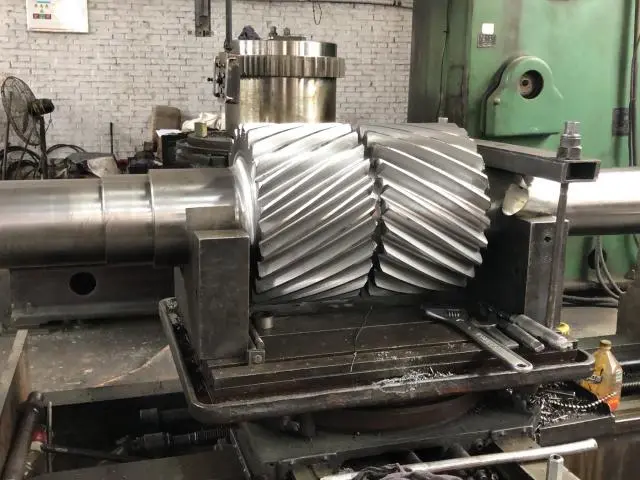
The basic structure of a Shaft Mounted Gearbox is made up of precisely cut helix gears inside a cast iron or ductile iron case. We at YIZHI MACHINERY make these units with high-quality materials like 20CrMnTi, 40CrNiMo, and SAE4340 alloy steels. These are then forged, hobbed, milled, and ground to achieve ISO 6 Grade precision. The gears are heated in a special way, like carburising, cooling and tempering, or induction hardening. This makes the surface hardness between 58 and 62 HRC, which makes them very resistant to wear.
The gearbox is what makes the process work. It is attached directly to the output shaft of conveyors or other driven equipment. Reaction forces are absorbed by a torque arm that is attached to the machine frame. This lets the whole assembly "float" with the system while keeping the belt tension constant. This setup gets rid of the need for laser alignment steps that take up valuable engineering time during the setup and start-up phases.
Configuration Types and Industrial Suitability
In industrial settings, three main configurations are used most often. For horizontal conveyors in packaging lines, parallel shaft arrangements are the best way to send power in a straight line. Right-angle configurations work well in places where the direction needs to change by 90 degrees, like in bulk material elevators and agricultural processing equipment. The most common type of gear in our production catalogue is the helical gear, which distributes loads better and operates more quietly than spur gears. Helix angles can be anywhere from 5° to 45°, based on the needs of the application.
Key Advantages for Equipment Manufacturers
The shaft mount design gives you measurable benefits that have a direct effect on your bottom line and the efficiency of your operations. Here are the main benefits that are driving growth in the packaging and conveying machines industries:
1. Compact Spatial Footprint: The direct-mount design takes up 40% to 50% less room for installation than foot-mounted units with separate motor bases. This space-saving technique is very useful for retrofitting situations where regular mounting setups can't work with current production lines.
2. Simplified Installation Protocol: Our clients regularly say that the time it takes to install each unit has gone from 8 to 12 hours to 2 to 3 hours. When you don't have to make baseplates, grout them, or align them precisely, you save money on labour and time during equipment commissioning.
3. High Torque Capacity with Zero Backlash: We achieve gearbox stiffness levels that stop the link backlash that happens with lower-quality reducers by precisely grinding and carburising the parts. This quality is very important for tracking conveyors and packing equipment that needs to be placed precisely.
4. Superior Transmission Efficiency: Our Shaft Mounted Gearboxes keep 96–98% efficiency per reduction stage, which means they lose less power and use less energy, which is very important when you look at how much electricity costs for businesses in the US right now.
5. Maintenance Accessibility: Synthetic lubricants and sealed bearing arrangements make service intervals up to 2,500 hours after the initial break-in. There are easy access points for oil changes and inspection procedures that maintenance technicians can do without special tools.
All of these benefits work together to solve the operational problems that supply chain managers face when they try to lower the total cost of ownership while keeping production reliability standards high. The small size is especially helpful for manufacturers of material handling equipment who work in small production spaces where every square foot of floor space is valuable.
Applications and Industry Use Cases
Conveyor Systems and Material Handling
Shaft Mounted Gearboxes are the most common way to power belt conveyors, screw conveyors and bucket elevators in a wide range of industries. These reducers power incline conveyors that move rough materials under high-shock loads in aggregate and mining operations. The built-in barrier, which is a sprag clutch that stops spinning in the opposite direction, is an important safety feature for when the power goes out and the fully loaded belts would normally turn around.
In one well-known example, standard foot-mounted drives kept breaking down in a cement processing plant because the structure was moving out of place. The facility got rid of fretting corrosion problems and increased bearing life by 300% after installing shaft mount reducers with twin taper bushing systems. This cut annual maintenance costs for twelve conveyor lines by about $47,000.
Packaging Equipment Integration
More and more, companies that make packaging equipment ask for shaft-mounted designs for filling lines, case packers, and palletising systems that only need to do light work. The zero-backlash feature makes sure that the product is placed accurately even when operations are going quickly, and the small design fits into the tight spaces that are common for packaging equipment frames.
A regional packaging equipment OEM worked with YIZHI MACHINERY to make custom reducers for their case erector product line. The reducers had to have different output bore sizes and certain ratio combinations. Their engineering team was able to quickly test ideas before committing to large-scale production because we could make custom orders of just one unit without a minimum order number.
Agricultural and Light Industrial Machinery
Shaft Mounted Gearboxes are used to power grain augers, feed mixing equipment, and irrigation pumps in agricultural processing. These machines are exposed to dust, water, and extreme temperatures, so they need to be built to last. The housing made of cast iron effectively reduces vibrations and keeps the internal parts clean, which is very important for equipment that works outside or in partially enclosed spaces.
Companies that use these reducers in robotic pick-and-place systems and automatic assembly lines benefit from their low noise operation (usually below 75 dB), which makes the workplace better and meets OSHA standards without the need for extra soundproofing.
Comparing Shaft Mounted Gearboxes with Other Drive Types
Structural and Installation Distinctions
For foot-mounted gearboxes to work, they need rigid mounting platforms, motor alignment that is accurate to within 0.002-inch, and flexible couplings that can handle small alignment errors. This setup works well for stable uses, but it makes things more complicated and costs more. Inline gearboxes are small and easy to install, but they are hard to service and need the whole drive to be taken out for maintenance.
Shaft-mounted units get rid of 60–70% of the installation parts and are better at adapting to the tension needs of belt drives. The torque arm link allows controlled radial movement for belt change without messing up the gear mesh patterns. This is especially helpful for operations that work multiple shifts and needs to keep things in good shape.
Performance Metrics Comparison
96–98% per stage is the same for both quality shaft-mounted and foot-mounted helical gears when it comes to efficiency rates. However, the belt-drive input feature of shaft mount configurations protects against overloading by absorbing shock loads that would damage direct-coupled drives otherwise. This shock reduction makes motor bearings last longer and cuts down on unnecessary trips in VFD-controlled settings.
Specifications for load ability should be carefully looked over. While foot-mounted units can handle higher absolute torque values, shaft-mounted reducers that are the right size can handle 2-100 HP, which is 90% of all conveyor and packing uses. Our engineering team helps clients figure out the right size for Class II and Class III job cycles by using AGMA standards to calculate service factors.
Leading Brand Considerations
Major companies like SEW-Eurodrive, Flender, and Bonfiglioli keep their strong market positions by offering a wide range of products and having well-established delivery networks. These brands offer a wide range of warranties and technical support services all over North America.
YIZHI MACHINERY stands out because it can customise products in ways that big manufacturers can't afford to do. With 15 years of production experience, we can make changes to standard designs, such as unique bore sizes, specific ratio combinations, and material choices that are best for the job. Production wait times are 35 to 60 days, and you can order as few as one unit. This adaptability is very important for equipment OEMs that are making specialised machines or replacing old parts when original makers no longer support models that have been taken off the market.
Procurement and Buying Guide for Equipment Manufacturers
Selection Criteria and Technical Specifications
Correctly describing the application is the first step in choosing the right reducer. These important factors should be gathered by procurement managers:
1. Torque Requirements: Figure out the output torque by using the required service factor, the diameter of the drive pulley, and the tension of the conveyor belt. AGMA suggests service factors of 1.5 to 2.0 for packing equipment that is only used sometimes and 2.0 to 2.5 for equipment that is used all the time to move heavy things and is subject to high shock loads.
2. Environmental Conditions: The choice of material and seal configurations is affected by the ambient temperatures, the amount of dust contact, and the dampness. Our 20CrMnTi and AISI4140 materials offer better corrosion resistance for harsh environments without charging more.
3. Mounting Configuration: Check the driven shaft width, the room that's available for the torque arm, and the distance between the centers of the belts. During the quotation process, YIZHI MACHINERY experts provide thorough dimensional sketches to make sure the parts will fit before committing to production.
Pricing Strategies and Lead Time Optimization
Prices for Shaft Mounted Gearboxes range from $800 to $4,500 per unit, depending on the size, ratio, and level of customisation needed. Volume discounts usually start at 10 units, and for annual contracts that cover 50 units or more, discounts of 15 to 20 percent are available.
Standard catalogue items ship in 35 to 45 days, but custom setups take 50 to 60 days, which includes time for engineering approval and tooling preparation. Strategic planning for buying things—like placing an order during the design stages of equipment instead of when it's all put together—avoids costly delays in production and speed charges.
Our flexible manufacturing method lets us make prototypes in small numbers for OEM product development. This way, we don't have to worry about the inventory risk that comes with big minimum orders while designs are still being tested.
Installation and Maintenance Protocols
Proper placement has a direct effect on how long something works. Important steps include:
To keep the torque arm from buckling under pressure, make sure it is installed in tension instead of compression relative to the direction of spin. When you use twin taper bushing systems instead of normal cylindrical bushings, you avoid fretting rust, which is what makes reducers stick to shafts when you try to remove them. This seemingly small detail cuts down on maintenance work hours by a large amount during replacement cycles.
At 500 hours of use, the oil is changed for the first time to get rid of break-in metal particles. After that, ISO VG 220 synthetic gear oil is used every 2,500 hours. Industry service data shows that keeping the right oil amounts in your bearings stops them from breaking down too soon, which is the main cause of problems in the field.
Verifying the tightness of the belt by measuring its deflection (1/64-inch per inch of width) keeps the load evenly distributed across the gear teeth. Over-tensioning speeds up the wear on the bearings, while under-tensioning lets the belt slip and causes the machine to work in strange ways.
Supplier Evaluation and Quality Verification
1. Manufacturing Process Documentation: Reliable sources give mill certifications for gear materials, heat treatment reports that show case depth and hardness profiles, and CMM inspection reports that confirm limits for hole concentricity. At YIZHI MACHINERY, we use quality control methods that are in line with ISO standards. From receiving the raw materials to sending the finished product, everything can be tracked.
2. Testing Protocols: Each unit goes through a no-load run test where noise levels, sound patterns, and bearing temperature stability are all watched. Air-pressure leak testing makes sure that the seal is still in place, which is very important for units that work at angles where oil starvation could happen.
3. Technical Support Capacity: Look at how responsive the supplier was during the quote phase to get an idea of how good their support will be after the sale. Our engineering team offers CAD models, installation help, and application troubleshooting all the way through the lifecycle of the equipment, not just when it is first bought.
Conclusion
When makers of conveying equipment, packaging equipment and material handling operators want reliable gearbox solutions with easier installation requirements and lower total cost of ownership, Shaft Mounted Gearboxes are the best choice. The direct-mount design gets rid of the usual problems with alignment while keeping the high efficiency and load capacity needed for tough industrial uses. To make execution work, you need to pay close attention to the right size using the right service factors, choose a provider that focuses on customisation options and strict quality control, and follow the installation and maintenance instructions that were given. As production environments continue to demand more space efficiency and shorter commissioning times, shaft mount reducer technology is the practical answer that meets both performance and operational needs.
FAQ
1.What determines appropriate service factor selection?
The job cycle classification and loading features affect the choice of service factor. Continuous conveyors that handle rough materials need 2.0 to 2.5 service factors, while intermittent packaging equipment only needs 1.5 factors. Applications with a lot of start-stop cycles, like crushers or mixers, need 2.5 to 3.0 factors to keep the gears from wearing out too quickly. Our engineering team helps make sure that AGMA classification and factor finding are done correctly.
2.Can shaft mounted gearboxes accommodate bidirectional rotation?
The spiral gearing itself can work in either way without any problems. But units with built-in backstop mechanisms (also called anti-runback devices) can only work in one direction. Before starting up, the backstop position must be checked to make sure there is no major damage inside. Clearly state rotational needs during buying to make sure the right backstop arrangement or removal.
3.How does customization affect lead times and minimum orders?
YIZHI MACHINERY keeps its making options open so that it can make unique items one at a time without charging more. Base wait times are extended by 5 to 10 days for standard changes, such as custom hole sizes, specific ratios, or material swaps. Schedules may be pushed back to 60 days for changes that are complicated and need custom tools. This method takes away the risk of inventory for equipment OEMs during the prototype development stages.
Partner with YIZHI MACHINERY for Reliable Transmission Solutions
Gearbox parts for your tools should be made to be precise and last a long time. With 15 years of experience in specialised production and the ability to make any changes needed, YIZHI MACHINERY can provide Shaft Mounted Gearbox solutions that are perfect for any purpose. Our quality control methods are ISO-compliant, and they make sure that every reducer, from samples to large production runs, meets strict performance standards. We use high-quality materials like 20CrMnTi, AISI4140, and SAE4340 alloy steels.
We know how hard it is for purchasing managers and mechanical design engineers to meet strict deadlines, follow exact technical specifications, and make sure that products work reliably. Our streamlined approach includes requirement gathering, design drawings, production machining, quality inspection, custom protected packing, and real-time shipment tracking. This makes the whole buying process clear and accountable. Our multi-channel logistics and damage protection guarantees, along with production wait times of 35 to 60 days, make sure that your parts come on time and in perfect condition.
Our technical team can help you find a Shaft Mounted Gearbox manufacturer for large-scale production or if you need custom configurations for specific uses. They can do this by giving you engineering support, CAD models, and application advice. Contact us at sales@yizmachinery.com or visit yizhimachinery.com to talk about your gearbox needs and get full quotes that are made just for you.
References
1. American Gear Manufacturers Association. (2019). AGMA 6001-E08: Design and Selection of Components for Enclosed Gear Drives. Alexandria, VA: AGMA Publications.
2. Dudley, D. W. (2020). Handbook of Practical Gear Design and Manufacture (3rd ed.). Boca Raton, FL: CRC Press.
3. Machinery's Handbook Editorial Staff. (2021). Machinery's Handbook 31st Edition: A Reference Book for the Mechanical Engineer, Designer, Manufacturing Engineer, Draftsman, Toolmaker, and Machinist. New York, NY: Industrial Press.
4. Norton, R. L. (2018). Machine Design: An Integrated Approach (6th ed.). Boston, MA: Pearson Education.
5. Shigley, J. E., & Mischke, C. R. (2017). Mechanical Engineering Design (11th ed.). New York, NY: McGraw-Hill Education.
6. Society of Manufacturing Engineers. (2020). Fundamentals of Tool Design (7th ed.). Dearborn, MI: SME Publications.

USER EVALUATE
Here is the customer's evaluation of us