


Precision Internal Gear: Everything You Need To Know
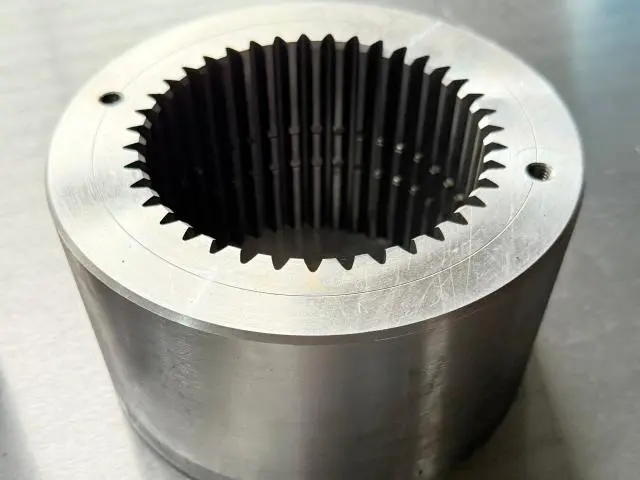
Precision Internal Gears are the elegant answer for engineers and procurement managers who need to get the most power into an area that isn't very big. A Precision Internal Gear is a special kind of power transmission part that has teeth cut into the inside of a cylinder-shaped ring or case so that it can mesh with an outside gear. Unlike most external gears, these parts are accurate to ISO 6 Grade or higher, which means they can handle a lot of weight while still being very small. This special tooth shape that faces inward lets planetary gear systems, robotic actuators, and heavy-duty winches work with less backlash and higher efficiency. It solves important design problems in industrial machinery, mining equipment, and aerospace applications where every millimeter and percentage point of efficiency matters.
Introduction
Industries demand compact, high-performance power transmission. Precision Internal Gears are critical for mining equipment, aerospace actuation, and industrial machinery. Procurement teams face challenges: sourcing consistent quality with customization flexibility, navigating technical specifications, and ensuring longevity in harsh conditions. This guide addresses these issues with practical insights on tooth geometry, material selection, procurement strategies, and supplier evaluation for real-world applications.
Understanding Precision Internal Gears
What Defines Internal Gear Architecture?
The main difference between Precision Internal Gears and other types is that their teeth are arranged in a different way. Internal gears have teeth that are cut into the inside diameter of a ring, while external gears have teeth that stick out from a cylinder body. When this design meshes with a pinion, it makes a concave-convex contact pattern, which changes the way loads are distributed in a basic way. Multiple teeth can share transferred forces at the same time because of the shape. This makes the contact ratio higher than with external gear pairs of the same size.
Tooth profiles are made using involute curves that are produced by standard pressure angles, which are usually 20 degrees. This combines how well the loads are shared with how complicated the manufacturing process is. To avoid involute interference, which is when tooth tips hit each other during rotation instead of smoothly passing motion, the addendum and dedendum measurements need to be carefully calculated. Profile shift coefficients are important design factors that help engineers find the best center distances while keeping the right blowback clearances.
Materials and Manufacturing Excellence
Alloy steels (42CrMo, 20CrMnTi, AISI 4140) offer optimal core toughness and surface hardenability. Carburizing creates 58-62 HRC wear-resistant cases with tough cores for shock resistance. Quenching/tempering refines grain structure; induction hardening strengthens specific tooth flanks. Manufacturing begins with hobbing/cutting, followed by heat treatment and finish grinding to ISO 6 Grade. CNC grinding maintains profile deviations within 5-8 microns for batch-to-batch consistency and vibration-free operation.
Critical Design Parameters
Modules 0.5-50 determine tooth size and load capacity—larger modules handle more power but increase package size. Helix angles 5°-45° add axial loads while reducing noise through gradual engagement. Pitch accuracy ensures center distance precision; controlled backlash prevents thermal expansion binding. Surface finishes below Ra 0.8 microns reduce wear initiation sites. CMM inspection verifies cumulative pitch error and radial runout, ensuring geometric accuracy translates to smooth operation.
Applications and Benefits of Precision Internal Gears
Industrial Machinery Transmission Systems
Precision Internal Gears are used in planetary reducers that power conveyor systems, automatic assembly lines, and CNC machine tool feed mechanisms. They are used as the fixed housing in these systems. Manufacturers of gearboxes can make them with 10:1 reduction ratios in packages that are 40% smaller than spur gear setups of the same size. This use of space effectively is very useful in robotic arm joints where carrying capacity is directly limited by envelope constraints.
For machine tool uses, positioning precision must be very high. When ISO 6 Grade standards are followed when making internal gears, the backlash is less than 3 arc-minutes. This lets servo systems keep positional repeatability within ±5 microns over thousands of index cycles. Internal-external mesh patterns have a high contact ratio that spreads loads across multiple tooth pairs at the same time. This stops vibrations that would otherwise ruin the quality of the surface finish in precision cutting operations.
Mining Equipment Durability
Mining transmissions face shock loads, constant duty cycles, and abrasive contamination. Internal gears in planetary drives have ring housings protecting against impact damage. Load-sharing tooth geometry prevents catastrophic failure—if one tooth cracks, adjacent teeth continue transmitting power. Surface hardness 58-62 HRC resists abrasive wear from mineral dust. Carburizing creates case depths exceeding 1.5mm, ensuring material remains after wear, extending service life in remote operations.
Aerospace Actuation Precision
In aerospace uses, weight-to-performance rates are very strict, and reliability is very important. Flight control actuators and landing gear retractions use internal gears inside small planetary stages to increase power while lowering the amount of spinning inertia. Every kilogram saved in control systems means more payload or a longer range. These are economic benefits that make it worth paying more for aerospace-grade parts.
Internal gearing's better mesh kinematics slows down the moving speeds between teeth that fit together, which lowers friction losses and heat production. This efficiency gain is very important for electrically-driven systems whose battery life limits how long they can work. Noise-reducing features are also useful in passenger planes, where noise-reducing features are needed for hydraulic pump drives and environmental control system fans to keep the cabins comfortable.
Here are the core operational benefits that make internal ring gears indispensable across these demanding sectors:
- Compact Package Dimensions: Internal gearing cuts down on center distances by placing the pinion inside the ring. This makes it possible for transmission designs to be 30–50% smaller than external gear versions while still having the same torque ratings. This is very important when installation room limits system performance.
- Enhanced Load Distribution: The concave-convex contact pattern and surrounding ring structure let 3-5 tooth pairs share loads at the same time. This lowers Hertzian contact stresses by 20–35% compared to external meshes, which directly increases wear life under cycle loading conditions.
- Superior Noise Characteristics: Gradual engagement across helical tooth widths and higher contact ratios lower sound pressure levels by 5 to 10 dB. This meets NVH requirements in places like passenger vehicles, medical equipment, and aerospace cabins where noise comfort affects user acceptance.
- Flexible Ratio Options: Designers can choose from a range of tooth counts to get the exact speed drops needed for the job. Common single-stage setups have ratios from 3:1 to 10:1, which means that multi-stage gears are not needed, which add weight, cost, and efficiency losses.
All of these benefits work together to solve one of the biggest engineering problems in modern transmission design: getting the most power into a space while still meeting dependability standards that keep the system from going down without warning. When procurement teams figure out the lifecycle costs, it's easy to see how the decision affects the economy. Investing more in Precision Internal Gears at the start usually pays off in the long run because they require less maintenance, last longer between replacements, and make the system more efficient, which means it uses less energy over many years of use.
Comparing Precision Internal Gears with Alternative Solutions
Engineers use Precision Internal Gears for compact power transmission without losing torque stability or service life. Modern drivetrain design offers more options. Understanding how they compare to external gears, harmonic drives, and cycloidal systems helps procurement teams and engineers balance technical and financial considerations based on application needs.
Internal Gears vs External Spur and Helical Gear Systems
Because the pinion is within the ring gear, Precision Internal Gears are more compact than spur or helical gear systems. This construction minimises centre distance and lets transmission systems provide equivalent torque in a smaller footprint. Space economy may simplify machine design in machine tool feed systems and hoisting equipment. External gear trains are simpler to make but need bigger housings and alignment support, increasing system size and vibration risk under strong loads.
Internal Gears vs Harmonic Drive Mechanisms
Robotics and precision instruments use harmonic drives due of their near-zero backlash and great positional accuracy. The flexible spline construction limits fatigue under constant high-torque settings. However, ISO 6 Grade Precision Internal Gears made of carburized steel like 20CrMnTi or 42CrMo provide a better blend of stiffness, load capacity, and longevity. Internal gears provide longer-term stability and decrease shock loading failure risk in industrial equipment and mining systems.
Internal Gears vs Cycloidal Gear Systems
Heavy-duty reducers employ shock-resistant cycloidal gear sets. They work well in severe settings but have lower transmission efficiency than Precision Internal Gears. Continuous multi-tooth engagement and optimised involute shape improve internal gear system efficiency and smoothness. Internal gears reduce noise and wear over lengthy operation cycles with adequate heat treatment and grinding. They are better for high-duty industrial applications that need energy efficiency and operational stability.
Procurement Guide for Precision Internal Gears
Supplier Evaluation Criteria
Evaluate suppliers on CNC gear grinding capability—essential for precision finishing. Request examples achieving ISO 6 Grade with inspection reports showing profile/helix deviations. Material certificates must verify alloy composition per AISI/DIN standards. Customization options matter—stock gears rarely meet specific needs. Engineering staff should optimize tooth forms for your application. Minimum order flexibility—single-piece samples support development; 100-unit minimums suit production programs.
Navigating Technical Specifications
Define operating conditions: power, speeds, duty cycles, environment. Specify materials by application—20CrMnTi for mining impact protection; vacuum-melted AISI 9310 for aerospace fatigue performance. Set hardness targets: 58-62 HRC for heavy-duty; 45-50 HRC where impact resistance exceeds wear concerns. ISO 6 Grade suits most industrial uses; ISO 4 tolerances add cost. Choose helix angles balancing noise reduction against axial thrust loads requiring robust bearings.
Cost Optimization Strategies
olume purchasing of Precision Internal Gears from single sources reduces per-unit costs. Custom packaging—wooden pallets with shock-absorbing liners—prevents shipping damage to precision internal gears. Clear currency terms manage foreign exchange risks. Flexible lead times for precision internal gear orders yield discounts; short deadlines incur premiums. Suppliers stocking popular materials accelerate repeat orders of precision internal gears. Evaluate total landed cost including freight, duties, and clearance—not just FOB price. Slightly higher pricing from operationally superior precision internal gear suppliers often delivers better overall value.
Maintenance Tips and Quality Assurance for Long-Term Performance
Inspection and Quality Verification
Incoming inspection checks for grinding burns (blue/brown discoloration) indicating excessive heat reducing case hardness. Magnetic particle testing finds subsurface cracks—critical for aerospace/mining applications. CMM verification of tooth profiles and helix angles creates K-charts comparing measured values against theoretical geometry. Total cumulative pitch error must stay within tolerance—excessive deviation causes transmission error. Radial runout tests confirm bore-to-tooth concentricity, preventing high-speed vibration.
Lubrication and Operational Care
Synthetic gear oils rated for high-pressure service suit most industrial uses; aerospace may require flame-resistant lubricants. Ensure lubrication reaches all mesh points—planetary designs need oil directed into internal gear housings where centrifugal forces could starve meshes. Particle filtration prevents abrasive wear; breather filters exclude moisture. Regular oil sampling monitors condition—rising iron content indicates accelerating wear requiring investigation before catastrophic failure occurs.
Preventative Maintenance Scheduling
Baseline measurements during commissioning establish normal signatures, and continued vibration monitoring reveals tooth wear, misalignment, and bearing degradation. Heat from inadequate lubrication or overload is detected by thermal imaging. Condition-based maintenance replaces parts at real condition, not intervals. Well-maintained internal gears last 20,000+ hours. Mine equipment may require 5,000-hour inspections; precision machine tools 15,000 hours.
Conclusion
Precision Internal Gears solve important engineering problems in the mining, aircraft, and industrial machinery industries by providing high torque levels in small spaces. Their special shape helps distribute load better, which extends their useful life in tough working conditions. Also, improvements in manufacturing have made fine grinding more affordable. To do a good job of procurement, you need to know the technical specs, look at what the supplier can do beyond unit price, and put in place quality assurance procedures that keep broken parts from making the system less reliable. Engineers like how these parts allow for more design freedom; buying managers like how they save money over the lifetime of a product; and OEM decision-makers like how they help differentiate products from competitors by making systems work better.
FAQ
1. What materials work best for precision internal gears in mining equipment?
Alloy steels like 20CrMnTi and SAE 4320 are good for mining because they are tough in the middle and can be hardened on the outside. Carburizing heat treatment makes case layers for Precision Internal Gears that are 58–62 HRC hard, which protects against wear from mineral dust while keeping cores that are flexible enough to handle shock loads from quick stops or rock hits without breaking.
2. How do helix angles affect internal gear performance?
Helix angles between 5 and 45 degrees make tooth contact more slow, which lowers noise levels by 5 to 10 dB compared to spur designs. Steeper angles make the process quieter, but they also create axial thrust loads that need a strong bearing choice. Medical equipment that needs to be quiet uses 30-45 degree helixes, while cost-conscious industrial gear that can handle higher noise levels uses simpler spur designs.
3. What inspection methods verify internal gear quality?
Coordinate measuring tools look at tooth profiles and make K-charts that show the difference between the real geometry and theorized involutes. This makes sure that profile and helix errors stay within ISO 6 Grade limits. Magnetic particle screening finds cracks below the surface, and hardness testing proves that heat treatment works. These two ways work together to make sure that parts meet the requirements before they are installed.
Partner with YIZHI MACHINERY for Your Precision Internal Gear Solutions
15 years of specialized knowledge have helped YIZHI MACHINERY make custom Precision Internal Gears for tough industrial tools, mining, and aerospace uses. Our production plant is ISO-compliant and has cutting-edge CNC gear grinding centers and smart heat treatment lines. It can make parts with ISO 6 Grade precision from modules 0.5 to 50. We use premium alloy steels like 42CrMo, 20CrMnTi, and AISI 4140 and put them through full production routines, which include hobbing, heat treating, and grinding, to get surface hardness levels from 45 to 62 HRC that fit your needs.
Because we only make Precision Internal Gears, we don't have to deal with the problems that come with rigid minimum order numbers. We can make both single-piece samples and large production runs. Before production starts, our engineering team gives you advice on the design and technical sketches. During the 35–60 day manufacturing cycle, real-time order tracking keeps you up to date. Customized wooden boxes with shock-absorbing liners keep your investment safe during global shipping, which is supported by a range of transport choices such as sea freight, air freight, and rail.
Enjoy the benefits of working with a seller who wants you to succeed. Email our team at sales@yizmachinery.com to talk about your unique needs, ask for engineering help, or get full quotes. You can learn more about our full range of services.
References
1. Dudley, D.W. (1994). Handbook of Practical Gear Design and Manufacture. CRC Press, Boca Raton, Florida.
2. ISO 1328-1:2013. Cylindrical Gears - ISO System of Flank Tolerance Classification - Part 1: Definitions and Allowable Values of Deviations Relevant to Flanks of Gear Teeth. International Organization for Standardization, Geneva.
3. Stadtfeld, H.J. (2014). Gleason Bevel Gear Technology: The Science of Gear Engineering and Modern Manufacturing Methods for Angular Transmissions. The Gleason Works, Rochester, New York.
4. American Gear Manufacturers Association. (2015). ANSI/AGMA 2001-D04: Fundamental Rating Factors and Calculation Methods for Involute Spur and Helical Gear Teeth. AGMA, Alexandria, Virginia.
5. Radzevich, S.P. (2012). Dudley's Handbook of Practical Gear Design and Manufacture, Second Edition. CRC Press, Boca Raton, Florida.
6. Litvin, F.L. and Fuentes, A. (2004). Gear Geometry and Applied Theory, Second Edition. Cambridge University Press, Cambridge, United Kingdom.

USER EVALUATE
Here is the customer's evaluation of us