


How Do Precision Worm Gears Work?
It's important to know how important gearbox parts work when you're looking for parts for industrial machinery, mining equipment or aerospace systems. A simple but very effective way for a Precision Worm Gear to work is for a threaded worm shaft to mesh with a toothed worm wheel. This changes the direction of rotation and provides high reduction ratios in small spaces. The worm's helical thread meets the wheel teeth at a right angle, making a sliding contact that transfers power smoothly with little sound. Engineers can get ratios from 5:1 to 100:1 in a single stage thanks to this basic mechanism. This makes these gears essential for a wide range of demanding applications.
Understanding Precision Worm Gears
Core Components and Mechanical Principles
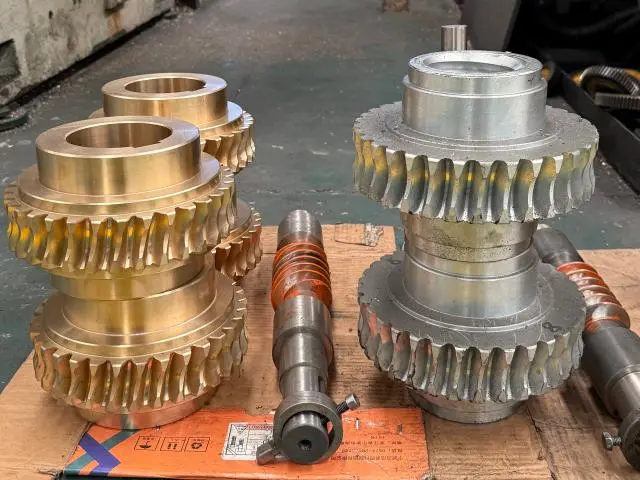
At the heart of every worm gear arrangement are two separate parts that work together. The worm looks like a screw because it has one or more threads that are wrapped around a cylinder-shaped shaft. The threads on this part engage with the teeth of the worm wheel when it turns. The worm wheel is a gear with a concave surface that fits the worm's curve perfectly. This perpendicular direction makes a sliding motion instead of the rolling contact that you'd find in most gear systems.
The manufacturing tolerances and quality of the surface finish are what set Precision Worm Gears apart from regular ones. Normal worm gears have to meet DIN Quality 8–10 standards, but precision ones have to meet ISO 8–9 standards or higher. At YIZHI MACHINERY, we use cutting-edge grinding methods to make units with worm sides that have surface roughness below Ra 0.4µm. This level of accuracy cuts down on kinematic mistakes and makes sure that the machine always works the same way, even in tough operating situations.
Types and Configuration Options
Single-thread worm systems have the best reduction ratios, but they are less efficient because there is more sliding friction. With two, three, or four threads, multi-thread configurations lower the reduction ratio and raise mechanical efficiency. If a system is self-locking, the lead angle, which is found by multiplying the thread size by the worm width, tells us. Angles less than 5 degrees usually cause self-locking, which stops spinning in the opposite direction without active input force.
The most common shape type for worm gears is cylindrical, which makes them easy to make and ensures consistent performance. Our production skills support module numbers from 1 to 50, so they can be used for a wide range of tasks, from sensitive instrumentation to heavy industrial reducers. You can still change the number of teeth based on your unique ratio needs and available room.
Key Design Principles and Materials
Critical Geometry Considerations
To make Precision Worm Gear systems precise, you have to pay close attention to the accuracy of the tooth profiles and the control of backlash. Profile mistakes have a direct effect on how smoothly the gearbox works and how the load is spread across the connecting surfaces. During production, we use CNC gear cutting centers that keep profile variations within 8–12 microns. This keeps the contact patterns consistent throughout the engagement cycle. Backlash, the small space between teeth that mesh, needs to be carefully managed to find the right balance between the need for lubrication and the need for positioning accuracy.
Accuracy of the lead angle is another important factor that affects efficiency and load capacity. Even small changes in this angle can change the contact ratio between the worm threads and the wheel teeth, which could lead to early wear or too much noise. As part of our quality control procedures, we do double flank rolling tests that find any runout or pitch errors before the parts leave the plant. These tests measure the total composite error.
Material Selection and Performance Impact
Material pairing has a big effect on noise levels, durability, and friction coefficients. The standard in the industry mixes sharpened steel worms with bronze worm wheels. This is done on purpose to make the materials mismatch, which stops seizure when the load is high. We at YIZHI MACHINERY have worms made from 20CrMnTi, 40CrNiMo, AISI4140, and other alloy steels. We choose which steels to use based on the load and environment needs of your application.
These materials are turned into high-performance parts through methods that use heat. Carburising makes the outside harder while keeping the inside tough, which makes it perfect for shock-loading uses. When you quench and temper steel, you get a mix of hardness and flexibility. Induction hardening, on the other hand, lets you treat only certain areas of the gear's surface. Our finished worms always have a surface hardness between 58 and 62 HRC, which means they are very resistant to wear over long periods of time.
The bronze wheel material serves as a sacrifice, slowly fitting the shape of the worm during the first break-in times. Over time, this change in anatomy improves the touch area and load capacity. CuSn12Ni2 is our normal bronze grade. It is more resistant to galling and stable at high temperatures than other bronze alloys.
Maintenance and Longevity Considerations
To make these gearbox parts last longer, you need to pay attention to how you lubricate them and how you handle heat. The sliding action that worm gears have by nature makes a lot of heat, especially at higher speeds. Polyalkylene glycol manmade oils are more stable at high temperatures than mineral-based options. They keep their viscosity over a wider range of temperatures.
Blueing tests are used to check the contact patterns on a regular basis to see if the load distribution stays centred on the tooth flanks. Edge loading conditions show problems with alignment or attachment displacement that speed up the wear process. Taking care of these issues right away stops catastrophic failures and extends the time between replacements. For industrial machinery, we suggest eye inspections every 2,000 hours of use. For mining equipment that is exposed to heavy contamination, we recommend inspections more often.
Comparing Precision Worm Gears to Other Gear Types
Performance Metrics and Selection Criteria
When procurement professionals look at gearbox options, they have to compare a number of performance factors to the needs of the application. Helical gears are almost as efficient as worm gears, but they need a lot more room to get the same reduction ratios. Spur gears are easy to use and very efficient, but they make a lot of noise when they're going fast. Worm gear systems aren't as efficient as other types of gears—they usually work between 50 and 90% of the time, based on the lead angle and the amount of grease used—but they make up for it by being small and self-locking.
When you compare torque capacities, you can see some interesting trade-offs. In pure rolling contact, helical and spur designs can handle higher power levels, but worm systems are better at absorbing shock loads when they are properly built. Sudden torque spikes that would damage regular gear teeth are naturally slowed down by the slide contact. This quality is especially helpful for mining tools and lifting mechanisms, since loads change without warning all the time during regular operations.
When exact angle setting is needed, Precision Worm Gear assemblies are the best choice because they are accurate and can be used over and over again. The continuous thread engagement gets rid of the tooth-to-tooth indexing mistakes that happen with other types of gear. This is a benefit that robotics makers and machine tool indexing mechanisms use to get positioning accuracy of less than one arcminute without the need for extra feedback systems.
Self-Locking Features and Safety Implications
Worm gears are different from almost all other types of gearbox because they can lock themselves. When made with the right lead angles and friction coefficients, these systems stop spinning in the opposite direction, even when there is a steady reverse torque. Elevator traction machines count on this feature to keep passengers safe because it keeps them in place when the power goes out without needing separate brake systems. Lifting equipment also benefits because loads that are hung can't push back on the device.
But people who work in procurement should know that how self-locking works rests on a lot of different things interacting with each other. The lead angle is the most important factor, but the quality of the surface finish, the thickness of the lubrication film, and the level of vibration all play a role in whether or not a design really stops reverse motion. Instead of depending only on theoretical self-locking formulas, safety-critical applications should have two sets of brakes. During the design review part, our engineering team carefully looks at self-locking margins to make sure that systems meet all safety requirements.
Applications and Benefits in B2B Industries
Industrial Machinery and Automation Solutions
Automated production line reducers need power transfer that is small, efficient, and keeps the same timing at all places. Worm gear assemblies work really well in these conditions because they can provide high reduction ratios in small spaces. For simpler mechanical systems and fewer maintenance spots, a single-stage unit can be used instead of a multi-stage planetary or helical gear train. Its smooth sliding action means that vibrations don't travel to nearby parts very much, so they don't mess up sensitive measuring or positioning systems.
The indexing devices on machine tools need to be accurate and have a lot of keeping force. In CNC machining centers, rotary tables must stay in place while cutting and refer to exact angular positions between processes. Our Precision Worm Gear assemblies, which are made to ISO 8-9 grade standards, can repeatably position themselves within ±5 arc-minutes, which meets the strict needs of modern machining operations.
Mining and Heavy Equipment Challenges
Heavy shock loads, abrasive contamination, extreme temperature changes, and long periods of time between maintenance are just some of the stresses that mechanical parts have to deal with in mining. Worm gear reducers have been shown to work reliably in these hard situations because they are built to last and can handle overloading. The bronze wheel material is better at handling small particles than the sharpened steel-on-steel contacts found in other types of gears. It slowly embeds contaminants instead of breaking teeth in a catastrophic way.
Underground activities that use conveyor drive systems benefit from small packaging that makes installation easier in tight areas. The self-locking feature stops the belt from moving backwards during emergency stops, keeping people safe and preventing material spillage. Our units made from SAE4340 and 42CrMo materials are tough enough for constant mining operations, and with the right amount of lubrication, they can go more than 10,000 hours without needing a major repair.
Aerospace Precision Requirements
For aerospace uses, the best mix of light weight, positional accuracy, and operating dependability is needed. Precision-ground worm assemblies are used in satellite positioning devices and telescope tracking drives to get the sub-arc-second accuracy needed for science views and antenna alignment for communications. There are no tooth-to-tooth indexing mistakes, so motion profiles are smooth and there are no micro-stepping artefacts that make setting the control system harder.
When it comes to aircraft, weight optimisation is very important. Our engineering team works with aerospace procurement experts to make sure that lightweight materials are used in the right places while advanced finite element analysis is used to keep the structure's integrity. Heat treatments, such as carburising, make thin-wall geometries possible by adding layers of hardness to the surface that keep the shape even though the cross-sectional dimensions are smaller.
Here are the core advantages that make these components valuable across diverse industries:
1. High Transmission Ratios with Compact Structures: Single-stage designs can achieve ratios of up to 100:1 with very small footprints, so there's no need for multi-stage assemblies that are more complicated and could fail at different places.
2. Self-Locking Capabilities: The right lead angle designs stop spinning in the opposite direction, which increases safety in lifting equipment and provides holding power without keeping the motor running all the time.
3. Smooth Transmission with Minimal Noise: Sliding contact mechanics make operation quieter than the impact forces created by spur gear tooth interaction, which is especially useful in medical tools and instruments.
4. High Load Capacity and Reliable Operation: When the right materials are paired together and the surfaces are treated properly, these systems can handle large torque loads and keep working for a long time even in tough circumstances.
These benefits work together to meet the performance needs that purchasing professionals have when they choose gearbox parts for important machines. Worm gear solutions are still chosen for the toughest jobs in industries from robots to heavy mining because they are small, give exact motion control, and have built-in safety features.
Procurement Considerations and Supplier Insights
Evaluating Manufacturing Capabilities
Evaluating suppliers requires assessing technical expertise, quality systems, and manufacturing flexibility. ISO certification provides assurance, while in-house machining and grinding capabilities improve precision and lead times. Strong material traceability supports compliance needs. Customization options, including tooth count, module size, and materials, allow suppliers to serve both prototypes and large-scale production programs.
Lead Times and Production Planning
Getting the materials, rough cutting, heat treatment, end grinding, and quality checking are all very specific steps in the Precision Worm Gear manufacturing process. Realistic lead times help procurement teams make sure that delivery of parts fits in with project schedules. YIZHI MACHINERY's normal production times are 35 to 60 days, but they can be shorter or longer based on the complexity and volume of the order. For urgent needs, these deadlines can be shortened by accommodating rush production, but rushed plans may limit some optimisation possibilities.
One of the most time-sensitive steps in the process is heat treatment. Carburising cycles need between 24 and 48 hours, based on the case depth requirements. Trying to speed up these thermal processes hurts the metallurgical properties and, in the end, makes the parts last less long. Even when they are under a lot of time pressure, responsible providers don't skip important steps in the process. They do this to protect the interests of their customers.
Minimum order amounts have a big effect on the economics of a project. When it comes to research projects or low-volume uses, manufacturers that focus on high-volume production often have very high minimum orders that can't be met. Our promise to take single-item production orders gives us the freedom to work on prototypes, retrofit projects, and specialised machinery that needs specific instructions.
Global Supply Chain and Logistics Excellence
Global supply chain excellence requires secure packaging, efficient transportation, and transparent tracking. Customized protective packaging reduces shipping risks for precision parts, while sea, air, and rail options balance cost and delivery speed. Real-time tracking provides shipment visibility from production to delivery, enabling better planning and faster responses to potential delays.
Supplier Reputation and Partnership Value
Supplier reputation and partnership value extend beyond product specifications. Experienced manufacturers provide industry knowledge, customization, and technical support. YIZHI MACHINERY leverages 15 years of experience across mining, aerospace, and industrial sectors to deliver practical solutions. Lifecycle services, including design support, production updates, and after-sales assistance, build long-term strategic partnerships.
Conclusion
In conclusion, when procurement professionals know how Precision Worm Gears work, they can make smart decisions about where to buy things that have a direct effect on how well the equipment works and how well the project goes. These specialised gearbox parts offer unique mixes of small size, high reduction ratios, and reliable performance that keep showing their worth in mining operations, military applications, and industrial machinery. The choice of materials, the accuracy of the manufacturing process, and the supplier's skills all play a role in how well components meet strict operating requirements. Instead of just looking at price, procurement teams look at possible partners' technical skills, ability to make changes, and service promise. This helps them find parts that will last longer and work better over time, which is good for long-term value.
FAQ
1.What distinguishes precision-grade worm gears from standard versions?
Manufacturing tolerances are what set one product apart from another. Precision Worm Gears meet ISO 8-9 grades by using advanced grinding methods that keep the accuracy of the tooth shape within microns. Standard units, on the other hand, usually meet the stricter DIN Quality 8-10 requirements. This higher level of accuracy cuts down on kinematic mistakes and raises the accuracy of placing in tough situations.
2.How do lead times vary for custom specifications?
Custom Precision Worm Gear production usually takes 35 to 60 days, which includes getting the materials, cutting, heat treating, and checking the quality. Complex geometries or specialised materials may cause delays, but standard configurations can sometimes ship faster. By telling sellers about needs early on, buyers can help them make the best production schedules and find ways to speed up delivery.
3.Can worm gear assemblies operate in harsh environmental conditions?
When you choose the right materials and set up your seals correctly, your equipment will work reliably in a wide range of temperatures, dirty surroundings, and acidic atmospheres. During mining operations, these parts are often exposed to rough dust and water. By choosing the right bronze alloys for worm wheels and putting in place effective lubrication systems, performance can be maintained over long periods of time, even in tough conditions.
Partner with YIZHI MACHINERY for Your Precision Transmission Needs
YIZHI MACHINERY is ready to meet your Precision Worm Gear needs with custom solutions backed by 15 years of excellent manufacturing. As a Precision Worm Gear supplier with a lot of experience working with industrial gear, mining, and aircraft, we offer ISO-compliant parts made from high-quality materials like 40CrNiMo, AISI4140, and other alloys. Our combined capabilities, which include design consulting, advanced grinding, and full quality testing, make sure that parts are ready for tough uses when they get to you. Contact us at sales@yizmachinery.com about your unique needs, ask for detailed drawings, or get quotes from other companies. We're happy to take both large production orders and prototypes of a single unit. We can customise our products to fit your needs and guarantee on-time delivery.
References
1. Dudley, D.W. (1994). Handbook of Practical Gear Design and Manufacture. CRC Press, Boca Raton, Florida.
2. Radzevich, S.P. (2012). Dudley's Handbook of Practical Gear Design and Manufacture, Second Edition. CRC Press, Taylor & Francis Group.
3. Townsend, D.P. (1991). Dudley's Gear Handbook: The Design, Manufacture, and Application of Gears. McGraw-Hill Professional.
4. Lynwander, P. (1983). Gear Drive Systems: Design and Application. Marcel Dekker, New York.
5. Buckingham, E. (1988). Analytical Mechanics of Gears. Dover Publications, New York.
6. Maitra, G.M. (2013). Handbook of Gear Design, Second Edition. Tata McGraw-Hill Education, New Delhi.

USER EVALUATE
Here is the customer's evaluation of us