


High Precision Internal Gear for Planetary Gear Systems
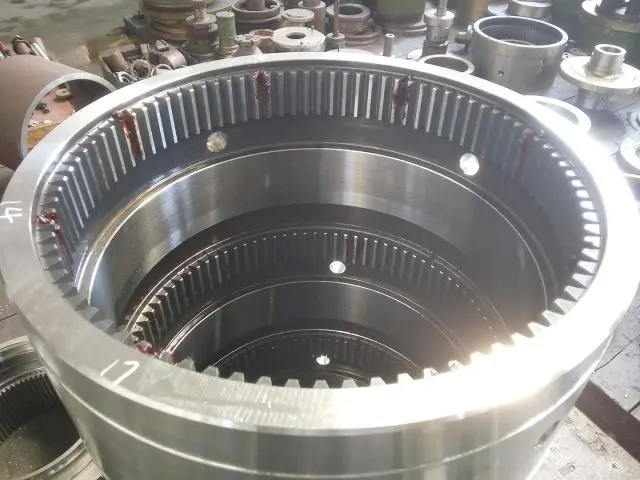
High precision internal gears for planetary gear systems are an important part of the system. They have gear teeth made along the inside diameter of a ring or cylinder so that they fit perfectly with the sun and planet gears. These precision-engineered parts work within ISO 6 Grade standards and use advanced manufacturing techniques like hobbing, milling, and grinding. They are often heated through carburizing or cooling to make the surface hardness between 58 and 62 HRC. The Precision Internal Gear is the stationary ring element in planetary configurations. This allows for small transmission designs with high torque density and low backlash, which are important features for industrial machinery, mining equipment, and aerospace applications that need to be reliable even under extreme loads.
Introduction
Planetary gear systems are vital in robotics, aerospace, mining, and heavy machinery. Internal gears with teeth cut on inner diameters enable high torque density in compact spaces. High precision versions meeting ISO 6 Grade standards directly affect backlash, noise, and load distribution. Choosing correctly prevents premature wear and costly downtime. This guide covers technical specs, materials, performance comparisons, and procurement strategies balancing cost and quality.
What Are High Precision Internal Gears and How Do They Work?
Understanding the Fundamental Design
When it comes to power transfer, internal gears are different because their teeth are machined along the inside width of a ring or cylinder, not the outside surface like on external gears. This upside-down shape makes a concave tooth outline that connects with external pinions or planet gears that are inside the ring. When two Precision Internal Gears mesh, they rotate in the same direction as the moving pinion. This is a kinematic difference between internal gear pairs and external gear pairs, which rotate in different directions.
Precision Manufacturing Standards
In industrial settings, the phrase "high precision" has a lot of technical weight. Standard specs for making these parts are usually in line with ISO 1328-1 or DIN 3962, and quality grades range from ISO 6 to ISO 4 for the toughest uses. These standards control important factors like pitch error, profile deviation, and helix deviation. These data have a direct effect on how smoothly the meshing works, how much noise it makes, and how well it transfers power. After being heated, advanced internal gears go through tooth grinding operations. This removes any distortions caused by the heat processing and finetunes the tooth shape to the level of micron accuracy.
Material Selection and Heat Treatment
The choice of material has a big impact on how well and how long a gear works. For precise tasks, 20CrMnTi, 42CrMo, and 18CrNiMo7 alloy steels are often used. These materials were chosen because they are better at hardening and being tough in the middle. Specialized heat treatments, like carburizing, are used on these metals to make the surface harder (usually between 58 and 62 HRC) while keeping the core flexible so it can handle shock loads. The case depth, which is usually between 0.8 mm and 2.5 mm based on the module size, protects against wear where teeth meet while keeping the core tough enough to keep it from breaking apart under impact loads that are common in mining and heavy machine uses.
Advantages of Using High Precision Internal Gears in Planetary Gear Systems
Precision Internal Gears used in planetary gear configurations give performance traits that solve a number of long-standing problems in power transfer engineering. With these benefits in mind, buying teams can better understand why these parts cost more than standard-tolerance options.
These precise parts make planetary gear systems better in the following ways:
- Compact Power Density: The way planetary systems are set up, with multiple planet gears striking a single internal ring gear at the same time, spreads the load over a number of mesh points. When compared to simple gear trains, this load sharing makes it possible to transmit a lot more power within the same space. Engineering studies show that a three-planet system that is properly built spreads about 33% of the total load to each planet gear. This lowers the contact stress on each tooth and increases the life of the parts.
- Minimized Backlash and Positioning Accuracy: High-quality planetary sets have backlash levels less than 3 arcminutes after precision grinding. This is an important requirement for robotics, machine tool indexing, and aerospace actuation systems where positional repeatability directly impacts output quality. This fine control comes from manufacturing methods that keep the distance between teeth to within 8 to 10 microns all the way around the gear.
- Reduced Noise and Vibration Characteristics: Noise and vibration levels are lower because when multiple teeth connect at the same time, the contact ratio is high. This makes power transfer smoother and dynamic loads lower than with gear types that have lower contact ratios. Grinding produces precise tooth shapes that reduce transmission error, which is the main cause of gear whine in high-speed situations. This quality is very useful in aircraft and precision machinery, where the acoustic profile has to meet strict requirements.
- Extended Service Life Through Optimal Load Distribution: The wrapping contact pattern between the teeth on the internal gear and the planet gears on the outside gives good Hertzian contact stress conditions. With case-hardened surfaces that reach 58–62 HRC, these gears don't break down in the pitting and micropitting ways that usually shorten component life in heavy-duty applications like wind turbine yaw drives and mine hoists.
Comparing High Precision Internal Gears with Other Gear Types
Precision Internal Gears versus Standard Tolerance Variants
The main differences between precision and normal internal gears are the tolerance bands used for production and the quality of the surface finish. Standard gears usually meet ISO 8 or ISO 9 quality standards, and tooth-to-tooth composite mistakes can reach 40 to 60 microns. This is fine for most industry uses, but not good enough when precise positioning is needed. Tolerances drop below 10 microns for precision versions that meet ISO 6 standards and below 15 to 18 microns for ground gears that meet ISO 4-5 grades. This improvement directly leads to less backlash, better operation, and longer bearing life throughout the transmission system, but it comes at a cost of 40% to 150% more, based on how complicated and big it is.
Internal Ring Gears versus Spur and Helical External Gears
There are big differences in how efficiently space is used and how much weight they can hold when you compare internal gears to regular external gear setups. A planetary set with an internal ring gear can get reduction ratios between 3:1 and 10:1 in a package that is about the same size as a simple gear pair that only gets 3:1 reduction. Multiple planet gears meshing with the internal ring at the same time spreads the transferred torque over several contact spots, allowing for a much higher torque capacity at the same center distance. External gear trains need bigger pitch diameters to handle the same loads, which means they take up more installation room. This is a major problem in aerospace and mobile equipment uses where weight and volume limits drive design decisions.
Precision Planetary Gears versus Harmonic Drive Systems
When looking at very precise motion control tasks, harmonic drives offer an option that can get even better backlash specs (often below 1 arcminute) and higher single-stage reduction ratios (50:1 to 160:1). While these benefits are nice, they come with some costs. Harmonic drives can't handle as much torque as planetary designs because they are smaller. They can usually handle 30–40% less torque in the same package space. In high-cycle uses, the flexspline part of harmonic drives suffers cyclic strain that shortens its service life. On the other hand, precision planetary sets with well-oiled internal gears regularly have service lives of more than 20,000 hours at full load. A study of costs shows that harmonic drives cost 200–400% more than precision planetary sets with the same output torque capacity. This means that planetary setups with Precision Internal Gears are the more cost-effective choice for uses where backlash below 3–5 arcminutes is sufficient.
Procurement Considerations for High Precision Internal Gears
Supplier Evaluation and OEM Capabilities
Evaluate suppliers beyond price—check hobbing, pre-grinding, controlled heat treatment, and finish grinding capabilities. CMM inspection must verify involute profile, lead/helix, pitch variation, and runout affecting meshing quality. Full customization services allow unique tooth counts, modules 0.5-50, helix angles 5°-45° for optimized gear ratios. Suppliers like YIZHI MACHINERY (15 years experience, ISO-certified) reliably handle custom specifications for diverse installation constraints and performance requirements.
Lead Times and Minimum Order Quantities
Custom precision gears require 35-60 days for material procurement, rough cutting, heat treatment, finish grinding, and inspection. Rare materials may extend timelines. Understanding these limitations prevents costly expediting. Single-piece orders support prototyping flexibility but reflect higher setup costs. Volume breaks at 10, 50, and 100 units reduce per-unit costs as setup expenses spread over longer production runs—critical for production planning and budget management.
Quality Certification and Testing Protocols
Demand inspection records for radial runout, cumulative pitch error, profile/helix deviations per ISO 1328-1, AGMA 2015, or DIN 3962 with measured values and tolerance bands. Rockwell/Vickers hardness testing must confirm 45-50 HRC core and 58-62 HRC case hardness. Case depth measurement verifies hardened layer thickness matches module size. Comprehensive documentation prevents costly field failures and ensures compliance with application requirements.
Technical Specification Communication
Clear specifications prevent costly misunderstandings: include tooth count, module, pressure angle, helix angle, face width, bore tolerance, material grade (SAE/AISI/DIN/JIS), heat treatment with hardness targets, ISO quality grade, and tooth modifications (tip relief/crowning). Add GD&T notes to reference drawings clarifying critical measurements and tolerance zones. This precision in communication ensures suppliers deliver parts meeting exact application requirements without expensive rework.
Case Studies and Applications of High Precision Internal Gears in Planetary Gear Systems
Robotics and Automated Manufacturing Systems
Industrial robots require ±0.02mm positioning accuracy for thousands of daily cycles. Cobots need smooth, jerk-free motion for human interaction. These performance traits come from Precision Internal Gears ground to ISO 6 standards in planetary reducers. A major automaker's new welding line with ground internal gears achieved 25% faster cycle times and eliminated manual weld misalignment corrections—directly improving production efficiency and quality.
Aerospace Actuation and Control Systems
Flight control, landing gear, and thrust reverser systems face high loads, temperature extremes (-55°C to +125°C), and vibration. Planetary systems with 18CrNiMo7 ring gears undergo millions of test cycles. Compact planetary designs reduce weight—critical for fuel efficiency. Next-generation commercial aircraft actuators with precision ground internal gears achieved 18% weight reduction and 50,000-hour overhaul targets, significantly improving reliability and operating economics.
Mining and Heavy Equipment Transmission Systems
Draglines, continuous miners, and haul trucks transmit 500,000+ Nm torque through drivetrains handling shock loads and dirty lubrication 24/7. Planetary final drives with module 12-25 internal gears (58-62 HRC) spread loads across multiple planet gears, resisting abrasive wear. A global mining OEM switching from parallel-shaft to planetary configurations with 42CrMo precision gears reported 40% longer service intervals and 30% fewer unplanned maintenance events—directly boosting production tonnage and revenue.
Machine Tool Feed Mechanisms and Precision Positioning
CNC machining centers and CMMs need precise linear positioning from rotary motor motion. Precision planetary reducers drive ball screw systems while minimizing backlash—excessive backlash causes positioning errors in machined parts. Five-axis machining centers for aerospace structural parts require planetary gear heads with internally ground precision gears maintaining backlash below 2 arcminutes, enabling 5-micron contour accuracy. Compact size fits within machine rotary axes without sacrificing floor space.
Conclusion
Selecting Precision Internal Gears requires balancing technical performance (ISO 6 Grade or higher) against cost, lead time, and supplier capabilities. Precision directly affects backlash, noise, and service life. Material selection, heat treatment, and grinding determine compliance with industrial, aerospace, or mining standards. Case studies confirm real-world value through improved positioning accuracy, reliability, and extended operating life. Understanding these technical and business aspects enables informed decisions matching application needs without overspecifying or premature failure.
FAQ
1. What typical lead times should I expect for custom precision internal gear orders?
From confirmation to delivery, custom Precision Internal Gear orders take 35 to 60 days. This timeline comprises materials, rough machining, heat treatment in controlled environment ovens, precision grinding to final tolerances, a quality check, and packaging. Rare materials, module sizes, and urgent orders might affect these schedules. Considering these production parameters while planning part locations helps keep projects on time without increasing production expenses.
2. How do I evaluate whether a supplier can reliably produce precision internal gears meeting my specifications?
Check the supplier's inventory of manufacturing equipment (especially gear grinding machines and CMM inspection systems), quality certifications (at least ISO 9001, and industry-specific certifications like AS9100 for aerospace applications), experience with the materials and heat treatments your application needs, and willingness to provide detailed inspection reports that show their products meet specific t Make sure you have samples with inspection papers and that the vendor follows standard processes from requirements assessment to manufacturing, quality control, and delivery for key projects.
3. What maintenance practices extend service life for precision planetary gear sets?
Lubrication is the most crucial maintenance step. Your oil should meet your application's temperature, speed, and load parameters. Listen for variations in vibration patterns and sound releases that may indicate wear or alignment issues before they become too severe. Use oil filters and sealing systems to control contamination. Abrasive particles accelerate gear wear. Check tooth contact patterns and backlash often to assess wear. This manner, you may replace components before they fail and prevent immediate repairs.
Partner with YIZHI MACHINERY for Your Precision Internal Gear Requirements
At YIZHI MACHINERY, we make Precision Internal Gears that are especially made to meet the exacting needs of industrial machinery, mining operations, and aerospace uses. Our wide range of skills covers the whole production process, from helping with the initial design to choosing the right materials, advanced manufacturing techniques like hobbing and precision grinding, strict heat treatment protocols like carburizing and quenching, and a full quality inspection that meets ISO 6 Grade standards.
The problems that buying teams and engineering departments face are unique, and our supplier services are designed to help them. We have low minimum order quantities and can make prototypes from as few as one piece. For larger production runs, we offer cheap volume prices. You can choose from high-performance alloy steels like 42CrMo, 20CrMnTi, 18CrNiMo7, and others that fit the needs of your application. The modules can be changed from 0.5 to 50, and the surface hardness can range from 45 to 50 HRC to 58 to 62 HRC, based on the load.
We have been making things for 15 years and have quality processes that are in line with ISO standards. We can consistently give results within 35 to 60 days. Our custom package options, which include shock-absorbing materials and protected pallets, make sure that your parts arrive undamaged, and real-time shipment tracking lets you see what's going on at all times during the logistics process. We offer expert support to help you find the best specifications for your unique needs, whether you need parts for a planetary gear reducer, a winch transmission, or a machine tool feed mechanism. Contact us at sales@yizmachinery.com about your needs.
References
1. Stadtfeld, H.J. (2014). Gear Geometry and Applied Theory. Cambridge University Press, Technical Reference Volume on Advanced Gear Manufacturing.
2. Radzevich, S.P. (2016). Dudley's Handbook of Practical Gear Design and Manufacture (Third Edition). CRC Press, Mechanical Engineering Series.
3. ISO 1328-1:2013. Cylindrical Gears — ISO System of Flank Tolerance Classification — Part 1: Definitions and Allowable Values of Deviations Relevant to Flanks of Gear Teeth. International Organization for Standardization.
4. Budynas, R.G. and Nisbett, J.K. (2020). Shigley's Mechanical Engineering Design (Eleventh Edition). McGraw-Hill Education, Chapter 13: Gears—General.
5. Lynwander, P. (1983). Gear Drive Systems: Design and Application. Marcel Dekker Inc., Industrial Engineering Reference on Planetary Gear Systems.
6. Müller, H.W. (1982). Epicyclic Drive Trains: Analysis, Synthesis, and Applications. Wayne State University Press, Technical Monograph on Planetary Gear Design.

USER EVALUATE
Here is the customer's evaluation of us