


Gear Manufacturing Process: Gear Shaping
We use a reciprocating pinion-type cutter for Gear Teeth Shaping, which is a continuous producing process, to make both internal and external gear teeth, splines, and non-circular profiles. In contrast to hobbing, which needs a lot of axial space, Gear Teeth Shaping works by turning the cutter and workpiece in a conjugated mesh relationship while the cutter moves back and forth along the workpiece to remove material. This way of making things is the usual way to make internal ring gears, cluster gears with shoulders that get in the way, and double helical gears, which can't be made with regular cutting methods. The process solves important production problems, like the fact that hobbing can't be used to cut internal teeth and gears need to be machined next to flanges, which would be impossible with hob runout.
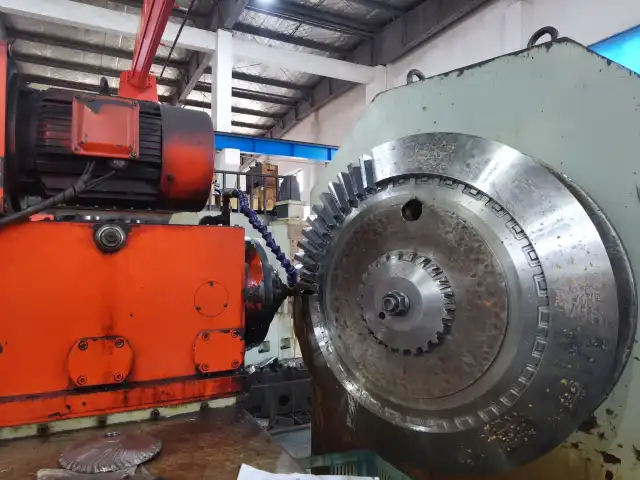
Understanding the Gear Teeth Shaping Process
How Gear Shaping Creates Precision Tooth Profiles
Three different mechanical moves must work together for the Gear Teeth Shaping process to happen. The producing motion is made by the cutter and the workpiece rotating around each other. The cutting action is provided by the revolving vertical stroke, and the cutter is moved deeper into the material by radial in-feed. The shaper cutter, which is usually made of Cobalt-alloyed High-Speed Steel or Powder Metallurgy versions with TiN or AlCrN coatings, can carefully create involute tooth shapes thanks to this kinematic mix. YIZHI MACHINERY's Gear Teeth Shaping processes are ISO 5-6 Grade precise, making sure that every tooth shape meets the tight size requirements for high-performance uses.
Critical Parameters Affecting Shaping Quality
Gear Teeth Shaping accuracy depends on the stroking speed (in strokes per minute), the rotating feed (in millimeters per stroke), and the cutting tool's relief angle. In our 15 years of production experience, we've seen that keeping the cutting settings at their best greatly lowers pitch deviation and keeps setups centered. During production, our techs keep an eye on these factors at all times. They use special cutting fluids, which are usually sulfurized oils, to keep the cutter from welding and the tooth side surfaces from breaking down chemically during high-friction reciprocation. We can regularly make gears that meet AGMA Q10–Q12 quality standards because we pay close attention to every detail.
Common Defects and Prevention Strategies
Imperfections on the surface, like burrs, tool marks, and differences in size, can make gears less effective. We've kept shipping damage rates below 0.1% by using thorough process control to cut down on these flaws. Our quality testing procedures find problems early on by checking each gear for burrs along the sides of the teeth and making sure the surface hardness is between 45 and 50 HRC for normal uses and 58 to 62 HRC for high-wear areas. Carburizing, quenching and tempering, and induction hardening are some of the heat treatment processes that improve wear resistance and longevity even more. These processes meet the strict needs of industrial tools, mining equipment, and aerospace parts.
Gear Teeth Shaping vs Alternative Gear Manufacturing Methods
Comparing Shaping with Hobbing and Milling
When procurement workers are looking at different ways to make gear, knowing the differences between them helps them choose the best options. Hobbing is very good at making a lot of external spur and helix gears, which saves money when making thousands of the same parts. Gear Teeth Shaping, on the other hand, gives you more options for internal gears, blind-bore jobs, and complicated shapes that hobbing cuts can't reach. We can shape modules with ranges from 0.5 to 50, unique tooth numbers, and pressure angles of 14.5° or 20°. This gives us a level of flexibility that milling and hobbing can't match in certain situations.
Surface Finish and Accuracy Considerations
When compared to grinding, Gear Teeth Shaping creates a better surface structure because it controls chip formation, which makes the tooth edges smoother. When shaping, the generating action makes real involute profiles instead of estimated shapes. This is very important in precision instrument transmission systems and robotic joints where even small errors can have a big effect on performance. Grinding is still the most precise way to finish a piece, but if you do it right, Gear Teeth Shaping often gets rid of the need for extra processes in situations where ISO 5-6 Grade accuracy is fine. With this ability, we can cut down on the number of steps needed to make something, which speeds up the normal 35–60 day output time while still meeting quality standards.
Cost-Effectiveness Across Production Volumes
The original cost of the tools and the ability to change how they are used are balanced by Gear Teeth Shaping. Broaching needs expensive tools that are made just for that gear shape. Gear Teeth Shaping cuts, on the other hand, can be dressed and changed to fit different designs. Our low minimum order quantities—we can even make one item—show that this is a benefit. Mining companies that need to change gears on old equipment can really benefit from Gear Teeth Shaping because it can make outdated designs without having to pay a lot for expensive tools. The process works well for small to medium-sized batches, from prototypes to medium-sized production runs. This is a good fit for the way that aircraft and specialized industrial machinery companies usually buy things.
Types of Gear Teeth Shaping Machines and Tools
Vertical vs Horizontal Shaping Configurations
Machine direction has a big effect on how well an application works. When using a vertical Gear Teeth Shaping machine, the workpiece is laid out horizontally. This makes it easier to add ring gears and big components because gravity helps. When working on smaller gears that need to be quickly indexed and changed tools, horizontal layouts work best. At our plant, we use both combinations on purpose, matching the type of machine to the needs of the part to get the best cycle times and surface finish. We can meet a wide range of customer needs with this variety of equipment, from small instrument gears to huge mining equipment parts with a width of over 1000 mm.
CNC Integration and Automation Benefits
Compared to older mechanical shapers, modern CNC Gear Teeth Shaping methods have changed how much can be made. Computer numerical control can make complex spiral angles, crowning modifications, and lead repairs that are difficult to execute manually. To ensure consistent production quality, we purchased high-precision CNC gear machining centres and intelligent heat treatment production lines. Automated tool adjustment accounts for cutting wear in real time, maintaining dimensions throughout lengthy production cycles. Aviation customers that need to manage operations and verify crucial measures using statistics would benefit from this solution.
Selecting Appropriate Cutting Tools
Consider the tooth profile design, material fit, and tool lifespan when selecting a shaper cutter. We have cutters for 45# steel, 20CrMnTi, 40CrNiMo, SAE4340, 42CrMo, AISI4140, and other specific metals, as well as high-stress carburising steel. The correct tool material influences cutting performance and cost. For ordinary operations, high-speed steel cutters perform well, while carbide-tipped ones allow longer tool changes for difficult materials. Technical consultation helps clients choose the optimal tooling techniques depending on output quantities and material needs.
Application of Gear Teeth Shaping in Different Industries
Automotive Transmission Components
Shaped interior ring gears are a big part of planetary gear sets in car transmissions. The Gear Teeth Shaping process is perfect for these parts because it makes the exact involute shapes needed for them to work smoothly and quietly under different loads. Cluster gears, which are multiple gears built into a single shaft, are used in both manual and automatic gearbox systems. This is where Gear Teeth Shaping cutters can stop exactly at the shoulders without hurting the teeth next to them. This feature makes up for the lack of room in current powertrains while keeping the torque density needed for smooth power transfer. Our shaped transmission gears are used by a wide range of vehicles, from light passenger cars to big commercial vehicles that work in harsh mining settings.
Aerospace Actuation and Control Systems
For aerospace uses, dependability must be unwavering, so choosing the right process is very important. The high accuracy that Gear Teeth Shaping offers is used in flap actuators and landing gear systems, which use high-precision internal and external splines. A lot of the time, these parts work in blind holes or small spaces where other cutting tools can't reach important areas. Shaper cuts' vertical reciprocating motion keeps structures strong, which is important for safety-critical systems. We've made aircraft clients gears that meet strict material certifications using metals like 18CrNiMo7, 17CrNiMo6, and 20CrNiMo. These materials were chosen because they don't wear down easily and keep their shape at very high and very low temperatures.
Heavy Machinery and Mining Equipment
Gears in mines are put through abrasive pollution, shock loading, and constant operation cycles that quickly show where the manufacturing process went wrong. When heat-treated and surface-finished correctly, shaped gears used in machine tool spindles, precision instrument transmission systems, and mining equipment last a very long time. Our surface finishing choices, such as blackening, phosphating, and hard chrome plating, make our products resistant to corrosion, which is very important for deep mines. Because Gear Teeth Shaping can be customized, it can handle non-standard gear patterns that are needed to fix old equipment or find the best gear ratios for certain working situations. Shaped components are reliable in these harsh working conditions, which is why we've built long-term relationships with many mechanical engineering companies.
Purchasing Guide and Maintenance Tips for Gear Teeth Shaping Machines
Evaluating Production Requirements and Budget
Before you can choose the right Gear Teeth Shaping tools, you need to be honest about your production size, exact needs, and available capital. Companies that make less than 50 gears a month might be fine with regular shapers, but companies that make a lot of gears need CNC systems, which can be set up faster and run without a person being there. The machine's capacity must be able to hold your biggest planned project in terms of both diameter and face width, plus extra space in case it needs to grow in the future. Our standardized OEM customization workflow helps buyers clearly define requirements by taking them step by step through discussions about needs, design drawings, production machining, quality inspection, packaging, and shipping. This way, buyers can be sure that the equipment they choose will work with their operations.
Sourcing Strategies and Supplier Evaluation
Buying Gear Teeth Shaping machines can be done in a number of ways, from buying brand-new machines to buying used machines that are cheaper. When looking at possible providers, give more weight to companies that can show they offer full expert support, spare parts, and help with applications engineering. Because Gear Teeth Shaping is so complicated, providers need to be able to fix problems with the process online and provide on-site service when needed. Our image is partly based on quick and helpful customer service after the sale. We offer a one-year guarantee and quickly fix any problems that come up. Buyers should make sure that the supplier has experience with their particular business. For example, making aerospace gear is very different from making gear for mines, which means that the supplier needs to know how to handle materials differently and follow different quality paperwork rules.
Maintenance Practices Extending Equipment Life
Preventive repair has a big effect on how long a Gear Teeth Shaping machine lasts and how well it works. Every day, you should check the cutting tools' state, the amount of hydraulic fluid in the system, and the concentration of the coolant. Once a week, you should check the slide ways for proper greasing and the spindle bearings for unusual temperatures or vibrations. Checking the machine's shape through test cuts and adjusting CNC positioning systems are both part of the monthly maintenance. Because our production equipment has been used nonstop for 15 years, we have developed strict repair plans that keep it running at its best. This keeps unplanned downtime to a minimum. We suggest that users set up similar procedures and keep records of their repair work so that problems can be found early on and prevented from stopping production. Maintaining equipment properly saves investments and makes sure that the quality of the equipment always meets ISO standards.
Conclusion
Gear Teeth Shaping technology gives industries like mining, aircraft, and industrial machines a huge range of options for making internal gears, complicated profiles, and precise parts. The process blends real involute generation with the ability to adapt to different customer needs from module 0.5 to 50, making it possible to achieve the ISO 5-6 Grade precision needed for tough uses. Knowing the differences between Gear Teeth Shaping and other methods, as well as how to choose the right tools and keep them in good shape, helps procurement pros make choices that are both quality- and cost-effective. Changing Gear Teeth Shaping to meet higher performance standards while keeping the basic benefits that made it an essential industrial process as automation gets better and tool materials get better is an ongoing process.
FAQ
1. What makes gear shaping preferable to hobbing for certain applications?
Gear Teeth Shaping works best for making internal gears (which can't be done physically with hobbing) and cluster gears next to shoulders or flanges (where hobbing cuts need space that isn't available in small units). Gear Teeth Shaping can also be used in blind-bore setups, which are popular in planetary gear sets and aircraft actuation systems. In these cases, the reciprocating cutter can get into tight spaces that hobbing cutters can't reach because they have to keep moving around the edge of the object in a spiral motion.
2. How do material choices affect the gear shaping process?
Changing the shape of different metals has different effects. Softer metals, like 45# steel, are easy to shape, but they may need to be heated after Gear Teeth Shaping to get the right level of toughness on the surface. Carburizing grades, such as 20CrMnTi and AISI8620, are shaped after being pre-hardened and then go through carburising to reach 58–62 HRC case hardness. To keep work from hardening, through-hardening metals like 42CrMo and AISI4140 need strong machine stiffness and sharp cutting tools. Our knowledge of materials makes sure that the right process factors are used for each alloy standard.
3. What tolerance levels can shaped gears achieve?
When Gear Teeth Shaping is done right, it usually meets AGMA Q10–Q12 quality standards, which are the same as ISO 5–6 Grade precision. This includes fine-tuning the pitch change, profile accuracy, and concentricity that are needed for quiet, smooth operation. Post-shaping grinding may be needed for applications that need even tighter tolerances, but many precision instrument transmission systems and robotic joints can work well with surfaces that are already shaped as long as the process parameters are kept at their best throughout production.
Partner with a Trusted Gear Teeth Shaping Manufacturer
YIZHI MACHINERY brings 15 years of specialized knowledge to every custom Gear Teeth Shaping job. They meet ISO quality standards and can make any changes that are needed. Our building has some of the most advanced precision CNC gear machining centers and intelligent heat treatment production lines in the world. These machines can make shaped gears from 45# steel to special aerospace alloys, and they can finish them to your exact specs with a surface hardness of 45 to 62 HRC. Whether you need a single piece of new equipment or ongoing production support, our team can get it to you within 35 to 60 days. It will be protected by special packaging that keeps damage to less than 0.1 percent during shipping. Contact us at sales@yizmachinery.com about how you need the teeth on your gears shaped. We offer design plans, technical advice, and real-time production reports throughout your project.
References
1. American Gear Manufacturers Association. (2015). ANSI/AGMA 2015-1-A01: Accuracy Classification System - Tangential Measurements for Cylindrical Gears. Alexandria, VA: AGMA Technical Publications.
2. Davis, J. R. (Ed.). (2005). Gear Materials, Properties, and Manufacture. Materials Park, OH: ASM International.
3. Klocke, F., & Brecher, C. (2016). Gear Production Technology. Berlin: Springer-Verlag.
4. Radzevich, S. P. (2012). Dudley's Handbook of Practical Gear Design and Manufacture (2nd ed.). Boca Raton, FL: CRC Press.
5. Stadtfeld, H. J. (2014). Gleason Bevel Gear Technology: Manufacturing, Inspection and Optimization. Rochester, NY: The Gleason Works.
6. Townsend, D. P. (1991). Dudley's Gear Handbook: The Design, Manufacture, and Application of Gears (2nd ed.). New York: McGraw-Hill Professional.

USER EVALUATE
Here is the customer's evaluation of us