


Understanding the Drive Gear Shaft: A Comprehensive Guide
When industrial equipment stops working all of a sudden because of a gearbox problem, it affects production schedules, upkeep funds and the company's bottom line. A reliable way to send power is through a Drive Gear Shaft, a carefully designed part that connects prime movers to driven machinery and handles huge torque loads. In mine drills, metallurgical rolling mills, and port container handling systems, this mechanical link turns rotational energy into useful work. Whether you're a purchasing head looking at seller capacity or a chief mechanical engineer choosing replacement parts, knowing the technical details and buying strategies behind choosing a Drive Gear Shaft has a direct effect on how well your equipment works and how long it lasts.
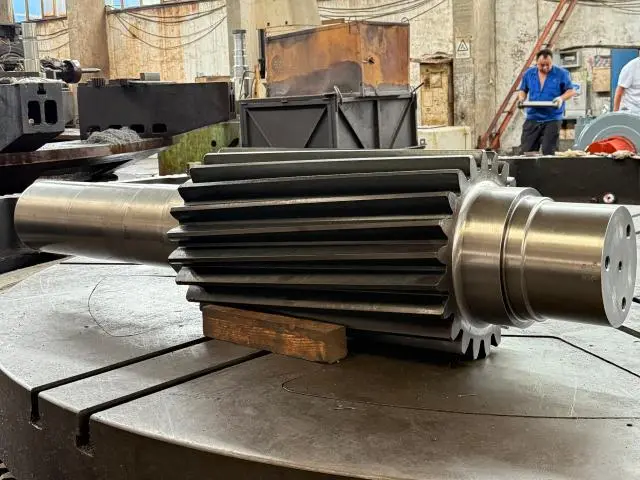
What Is a Drive Gear Shaft and How Does It Work?
The Drive Gear Shaft is an important part of heavy machinery because it transfers torque from power sources to driven parts. Unlike simple rotating rods, this part has precision-machined interfaces or gear teeth that are built in. These are made to handle large radial and axial loads while still rotating accurately.
Core Function and Torque Transfer Mechanism
A Drive Gear Shaft's main job is to turn the rotating motion of motors or engines into useful mechanical work. The coupling end of the shaft receives torque, and the teeth of the gears then transfer this energy to parts further down the drivetrain. How well the shaft handles stress concentrations during power transfer depends on the material's strength and the accuracy of its geometry. Forging and profile grinding are two high-quality production methods that make sure the part stays structurally sound even when it's being loaded and unloaded many times, which is common in mining crushers and port crane slewing drives.
Integration Within Complex Drivetrain Systems
Drive Gear Shaft assemblies work with gearboxes, differentials, and bearing housings to make modern industrial machinery work. Even though it is exposed to heat expansion and vibration, the shaft must stay in the right place. Splined joints let the part move axially while still transferring power, while keyed designs are easier to put together in situations that don't require as much strength. Bearing journals cut onto the shaft support radial loads, and the finish on their surface has a direct effect on how long the bearings will last, which is an important thing for buying teams to think about when they figure out the total cost of ownership.
Common Variants and Industrial Applications
Heavy machine setups are mostly based on three main designs. Spur gear shafts have straight teeth that are parallel to the shaft axis. They are easy to use and very efficient in rolling mills where room is limited and parallel shaft setups work well. Splined shafts have many longitudinal grooves that spread power over a bigger contact area. This makes them perfect for places with a lot of shock, like mine shovel swing drives. When it comes to port gantry crane travel mechanisms, where light loads and easy maintenance access are important, keyed shafts are a cost-effective way to transmit torque thanks to their single rectangular key.
Key Design Principles and Materials of Drive Gear Shafts
The choice of materials and the engineering design of a Drive Gear Shaft determine whether it lasts for decades without breaking or fails early because of operational stress. It's helpful for procurement professionals to know how these technical factors affect long-term value propositions.
Essential Design Criteria for Durability
Deflection under load is controlled by how stiff the shaft is; too much twisting throws off the gears and speeds up tooth wear. Engineers figure out the limits of movement based on the length of the supported span and the forces that are being applied. They then choose the right shaft sizes to keep the structure rigid. When the input and exit connections are lined up correctly, bending moments that concentrate stress at key cross-sections are avoided. It's not enough to just look at steady-state running loads when figuring out load capacity. You also need to take into account high transient forces that happen when mining conveyors start up and when port machinery stops working in an emergency.
Material Selection and Heat Treatment Processes
Alloy steel grades like 42CrMo, AISI4140, and 20CrMnTi are mostly used to make Drive Gear Shaft parts because they have the best combination of tensile strength, fatigue resistance, and hardenability. The 42CrMo grade is very tough and works well for shock loads, and the 20CrMnTi grade works well with carburising treatments that make the surface layers resistant to wear. Heat treatments completely change the qualities of a material. For example, carburising makes a hardened case with a top hardness of 58–62 HRC while keeping the body flexible so it can absorb impact energy. Through-hardened shafts can be treated with quenching and tempering to balance strength and fracture toughness. Induction hardening improves the surface of bearing journals without changing the metallurgy of the gear teeth.
Compliance with International Standards
When you make something with ISO 6 Grade perfection, you can be sure that the dimensions are correct and the surface finish meets world standards that are recognised across markets. The tolerances and spline shape are controlled by DIN standards, which affects how well they work with gears made in Europe. By following these guidelines, you can avoid expensive problems with compatibility during installation and make it easier for procurement teams to make choices about where to get supplies in the future when they are in charge of multi-vendor supply chains that serve foreign operations.
Common Problems, Maintenance Tips, and Performance Optimization
Even parts that were designed to be very strong will eventually wear out. Capital equipment investments are protected and unplanned downtime is avoided by spotting early warning signs and following proactive repair procedures.
Recognizing Early Warning Signs
Unusual vibration frequency patterns are often a sign that there are problems with the Drive Gear Shaft that will get worse before they break completely. Noise levels that go up could mean that gear teeth are damaged or that bearings on shaft journals are wearing out. During routine maintenance, fretting corrosion at splined connections should be easy to spot because it shows up as reddish-brown oxidation products between the surfaces that fit together. A magnetic particle analysis shows cracks below the surface that are caused by stress builds up at keyways or fillet radii. These are flaws that weaken the structure even if the outside looks fine.
Routine Maintenance Best Practices
Actual component job cycles can be taken into account by setting check times that are in line with working hours instead of calendar intervals. Protocols for lubrication must specify the types of oil viscosities that work at normal temperatures and speeds. Lubricants that are contaminated with abrasive particles wear down gear teeth and bearing surfaces. Precision-ground surfaces don't get damaged by impacts if they are handled properly during removal and installation. To keep the right amount of pressure on the shaft without putting it under too much stress, the torque specs for the holding nuts must be followed.
Performance Optimization Strategies
When normal materials wear out quickly in heavy-duty situations, upgrading to higher-quality alloys like 18CrNiMo7 can extend their useful life. In naval port settings, corrosion is kept at bay with protective coats that include phosphate conversion layers. Predictive maintenance strategies can be used by setting up condition monitoring systems that keep an eye on temperature and vibration patterns. These investments lower costs over the life of the machine by keeping expensive gearbox housings from getting damaged again and by extending the time between major overhauls.
How to Choose and Procure the Best Drive Gear Shaft for Your Needs
A successful procurement process strikes a balance between technical needs and business concerns. The framework below helps buying directors and supply chain managers with the process of defining requirements and evaluating vendors.
Defining Critical Technical Specifications
Start by writing down the input torque needs, the speed ranges that will work, and the room limitations that come from the equipment models. Set the module's settings and the number of teeth that will work with current gearbox parts. Choosing the right helix angle affects how the load is distributed and how much noise is made. Angles between 15 and 25 degrees work best for most industrial uses, while higher angles lower the thrust loads on bearings. Surface hardness needs rely on how much contact stress is expected. For example, 58–62 HRC is usually needed in mines to prevent abrasive wear.
Comparing Design Variants and Material Options
Drive Gear Shaft designs with gear teeth that are made from solid stock get rid of the weak spots that can happen with pressed-on gears, but they cost more to make at first. Steel alloys always work better than aluminium in high-torque situations, which is why they are heavier in stationary industrial machinery. Customisation options let you get the best performance for certain duty cycles. Module manufacturers who can make sizes ranging from 0.5 to 50 can supply everything from precision robotics to heavy mining equipment.
Evaluating Supplier Reliability and Capabilities
Check out possible providers' inventory of manufacturing tools to see if they meet your needs. Companies that use CNC gear hobbing tools and precision grinding centers show that they can do work with tight tolerances. Certifications for quality management systems check the rules that make sure that each batch of production is the same. Customisation services, such as engineering help during specification development, are worth more than the price of a commodity. Clear lead time commitments—our standard production cycle lasts 35 to 60 days—allow for accurate planning of projects. Policies on minimum order quantities affect how inventory is managed. Suppliers that are flexible enough to accept single-unit orders are helpful for managing spare parts inventories.
Trusted Brands and Market Leaders in Drive Gear Shafts
Established manufacturers bring decades of application experience and proven track records to procurement decisions. Understanding market positioning helps buyers align supplier selection with project risk profiles.
Global Industry Leaders and Their Specializations
Timken has built a name for making bearing-integrated shaft systems that can be used in mobile equipment. ABB specialises in drive systems for industrial automation and makes gear parts that are designed to work with precision servos. Siemens offers options that focus on integrating their motor and gearbox lines. Rexnord is an expert in power transfer for heavy industries. They are especially good at making new parts for old mining and aggregate handling equipment. These groups keep up large technical support networks and global distribution channels that make it easy to solve problems quickly.
Advantages of Specialized Manufacturers
Because they only make custom gear, companies that do that often offer better value for specific uses. At YIZHI MACHINERY, we focus our engineering resources on making custom gears. This gives us the technical know-how to deal with complicated specifications that high-volume manufacturers find hard. Being able to make double helical gears, internal gears, and bevel gears all under one roof makes it easier to coordinate projects that need a lot of different types of parts. Specialised operations are naturally flexible, so they can handle making prototypes and small batches of products that help with equipment development programs and the need for spare repair parts.
Building Strategic Supplier Partnerships
Successful relationships are more than just buying things. Early on in the equipment design process, involve engineering teams to find the best shaft specs for cost and ease of manufacture. Before placing a large order, ask for sample parts to be tested for quality assurance. A physical inspection can reveal details about the quality of production that aren't clear from the documentation. When problems arise with field performance, use after-sales support to help you figure out what's wrong. Setting up preferred seller deals with clear price structures and guaranteed capacity sharing protects supply continuity during market disruptions that make it hard for heavy equipment manufacturers to plan their purchases.
Conclusion
As a key part of industrial output, the Drive Gear Shaft is more than just a simple mechanical part. It needs to be carefully specified and bought through strategic source selection and technical evaluation. Reliability and lifetime costs of equipment are directly related to how well it is made using the right alloy steels, following exact heat treatment methods, and adhering to international tolerance standards. When procurement professionals know about design principles, maintenance needs, and how the market works, they can help their companies get the most out of their machines while also managing supply chain risks. When you make smart decisions about where to get your tools, you gain a competitive edge that spreads across entire fleets. This is because technical knowledge leads to real operational changes and financial returns.
FAQ
1.How do I accurately measure a Drive Gear Shaft for replacement purposes?
Use precise callipers or micrometres to measure the total length between the bearing shoulders, the journal diameters at the bearing locations, and the pitch diameter of the gear teeth. Track the number of teeth and find the module by splitting the pitch diameter by the number of teeth. Write down the sizes of any keyways that are there, as well as the major and minor diameters and tooth counts of any splines. Photographs taken from different angles help suppliers find possible compatibility problems during the quotation process.
2.What maintenance intervals are recommended for Drive Gear Shaft assemblies in heavy machinery?
Instead of being set in stone, inspection schedules should be based on when the equipment is actually being used. Equipment that works in rough mining environments should be visually checked every three months and thoroughly checked once a year, with magnetic particle testing included. For cleaner industrial uses, inspections may be done every six months instead of every year. Check the amount of contamination in the lubrication once a month, and change the oil when the particle count goes over what the maker recommends, no matter how much time has passed. Vibration analysis done during normal operation can help find problems early, before they get too bad for checks.
3.Can I substitute Drive Gear Shaft components between different equipment brands?
Interchangeability is based on how well the dimensions and materials match up. Different brands can usually use shafts that were made to the same standards, like DIN or ISO, and have the same number of teeth, modules, and interface measurements. Make sure that the grades of materials and the conditions of their heat treatment meet or go beyond what was required by the original equipment. Using lower-strength materials could cause the system to fail early. Talk to qualified engineers before making any changes in important situations where failure could cause safety risks or costly secondary damage.
Contact YIZHI MACHINERY for Premium Drive Gear Shaft Solutions
YIZHI MACHINERY has been making high-quality Drive Gear Shaft solutions for 15 years and works with mining equipment OEMs, metallurgical machinery manufacturers, and port equipment builders all over the world. Our ISO-certified factory makes custom parts from high-quality alloy steels like 42CrMo and AISI4140. The modules range from 0.5 to 50, and the surface hardness can reach 58 to 62 HRC. We can take orders for just one unit, and we offer full technical support, from helping with design to coordinating global shipping. Our customised packaging protocols lower the rate of damage during transport to less than 0.1%, and real-time shipment tracking lets everyone in the supply chain see what's going on during the 35–60 day production cycles. Contact us at sales@yizmachinery.com to talk about your Drive Gear Shaft needs and ask for technical drawings or samples to look over. We're ready to help you meet your procurement goals with reliable, high-performance gearbox parts.
References
1. Deutschman, A.D., Michels, W.J., and Wilson, C.E. (1975). Machine Design: Theory and Practice. Macmillan Publishing.
2. Norton, R.L. (2013). Machine Design: An Integrated Approach (5th ed.). Pearson Education.
3. Budynas, R.G., and Nisbett, J.K. (2015). Shigley's Mechanical Engineering Design (10th ed.). McGraw-Hill Education.
4. American Gear Manufacturers Association. (2018). AGMA 2001-D04: Fundamental Rating Factors and Calculation Methods for Involute Spur and Helical Gear Teeth. AGMA Standards.
5. International Organization for Standardization. (2013). ISO 6336: Calculation of Load Capacity of Spur and Helical Gears. ISO Standards Catalogue.
6. Davis, J.R. (Ed.). (2005). Gear Materials, Properties, and Manufacture. ASM International.

USER EVALUATE
Here is the customer's evaluation of us