


What Is Spur Gear Grinding and Why It Matters in Manufacturing?
Spur Gear Grinding is a precision finishing technique used by industrial organizations that require high-quality gears. This abrasive machining technology removes small layers of material from heated gear teeth using specific grinding wheels. This corrects thermal processing aberrations and may achieve ISO 5-6 grade limitations. Grinding, however, improves tooth form to nearly perfect involute profiles, minimizes surface roughness, and eliminates transmission errors that cause noise and early wear. Understanding this finishing procedure affects equipment dependability, operating efficiency, and total cost of ownership throughout the product lifespan for mining, aerospace, and industrial machinery procurement personnel.
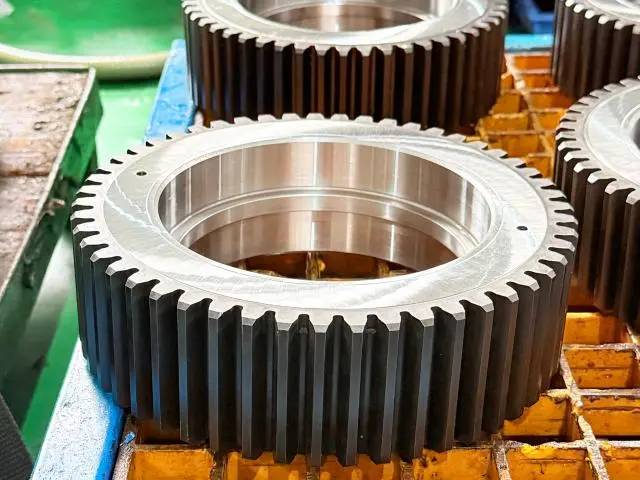
Understanding Spur Gear Grinding: The Core Process
Before grinding wheels touch hardened steel, precision gearmaking starts. YIZHi Machinery starts by casting or cutting the blank to shape it. Rough machining sets outer widths, hole sizes, and end faces before hobbing the first tooth. First phases prepare for heat treatment-induced change.
Heat Treatment and Material Considerations
Carburizing, cooling and tempering, and induction hardening strengthen but shape gears. 45# steel, 20CrMnTi, 40CrNiMo, SAE4340, 42CrMo, AISI4140, 18CrNiMo7, and 20CrNi2Mo alloys. Hardening affects grinding. Carburized gears have 58–62 HRC surface hardness, making the case and core wear-resistant. Teeth-hardened materials may reach 45–50 HRC. These hardness differences make choosing the right grinding wheel and adjusting settings crucial to minimizing heat damage during finishing.
The Grinding Operation Itself
Abrasive wheels for gear grinding machines include aluminum oxide, silicon carbide, and vitrified or resinoid ceramic. The involute shape is created by a threaded grinding worm or the wheel contour fits the teeth spacing. The gear blank spins slowly between tooth gaps as the grinding wheel turns 1,800–3,000 surface feet per minute. Each pass removes 0.0005-inch layers at thousandths of an inch. Coolant modulates heat and flushes swarf to preserve surface structure during grinding. Modern CNC machines are used for Spur Gear Grinding automation. Hardened blanks are fed into the machine, which measures the initial tooth shape with built-in probes, identifies the best grinding paths, does multiple roughing and finishing passes, and validates the work. Manufacturing uniformity and wheel wear correction are achieved using this technology. Our advanced grinding equipment can grind 0.5–50 modules. The machines can handle small instrument gears to massive industrial power transmission parts.
Quality Control and Inspection Standards
Coordinate measuring and gear testers are used for dimension testing. These devices measure profile deviation, lead variation, pitch errors, and runout across numerous parameters. ISO grades 5–9 allow deviation. High-speed or noise-sensitive use requires tighter grades. Surface finish measures 0.4–1.6 micrometers Ra roughness. Lubrication film formation and contact wear resistance depend on these variables. In metallurgy analysis, which measures diameters, grinding burns through initial etching show heat-weakened teeth. Every gear leaves our factory fulfilling performance and application criteria due to our strict quality standards.
Why Spur Gear Grinding Matters in Manufacturing
Manufacturing executives must balance quality, cost, delivery speed, and long-term reliability. Spur Gear Grinding delivers genuine mechanical system improvements that alleviate all these issues.
Precision That Translates to Performance
Grinding quickly reduces transmission error, the major source of gear noise and shaking, by improving dimensions. Mesh gears encounter speed fluctuations that cause sound energy and dynamic stress when tooth profiles deviate by a few microns from the intended involute shape. Hobbed soft gears lose 20–40 microns across the active tooth side, whereas ground gears maintain 5–10 microns. Due to this precision, motor reducers function less silently, agricultural equipment distributes power more smoothly, and gears in key mining equipment last longer. Surface finish improvements equal efficiency. Grinding surfaces with consistent lay patterns and low peak-to-valley heights lubricates edges and reduces break-in wear. Rough cutting sections provide stress concentrations that induce pitting and spalling when loaded and unloaded repeatedly. Precision grinding evenly distributes contact loads, extending contact fatigue life three to five times longer than unground solutions.
Production Efficiency and Cost Considerations
Although many procurement experts assume grinding is an expensive finishing operation, lifecycle analysis reveals it's a good value. Grinding hardened gears eliminates the requirement for soft cutting and extra processes to adjust for distortions. Soft steel used to be hobbed, carburized, quenched, and shaved or honed to restore precision. Each additional step increases cost, time, and quality risk. Grind immediately after heat treatment to save processing time and work-in-process inventory. Avoiding faults saves money. Remove heat-treated scale and decarburized top layers to strengthen teeth. It addresses quench cracking and case depth mismatches before assembly. Finding these issues during finishing is cheaper than having gears break down in the field, submit a guarantee claim, or shut down the manufacturing line. Over 15 years of manufacturing experience has shown that investing in the correct grinding technology decreases component costs throughout a product's lifespan.
Common Defects and Prevention Strategies
Although many procurement experts assume grinding is an expensive finishing operation, lifecycle analysis reveals it's a good value. Grinding hardened gears eliminates the requirement for soft cutting and extra processes to adjust for distortions. Soft steel used to be hobbed, carburized, quenched, and shaved or honed to restore precision. Each additional step increases cost, time, and quality risk. Grind immediately after heat treatment to save processing time and work-in-process inventory. Avoiding faults saves money. Remove heat-treated scale and decarburized top layers to strengthen teeth. It addresses quench cracking and case depth mismatches before assembly. Finding these issues during finishing is cheaper than having gears break down in the field, submit a guarantee claim, or shut down the manufacturing line. Over 15 years of manufacturing experience has shown that investing in the correct grinding technology decreases component costs throughout a product's lifespan.
Spur Gear Grinding Techniques and Machine Types
Each grinding technique meets production or quality needs. Knowing these possibilities helps buying teams choose the best one for their applications.
Conventional Versus High-Precision Methods
Profile grinding wheels match tooth spacing. The wheel is involute-formed and placed in each tooth gap. This method works for short manufacturing runs and bigger module gears, but wheels must be prepped and configured often. During generation grinding, a threaded grinding worm rolls with the gear blank to generate the involute shape. This method is appropriate for precise tasks and large output volumes since it is more accurate and steady across volumes. To regulate heat energy and lubricate grinding contact, wet grinding floods the cutting zone with coolant. The traditional method works for most materials and combinations. Dry grinding is better for the environment and waste management without coolant, but it needs particular wheels, lower feeds, and rigorous temperature control to safeguard the workpiece. Since temperature regulation is essential for quality and metal integrity, we propose wet Spur Gear Grinding for hardened steel gears.
Machine Tool Selection
Manual grinding machines allow skilled users to dress wheels, adjust settings, and check quality. They're good for prototypes and small volumes. Semi-automatic grinders use hand-loaded and set-up gear. It balances efficiency and capital investment for medium-sized production. CNC grinding centers automatically load, inspect, and create high-volume parts with the best throughput, precision, and efficiency. Industry leaders make specific equipment. German engineering specializes in rigid and thermal building. Japanese systems emphasize precise control and high-level automation, and new manufactures provide affordable pricing while improving. When picking grinding machines for your organization, consider module range capacity, largest workpiece diameter, axis arrangement for difficult geometries, and built-in measurement capabilities to speed setup and process control.
Grinding Wheel Technology
Business expenditures and grinding performance rely on wheel choice. For mild-hard steel, aluminum oxide wheels are flexible and cheap. Abrasives like ceramic and seeded gel cut aggressively and cool on hard surfaces, prolonging wheel life. Cubic boron nitride wheels work well on materials exceeding 55 HRC but are more expensive due to their sharp cutting edges and decreased grinding pressures. Abrasive type, grit size, grade (hardness), structure (porousness), and bond material constitute wheel specifications. These criteria are tailored to the item's hardness, structure, and bond. Our technical team works with abrasive experts to match wheel specs to gear materials and performance.
Comparing Spur Gear Grinding Solutions: Making the Right Choice
B2B buying choices depend on knowing how Spur Gear Grinding compares to other finishing techniques and how different grinding operations compare across a range of key selection characteristics.
Grinding Versus Alternative Finishing Methods
Hobbing rough cuts soft materials quickly and inexpensively for non-critical use. Heavy-load, high-speed, and low-noise operations demand precise fit and excellent surface finish, which Hobbed gears cannot provide. Sharpened tool shaving benefits only soft gears before heating. Grinding corrects heat treatment deformities and produces exact grades and surface finishes on hardened gears, which cutting cannot. Cost analysis requires a complete process review. Ground gears cost 30–50% more to produce directly than hobbed counterparts, but they last longer, need fewer finishing processes, and cause less heat-treat distortion. Ground gears help electric motors, precision clutches, aircraft actuators, and noise-sensitive equipment function.
High-Speed Grinding Versus Conventional Parameters
Traditional grinding maintains surface quality and temperature at 30 m/s wheel speeds and low feed rates. At speeds exceeding 60 m/s, CBN wheels grind quicker and minimize cycle time. Surface structure may improve with thinner chips and faster heat removal per volume. To handle higher cutting forces, high-speed grinding tools need more safety features, balanced high-RPM spindles, and durable construction. Based on manufacturing numbers and part complexity, we advise clients on cycle time reduction value.
Evaluating Service Providers and Machine Suppliers
A successful procurement needs reliable partners. Assess suppliers' technical expertise, equipment, quality control, delivery performance, on-time metrics, and production capacity transparency. Technical expertise should be shown via sample parts and capability evaluations. Our routine includes communication, design drawings, production processing with real-time updates, quality testing, protective packing, and safe transportation. This scientific method, established over 15 years of working with aviation, mining, and industrial equipment clients, guarantees operational goals are met. Production planning requires clear lead times. Typical production time is 35–60 days from order confirmation to delivery. Due to careful forging, cutting, hobbing, heat treatment, grinding, and quality control. To minimize assembly schedule interruptions, we follow this timetable with capacity planning and scheduling.
Future Trends and Innovations in Spur Gear Grinding
Technology for making things never stays still. Over the next ten years, a number of new trends are expected to change how gears are finished and how competition works.
CNC and Automation Advances
New CNC grinding centers use adaptive control systems to monitor grinding forces, noise, and power use in real time. These systems automatically modify parameters to keep things running smoothly as wheels wear down or material values change between heat-treat batches. Prior production data helps machine learning techniques forecast quality and offer parameter modifications before difficulties develop. The intelligence layers increase first-pass yield, reduce operator skill, and assure quality in all production sites. To stay competitive, these technologies are monitored and new tools are obtained. Customers of Spur Gear Grinding enjoy consistency and shorter wait times.
Material Innovations and Grinding Challenges
Engineering materials adapt to meet application needs. Modern alloy steels' case hardness and toughness make them harder to grind with standard wheels and settings. Powder metal gears may be made in almost any shape, but their strength varies, making them hard to grind. Composite materials are lighter for flight but need new grinding procedures to minimize delamination and fiber pullout. We can grind new metal compositions because we understand materials engineering. This helps us outperform competition as client needs change.
Sustainability and Safety Imperatives
Environmental laws increasingly govern coolant chemicals, disposal, and energy use. Manufacturers have reacted with minimum-lubrication systems that use less coolant, closed-loop filtration systems that lengthen fluid life, and energy-efficient machines with regenerative brakes and enhanced support systems. We use green technology to comply with the law and boost our competitiveness by saving expenses and showing socially aware shoppers we care about the environment. Worker safety is vital. Modern grinding machines are safer with full protection, dust filtration, vibration isolation, and ergonomic loading interfaces. Safety goes from staff to product. Client equipment performs better with normal ground gears. This reduces liability and protects value chain end consumers.
Conclusion
Special and precious parts impact precision gear system performance. Spur Gear Grinding provides accurate dimensions, surface quality, and metal integrity for critical industrial, mining, and aircraft equipment. You may make smart choices that balance short-term costs and long-term benefits by studying grinding processes and comparing benefits. Automation, new materials, and environmental efforts increase manufacturing technology, which modifies grinding skills to meet performance standards. Your company may prosper in demanding global markets if you choose manufacturing partners with knowledge, high-quality procedures, and a dedication to improvement.
FAQ
1. How does gear grinding differ from hobbing?
A spinning cutting tool matches tooth profiles to hobing soft gear teeth before heating them. To fix deformities and ensure accurate limits after heating, gears are polished using abrasive wheels that remove the least material. Hobbing is fast and rough, while grinding gives you accuracy and a high-quality surface for difficult applications.
2. Can all gear materials be ground after hardening?
Common case-hardened and through-hardened gear steels may be ground with the right wheel and settings. Materials above 62 HRC may be cut using CBN wheels. Powder metals and alloys need special processing. Our technical team evaluates material demands and proposes grinding processes.
3. What criteria should guide grinding service provider selection?
Take that potential suppliers have the right equipment, quality certifications to control the process, sample parts to prove they can deliver, a history of on-time deliveries, technical support for the application, and clear communication throughout the procurement process. In 15 years of serving industrial clients, we've excelled in all these areas.
Partner with a Trusted Spur Gear Grinding Manufacturer
Precision Spur Gear Grinding is the focus of Henan Yizhi Machinery Co., Ltd., which also offers advanced CNC grinding centers, heat treatment, and ISO-compliant quality systems. Our innovative production method can handle modules from 0.5 to 50, 45# steel to SAE4340 and 18CrNiMo7 alloys, and ISO 5-6 to 8-9 exact grades, depending on the application. Our low minimum order numbers and flexible manufacturing methods make sample gear easy to get. Our mining, aerospace, and industrial equipment clients worldwide trust our technical competence, on-time deliveries, and fast customer service, including design assistance, production status updates, and logistical support with real-time tracking. Get in touch with our engineering team at sales@yizmachinery.com to talk about your gear grinding needs and get full technical plans that are made just for you.
References
1. Dudley, D.W. (1994). Handbook of Practical Gear Design and Manufacture. CRC Press.
2. Klocke, F., & Brecher, C. (2016). Gear Manufacturing Processes: Finishing Processes. RWTH Aachen University Publications.
3. Rowe, W.B. (2009). Principles of Modern Grinding Technology. William Andrew Publishing.
4. American Gear Manufacturers Association. (2015). AGMA 2015-1-A01: Accuracy Classification System - Tangential Measurements for Cylindrical Gears.
5. ISO 1328-1:2013. Cylindrical Gears - ISO System of Flank Tolerance Classification - Part 1: Definitions and Allowable Values of Deviations Relevant to Flanks of Gear Teeth.
6. Marinescu, I.D., Rowe, W.B., Dimitrov, B., & Inasaki, I. (2013). Tribology of Abrasive Machining Processes. William Andrew Publishing.

USER EVALUATE
Here is the customer's evaluation of us