


What is Drive Gear Shaft? Clear Principle & Advantages
There is a very important part of machinery called a Drive Gear Shaft that connects a motor or engine to the machinery it powers. Unlike most shafts, it has gear teeth that are built in or mounted on it. These teeth are designed to transfer high torque and rotational motion while handling large radial and axial loads. As the mechanical backbone of power transmission systems, this part solves problems like torsional wear, too much backlash that causes noise and vibration, and stress caused by imbalance. Premium Drive Gear Shafts keep power loss to a minimum and catastrophic failures to a minimum in demanding mining, metallurgy, and heavy construction equipment by using advanced manufacturing methods such as profile grinding and case hardening.
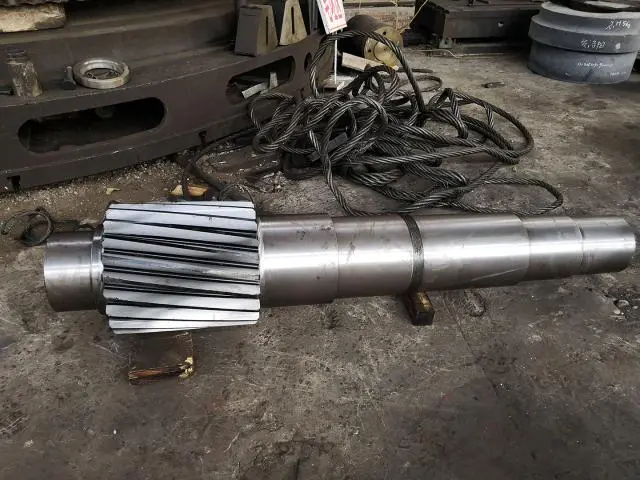
Understanding Drive Gear Shafts – Definition and Core Functions
What Makes a Drive Gear Shaft Different?
A Drive Gear Shaft is made up of two basic mechanical parts that work together: a rotating shaft and gear teeth. This integration gets rid of the need for separate connections or couplings, which lowers the space needed and improves the accuracy of the gearbox. The shaft turns on bearings to transfer power, and its rigid design keeps it from bending or twisting, which could throw the alignment off. In heavy machinery, this part has to be able to handle not only continuous rotation but also shock loads and thermal expansion without losing its shape.
Types and Material Configurations
Drive Gear Shafts are available in a variety of configurations to meet the needs of different industries. Direct gear integration is stronger than keyed assemblies because it gets rid of possible weak spots like key shear and fretting corrosion. Choosing the right material has a big effect on efficiency. For example, high-grade steel alloys like 20CrMnTi, 40CrNiMo, and SAE4340 have very high tensile strength and wear resistance. Specialized heat treatments, such as carburizing, quenching and tempering, and induction hardening, are used on these materials to make the surfaces hard (58 to 62 HRC) while keeping the cores flexible. This makes sure that the gear teeth don't wear down and that the core of the shaft can handle shock loads without breaking.
Functional Role in Power Transmission
A Drive Gear Shaft's main job is to send rotating motion from an input source to mechanical parts further down the line. It does this by precisely engaging the teeth, which changes the speed of rotation and increases or decreases torque based on gear ratios. To make sure that power is transferred smoothly with little energy loss, the shaft must stay perfectly aligned even when it is under load. These parts are often used in mining equipment main drives or industrial rolling mill systems, where they have to deal with torque levels higher than a few thousand Newton-meters while working in places with high temperatures, dust, and constant shaking.
Key Design Principles and Material Considerations
Engineering Fundamentals Behind Shaft Design
To make a good Drive Gear Shaft, you have to balance a lot of different technical ideas. The torque capacity is based on the diameter of the shaft, the strength of the material, and the depth of the heat treatment. To figure out these numbers, engineers use torsional stress models that take high loads and safety factors into account. In precision uses, lowering noise is very important. Changes to the gear tooth profile, such as crowning and tip relief, improve the contact patch under load, which lowers gearbox error and gear whine. In modern designs, the helix angle can be anywhere from 5° to 45°. This angle affects how the load is spread across the tooth width and how the bearings must handle axial thrust forces.
Material Selection and Performance Trade-offs
The choice of material has a big impact on how long a shaft lasts and how often it needs to be serviced. Because they are stronger than aluminum alloys, steel alloys are used in heavy-duty uses. They can also handle cyclic loads. Materials like AISI4140 and 42CrMo are very good at hardening, which lets them be strengthened all the way through at larger cross-sections. Specialized metals like 18CrNiMo7 make the core tougher, which is important for uses that need to handle shock loads, like the final drives of excavators or the input shafts of crushers. Forging, cutting, hobbing, milling, and grinding are the steps used to make a part that gets better and better until it reaches ISO 6 Grade precision. This makes sure that the tooth shapes stay accurate within micrometers at all working temperatures.
Understanding the qualities of a material helps buying managers weigh the costs of a product against its performance. A higher alloy content makes the raw materials more expensive, but it makes the product last a lot longer in rough environments. Case hardening creates a tough, wear-resistant layer on top of the material while keeping the tough, ductile core that keeps it from breaking easily when it hits something. While through hardening is less expensive, it makes the whole shaft stronger but also more likely to break in a big way when it's overloaded, which can happen with mining and building tools.
Common Wear Mechanisms and Prevention
Drive Gear Shafts can break down in a number of ways that repair teams need to be aware of right away. Surface pitting happens when contact stress goes beyond the material's failure limits. This makes small craters on the tooth sides that get bigger over time. Spalling is a more advanced form of pitting in which pieces of material break off. This is usually caused by a dirty lube adding rough particles. Most of the time, bending fatigue cracks start at the root of the tooth, which is where tensile stress builds up during load cycles. Properly distributing the load, keeping the lubricant clean, and following the suggested working conditions all help to stop premature wear and extend the life of parts beyond what was originally planned.
Maintenance Tips and Best Practices for Longevity
Establishing Effective Inspection Routines
Visual checks done on a regular basis can find problems early on, before they get worse and cause the equipment to break down. Maintenance teams should look at the surfaces of teeth for strange wear patterns. They should look for polishing, which means the teeth aren't aligned correctly, or pitting, which means the teeth aren't getting enough oil. Regularly checking backlash shows how wear is progressing—too much space between meshing teeth causes noise and lowers gearbox accuracy. Check the shaft journals where the bearings are installed for fretting corrosion, which shows up as rust-colored deposits and means that two surfaces that should be fixed are actually moving relative to each other.
Lubrication Strategy and Contamination Control
When you lubricate metal surfaces properly, a protective film forms between them. This keeps them from touching directly and gets rid of frictional heat. The lubricant's thickness needs to be the same at all working temperatures. If it's too thin, the film breaks apart when it's loaded, and if it's too thick, churning losses make it less effective. By counting particles and finding wear metals, oil analysis programs find contamination early on. Water getting into outdoor mining equipment is common and makes rust and lubricant additives less effective. Putting in place good sealing systems and changing the oil on a regular basis protect the Drive Gear Shaft's integrity in a way that goes beyond basic care.
Troubleshooting Vibration and Alignment Issues
Unusual sound patterns are often a sign that problems are getting worse. Low-frequency vibration is usually caused by shafts that are not balanced or aligned properly. High-frequency vibration is a sign of a problem with the gear mesh, such as tooth damage or bad backlash. Vibration analysis tools should be used by maintenance staff to find frequency signatures that match up with certain component speeds. If the shaft isn't lined up right, even by a small amount, the loads are concentrated on the tooth edges instead of being spread out across the whole face width. This edge loading speeds up wear and makes heat. Laser adjustment tools help get the couplings perfectly lined up, which increases the life of the bearings and seals and lowers the amount of energy used.
Protective steps make operations last a lot longer. When there is border lubrication, putting special coats on gear teeth lowers the friction coefficients and raises the resistance to scuffing. Shot peening adds leftover compressive stresses to the top layers of a material. These stresses increase wear resistance by opposing the tensile stresses that make cracks spread. When you stay within the speed and load limits that were planned, you avoid overheating, which softens surfaces that have been hardened. When used together, these methods cut down on unplanned downtime and put off costly replacement costs in businesses that rely on capital.
Comparison and Selection Guide for Drive Gear Shafts
Distinguishing Between Shaft Types
Understanding the functional differences between parts that work together makes it easier to choose the right one. A Drive Gear Shaft actively transfers power through teeth that mesh together. An axle shaft, on the other hand, holds moving parts and may or may not transfer torque. When driven gear shafts get power, they don't start gearboxes. This difference changes the design priorities: axles need to have better bending resistance and wear life under radial loads, while drive shafts need higher rotational strength and surface hardness. Heavy-duty versions have bigger cross-sections and better alloy grades so they can handle continuous high-torque uses like in mining haul trucks and port crane slewing mechanisms.
Evaluating Transmission Methods
Chain drive systems that use Drive Gear Shafts can handle a lot of torque and can work even if they aren't lined up perfectly, but they need to be tensioned and oiled on a regular basis. Belt drive configurations are quieter and protect against overloading by slippage, but they send less torque per unit width. The most popular type of gear mesh in industrial gearboxes is direct gear mesh, which offers high efficiency (often over 98%) and small size. Steel construction is most common because it needs to be strong, but aluminum can be used in some situations where lower torque capacity is acceptable because of weight reduction. For example, it can be used in aircraft actuators or robotic joint drives that need to be very precise and have very little friction.
Performance Benchmarks from Industry Leaders
Well-known companies like SKF and Timken made their names by combining bearings with drive parts and providing whole shaft systems with the best bearing fits and preload requirements. Bosch is very good at making parts for cars, where tight standards and uniform quality are needed for mass production. NSK and NTN offer a lot of technical support for unique uses, which helps procurement teams figure out how to meet the complicated requirements. These leaders in the field keep up quality systems that make it possible to track materials from the time they are certified as raw materials all the way through to the final inspection. This gives large companies the peace of mind they need when they buy parts for important power transmission paths.
When purchasing professionals look at different suppliers, they should check how well they can make things that aren't in the catalog. Flexible production methods are needed for gears with custom factors like tooth count, module ranging from 0.5 to 50, and specific helix angles. Surface hardness levels between 45 and 50 HRC are good for medium-duty uses, while 58 to 62 HRC are for tough situations. Lead times for production, which are usually 35 to 60 days for engineered parts, need to work with project plans and strategies for managing stockpiles.
Procurement Insights – Buying Guide and Supplier Information
Navigating Bulk Purchasing and Custom Manufacturing
Comparing unit prices is only one part of large-scale industrial procurement. When you make a volume commitment, you can often get better prices, but you need to be able to accurately predict demand to avoid having to pay extra for holding too much inventory. Custom production partnerships allow engineers to change tooth profiles, choose specific materials, and change heat treatment methods to fit the exact conditions of the application. This customization leads to better performance that off-the-shelf parts can't match, especially in unique situations like continuous miner drive trains or special rolling mill configurations.
Evaluating Supplier Capabilities and Support Infrastructure
Criteria for choosing a supplier include more than just the specifications of the products. They also include the level and speed of expert assistance. Can the supplier give you a finite element analysis to prove that the shaft is strong under the conditions you're using it in? Do they offer the material traceability paperwork that is needed for important applications? The terms of the warranty show how confident the maker is in the product; full coverage shows that the quality control system is strong. How responsive customer service is during the quote part is a good indicator of how good help will be when problems happen in the field. Suppliers who offer design help help buying teams make the best use of specs, which could lower costs and boost performance through joint engineering.
Transportation logistics have a big effect on the total cost of an acquisition and the time it takes to complete a project. Precision-ground surfaces are kept safe from damage during shipping by using special wrapping with shock-absorbing materials and custom-made wooden boxes. Multi-modal transportation, which combines ocean freight for large packages with fast air freight for urgent repairs, gives you options. Real-time tracking tools let managers in the supply chain see where shipments are at all times, so they can respond quickly to problems. Careful packaging can cut down on damage rates to less than 0.1%, which lowers the hidden costs of rejected shipments and production delays.
Building Strategic Supplier Relationships
Long-term relationships with reliable providers build value for both sides that goes beyond simple transactions. Preferred vendor deals may include specialized inventory stocks that make sure parts are available when equipment breaks down. Through collaborative product development, supplier knowledge is used to make designs for next-generation equipment better. Using the same tried-and-true parts for all of your equipment makes it easier to keep track of spare parts and teach people how to do maintenance. These strategic partnerships become competitive advantages because they make procurement easier and make sure there are stable supply lines for parts that keep production going.
Conclusion
Drive Gear Shafts are very important parts where the accuracy of the engineering directly affects how well and how reliably the equipment works. Procurement pros can make smart choices that balance beginning costs against long-term value when they understand design principles, material science, and maintenance needs. When gear teeth are combined with shaft functionality, they make a strong answer for power transfer problems in tough industrial settings. Companies can get the most out of their equipment while keeping costs low in competitive markets by choosing high-quality parts from reliable sources, using proactive repair plans, and getting custom engineering help.
FAQ
1.What distinguishes a drive gear shaft from a driven gear shaft?
As the input element in gear systems, a Drive Gear Shaft takes power from the prime mover and starts the gearbox to downstream parts. This power is sent to the driving gear shaft, which is the output part. Because they handle all of the input torque before any gear reduction happens, drive shafts usually need higher torsional strength requirements.
2.When should I replace a drive gear shaft?
When measuring backlash is more than 50% of what is allowed, when tooth surfaces have deep pits that cover more than 20% of the active profile, or when cracks show up at the roots of teeth or on shaft journals, replacement is needed. Unusual noise, more vibrations, or higher working temperatures are also signs of wear and tear that need to be fixed before a catastrophic failure happens.
3.Which materials suit heavy-duty industrial applications best?
After the right heat treatment, alloy steels such as 40CrNiMo, SAE4340, and 18CrNiMo7 have the best mix of core toughness and surface hardness. These materials can handle the shock loads and cyclic stresses that come from big rolling mills, crushers, and mining tools. Case hardening to a surface hardness of 58–62 HRC and carburizing to the right depths for each tooth module provides long service life in rough settings with little upkeep.
Partner with YIZHI MACHINERY for Superior Drive Gear Shaft Solutions
YIZHI MACHINERY designs and engineers Drive Gear Shaft solutions that work well in tough industrial settings. Our production methods are ISO-compliant and use advanced forging, precision hobbing, and special heat treatments to make parts that meet the strict requirements of the mining, metallurgical, and heavy machinery industries. With over 15 years of production experience and the ability to customize modules from 0.5 to 50, we can solve difficult power transmission problems that standard catalog parts can't.
Our Drive Gear Shaft manufacturer offers flexible order quantities, even single-piece production, so you can get high-quality parts without having to place huge minimum orders. Production times of 35 to 60 days are in line with project plans, and our multi-channel logistics network, which includes ocean freight, air express, and rail transport, makes sure that delivery is under control. Tracking shipments in real time and custom protective packaging keep damage rates during transport to less than 0.1%, protecting your investment from the factory to the installation site.
During the whole procurement process, we offer full technical support, including collaborative design advice, synchronized production updates, detailed recording of quality inspections, and a guarantee that covers one year. Contact our team at sales@yizmachinery.com to talk about your specific Drive Gear Shaft needs and get a quote that takes into account your application parameters, material preferences, and delivery schedule.
References
1. American Gear Manufacturers Association. "Gear Materials and Heat Treatment Manual." AGMA Technical Publication, 2019.
2. Dudley, Darle W. "Handbook of Practical Gear Design and Manufacture." CRC Press, Second Edition, 2020.
3. International Organization for Standardization. "ISO 6336: Calculation of Load Capacity of Spur and Helical Gears." Geneva: ISO Standards, 2018.
4. Budynas, Richard G., and Nisbett, J. Keith. "Shigley's Mechanical Engineering Design." McGraw-Hill Education, Eleventh Edition, 2021.
5. Society of Automotive Engineers. "SAE J1940: High Strength Steel Shaft Applications and Materials." SAE International Standards, 2017.
6. Norton, Robert L. "Machine Design: An Integrated Approach." Pearson Education, Sixth Edition, 2020.

USER EVALUATE
Here is the customer's evaluation of us