


Industrial Spur Gear vs Helical Gear: Which Fits Your System?
Gears for tools generally come in two primary types: spherical with straight teeth and angle teeth. Industrial Spur Gear choices are suitable for parallel shaft installations that prioritize simplicity of use, cheap cost, and transmission efficiency. These parts are ideal for moderate-speed mine conveyors, aviation auxiliary drives, and tiny motor reducers since their teeth are parallel to the rotation axis. Knowing which gear arrangement best fulfills your practical goals, such as noise reduction or load capacity, affects system reliability and ROI. Power is transported via industrial gears in factories, robots, and heavy equipment. Different gear kinds affect how well equipment performs, how frequently it requires maintenance, and how much it costs to purchase. Straight- or angled-toothed bearings affect weight-holding and loudness. We have worked with aviation firms that require precision-ground components and mining organizations that need 24/7 online. This taught us that gear selection is both technical and strategic. Choose between helical-angled and parallel-toothed cylinder gears based on load rates, speed ranges, space, and budget. This article walks buyers through these steps to ensure gear specifications match use.
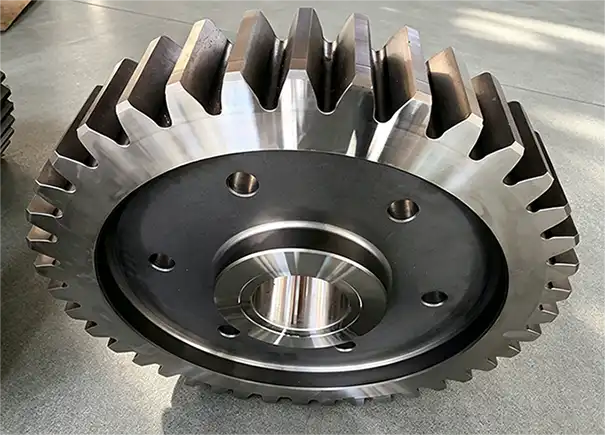
Understanding Industrial Spur Gears and Helical Gears
What Makes Straight-Toothed Gears Unique
The most basic power transmission method is cylindrical gears with shaft plane-aligned teeth. Making these pieces involves forging, hobbing, and precise cutting. 45# steel is appropriate for ordinary usage, whereas 20CrMnTi and AISI4140 are preferable for demanding situations. Involute geometry determines tooth form. This fixes velocity ratios and eliminates axial thrust stresses that complicate bearing selection.Industrial Spur Gear parts function best with straight shafts and speeds under 20 m/s. Housings and bearings are cheaper and simpler to construct than helical ones since there are no longitudinal forces. Despite their basic teeth, these gears can take enormous loads owing to heat treatment such carburizing to 58–62 HRC.
How Helical Gears Differ Fundamentally
Unlike straight teeth, angled teeth join slowly across the face. This increased contact reduces impact forces and noise, making helical designs ideal for rapid, quiet machines. The tooth angle is commonly 15–30 degrees. This improves meshing but increases axial thrust that requires thrust bearings or double-helical designs. Helicoidal gears need more complicated equipment and setup. When aviation gears and industrial reducers operate over 3,000 RPM, grinding is essential for precision. Helical meshing requires greater surface contact pressures, hence case-hardened metals like SAE4340 or 18CrNiMo7 are commonly used.
Core Application Environments
Straight-toothed cylinder gears are best for simplicity and maintenance. Mining equipment operators enjoy how simple it is to examine and replace these pieces during maintenance. Small, affordable gearboxes are ideal for agricultural implements since they are straightforward to install. Helical variants suit precision motion control and high-speed reduction systems. Helical gears in CNC machine tool drives prevent vibrations from spreading. Helical power generators disperse load better among several active teeth.
Key Differences Between Industrial Spur Gears and Helical Gears
Tooth Geometry and Engagement Characteristics
The fundamental distinction is tooth contact. Parallel-tooth designs apply load immediately when they connect swiftly across the face width. This feature creates additional noise (80–90 dB when loaded), but all loads operate perpendicular to the shaft axis, making force measurement simpler. An angled tooth form allows teeth to link progressively from one end to the other across the face. In comparable scenarios, this reduces shock loads and noise to 65–75 dB. The helix angle affects axial thrust forces, making bearing selection and case construction difficult.
Performance Metrics Comparison
Due to low tooth friction, Industrial Spur Gear systems have transfer efficiencies of 98 to 99%. Because there are no axial parts and the load line is straight, the output shaft receives more power than the bearings. Helical arrangements are 96–97% efficient due to the increased moving motion between slanted teeth. But they can transfer greater force in the same area since they may contact many teeth at once. Due to load distribution, a gear with spiral teeth can move 70 kNm, but one with straight teeth can only move 50.
Maintenance and Serviceability Factors
Maintenance-friendly cylindrical gears with aligned teeth. The inspection procedure remains easy. Pitting, scoring, and tooth wear may be checked using a mirror and basic measurement equipment. After adjusting center distance and backlash, replacement techniques need no more adjustments. Precision is needed for helical gear maintenance. Misaligned edge stress tenfolds wear. Vibration research is essential for predictive repair, complicating operations. Angled teeth need special lubricants with high-pressure additives to manage quicker movement speeds.
These operational variations affect purchasing strategy. Simple actions that don't need much technology should use straight-toothed alternatives. Facilities with specialist repair crews and equipment can monitor condition with helical performance.
How to Choose Between Spur and Helical Gears for Your System
Assessing System Requirements
Gear selection is determined on load capacity. Calculating service elements like shock loads, task cycles, and weather conditions will help you decide whether cylindrical or helical designs are best. Straight-toothed designs are sturdy and simple, making them suitable for mining applications that need high impact loads, despite their noise. Speed requirements strongly influence gear type. Straight-toothed gears are quiet and function well below 1,500 RPM. High-speed applications above 3,000 RPM need helical arrangements to manage dynamic stresses and reduce vibrations. How noise-sensitive the sensor is and space availability determine the decision.
Procurement Considerations Beyond Technical Specs
Each gear has varying lead times. Standard straight-toothed gears may be supplied in 35 to 60 days due to simplified manufacture and convenient tool availability. A unique helical gear machined to ISO 5-6 grade may take 60–90 days. Customization is crucial when catalog items don't suit demands. Module lengths from 0.5 to 50 and materials from 45# steel to SAE4340 provide clients many options for utilizing their goods creatively. Single-unit manufacture is important for testing or maintaining obsolete equipment with old parts. In the mining and aerospace sectors, suppliers must have demonstrated quality procedures to obtain accredited. For most applications, ISO 9001 is sufficient, but aerospace requires AS9100. Material traceability and heat treatment ensure mechanical quality.
Real-World Application Examples
Shock loads from large ore pieces caused conveyor drive issues at a Midwest mining company. Switching from helical to Industrial Spur Gear reducers eliminated thrust bearing issues and simplified field maintenance. Since there were no rotating stresses, the bearings lasted 48 months instead of 18, reducing downtime expenses. A business making airplane actuators required compact gears for flight controls. Straight-toothed approaches were utilized due to space limits, even though helical forms are smoother. They requested precision-ground parts with case-hardened surfaces of 58–62 HRC and ISO 6 tolerances to reduce noise and meet packaging requirements. Agricultural tool manufacturers balance cost and efficiency. Straight-toothed tractor PTO gears are used for tool drives since field noise is less of a concern and affordability is more significant. However, hydrostatic gearbox secondary drives employ helical gears, which are less smooth and less pleasant.
Comparative Analysis: Spur Gear vs Helical Gear in Industrial Procurement
Performance Metrics Deep Dive
Contact ratio, or how many teeth are engaged at once, determines a machine's torque capacity. Most straight-toothed gears have contact ratios between 1.2 and 1.5, so one to two teeth share the load. Helical designs may take greater weight at the same size since they have 2.0–3.0 contact ratios due to face width engagement. How interaction operates affects noise emissions. Each tooth impacts the mesh when two parallel teeth abruptly connect across their width, producing impact noise. Most business spaces have 85–90 dB sound pressure. Helical gears' slow contact reduces this to 70–75 dB, making them preferable for noise-sensitive or comfortable environments. Comparisons of energy economy show minimal variations. Industrial Spur Gear gears lose less power to bearing wear without axial pressure. Helix teeth may lose 600W to gear mesh and bearing wear on a 50 kW drive, compared to 500W with straight teeth. Using this disparity for years adds up to substantial energy expenditures for a firm.
Material Selection Impact
The correct steel grade greatly affects tooth form. Straight-toothed designs can handle 42CrMo and AISI4140 for numerous applications. Wear may be prevented by through-hardening to 45–50 HRC. Because stress is distributed more uniformly and contact forces are reduced, high material grades are unnecessary. Helical gears benefit from case-hardening metals like 20CrMnTi or AISI8620. Carburizing hardens surfaces (58–62 HRC) over robust cores to accommodate increased contact pressures from angled teeth. In harsh conditions, the material's increased cost (15–25% more than medium-carbon kinds) helps it last longer. Materials affect how things are manufactured. Forging and hobbing work on both types of gears, although perfect helix gears need grinding. Straight-toothed pieces are simpler to grind since the grinding wheel doesn't require spiral interpolation. Due to their ease of production, they cost 10–20% less than comparable goods.
Supplier Evaluation Criteria
Certified manufactures follow established methods to demonstrate quality. How effectively suppliers manage heat treatment—do they carburize themselves or outsource? Process control and traceability are usually better with in-house heat treatment. No matter the inspection equipment, a supplier's CMM and gear testers can examine involute profiles and lead accuracy to specific limitations. Expert advice and goods from authorised wholesalers are helpful. Stock systems help distributors reduce downtime when replacements are required rapidly. The distributor's stock should fulfill your module, material, and hardness demands as stock programs seldom incorporate non-standard designs. Customer support continues after purchase. Technical support from suppliers during specification development might help you pick the optimal gear. Technical features like failure analysis, loading estimations, and lubrication advise distinguish luxury from inexpensive suppliers. Our research shows that manufacturers with application knowledge provide superior long-term value.
Optimizing Gear Performance and Maintenance for Longevity
Lubrication Strategies
Gears endure longer with proper lubrication. Industrial Spur Gear systems run smoothly with splash lubrication in enclosed gearboxes using ISO VG 220-320 mineral oils. Normal industrial gear oils may cover parallel teeth since they don't increase sliding speeds. Helical teeth move faster and need more sophisticated lubrication since they contact at an angle. ISO VG 320–460 oils need extreme-pressure chemicals, particularly in high-load circumstances. After splash lubrication fails, forced lubrication systems transfer oil directly to mesh zones to prevent scuffing on high-speed helical drives. Oil research technologies identify wear patterns before catastrophic breakdown. Monitoring iron concentration demonstrates typical wear rates, whereas unexpected spikes indicate misalignment or insufficient lubrication. Particle counting determines pain. These tools for planned maintenance are useful for both types of gears, but they are especially useful for helix systems that need to be perfectly aligned.
Wear Monitoring and Inspection
Regular visual inspections detect most issues early. Straight-toothed gears wear clearly. Even contact across the tooth face indicates gear alignment, whereas edge loading causes wear around the tooth ends. Blowing back with normal maintenance indicates wear. Replacement is recommended if backlash exceeds 50% of its original value. Vibration analysis detects spiral gear issues earlier. Installation-set baseline vibration patterns facilitate tracking. If vibration strength or frequency varies, cracking, misalignment, or bearing wear may begin. Straight-toothed designs' mesh frequency sound masks early wear, making this method less effective.
Replacement Part Considerations
OEM parts ensure replacement parts are the same size and quality. But budget-conscious organizations are attracted by aftermarket suppliers that provide the same characteristics at cheaper rates. Aftermarket gears should match originals in size and heat treatment, not simply dimensions. If a gear has the appropriate tooth form but not adequate hardness, it will break down early, negating any initial cost savings. Changing individual gears instead of sets requires consideration of the mating surface. When a new Industrial Spur Gear is compared to an old one, the load is unequal, accelerating wear. To maximise performance, replace both at once if the connecting gear has less than 10% tooth thickness loss. These maintenance techniques simplify total cost of ownership, aiding buying choices. Straight-toothed gears have reduced lifespan costs due to their easy maintenance, even though they may need to be changed more frequently in high-speed operations. Maintenance is harder for helical gears, raising expenses. In certain cases, their performance gains justify the expense.
Conclusion
When choosing between cylindrical gears with straight or slanted teeth, be sure the technical requirements meet the application. For moderate-speed activities with little noise, straight-toothed designs are simplest, most efficient, and cheapest. Their low rotating loads make choosing bearings, building housings, and maintaining them straightforward. Although more sophisticated and maintenance-intensive, helical solutions provide smoother performance, better load capacity, and less noise. You must weigh these aspects against practical concerns like downtime, starting costs, and performance targets to succeed in procurement. Understanding these trade-offs helps you make sensible, long-term decisions.
FAQ
1. Can straight-toothed cylindrical gears handle high-speed applications?
Up to a pitch line rate of about 20 m/s, Industrial Spur Gear components perform successfully. When these forces go beyond this point, they cause too much noise and dynamic loading, which speeds up wear. Helical configurations that connect gradually usually work better for high-speed uses above 3,000 RPM because they lower the amount of shock loading and vibration that gets to the bearings and housings.
2. How do I optimize costs when ordering custom gears in bulk?
With volume agreements, costs can be cut by a lot. Orders of more than 50 units often get savings of 15 to 25 percent because the costs of setup are spread out over more units. By letting you make bigger batches, standardizing on fewer module sizes and materials across all of your tools further cuts costs. Setting up blanket purchase orders with planned drops lets suppliers see your forecast, which can often lead to lower prices.
3. What certifications validate gear supplier quality?
ISO 9001 approval shows that you know how to use basic quality management methods. For aerospace uses, providers must be certified to AS9100, which shows that they meet strict standards for process control and traceability. Material approvals, which show the gears' chemical make-up and mechanical properties, make sure they meet performance standards. Check that the production precision meets the AGMA or DIN tolerance classes listed in your purchase papers by looking at inspection reports that show the accuracy of the tooth profile, the lead deviation, and the surface finish.
Partner with Henan Yizhi Machinery Co., Ltd. for Custom Gear Solutions
Henan Yizhi Machinery Co., Ltd. makes precise gear transmission components for industrial, mining, and aeronautical applications. We manufacture Industrial Spur Gear systems from 0.5 to 50 modules. Our high-quality 42CrMo, AISI4140, and SAE4340 materials are heat treated to 58–62 HRC. Since 2016, we have created unique ISO 5-6 grade solutions employing innovative forging, hobbing, and grinding procedures. Precision CNC gear machining centers and automated grinding systems are our manufacturing tools. They provide consistent part quality. Our 15-year manufacturing history includes long-term partnerships with three nations' top mechanical engineering firms. With unexpected lead times, inconsistent quality, and insufficient technology, buying products may be difficult. We guarantee delivery timeframes between 35 and 60 days, tracked your purchase in real time from the production floor to your receiving dock, and provided design help and a one-year warranty before the sale. Our specialized packaging with shock-absorbing liners protects your investment across worldwide transportation chains with damage rates under 0.1%. Our making is flexible enough to handle orders of any size, from a single test unit to a large production run. You can talk to our expert team about your needs by emailing sales@yizmachinery.com. We'll give you plan drawings, suggestions for materials, and fair bids that are in line with your performance requirements and budget. Find out why top makers trust Henan Yizhi Machinery to provide them with reliable, precisely ground gear solutions that improve machine performance and lower costs over its entire lifecycle.
References
1. American Gear Manufacturers Association (AGMA). "AGMA 2001-D04: Fundamental Rating Factors and Calculation Methods for Involute Spur and Helical Gear Teeth." AGMA Technical Publications, 2004.
2. Dudley, Darle W. "Handbook of Practical Gear Design and Manufacture." CRC Press, 2nd Edition, 2012.
3. International Organization for Standardization. "ISO 1328-1:2013: Cylindrical Gears - ISO System of Flank Tolerance Classification." ISO Standards Catalogue, 2013.
4. Khurmi, R.S. and Gupta, J.K. "Machine Design: Textbook of Machine Design." S. Chand Publishing, 14th Edition, 2005.
5. Townsend, Dennis P. "Dudley's Gear Handbook: The Design, Manufacture, and Application of Gears." McGraw-Hill Professional, 2nd Edition, 1992.
6. Maitra, G.M. "Handbook of Gear Design." Tata McGraw-Hill Education, 2nd Revised Edition, 1994.

USER EVALUATE
Here is the customer's evaluation of us