


What is the function of a rotary kiln girth gear?
The Rotary Kiln Girth Gear is the main part that transfers power to large circular kilns so that they can be rotated in a controlled way in industrial settings. This big bull gear is mounted on the outside of the kiln shell and connects with the drive pinions to provide a lot of torque. This torque turns motor power into the slow, steady spinning that is needed to process materials like cement clinker, lime, and metallurgical ores. It does more than just move motion; it also absorbs thermal expansion pressures and works with shell deformations that happen when equipment is heated above 400°C. This makes it essential for keeping production going and avoiding catastrophic equipment failures.
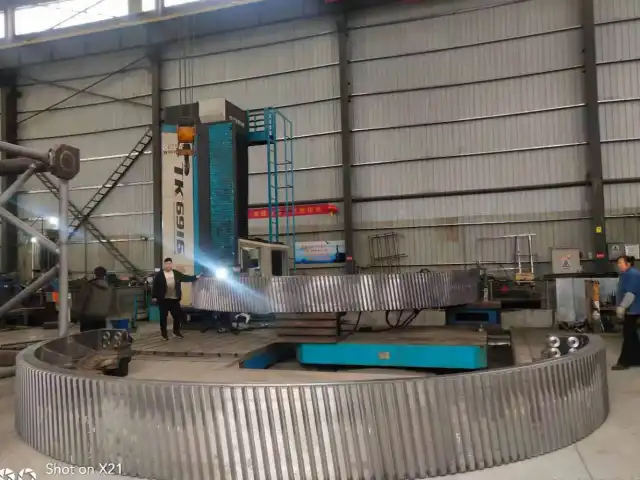
Understanding the Core Function of the Rotary Kiln Girth Gear
Torque Transmission and Load Distribution
For the Rotary Kiln Girth Gear, its main job is to turn high-torque drive input into steady circular motion. Electric motors make power, which moves kilns that weigh hundreds of tons at controlled speeds, usually between 0.5 and 5 revolutions per minute. The drive pinion engages with the gear teeth, making a mechanical advantage. For processing materials, this exact speed control is necessary. If the speed is too fast, the materials don't get properly calcined, and if it's too slow, production drops by a lot. The gear's tooth shape spreads out heavy loads over many contact points at the same time, stopping localized stress buildsups that would otherwise cause teeth to break too soon. According to engineering data, gear systems that are properly built can transfer torques greater than 3,000 kN·m while keeping their dimensions within ISO 5-6 Grade tolerances.
Accommodating Thermal and Mechanical Deformation
In contrast to fixed equipment, rotating kilns continuously change temperature and bend mechanically. When the temperature inside the kiln changes during production, the shell grows unevenly. This is known as "shell wobble" or ovality by engineers. Good designs for Rotary Kiln Girth Gears have flexible parts that let them handle these changes without losing tooth contact. Some makers use segmented gear design, which is made up of two to four pieces that are bolted together and lets you make small positional changes while installing and using the gear. This way of thinking about design stops binding and too much tooth wear that would happen with stiff, single-piece designs. The hot kiln shell and cooler gear rim are at different temperatures, which adds to the problems. Advanced mounting systems use tangential supports or bolts that are spring-loaded to keep the structure strong and avoid stress from building up at the connection points.
Maintaining Rotational Stability Under Variable Loads
The flow of materials inside ovens doesn't stay the same for long. The drive system is subject to shock loads and changes in torque when raw materials move and form internal rings or quickly discharge. The Rotary Kiln Girth Gear acts as a mechanical cushion, and its large mass provides rotary inertia that smooths out these changes. The structure of the gear rim, which usually has Y-shaped or rectangular spokes, makes it strong and flexible at the same time. These spoke arrangements let the spokes bend in a controlled way, which reduces noise while keeping the teeth in place. Surface safety methods are needed in places where there is a lot of dust or an atmosphere that is corrosive. We've seen that gears with the right heat treatment and surface finishing keep their teeth shape for longer, which means they don't need to be shut down as often, which can save up to 40% of the cost.
Design Features and Material Considerations of Rotary Kiln Girth Gears
Material Selection for Extreme Operating Conditions
Strong, durable, and machineable materials are needed for heavy-duty kilns. We deal with 42CrMo, AISI4140, and 18CrNiMo7 alloy steels. Each steel behaves differently. When kilns unexpectedly change load during material release, the 42CrMo grade's above 1,000 MPa tensile strength and impact resistance are crucial. Case-hardening types 20CrMnTi or AISI8620 are utilized for harder tasks. Carburizing makes the top layer wear-resistant while retaining the core robust and supple. This combination prevents poor surface pitting and root breakage. Materials respond differently to heat treatment depending on their chemistry. Nickel makes things tougher at high temperatures, whereas chromium makes them harder to soften and wear down. Adding molybdenum strengthens the temper and grain structure. Our metallurgical testing demonstrates that the proper materials offer tooth sides 58–62 HRC surface hardness and 280–320 HB core hardness. The hardness difference is ideal for matching pinions.
Precision Machining and Tooth Profile Engineering
Rotary Kiln Girth Gear teeth accuracy impacts contact patterns, noise, and weight capacity. Manufacturing begins with forging. It aligns grain structure with stress orientations to strengthen the material. After preliminary cutting, excess material is eliminated and precision hobbing creates the involute tooth form. CNC tools are used to hone gears over 4 meters with a 0.02 mm pitch accuracy. Tooth grinding, with ISO 5-6 Grade accuracy, concludes precise work. This exact level ensures seamless meshing and little pushback. Reduces dynamic loads that accelerate wear. The pressure angle, commonly 20° in commercial settings, affects load distribution and contact stress. Larger pressure angles allow more weight but increase separation forces. Based on each kiln drive arrangement, our research team determines how to utilize this capability. Kiln Rotary Kiln Girth Gear module specification (tooth size relative to pitch width) is 12 to 50. Larger modules handle more torque. Custom adjustments such tip relief and profile crowning compensate for loaded tooth deflections, extending contact throughout the tooth face.
Heat Treatment Protocols and Surface Protection
Heat treatment improves gear performance from basic materials. Quenching and hardening establish the gear body's mechanical properties. Strength, hardness, toughness. Induction hardening hardens teeth to 58–62 HRC, reducing wear in contact regions. The carburizing process adds carbon to low-carbon steels' top layers. This provides 1-3 mm deep case hardening to prevent contact wear and cracking. These stages need precise temperature control; a 20°C variation may destroy the result. Surface finishes resist environmental degradation. Blackening provides basic corrosion protection for sealed drive systems. Phosphating forms a thin grease-protecting coating, which is useful in dusty areas. Hard chrome coating resists wear and rust better, but hydrogen weakens it if not maintained properly. Workplace conditions determine the option. Concrete plants with alkaline dust require different treatments than metalworking operations with acidic condensates.
Maintenance, Failure Causes, and Wear Signs of Rotary Kiln Girth Gears
Common Failure Modes and Root Causes
Common failure causes include gear and pinion misalignment. When fitting tolerances are excessively high or support structures settle, tooth contact moves away from the face width center to the sides. Contact stress rises 200–300% at this concentration, promoting surface degradation. Shiny edges and dingy middles indicate tooth wear. Lack of grease promotes wear. Rotary Kiln Girth Strong open gear lubricants use graphite or molybdenum disulfide. Lubrication ranges from hand brushing to motorized spray systems that count rotations. Heat and damage result from metal-on-metal contact when the lubrication coating breaks down. Infrared temperature sensors may identify lubrication concerns early. Years of loading and unloading wear materials. Microcracks form at dental roots, where twisting pressures are highest. When cracks get too big, teeth break. Magnetic particle screening or ultrasonic testing during planned downtime may reveal below-surface cracks before a serious failure.
Diagnostic Signs and Inspection Protocols
Anomaly wear patterns on the Rotary Kiln Girth Gear show machine use. Pitting, tiny depressions on teeth, occurs when surface pressures exceed material capacity. Pitting less than 1 mm deep indicates typical wear, but pitting deeper than that indicates overload or improper lubrication. Scoring is like tooth-length scratch lines. This is because glue and lubricant wear out. Spalling occurs after significant pitting or contact damage and breaks off larger chunks of material. Real-time monitoring is possible with noise attributes. A smooth, constant sound indicates proper meshing. Every rotation sounds like something is impacting, perhaps a fractured tooth or mesh obstruction. High-frequency screaming indicates a poorly lubricated bearing. Organized inspection plans should include daily visual checks while the system is operating, weekly close inspections during brief shutdowns, and comprehensive measurement during annual maintenance breaks. To calculate wear rates, measuring protocols should capture tooth thickness in many locations and compare them to the initial data. Backlash may be measured using gear markers to detect wear or mounting bolt relaxation.
Proactive Maintenance Strategies
Gear lifespan depends on lubrication. Setting lubricant viscosity for temperature prevents thin oil runoff and thick entry. Outdoor labor in hot weather may need seasonal modifications. Shields and air seals keep gritty particles out, accelerating wear. Always check alignment after a big loss. Laser alignment devices assess gear axial position, pinion position, and rotational wobble. Specifications allow 2–3 mm indicator runout on large gears. Support roller or shell positioning must be changed if exceeded. Fixing nut torque checks avoid contact surface loosening and fretting. Condition-based monitoring prevents issues beyond routine maintenance. Accelerometers near the mesh may identify difficulties weeks in advance. By sampling open gear lubrication for wear debris, oil analysis equipment may determine wear rates and find abnormal particle types that suggest failure processes. These monitoring systems enable equipment repair to be planned depending on its state rather than randomly. It maximises equipment availability and maintenance expenses.
Comparing Rotary Kiln Girth Gear with Other Critical Components
Girth Gear Versus Pinion Gear Roles
A reduction gear connects the driving motor to the pinion gear, which is normally tenths to twenty-twentieths of the girth gear. Size differences delay and power the kiln, allowing it to function. Both sides collaborate but play separate roles. The active driver, the pinion, transfers motor power to the larger gear. The Rotary Kiln Girth Gear spins the massive kiln unit in response to gear input. Engineering practice dictates that the pinion be 20–40 HB tougher than the gear. This disparity causes the smaller, cheaper pinion to wear out to protect the larger, more costly gear. This strategy is superior since replacement costs are cheaper. A pinion costs $15,000–$40,000, and a girth gear $80,000–$300,000. Design guidelines set part quality standards. Most pinions reach AGMA Quality Class 11–12, whereas girth gears only Class 9–10. This is because smaller components can be built to higher standards and large-diameter gears cost more.
Manufacturing Standards and Quality Specifications
International standards control how gears are designed and made, making sure that they can be used with other gears and that their performance can be predicted. Most world specs are based on ISO standards, especially ISO 1328 for accuracy and ISO 6336 for figuring out load capacities. In North American markets, AGMA standards are still widely used. AGMA 2001 covers gear shape, and AGMA 6014 covers surface toughness. In Europe, DIN standards are still used, especially for devices made by German original equipment manufacturers (OEMs). Specifications for materials are based on the relevant standards, which are ASTM in North America, EN in Europe, and GB in China. It's important to know these equivalents when looking for new parts or components such as a Rotary Kiln Girth Gear. A gear marked with the number AISI4140 is the same as 42CrMo4 (EN designation) or 42CrMo (GB designation), but there are some small differences in the chemistry between the two standards. Quality certification paperwork should include mill certificates that show what the material is made of and hardness tests records that show how well the heat treatment worked. Dimensional inspection records that show agreement with certain range grades give you peace of mind that the fit and function are correct.
Cost Considerations and Performance Trade-offs
Due to budget constraints, desired and practical needs must be balanced. Single-piece girth gears are strongest and simplest, but large sizes are hard to move. Segmented designs (halves or quarters) simplify shipping and installation but include permanent pieces that require periodic inspection. Single-piece buildings cost 15–25% extra when wider than 5 meters. The product's initial and lifetime costs depend on the material. High-quality alloy steels like 18CrNiMo7 cost 30–40% more than 45# steel but last twice as long in demanding environments. The entire cost of ownership must include installation, service life, maintenance, and repair downtime. Working on projects has shown that higher standards frequently result in reduced overall costs, even if they cost more. A $180,000 gear that lasts 18 years is cheaper than a $120,000 gear that has to be changed every 10 years when installation costs $40,000 and output is lost during the transition.
Procuring Rotary Kiln Girth Gears: What B2B Buyers Need to Know
Evaluating Manufacturer Capabilities
Competition comes from global OEMs, specialist gear makers, and newcomers. FLSmidth and KHD, European kiln manufacturers, provide decades of technical support. Premium cost is justified by their dependability and technical support. Drive sets comprising pinions, motors, and controllers are typical. Chinese manufacturers provide 30–50% cheaper prices than European ones, although quality is increasing. You must exceed these suppliers' output commitments to assess them. Modern CNC machining equipment that can handle 6 meters or more are pricey, demonstrating production devotion. Heat treatment facilities with computer-controlled ovens and proper quenching equipment preserve material quality. Coordinate measuring machines (CMM) for tooth shape and metallurgical labs for material accuracy are technical quality checking tools. ISO9001 provides basic quality assurance, whereas API and ATEX exhibit industrial expertise. Long-term relationships with well-known industrial companies may reflect a seller's dependability. Manufacturing for cement or steel businesses often requires high qualifications.
Customization Options and Technical Support
Standard shop products don't fit rotary kiln applications. The diameter, tooth count, mounting choices, and material requirements depend on the kiln size, driving power, and operating circumstances. Suppliers who can do so provide tech help and complete customisation. Kiln weight, rotation speed, drive motor power, ambient conditions, and maintenance should be included in technical talks. The gear size and materials depend on these factors. The design plans from these conversations must be reviewed. Pitch diameter, face width, tooth count, mounting hole designs, and spoke arrangement are crucial Rotary Kiln Girth Gear parameters. Interface measures must match kiln shell diameter and pinion requirements. We provide detailed production layouts with tolerances, surface finishes, heat treatment instructions, and inspection requirements. Customers may verify compliance before manufacturing begins. Other items may be made besides gear. Sometimes matching pinions, gear couplings, or drive elements are required as systems. Suppliers of connected items make buying and checking compatibility easy. Spare parts availability is also crucial. Tooth segments for segmented gears, mounting tools, and worn parts should be accessible while the device is in operation.
Lead Times, Logistics, and After-Sales Support
Production and shipping of big custom gears take 35–60 days after approval. This timeframe covers materials (10–15 days), rough machining (8–12 days), heat treatment (5-7 days), finish machining (10–15 days), and final testing (3-5 days). Rush orders cost more, but tight planning may impair quality. Expect delays and buy new hardware months before installation. Gears of greater size hinder logistics. Parts under 3 meters are carried in conventional containers. Larger pieces require flat rack or break-bulk shipment. Handcrafted wooden containers with shock-absorbing covers preserve tooth surfaces during delivery. Packaging criteria keep damage rates below 0.1%, essential for accurate measurements. Sea freight for export commodities, air freight for urgent needs, and rapid, economical internal rail links between China and Europe are employed. You may trace your cargo from the plant to its destination in real time. After-sales service sets top vendors apart from commodity merchants. Early product failure is prevented by a one-year warranty for material and manufacturing mistakes. Startup and operational troubles are straightforward to fix using tech. Service teams provide starting, alignment, and operator training. Hotlines and technical email help engineers resolve problems quickly.
Conclusion
The Rotary Kiln Girth Gear is more than just a simple piece of machinery. It reflects the technical precision, material science, and production excellence needed for factories to handle millions of tons of materials every year. This part does more than just transmit power; it also handles heat, absorbs shock, and adjusts the position in situations that would damage smaller parts. Engineering and purchasing workers can make choices that improve both the reliability and lifecycle costs of equipment by learning about its design features, upkeep needs, and buying factors. Industrial operations are under more and more pressure to keep costs low and service high. To stay ahead of the competition, they need to work with makers who can show they have technical knowledge, a commitment to quality, and full support capabilities.
FAQ
1. What makes a Rotary Kiln Girth Gear different from standard industrial gears?
The Rotary Kiln Girth Gear has to deal with a lot of thermal expansion, shell ovality, and misalignment that come with big rotating cylinders that are exposed to temperature gradients of more than 400°C. This is different from normal gears that work in controlled settings. Its split design, adaptable mounting systems, and special heat treatments make it work in situations where regular gears wouldn't be able to. Open-gear lubrication systems can handle levels of dust contamination that would destroy sealed gearboxes.
2. How do I determine when gear replacement becomes necessary?
Instead of random time frames, choices about replacements should be based on organized criteria. Check how much the tooth's thickness has decreased; replacement is usually needed when it wears down to 15-20% of its original size. Surface state is just as important—deep pits that are more than 2 mm wide, obvious cracks in the teeth when magnetic particles are inspected, or chipping that affects more than one tooth mean that the tooth needs to be replaced. Operational symptoms like more shaking, strange noise patterns, or alignment problems that need to be fixed often are signs of decline. When readings get close to these levels, you should talk to experienced engineers to plan a replacement for when the system isn't being used and not when there is a problem.
3. Can different gear materials affect my kiln operation?
Choosing the right materials has a direct effect on how reliable they are and how often they need to be maintained. Basic carbon steels, like 45#, work well for light to average loads but wear out more quickly in rough or heavy situations. Alloy steels, like 42CrMo and AISI4140, are more durable and strong, which makes their higher cost worth it in tough situations. Case-hardening grades like 18CrNiMo7 give the most durable surface for heavy-duty uses where longer replacement times make up for the higher original cost. Material selection should be based on your unique needs, such as production tonnage, working hours, maintenance skills, and budget limits. This can be done by talking to informed suppliers.
Partner with YIZHI MACHINERY for Your Custom Gear Solutions
YIZHI MACHINERY has been making specialized products for 15 years and has the latest production equipment to make precision-engineered Rotary Kiln Girth Gear solutions that meet the strict needs of the cement, mining, and metalworking industries. Our full customization process, which includes analyzing initial needs, design engineering, precision production, strict quality control, protective packing, and dependable global logistics, makes sure that every part comes ready to be installed. We offer solutions that meet both performance and cost concerns. Our quality systems are ISO-compliant, and our production tools include high-precision CNC machining centers and automatic grinding machines. We can also work with a wide range of materials, from 45# steel to specialty metals like 18CrNiMo7. Our custom packaging with shock-absorbing protection keeps the goods safe, and our multiple shipping choices and real-time tracking give you peace of mind about delivery. Our engineering team is ready to turn your specs into made reality, with one-year warranties and quick technical support, whether you need a single piece of replacement gear or a long-term supply partnership. Get in touch with our experts at sales@yizmachinery.com to talk about how our Rotary Kiln Girth Gear manufacturing services can help your business and find out why more and more industry leaders choose YIZHI MACHINERY as their chosen supplier.
References
1. American Gear Manufacturers Association. (2015). Gear Classification and Inspection Handbook: Tolerances and Measuring Methods for Unassembled Gears. AGMA 2015-1-A01. Alexandria, VA: AGMA Publications.
2. Davis, J.R. (Ed.). (2005). Gear Materials, Properties, and Manufacture. Materials Park, OH: ASM International.
3. Errichello, R., & Muller, J. (2012). Gearbox Reliability Collaborative Gearbox 1 Failure Analysis Report. Golden, CO: National Renewable Energy Laboratory Technical Report NREL/TP-5000-53062.
4. International Organization for Standardization. (2013). Cylindrical Gears - ISO System of Flank Tolerance Classification. ISO 1328-1:2013. Geneva: ISO Standards.
5. Shipley, E.E., & Cornell, R.W. (1967). "Power transmission gears for cement kilns and dryers." Rock Products, 70(8), 94-102.
6. Townsend, D.P. (Ed.). (1991). Dudley's Gear Handbook: The Design, Manufacture, and Application of Gears (2nd ed.). New York: McGraw-Hill Professional.

USER EVALUATE
Here is the customer's evaluation of us