


Large Gear Wheel Manufacturing Guide: Materials & Processes
When engineers design drive systems for rotary kilns, SAG mills, or heavy crushers, the Large Gear Wheel is the most important part. Its width is often more than three meters, and it has to transfer torques of more than 8,000 kNm while being continuously loaded with shocks. This detailed guide goes over everything from choosing the right materials to how to buy them and how to make sure that the girth gears they buy will last for decades in mines, cement production, and aerospace-grade machinery.
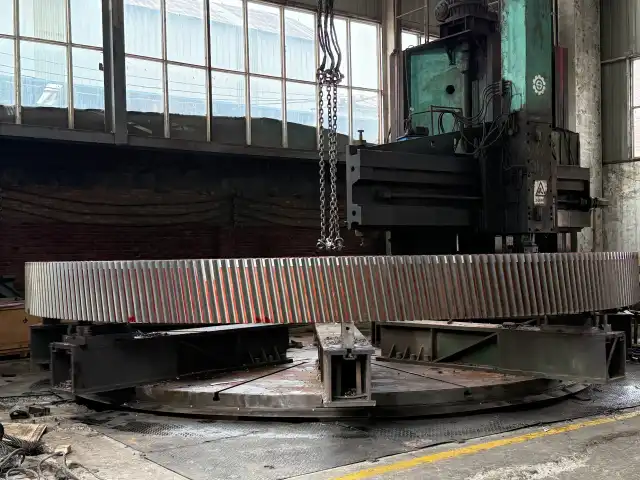
Understanding Large Gear Wheels: Definitions and Types
A Large Gear Wheel is a huge spinning transmission part that turns high-speed motor output into the low-speed, high-torque motion that is needed to power things like tumbling mills, rotor dryers, and ship propulsion systems. Unlike small enclosed gearboxes, these open-gearing solutions are able to move huge amounts of inertia—imagine a 400-ton ball mill shell rotating at only 12 RPM—which makes standard gearbox designs impractical because of space issues and the need to easily reach repair areas.
Core Gear Types in Heavy-Duty Applications
Different tooth shapes are used for different tasks. Spur gears have straight teeth that are parallel to the shaft plane. They are the most efficient way to transfer rotational loads, but they make more noise. Helical versions have curved teeth that connect gradually, lowering vibration and spreading loads over larger contact areas. This is very important when a single tooth has to handle 50 kN of concentrated force during mill start-up. Bevel gears change the direction of rotating axes at an angle. These are often used in conical crusher drives. Worm gears, on the other hand, can reduce speed by more than 60 times, which is useful for winch uses.
Distinguishing Gears from Related Components
People who work in procurement often mix up gears, sprockets, and pulleys, but there are big differences in how they work. Positive interlocking makes it possible for sprockets to join chain links, which is good for conveyors where slipping is not acceptable. Pulleys use friction-based belt drives that work well for systems with low accuracy and no shaking. Girth gears, on the other hand, keep velocity ratios constant through continuous tooth meshing, which achieves positional accuracy within 0.05 degrees. This is necessary for kiln shell alignment that keeps refractory bricks from breaking.
Industrial Applications Across Sectors
Mineral processing uses semi-autogenous grinding mills with ring gears that can be up to 14 meters long to break up metal that weighs less than 1,200 tons. In cement plants, kiln gears work in 250°C atmospheric heat and keep the mesh intact even though the heat expands it. Precision-ground bull gears are used in aerospace ground support equipment to make sure that satellite tracking antenna pedestals have positional errors of less than 0.001 degrees. This keeps the signal locked during fast orbital runs. Customized material qualities and production tolerances are needed for each application.
Materials Used in Large Gear Wheel Manufacturing
The choice of material affects whether a girth gear lasts the 25 years it was made to last or fails early due to cracking within 36 months. The metal base has to find the right mix between core toughness and surface hardness so that it can handle repeated bending loads and keep airborne particles from wearing it down.
Alloy Steel Grades: The Industry Standard
Medium-carbon alloy steels like 42CrMo, AISI 4140, and 18CrNiMo7 are mostly used to make our Large Gear Wheels because they are better at being hardened and withstanding wear. The 42CrMo grade has a tensile strength of 900 MPa after being quenched, which makes tooth roots very resistant to shock loads. AISI 8620 has a better case-hardening reaction, which lets carburizing processes create a surface hardness of 58–62 HRC while keeping the core flexible at 280 HB. This difference in hardness stops catastrophic brittle fracture when edge loading happens because the shell deflects.
Evaluating Material Trade-Offs
Cast iron is cheaper and easier to work with, but it doesn't have the bending stress limits needed for reverse loads in reversible mills. Iron and bronze metals work well in salty seas, but they can't hold as much weight as steel. Advanced composites are still being tested for gears with widths larger than 1.5 meters, but they can't be used yet because they are hard to make and we don't know how they will behave over time when force is applied continuously.
Quality Standards Governing Material Certification
ASTM A609 requires ultrasonic testing to find internal holes bigger than 3 mm in diameter, while ISO 683 sets chemical makeup limits that make sure the material hardens consistently. We only buy materials from mills that give us EN 10204 3.1 certificates that show melt analysis and mechanical qualities. This makes it very important to be able to track down when something breaks. For example, when a gear tooth breaks, metallurgical records help figure out whether it was because of a defect in the material or too much use, which has a direct effect on guarantee claims and responsibility.
Manufacturing Processes for Large Gear Wheels
To turn a 12-ton steel casting into a precise Large Gear Wheel, a series of carefully planned heating and mechanical steps are needed, and each one must be approved by strict inspection rules. For 15 years, we've been making things by combining traditional handiwork with CNC machinery to get ISO 5-6 precision grades.
Step-by-Step Production Workflow
The first step is open-die forging, which uses 8,000-ton hydraulic presses to smooth out the grain structure and get rid of any holes. This mechanical working improves fatigue strength by 30% compared to cast flats. Rough machining on vertical lathes sets the face smoothness and bore width to within 0.2 mm. This makes the reference surfaces for later operations. Then, rack-type cuts are used on hobing tools to make tooth shapes. For helical teeth that need 15-degree helix angles, CNC milling gets the exact flank geometry. To get the finished tooth profile tolerances below 20 microns, which is necessary for quiet operation, grinding processes take away 0.5 mm of material.
Heat Treatment: Engineering Surface Durability
Carburizing adds carbon to the surface at 930°C for 48 hours, spreading it out to a depth of 2 mm. An oil cooling process then locks in a martensitic structure with a 60 HRC rating. This case-hardened layer stops silica dust from wearing it down, and the tough heart takes the impact. Induction hardening has shorter cycle times because it uses electromagnetic fields to specifically heat the sides of teeth. However, it is hard to control the process so that the hardness is the same around a 12-meter circle. Tempering at 180°C releases leftover loads, which stops cracks from starting months after the product was made.
Quality Control: Validating Performance Readiness
A coordinate measuring machine checks each Large Gear Wheel by drawing 200 points per tooth to compare profile variations to the limits set by DIN 3962 Grade 8. Magnetic particle inspection shows surface cracks that can't be seen with the naked eye, especially at tip edges where stress levels are highest. Engineer's blue is used for contact pattern tests on meshing surfaces to make sure that load distribution covers at least 75% of the face width. If there isn't enough contact, forces are concentrated, which speeds up wear rates tenfold.
OEM Customization Advantages
When you work with makers that offer custom solutions, you can get around the problems that your business faces. We can make modules in any size—from 6 to 50 pieces—with any number of teeth—from 80 to 240—and with extras like transportable parts that shrink-fit together. Our 35–60-day lead times allow for quick kiln refurbishments, and our bulk production can grow to meet the yearly needs of mine fleets. On-site laser alignment services are part of the installation support. They make sure that the pinion-to-gear distance is within 0.08mm, which directly stops tooth edges from breaking too soon.
Design Principles and Performance Optimization
The best gear size combines torque capacity with cost and space limitations. Engineers have to find the best mix between module, face width, and material grade.
Critical Design Parameters
The shape of the tooth profile follows the curves of the involute, which keeps the velocity ratios fixed even when the center distance changes slightly. The ratio of pitch circle diameter to tooth count tells you the size of the teeth. For example, a module 25 gear with 100 teeth has a pitch circle diameter of 2.5 meters. When you raise the module from 20 to 30, the twisting power goes up by 50%, but the cost of the materials goes up by the same amount. 20-degree pressure angles balance radial and tangential load components, which lowers bearing loads compared to 14.5-degree profiles.
Torque Calculations and Stress Analysis
The Lewis bending equation tells us how much force can be transmitted based on the module, the face width, and the allowed bending stress. A gear with a diameter of 4 meters, a face width of 200 mm, and a working force of 250 MPa can constantly handle 9,500 kNm. Finite element analysis reveals stress concentrations at tooth roots often exceed average values by 280%, necessitating generous fillet radii and shot peening treatments to introduce compressive residual stresses.
Maintenance Strategies for Extended Service Life
Using structured repair procedures makes operations last longer. Inspections every three months using borescopes find the start of pitting before it spreads and breaks a tooth. Automatic lubrication systems use high-viscosity open-gear compounds (NLGI Grade 000 with molybdenum disulfide additives) to make 0.1 mm fluid films that keep metal surfaces apart even when there are 2 MPa of contact pressure. Using accelerometers to track mesh shaking gives early warning of misalignment, allowing for corrected shimming before major damage happens. By putting off replacement costs past the initial 20-year build life, these methods lower the total cost of ownership.
Procurement Guide: Choosing and Buying Large Gear Wheels
To avoid expensive installation delays or early failures that stop whole production lines, it's important to carefully match specifications and check out suppliers when looking for large gear wheels' girth gears.
Matching Specifications to Application Requirements
To figure out what module and face width are needed, start by figuring out the transferred power and working speed. For mining purposes, steel needs to be between 58 and 62 HRC hardness to protect against sand wear, while normalized steel processes are used in cement kilns to make steel more thermally stable. Check that the sizes are compatible—the bore diameters must match the current shell flanges, and the total diameter may mean that designs need to be divided into three 120-degree pieces that are joined by precision-machined bolts.
Evaluating Supplier Credibility and OEM Capabilities
Reputable makers keep their quality systems ISO 9001-certified and give mill test results that show where the materials came from. Check the manufacturers' inventory of production machinery. Companies that use 6-meter vertical lathes and 8-meter gear hobbers show that they can do work with big diameters. Ask for case studies that show similar projects. For example, a provider that knows a lot about 12-meter SAG mill gears will know how to handle thermal distortion during heat treatment. Less downtime is possible with after-sales assistance like having spare parts on hand and field repair workers.
Pricing Benchmarks and Lead Time Expectations
The cost of materials makes up 40% of the total price. Base rates are based on alloy steel, which costs $3,200 per ton. A module 24 gear with a diameter of 4 meters costs between $85,000 and $135,000, based on the precision grade and surface processes. Standard production takes 35 to 60 days and includes rounds of forging, casting, heat treatment, and final testing. There are extra fees for faster timelines, but they may be worth it when the cost of plant downtime is more than $50,000 per day.
We at YIZHI MACHINERY have been making specialized parts for 15 years, so we can make gears that meet the strictest requirements. Our building has ultrasonic and magnetic particle inspection systems, as well as high-precision CNC machining centers and automatic grinding tools that can meet ISO 5-6 tolerances. We've built long-term relationships with mining companies all over North America by making unique gears with tooth counts that can be changed to fit the needs of the application. Our gears range from module 0.5 to 50. Our logistics infrastructure includes shock-absorbing packing and coordinated multi-modal transport, which keeps damage rates for packages between continents below 0.1%.
Conclusion
To choose the right Large Gear Wheel, you need to combine your knowledge of metals, the production process, and the performance needs of your particular application. When you choose between 42CrMo, AISI 4140, and carburizing grades, the service life is directly affected by how rough and shock-loaded the conditions are. Reliable sellers can be told apart from those whose goods break down too soon by the quality of their manufacturing, which can be confirmed by thorough NDT and dimensional inspection. Partnering with OEM makers that offer flexible customization, clear quality documentation, and quick expert help is key to success in procurement. By following these tips, industrial buyers will be able to find and select girth gears that will reliably transfer torque for decades in the toughest heavy machinery uses around the world.
FAQ
1. How Do You Calculate Required Torque Capacity for a Large Gear Wheel?
Power from the motor (in kilowatts) times 9,550, then divide by pinion RPM to get force in Newton-meters. Use a service factor between 1.8 and 2.5, based on how the load changes. For example, smaller factors should be used for continuous conveyors, while higher multipliers are needed for impact crushers to account for shock peaks.
2. What Material Performs Best in Dusty Mining Environments?
AISI 8620 that has been carburized to 60 HRC has the best resistance to wear from silica particles while still being tough in the middle. The case depth of 1.8 to 2.2 mm makes sure that the mesh shape stays the same over the 20-year design life, even if it is exposed to dust all the time.
3. What Are Typical Lead Times for Custom Large Gear Wheels?
Standard production takes 35 to 60 days, which includes getting the materials, casting, cutting, heat treating, and checking the quality. For segmented designs with widths greater than 5 meters, extra joint cutting and assembly testing procedures may add 10 days to the schedule.
Partner with a Trusted Large Gear Wheel Manufacturer
YIZHI MACHINERY focuses on making custom girth gears for industries like mining, aircraft, and industrial tools that need accuracy and dependability. Our production methods are in line with ISO standards and include advanced CNC cutting, controlled heat treatments, and full NDT to make gears that meet ISO 5-6 precision grades. For quick replacement needs, we offer modules ranging from 0.5 to 50, surface hardness up to 62 HRC, and open customization options such as low minimum order amounts and even production of a single piece. We offer clear project management from the initial design meeting through installation support. Standardized processes guarantee delivery within 35 to 60 days, and shipments can be tracked from start to finish. Our expert team is ready to look over your requirements and suggest the best grades of materials, tooth shapes, and heat treatment methods. Email our technical experts at sales@yizmachinery.com to talk about your needs for a Large Gear Wheel and get a full quote that fits your specific needs.
References
1. American Gear Manufacturers Association. (2019). AGMA 6014-A06: Design and Specification of Gearboxes for Wind Turbines. Alexandria, VA: AGMA Publications.
2. Dudley, D. W. (1994). Handbook of Practical Gear Design and Manufacture. Boca Raton, FL: CRC Press.
3. International Organization for Standardization. (2021). ISO 6336-1:2019 Calculation of Load Capacity of Spur and Helical Gears – Part 1: Basic Principles. Geneva: ISO Standards.
4. Radzevich, S. P. (2016). Dudley's Gear Handbook: The Design, Manufacture, and Application of Gears. New York, NY: McGraw-Hill Education.
5. Society of Automotive Engineers. (2018). SAE AMS 6414: Steel, Carburizing, Bars, Forgings, and Tubing, 0.80Cr – 1.80Ni – 0.25Mo. Warrendale, PA: SAE International.
6. Townsend, D. P. (1991). Dudley's Gear Handbook: Design, Manufacture, and Application. New York, NY: McGraw-Hill Professional.

USER EVALUATE
Here is the customer's evaluation of us