


Precision Helical Gear Uses in Robotics
Precision Helical Gear units are now an important part of modern robots because they transmit power smoothly and allow for great motion control, which has a direct effect on how well the system works. Helical gears have curved teeth that gradually make contact, unlike traditional spur gears that engage quickly. This progressive engagement pattern is important for robotic applications that need to make as little noise and sound as possible. This feature of the design lets several teeth share loads at the same time, giving industrial machinery, mining operations, and aircraft systems the dependability they need. From our many years of experience making gears, we know that robots developers are putting more and more emphasis on these parts for articulated arms, automatic guided vehicles, and precision positioning systems, where other types of gears can't provide the necessary smoothness and accuracy.
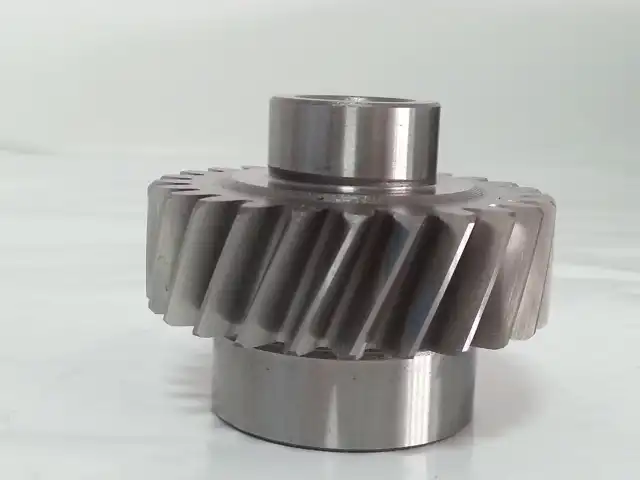
Understanding Precision Helical Gears in Robotics
Spiral Tooth Design and Operational Mechanics
The shape of the teeth is what makes Precision Helical Gear designs unique. Each tooth follows a spiral path along the gear blank, usually at an angle between 5° and 45°. When this is set up, an oblique contact line is made instead of the rapid full-width connection that is seen in spur gears. When this slow tooth engagement is used in artificial joints and actuators, the contact ratio is often higher than 2.0, which means that at any given time, two or more tooth pairs are carrying the load. Robotics engineers like this trait because it stops the shock loading that wears parts down too quickly in high-cycle applications that are common in industrial automation.
Torque Transmission Efficiency in Robotic Systems
Precision Helical Gear designs are great at getting power from servo motors to end effectors quickly and efficiently, which is what modern robotic systems need. Because the teeth are slanted instead of straight, they spread force over a larger surface area. This lets these gears handle 20–30% more power in smaller gearbox housings. This benefit is especially useful in joint robots (cobots), where limited room limits the size of parts. Making these gears to ISO 6 Grade standards guarantees transfer efficiency of more than 98% per stage. This directly leads to lower energy use and cooler working temperatures, which are important for robotic applications that run all the time.
Noise Reduction and Extended Service Life
Robotics setups in places like making semiconductors, putting together medical devices, and making aircraft parts can't handle too much noise. Traditional types of gear make noise levels that mess up measuring tools and make working conditions that aren't acceptable. This problem can be fixed by Precision Helical Gear technology, which has a progressive contact pattern that lowers transmission error and makes the system 10-15 dB(A) quieter than similar spur gear systems. The gradual load shift also reduces stress concentrations that cause teeth to break. In well-maintained systems, this makes the operating lives over 20,000 hours. Case-hardening methods, such as carburizing, raise the surface hardness to 58–62 HRC while keeping the core tough at 30–40 HRC. This gives the metal the impact strength it needs for robotic uses that use changing loads.
Critical Design Principles and Material Considerations
Helix Angle Optimization and Tooth Profile Engineering
For optimal Precision Helical Gear performance, key geometry must be balanced. Helix angles between 15°–25° provide smooth engagement while limiting axial thrust that complicates bearing selection. Tooth profile modifications such as crowning and tip relief prevent edge loading and premature wear. Finite element analysis validates stress distribution before production, ensuring reliability across robotic applications from micro-assembly to heavy-duty automation. Module selection depends on torque and space, ranging from 0.5 to 50. Smaller modules suit compact robotic joints, while larger ones handle high loads. Adjustable tooth counts enable precise ratios, aligning motor output with load demands and improving system efficiency.
Advanced Materials and Heat Treatment Protocols
Material choice directly determines durability in Precision Helical Gear systems. Alloy steels like 20CrMnTi, 18CrNiMo7, and AISI 8620 provide strength, fatigue resistance, and wear protection under cyclic loads. These materials resist micropitting in marginal lubrication conditions and meet strict traceability requirements. Heat treatments enhance performance: carburizing creates a hard wear-resistant surface (58–62 HRC) with a tough core for shock absorption, while quenching and tempering ensure uniform hardness. Induction hardening selectively strengthens tooth surfaces for efficiency. These processes allow gears to withstand millions of load cycles, critical for robotic systems with frequent acceleration and directional changes.
Manufacturing Precision and Quality Control
Producing high-accuracy Precision Helical Gear components requires controlled manufacturing. Forging ensures optimal grain structure and strength, followed by hobbing and machining to form tooth geometry. Heat treatment introduces distortion, corrected through precision grinding to achieve 0.4–0.8 μm surface roughness for quiet, durable operation. Advanced CNC machines maintain micron-level tolerances across tooth profiles. Coordinate measuring machines verify spacing, alignment, and profile accuracy for each batch. This rigorous quality control ensures consistent performance whether for prototypes or mass production. Typical lead times of 35–60 days reflect the multiple processing and inspection stages required to guarantee reliability.
Comparing Precision Helical Gears with Alternative Gear Types for Robotics
Performance Analysis: Helical vs. Spur Gears
Engineers compare gear types based on speed, noise, and load behavior. Spur gears generate no axial thrust and are simpler, but their full-tooth engagement causes impact loading, limiting high-speed use above ~3000 RPM. In contrast, Precision Helical Gear systems use gradual engagement, allowing smoother operation and speeds two to three times higher with reduced noise. Higher contact ratios distribute loads efficiently, improving durability and enabling simpler drivetrain designs. The trade-off is axial thrust, which must be managed through proper bearing selection such as angular contact or tapered roller bearings for stable performance.
Comparison with Worm and Bevel Gear Systems
Worm gears offer high reduction ratios and self-locking, useful for vertical loads, but their sliding contact reduces efficiency (40–70%) and generates heat. Precision Helical Gear systems exceed 98% efficiency, making them more energy-efficient for continuous operation. Bevel gears handle intersecting shafts and are useful in robotic wrists, but are complex and costly. Spiral bevel designs improve smoothness but still lack the simplicity and cost efficiency of parallel-axis helical systems. For most robotic applications, helical gears provide the best balance of efficiency, reliability, and cost.
Backlash Considerations and Positioning Accuracy
Low backlash is essential for robotic precision. Properly manufactured Precision Helical Gear units achieve backlash below 3 arcminutes, ensuring high positioning accuracy. Advanced anti-backlash designs further improve repeatability to micrometer levels, critical in semiconductor and precision machining tasks. Helical gears also provide higher torsional stiffness than spur gears, enabling faster servo response and improved stability. Smooth torque transmission simplifies control tuning, allowing optimized motion profiles and enhanced robotic performance across varying loads and speeds.
Procurement Insights: Buying and Customizing Precision Helical Gears for Robotics
Sourcing Strategies and Supplier Evaluation
Selecting Precision Helical Gear suppliers requires evaluating manufacturing capability, quality systems, and technical support—not just price. ISO-certified processes indicate consistency and traceability. Suppliers offering engineering assistance and customization provide added value, especially for adapting gears to new robotic applications. Strong quality control, from raw materials to final inspection, ensures reliability in demanding systems.
Custom Gear Manufacturing and OEM Partnerships
Robotics often demands custom Precision Helical Gear designs beyond standard catalogs. Modern CNC facilities support flexible production from prototypes to large volumes. The process begins with requirement analysis—speed, load, duty cycle, and environment—followed by detailed engineering design. Suppliers optimize materials and geometry for performance and manufacturability. Production includes multi-stage inspections to ensure compliance. Protective packaging minimizes shipping damage, while multiple logistics options balance cost and delivery speed, supporting global supply chains.
Pricing Analysis and ROI Optimization
Lead times for custom Precision Helical Gear units typically range from 35–60 days, requiring planning to avoid delays. Volume agreements can reduce costs and secure production capacity. While high-precision gears have higher upfront costs, their longer lifespan and reduced maintenance lower total ownership cost. In continuous-duty environments, improved durability quickly offsets initial investment. Tooling ownership can further reduce long-term production costs, making it advantageous for high-volume applications.
Installation, Maintenance, and Technical Support for Precision Helical Gears in Robotics
Best Practices for Assembly and Alignment
Proper installation is critical for Precision Helical Gear performance. Shaft alignment must stay within 0.1° angular error and 0.05 mm parallel offset to prevent uneven load distribution and premature wear. Accurate assembly tools ensure correct positioning. Bearing preload must be carefully set—too little causes vibration and tooth separation, while too much increases friction and heat. Following manufacturer guidelines ensures optimal balance between stability and efficiency.
Lubrication Selection and Preventive Maintenance
Lubrication is vital for Precision Helical Gear longevity. High-quality synthetic oils with extreme-pressure additives reduce wear and improve efficiency across temperature ranges. Correct viscosity ensures adequate film thickness without excessive drag. Maintenance intervals depend on operating conditions, ranging from 2,000 hours in clean environments to shorter cycles in harsh conditions. Monitoring vibration and temperature trends enables predictive maintenance, preventing failures and extending service life.
Troubleshooting Common Issues and Technical Support
Abnormal noise often signals issues in Precision Helical Gear systems. Low-frequency noise indicates misalignment, while high-frequency sounds suggest lubrication problems. Systematic diagnostics isolate faults using vibration analysis. Many issues stem from improper installation rather than gear defects. Load-related failures require comparing actual conditions with design limits to identify overloads or mismatches. Metallurgical analysis of failed components helps determine root causes. Strong technical support ensures rapid problem resolution, minimizing downtime and maintaining robotic system reliability.
Conclusion
Precision Helical Gear units give modern robotic systems the quiet performance, high load capacity, and smooth operation they need in aircraft, industrial machinery, and mining automation. Knowing their technical features, the materials they need, and how they are made helps you make smart purchasing choices that save you money and make sure they work well for a long time. Access to parts that meet strict standards for robotic applications is made possible by carefully choosing a supplier based on their manufacturing skills, quality systems, and expert support. The best way to extend the life of something is to put it correctly, lubricate it properly, and do regular maintenance. This will also cut down on unexpected downtime that can throw off production plans.
FAQ
1. What advantages do helical gears provide over spur gears in robotic applications?
Through progressive tooth contact, Precision Helical Gear designs can transmit 20–30% more power within the same envelope dimensions while being 10-15 dB(A) quieter. The higher contact ratio spreads the load across more teeth at the same time, lowering the stress levels that lead to early failure. When the speed of a robotic joint is higher than 3000 RPM and spur gear impact loading makes too much noise and shaking, these features come in very handy.
2. How do customization options affect lead times for robotic gear procurement?
Standard stock gears that fit current needs can usually be shipped within two to three weeks. Custom designs that need different tooth numbers, modules, or materials, on the other hand, take 35 to sixty days to make. This schedule includes the steps needed to achieve ISO 6 Grade accuracy, such as casting, heat treatment, precise grinding, and quality testing. Planning buying during the early stages of design keeps projects on plan as they move from design to production.
3. What material specifications should engineers prioritize for robotic gear applications?
Some high-quality alloy steels, like 18CrNiMo7, 20CrMnTi, and AISI 8620, can be hardened very well. They can have case-hardened surfaces that reach 58 to 62 HRC while still having tough cores that can withstand contact. For aerospace uses, you might need more tracking paperwork and proof of mechanical properties. For the best resistance to surface wear, heat treatment methods should say to carburize or through-harden the material, depending on whether impact loads are most likely to happen.
Partner with YIZHI MACHINERY for Superior Precision Helical Gear Solutions
YIZHI MACHINERY has been making unique Precision Helical Gear solutions for 15 years. These gears are designed to work with challenging robots in the mining, aircraft, and industrial machinery industries. Our ISO-certified factory has high-tech CNC gear machining centers and automatic grinding machines that can reach ISO 6 Grade precision and meet surface hardness requirements of 45–50 HRC to 58–62 HRC. As a precision gear maker with a lot of experience, we can handle projects of all sizes, from single samples to mass production. We can make modules with lengths from 0.5 to 50 and helix angles from 5° to 45° that are exactly what you want. Our full service includes design advice before the sale, reports on production that happen at the same time, and one-year warranty support with quick technical answer. Get in touch with our engineering team at sales@yizmachinery.com to talk about your robotic equipment needs and find out how our custom packing, multi-channel logistics with real-time tracking, and 35–60 day shipping times can help your project succeed.
References
1. Jelaska, D. (2012). Gears and Gear Drives. Wiley Publishing, examining helical gear geometry and load distribution mechanics in precision applications.
2. Radzevich, S.P. (2018). Theory of Gearing: Kinematics, Geometry, and Synthesis. CRC Press, covering advanced tooth profile optimization for robotic transmission systems.
3. Townsend, D.P. (1991). Dudley's Gear Handbook: The Design, Manufacture, and Application of Gears. McGraw-Hill Education, providing comprehensive material selection guidance for demanding gear applications.
4. ISO 1328-1:2013. Cylindrical Gears - ISO System of Flank Tolerance Classification - Part 1: Definitions and Allowable Values of Deviations Relevant to Flanks of Gear Teeth. International Organization for Standardization.
5. Stadtfeld, H.J. (2014). Gleason Bevel Gear Technology. The Gleason Works, comparing helical and bevel gear technologies in robotic joint applications.
6. Dooner, D.B. & Seireg, A.A. (1995). The Kinematic Geometry of Gearing: A Concurrent Engineering Approach. John Wiley & Sons, analyzing efficiency characteristics of various gear types in automated systems.

USER EVALUATE
Here is the customer's evaluation of us