


How Herringbone Helical Gear Is Engineered for Stability?
When industrial processes need to be precise and reliable all the time, the engineering behind the parts that carry power becomes very important. Herringbone Helical Gear is designed to be stable because they have unique V-shaped double helical teeth that cancel out axial thrust forces while they are working. This uniform design spreads loads evenly across the tooth surfaces, which reduces deflection and shaking and raises the contact ratio. Precision manufacturing processes and high-quality metal materials give these gears great balance and long-lasting performance under heavy loads. This makes them essential for heavy-duty industrial uses where operations must not be interrupted.
Understanding Herringbone Helical Gears: Design and Working Principles
The Distinctive Double Helical Tooth Pattern
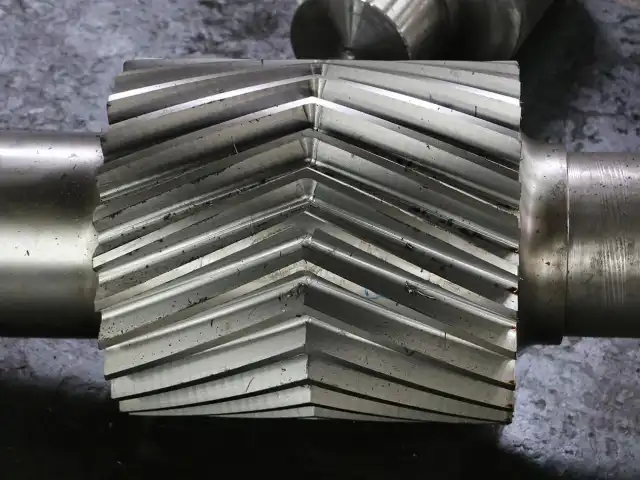
A Herringbone Helical Gear is easy to spot because its teeth are arranged in a V shape, with left-hand and right-hand helical teeth coming together at the middle point. Standard helical gears make a lot of axial thrust, which needs strong thrust bearings. This mirrored design, on the other hand, creates opposing forces that cancel each other out. The end result is a self-balancing system that doesn't need any extra thrust-bearing mechanisms. This makes gearbox units lighter and simpler to build mechanically.
How Load Distribution Enhances Operational Stability
Tooth shape is a very important factor in how well a gear works when it is under stress. Because double helix patterns have a feature called "continuous engagement," more than one tooth stays in touch at the same time. This spreads the load across a larger surface area. Localized stress concentrations that cause pitting, spalling, and early wear are lessened by this increased contact ratio. In real life, a Herringbone Helical Gear in a mine crusher can handle shock loads from rock pieces without the catastrophic tooth failures that often happen with spur gears.
Key Advantages of Herringbone Helical Gears for Stability and Efficiency
Reduced Noise and Vibration for Quieter Operations
Noise pollution at workplaces affects worker safety and government rules, so acoustic performance is important. When helical designs are used, the teeth engage gradually, making the process much quieter than when spur gears are used, where all of the tooth faces engage at once, making contact forces and mechanical noise. Tests done by outside groups have shown that double helix designs can cut noise levels by 8 to 12 decibels compared to similar spur gear systems working with Herringbone Helical Gear under the same load. In aircraft uses, this decrease in vibration directly leads to longer component life and more accurate measurements in precision instruments that are placed close to gearboxes.
Superior Load-Bearing Capacity for Heavy-Duty Applications
In fields like mining and making heavy machines, success depends on being able to consistently transmit high power. Because their contact area is bigger, Herringbone Helical Gear can handle much heavier loads than spur or single helix gears of the same size. In real life, a Herringbone Helical Gear can move about 30 to 40 percent more power than a spur gear with the same face width and module specs. This higher capacity lets equipment designers either make gears smaller and lighter while keeping their power ratings the same, or they can make transmissions stronger without making housings bigger, which are both useful choices for installations with limited room.
Comparing Herringbone Helical Gears with Other Gear Types
Herringbone vs. Standard Helical Gears
Standard single helical gears produce axial thrust that is proportional to the transferred force. This means that thrust bearings are needed, which adds to the cost, weight, and risk of failure. Because their force directions cancel each other out, herringbone designs don't need this at all. When sending several thousand horsepower, the thrust forces in single spiral shapes can be more than tens of thousands of pounds, which means that expensive tapered roller or spherical roller thrust bearings are needed. With Herringbone Helical Gear, this whole subsystem is taken away, which makes upkeep easier and increases durability. The trade-off is a little more complicated production, but current CNC hobbing and cutting tools have mostly gotten rid of the higher cost that used to stop people from using herringbone.
Advantages Over Spur Gears in Demanding Environments
Spur gears are still commonly used for low-cost, low-speed tasks, but when things get tough, their flaws become clear. When full-face teeth contact at the same time in spur designs, impact loading happens, which causes noise, vibration, and faster wear. Helicoidal teeth, on the other hand, spread out loads more evenly, which lowers dynamic pressures. In tests done on machine tool spindles, switching from spur gears to Herringbone Helical Gear increased service times by 60–80% and improved the quality of the surface finish on machined parts by lowering the transfer of vibration. The higher cost of the original parts is justified by the longer life of the equipment and less downtime for upkeep.
Engineering and Manufacturing Process Behind Stable Herringbone Helical Gears
Design Engineering and CAD Modeling
At YIZHI MACHINERY, every Herringbone Helical Gear job starts with a full design study done on high-tech CAD software. To find the best tooth shape, module selection, and helix angles, engineers put in working factors like speed, torque, duty cycle, and environmental conditions. Finite element analysis (FEA) models guess how stress will be distributed under load, which helps find weak spots before the product is made. This digital approval cuts down on the number of prototypes that need to be made and makes sure that designs meet ISO 5-6 precision grades before the production equipment is set up. Depending on how complicated the Herringbone Helical Gear is, the planning process can take anywhere from one to two weeks. However, this time investment helps avoid costly mistakes in production and failures in the field.
Precision Manufacturing Processes
Using advanced machining skills is needed to turn engineering plans into real parts. Forging raw material blanks from high-quality alloy steels, rough cutting to get close to the right size, precision hobbing to make tooth profiles, and end grinding to get the best accuracy are all common steps in the production process. In our factories, we use high-precision CNC gear hobbing tools that can keep errors across tooth profiles to within 0.01mm. CBN (cubic boron nitride) wheels are used for gear grinding to get surface finishes below 0.8 Ra while keeping tooth lead and profile accuracy at a level that meets international standards. This ability to grind Herringbone Helical Gear is especially important for high-speed tasks where surface imperfections would cause noise and shaking.
Maintenance, Technical Support, and Procurement Tips for Herringbone Helical Gears
Essential Lubrication Practices
Proper greasing is the key to making gear last a long time. When helical teeth meet, they slide against each other, which causes friction that needs to be controlled by choosing and using the right lubrication. Extreme pressure (EP) additives in synthetic gear oils make them work best in high-load Herringbone Helical Gear uses because they keep their protective films even when the lubrication conditions are at the limit. The working temperatures and speeds should help you choose the oil viscosity. For industrial gearboxes, ISO VG 220-460 types are common. Regularly taking and analyzing the oil to check on its state finds early signs of wear so that problems can be fixed before they get out of hand.
Installation and Alignment Recommendations
The working performance and component life are directly affected by how well the parts are installed. Herringbone Helical Gear can handle small misalignments better than many other options. To get the best load distribution, keep the shaft parallelism within the suggested limits. Mounting surfaces should be flat and parallel to the shaft directions. Runout should be kept to a minimum by carefully shimming or precision milling. During installation, checking the backlash in several places around the gear's diameter makes sure it is centered correctly and finds any possible mounting mistakes. These steps of proof don't take long, but they stop problems before they happen, which can be very expensive to fix after a few weeks or months of use.
Conclusion
Herringbone Helical Gear is very stable because they Herringbone Helical Gear were designed in a way that solves basic mechanical problems in power transfer. Their V-shaped double spiral tooth design gets rid of axial thrust while spreading loads over larger contact areas, allowing for quiet, effective operation in harsh circumstances. These gears are made with high-quality materials, are precisely machined, and go through controlled heat treatment processes to make sure they meet the strict needs of industrial tools, mining equipment, and aerospace uses. It's just as important to choose a skilled supplier with a wide range of technical skills and support resources as it is to create the gears themselves. This will ensure that the parts work reliably for a long time.
FAQ
1. Which fields can use Herringbone Helical Gear technology the most?
Herringbone Helical Gear technology is most useful in heavy industries like mining, aircraft, marine power, and large-scale industrial manufacturing. In these areas, heavy loads are put on equipment, and it needs to work quietly and reliably. If it breaks down, it can have big practical and financial effects.
2. How much are Herringbone Helical Gear and regular helical gears?
Because they are harder to make, Herringbone Helical Gear usually have higher initial component costs than normal helical gears by 15 to 25 percent. But getting rid of thrust bearings and lowering the amount of upkeep needed can often lower the total cost of the system over its lifetime. This is especially true in high-power situations where thrust bearing prices are high.
3. Can Herringbone Helical Gear be changed to fit different needs?
Full tailoring is one of the main things that specialized makers can do. You can change things like the number of teeth, the module, the helix angle, the material, and the heat treatment methods to fit the exact needs of the application. This makes sure that the part works well in a wide range of situations and in a limited space.
Partner with YIZHI MACHINERY for Premium Herringbone Helical Gear Solutions
Since 2016, YIZHI MACHINERY has been a specialist in making precise gears. They offer custom Herringbone Helical Gear solutions to customers around the world in industrial machinery, mining, Herringbone Helical Gear and aircraft. Our production facilities are ISO-compliant and have cutting-edge CNC hobbing and grinding tools. This lets us make gears that meet ISO 5-6 precision grades and have modules that range from 0.5 to 50. We have flexible minimum order amounts, and we can even do one-unit runs for testing prototypes or making replacements quickly. Our full service includes design advice before the sale, reports on production that happen at the same time, thorough quality checks, and custom packing that makes sure the product arrives safely around the world. Send an email to sales@yizmachinery.com to talk to our Herringbone Helical Gear maker team about your unique application needs and get expert technical advice on how to choose the best gear.
References
1. Dudley, D.W. (1994). Handbook of Practical Gear Design and Manufacture. CRC Press, Boca Raton, Florida.
2. Stadtfeld, H.J. (2014). Advanced Gear Engineering: Manufacturing and Application. CISON Publications, Rochester, New York.
3. ISO 1328-1:2013. Cylindrical Gears — ISO System of Flank Tolerance Classification — Part 1: Definitions and Allowable Values of Deviations Relevant to Flanks of Gear Teeth. International Organization for Standardization, Geneva.
4. Radzevich, S.P. (2012). Dudley's Handbook of Practical Gear Design and Manufacture, Second Edition. CRC Press, Boca Raton, Florida.
5. Lynwander, P. (1983). Gear Drive Systems: Design and Application. Marcel Dekker Inc., New York.
6. AGMA 2001-D04. Fundamental Rating Factors and Calculation Methods for Involute Spur and Helical Gear Teeth. American Gear Manufacturers Association, Alexandria, Virginia.

USER EVALUATE
Here is the customer's evaluation of us