


Herringbone Gear Transmission Uses Explained
When looking for heavy-duty power transmission options, it's important to understand Herringbone Gear Transmission. In this unique system, double helical gears with V-shaped tooth designs cancel out axial thrust forces inside the system. In contrast to regular helical gears that need big bearings to produce a lot of power, the opposing helix angles on herringbone designs make them self-centering. This design gets rid of the need for big thrust bearings, shrinks the gearbox's size, and makes shaking and noise much less noticeable. The constant tooth contact across the V-pattern spreads loads evenly, which makes these gears perfect for fields that need to be reliable even when there is a lot of power.
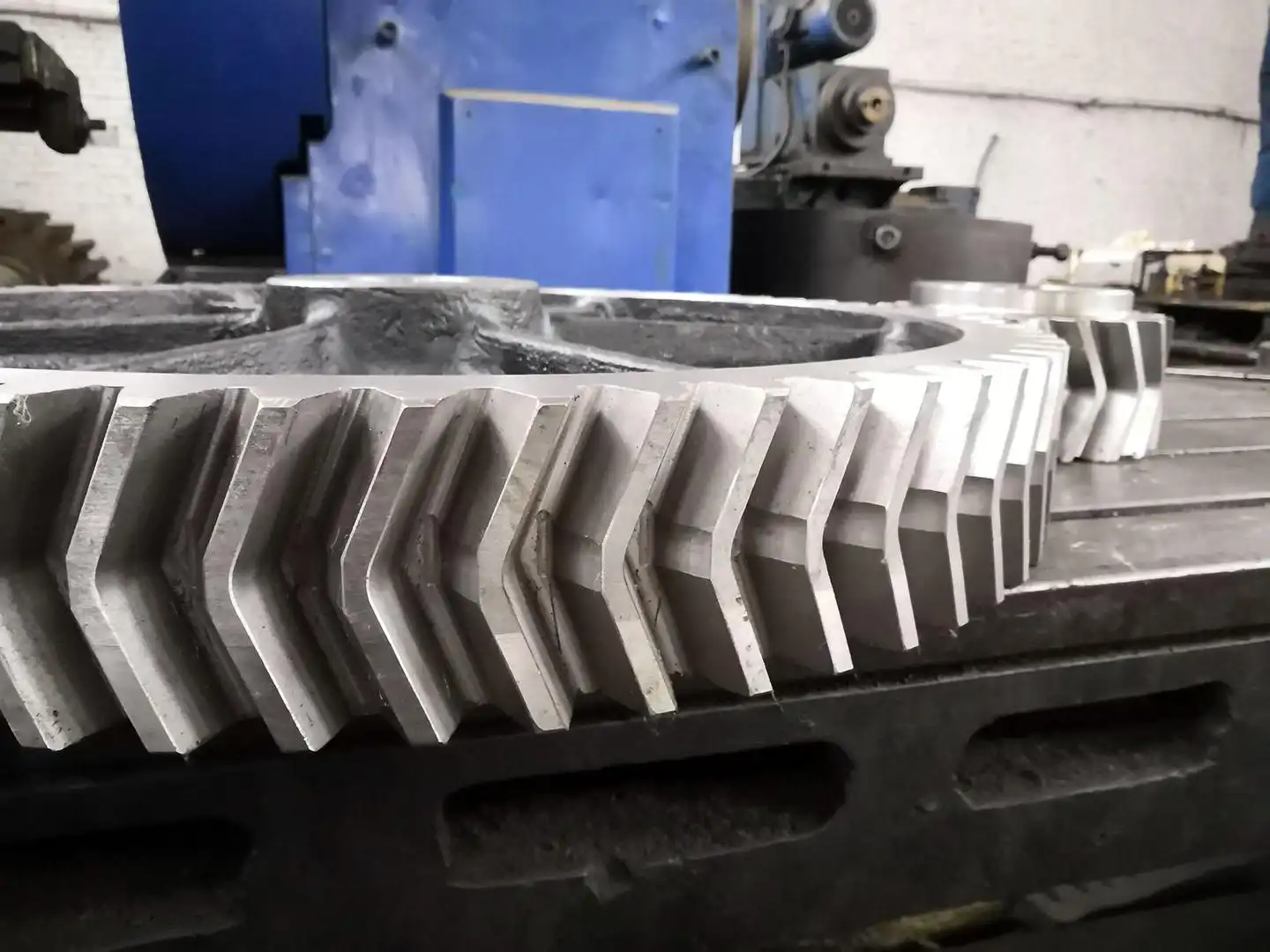
Understanding Herringbone Gear Transmission
What Makes Herringbone Gears Unique?
Herringbone gears are unique in the world of mechanical motion because their teeth are shaped in a V. Each gear has two helix angles, one on the left side and one on the right, cut into the same gear face. This different shape makes a balanced system where the axial forces from one side are balanced out by the forces from the other side. True continuous herringbone gears don't have a center relief groove. This lets the full face width of the gear be used and keeps the structure strong under high pressure. This form is different from regular double-helical gears, so it can hold more weight.
Working Principles Behind the Design
Double helical gearing works by gradually engaging teeth, which makes sure that several teeth stay in touch with each other while the gear is turning. When compared to spur gears, where teeth connect suddenly, this progressive meshing design makes power transfer smoother. During operation, the angled teeth line up straight, transferring force, while the uniform V-shape keeps the balance. The spiral angle controls how well the load is distributed and is usually between 5° and 45°. This constant contact lowers vibrations, impact forces, and noise during operation, all of which are important for accurate equipment.
Material Selection for Performance
To make strong Herringbone Gear Transmission systems, you need special materials that can handle tough working conditions. For example, we use 45# steel, 20CrMnTi, 40CrNiMo, SAE4340, 42CrMo, AISI4140, 18CrNiMo7, 17CrNiMo6, 20CrNiMo, AISI8620, 20CrNi2Mo, and SAE4320. Carburizing, quenching and tempering, and induction hardening are some of the harsh heat treatments that these materials go through to get their surface hardness to between 45 and 50 HRC and 58 to 62 HRC. Having tough cores and sharpened surfaces together gives the best wear protection while still being able to absorb shock. Choice of material has a direct effect on longevity. In high-load situations, the right metal choice can increase service life by 200 to 300 percent.
Comparing Herringbone Gears with Other Gear Types
Performance Against Helical Gears
Standard helical gears are quiet when they're working, but they produce a lot of axial pressure, which makes choosing bearings and designing housings more difficult. When one helical gear is running at 1000 HP, it can cause axial forces of more than 15,000 pounds. This means that strong thrust bearings are needed, which adds to the cost and room needs. Because they are balanced, herringbone designs get rid of this problem completely, letting engineers choose smaller housings and easier bearing arrangements. Helical gears are good for light loads, but the double helical design works better when force needs to be more than 50,000 Nm all the time.
Advantages Over Spur Gears
Spur gears have straight teeth that are parallel to the axis of the gear. When they connect, they make rapid full-face contact. This sudden meshing makes 15-20 decibels more noise than options that use a herringbone pattern, and it also creates shock loads that speed up wear. When angled teeth in double helical devices slowly connect, forces are spread out over time. This lowers peak loads by about 40%. This means that parts will last longer and need to be serviced less often. Spur gears work well in low-speed situations where noise isn't a problem, but herringbone technology is needed for precision tasks.
Comparison with Bevel and Worm Gears
Bevel gears move power between shafts that cross each other at right angles, usually 90 degrees. This means that they can't be used with parallel shafts, which is where herringbone gears shine. Worm gears have high reduction ratios, but because they slide against each other, they are often 50–70% less efficient. Through moving contact, herringbone gears keep efficiencies above 98%, which means they lose as little energy as possible. Choosing between these types of gears is mostly based on how the shaft is oriented and how efficient you want to be, not on how well they work directly.
Applications and Industry Use Cases of Herringbone Gear Transmission
Mining Equipment and Heavy Machinery
Equipment is put through terrible conditions in both underground and open mining. When rock is processed, shock loads are constantly put on crushers, conveyors, and ball mills. We've given mine companies double helical gears when regular helical units broke after just a few months. Big rocks don't hurt the balanced tooth design because it doesn't create damaging axial forces that would push shafts out of alignment. One coal processing plant said that repair intervals were 18 months with herringbone gears and only 6 months with helical configurations before. This meant that downtime costs were cut by a large amount.
Aerospace Ground Support Systems
In aircraft uses, accuracy is very important. Systems that move the jet bridge, pump fuel, and move goods need to work smoothly and with little sound so they don't damage sensitive parts of the plane. It is important that Herringbone Gear Transmission systems are reliable and don't make too much noise near busy airports. The high load capacity can handle big airplane repair equipment, and the ISO 5-6 level of accuracy we keep up makes sure that the positioning is always accurate within the ±0.05mm range needed for automatic docking systems.
Industrial Machinery Applications
Herringbone technology is very helpful for machine tool bearings, compressors, and big gears. Spindle drives for high-speed machining centers need to be able to keep the spindle centered even when the cutting load changes. Because V-shaped teeth are self-centering, they keep the shaft from deflection, which would lower the quality of the surface finish. Pulsating loads are made by reciprocating compressors in petroleum plants, which would quickly damage normal gears. The ongoing tooth contact successfully spreads these cyclic loads; installations have shown that they can work continuously for 15 years or more.
Marine Propulsion Systems
Ship reduction gears send thousands of horsepower from the turbine's high speed output to the propeller's speed. For the safety of the crew and to keep the submarine hidden, operations must be kept quiet in marine settings. Compared to spiral designs, herringbone patterns make underwater noise signatures smaller. Because there is no axial thrust, designing the turbine shaft assembly is easier because there are no complicated thrust bearing setups that would make it heavier and harder to maintain. Naval ships all over the world use double helical reduction gears for their major power, which has been proven reliable in mission-critical situations.
Procurement Considerations for Herringbone Gear Transmission
Essential Selection Criteria
To choose the right double helical gear system, you need to carefully look at the working factors. Load capacity is very important. Our units can safely handle high torque needs by choosing the right modules, which range from 0.5 to 50. Helix angles between 5° and 45° affect both noise level and efficiency. Stricter angles make the process quieter but need to be manufactured with more care. You can change the number of teeth to get the exact speed rates you need for your purpose. Precision grade has a direct effect on how smoothly something runs. ISO 5-6 grade is good for most industry uses, but aircraft needs may call for tighter standards.
Evaluating Manufacturers and Suppliers
When looking for parts for a Herringbone Gear Transmission, the skills of the supplier are just as important as the product specs. Forging should be part of the manufacturing process to get the best grain structure. Cutting, hobbing, milling, and grinding should then follow. It is necessary to be able to grind with teeth in order to get surface finishes below 0.8 Ra that reduce friction and wear. Expertise in heat treatment affects the end properties of a material. Make sure that possible suppliers know how to do methods like induction hardening, quenching and tempering, and carburizing. High-precision CNC gear machining centers and fully automatic gear grinding tools that can keep tight tolerances across production runs should be part of the production equipment.
Understanding Lead Times and Customization
Standard stock gears don't always work perfectly for specific tasks. Customization features let you get the best results for your unique operating situations. Our production time ranges from 35 to 60 days, which allows for unique orders while still meeting quality standards. This schedule includes communicating the needs, making the design drawing, turning in production with checks made along the way, checking the quality at the end, and protecting the finished product. Because the minimum order quantity is low, unique solutions can be used even for one sample or a small run of products. Setting clear specs up front saves a lot of money on changes that need to be made later. Giving engineers detailed information about load cycles, environmental conditions, and room limitations helps them build the best solutions quickly.
Quality Control and Inspection Standards
In double helical gears, the most important characteristic is the apex line. The point where the left and right helix patterns meet must be perfectly lined up so that the load isn't unevenly distributed and weakens one side. Coordinate measuring tools check that this shape is correct to the nearest micron. When you test the tooth contact pattern under a standing load scenario, it should show that it covers more than 80% of the face width and 60% of the tooth height. Deviations show helix angle mistakes that are not acceptable and need to be fixed. Magnetic particle screening finds flaws on the surface, such as grinding burns or tiny cracks at the roots of teeth, where stress builds up. Following ISO 1328 guidelines makes sure that the accuracy of the dimensions fits the needs of the application. For high-speed turbine uses, accuracy levels of Grade 5 or higher are needed.
Troubleshooting and Maintenance of Herringbone Gear Transmission
Common Operational Issues
Unusual noise patterns are often a sign of problems that are starting to happen before they become catastrophic. Grinding sounds happen when teeth aren't properly lubricated or are being worn down by debris. Too much pressure or an improperly aligned bite can hurt teeth and cause them to click or knock. Bearing wear, installation looseness, or shaft imbalance are all signs of increased vibration. When temperatures rise above usual ranges, it means that the grease is breaking down or the machine is being overloaded. By checking these signs on a daily basis, problems can be found early, when they are still cheap to fix.
Preventive Maintenance Recommendations
Setting up regular repair times makes tools last a lot longer. The amount and quality of lubrication need to be checked on a daily basis. In high-temperature situations, synthetic gear oils keep their film strength better than mineral oils. Gears break down quickly when they get dirty, so filtering systems need to be checked and their filters replaced on a regular basis. When you look at the sides of your teeth, you can see early signs of wear and tear that happen before bigger problems happen. Using accelerometers for vibration research can find signs of bearing wear months before they can be heard. Taking standard measurements during installation gives you data to compare and use for trend analysis. As part of a thorough yearly checkup, backlash should be measured, the tooth contact pattern should be confirmed, and the bearing clearance should be checked.
When to Seek Professional Support
Expertise in transmission diagnostics is needed for problems that are more complicated. Weird wear patterns that are focused on certain teeth could mean that there were problems with the manufacturing process or with the fitting that can't be fixed by people in the field. Alignment problems that don't go away after multiple changes suggest that there are structural issues with the frames or roots that support the structure. Metallurgical fails, like tooth fractures, need to be analyzed in a lab to find out what went wrong. Different solutions are needed for each cause, such as poor heat treatment, material flaws, or overload conditions. At first, our technical support team does tests over the phone, but they can also come to the spot if needed. Warranty coverage fixes problems with the way the product was made, and service agreements offer ongoing help for improving how it works.
Conclusion
In conclusion, when it comes to demanding industrial uses in the mining, aircraft, and heavy machinery sectors, Herringbone Gear Transmission technology is the best there is. The V-shaped tooth arrangement gets rid of axial pressure and keeps the operation smooth and quiet even when heavy loads are applied. Careful choice of materials, precise manufacturing, and strict quality control make sure that these important parts meet the highest standards. Understanding the benefits compared to other kinds of gear helps procurement workers make smart choices that meet business needs. Maintaining things properly extends their useful life, and working with skilled makers guarantees dependable help for the supply chain.
FAQ
1. Why Do Herringbone Gears Handle Loads Better Than Standard Gears?
The double helical tooth pattern spreads loads over a bigger contact area than the single helical or spur patterns. Peak stresses are cut by 40% with progressive contact, and the V-shape stops deflection under force. When the helix angles are opposite, they cancel out axial forces that would normally need heavy-duty thrust bearings. This lets the gear body handle radial loads better.
2. How Do Material Choices Affect Durability?
When compared to plain carbon steel, alloy steels like 20CrMnTi and 42CrMo are stronger for their weight. Carburizing makes surfaces hard (58–62 HRC) so they don't wear down and keeps cores tough so they can handle shock loads. If you choose the right material for the job, it can last three times as long. For example, a gear used in mining needs a different kind of metal than one used in aircraft, even if the gears are the same size.
3. What Should I Consider When Selecting a Supplier?
Quality uniformity is based on how well a product can be made. Check to see if the seller keeps precise grinding tools, heat treatment facilities, and coordinate measuring machines available for review. Experience in production is important—older makers know how to handle complicated shapes better than new ones. Customization gives you the freedom to make things work best for your needs instead of having to settle for stock goods. During the specification and production stages, misunderstandings can be avoided by having quick expert help and clear communication.
Partner with YIZHI MACHINERY for Premium Herringbone Gear Solutions
YIZHI MACHINERY has been making custom gears for 15 years and works with companies around the world in the mining, aircraft, and industrial machinery fields. Our advanced production plant has fully automated grinding machines and high-precision CNC gear machining centers that constantly hold ISO 5-6 grade tolerances. Our company uses high-quality products like SAE4340, AISI4140, and 18CrNiMo7, and uses advanced heat treatment methods to make sure the surface hardness meets your needs. As a reliable company that makes Herringbone Gear Transmission systems, we offer full customization, from figuring out what you need to designing, making, inspecting, and safely sending your order around the world. Our regular methods get quality parts to customers in 35 to 60 days, and real-time tracking lets you see how the production is going. Our low minimum numbers make custom solutions possible, whether you need a single sample or a lot of them. Email our engineering team at sales@yizmachinery.com to talk about your transmission needs and get thorough technical proposals that are made just for your purpose.
References
1. Dudley, D.W. (1994). Handbook of Practical Gear Design and Manufacture. CRC Press.
2. Maitra, G.M. (2012). Handbook of Gear Design, Second Edition. Tata McGraw-Hill Education.
3. American Gear Manufacturers Association (2015). ANSI/AGMA 2015-1-A01: Accuracy Classification System - Tangential Measurements for Cylindrical Gears.
4. ISO 1328-1:2013. Cylindrical Gears - ISO System of Flank Tolerance Classification - Part 1: Definitions and Allowable Values of Deviations Relevant to Flanks of Gear Teeth.
5. Stadtfeld, H.J. (2014). Advanced Bevel Gear Technology. The Gleason Works.
6. Radzevich, S.P. (2016). Dudley's Handbook of Practical Gear Design and Manufacture, Third Edition. CRC Press.

USER EVALUATE
Here is the customer's evaluation of us