


Gear Milling Process Explained
Gear Teeth Milling is a precise subtractive production process that takes away material from a gear blank to make the unique tooth shapes needed to transmit power. Rotating multi-point cutting tools are used in this process to carve involute profiles very accurately, which solves important problems in mining, aircraft, and industrial machines. Gear Teeth Milling is more flexible than continuous generation methods when it comes to custom geometries, big modules, and low-volume production runs where traditional hobbing is either too expensive or not doable.
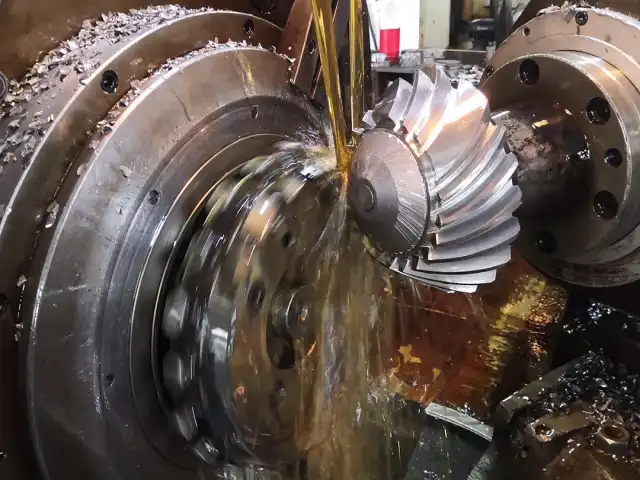
What is Gear Teeth Milling? Understanding the Basics
Defining the Core Process
In Gear Teeth Milling, special tools remove material between gear teeth to make the shape of the teeth that are needed. The first step is to make a blank, which is usually made or cast. The blank is then rough-turned to set the outer diameter, bore, and end faces. When the module and pressure angle are right, the milling cutter moves around the blank and cuts one tooth space at a time. This way of copying shapes is very different from hobbing, which creates shapes continuously by rotating the cutter and the subject at the same time.
Sequential Manufacturing Steps
The method has multiple phases. After prepping the blank, workers center and align it within 0.02 mm on supports. At high input rates, roughing passes remove masses of material. Gear Teeth Milling indicates tooth depth. The profile is semi-finished to reduce surface roughness to Ra 1.6–3.2 micrometers. The metal is then heated and treated with carburizing, cooling and tempering, or induction hardening to achieve a surface hardness of 58 to 62 HRC or a core hardness of 45 to 50 HRC, depending on the application. Finishing processes like grinding or severe milling repair heat treatment deformities. Machine tool spindles and robotic joints benefit from ISO 5–6 accuracy.
Comparison with Alternative Cutting Methods
To know when to use Gear Teeth Milling, you need to look at it next to hobbing, shape, and broaching. Hobbing is great for making a lot of external spur and helix gears because it can do it faster and with better quality for modules that are less than 25 mm in diameter. Shaping is still the norm for internal gears and gears next to shoulders where there isn't enough hob space. Broaching has the quickest cycle times, but it needs expensive special tools that are only used for that process, so it can only be economically done in batches of more than 5,000 pieces. Gear Teeth Milling is the best way to make unique shapes, big modules (up to 50 mm), herringbone profiles, and prototypes when the cost of buying tools is too high.
Key Technical Aspects of the Gear Teeth Milling Process
Machine Architecture and Motion Control
Modern gear milling machines have strong cast iron bases that have vibration dampers built in to keep chatter to a minimum when making heavy cuts. The spindle system has 15–50 kW of power and spins at speeds of 100–3,000 RPM, based on the size of the cutter and the material of the item. The multi-axis CNC control handles four movements at the same time: X-axis radial positioning, Y-axis tangential feed, Z-axis depth control, and C-axis object indexing. These movements are repeatable to within ±0.003mm. This level of accuracy makes sure that all teeth have the same pitch accuracy and profile shape, which is important for sending power smoothly.
Critical Cutting Parameters
To ensure processes go well, optimizing three factors that depend on each other is necessary. For Gear Teeth Milling when making final cuts in hard materials like AISI4140, the feed rate (measured in millimeters per tooth) is usually between 0.05mm and 0.3mm. When roughing soft 45# steel blocks, it's usually between 0.05mm and 0.3mm. Spindle speed needs to be a mix between output and tool life. For example, when cutting 42CrMo alloy steel, carbide inserts with TiAlN coatings work best at cutting speeds of 80–120 m/min, while high-speed steel cutters need speeds between 25 and 40 m/min. The cutting depth changes from 8 to 12 mm for roughing to 0.2 to 0.5 mm for finishing. This has a direct effect on the surface finish and the accuracy of the measurements.
Tooling Materials and Maintenance Strategies
The choice of cutter affects both skill and cost. High-speed steel form cuts work well for prototypes and soft materials, but they need to be sharpened every 50 to 80 pieces. Even though they cost more at first, carbide insert cuts can make 500 to 800 gears before they need to be replaced. Modern treatments, like AlCrN for aluminum, TiAlN for steels, and CBN for hard milling after heat treatment, make things last 200 to 300 percent longer. By following planned maintenance plans and checking for flank wear every 100 cycles, you can avoid catastrophic failures that hurt both the object and the machine spindle bearings.
Comparison Guide: Gear Teeth Milling vs Alternative Gear Manufacturing Methods
Milling Versus Hobbing: Strategic Selection Criteria
It's important for buying teams to know the economic crossing points when they look at different ways to make things. Since hobbing has faster cycle times, it is most common for batch production of more than 200 pieces. For example, a 100mm circle, 50-tooth gear might only take 8 minutes to hob instead of 25 minutes to mill. But hob tooling costs between $1,200 and $4,500 per unique design, and these costs are only spread out over big quantities. Standard modular cuts that cost $300 to $900 are used for Gear Teeth Milling, which makes it a cheap method for sales of less than 100 pieces. The choice of method is also based on the size of the module. Hobbing machines can only handle 25mm modules, while milling machines can handle 50mm and larger modules that are needed for mine kiln drives and cement mill reducers.
Grinding and Honing: Precision Enhancement
Gear Teeth Milling sets the tooth shape and root geometry, while grinding gets better accuracy (DIN 4-5 standard) by removing 0.05-0.15 mm of material from each side after heat treatment. This way fixes distortions, but it costs 15to15to40 more per piece to handle and takes 7 to 10 days longer. Honing, a softer abrasive finishing method, raises the surface finish to Ra 0.2–0.4 micrometers and lowers noise in high-speed systems like those used in aircraft transmissions. A cost-effective combination method involves Gear Teeth Milling to almost-final dimensions and then selective grinding. This saves expensive grinding power for the most important contact areas while Gear Teeth Milling sets the tooth shape and root geometry.
Shaping and Broaching: Specialized Applications
For internal ring gears and cluster gears where rotary tool access makes milling impossible, gear shape with a reciprocating cutter that looks like a gear is still the best way to go. Cycle times are in the middle of hobbing and milling. Gear Teeth Milling is more accurate than hobbing, but less productive. When you broach, you push a cutting tool with many teeth through the product in one stroke. For splines and internal profiles, the cycle time is 30 seconds. The method needs investments in broaches of $8,000 to $25,000, so it can only be used for stable, high-volume production of more than 10,000 units per year.
Procurement Considerations for Gear Teeth Milling Equipment and Services
Price Drivers and Investment Analysis
Costs to buy machines change a lot depending on their level of potential. Beginner 3-axis vertical milling centers with manual indexing heads cost around $45,000 and can handle modules as small as 8 mm and workpieces as big as 400 mm in diameter. The prices of mid-range 4-axis CNC machines with automatic tool changes and built-in probe systems range from $120,000 to $280,000. These machines can handle modules up to 25 mm in size and provide accuracy of DIN 7-8. Premium 5-axis horizontal machining machines with palletized automation and hard milling skills cost more than $500,000, but they can achieve DIN 6 precision on modules up to 50 mm while running without a person present.
The amount of automation has a big effect on the total cost of ownership. Every turn on a manual machine needs a skilled user, so it can only make 40 to 50 gears per week. Robotic loading in semi-automated systems cuts work by 60% while increasing output to 120 pieces per week. Fully integrated cells with in-process monitoring and adaptable control make the most of unmanned night shifts, which are able to produce 300+ tons of goods every week with uniform quality.
Sourcing Reliable Tooling and Service Partners
The quality of the cutter is directly linked to the uniformity of the output. Sandvik, Kennametal, and Mitsubishi are well-known names that offer performance data and metallurgical certifications that lower risk in important uses. When evaluating sources, you have to look closely at material papers that prove the carbide makeup and coating specs. A lot of buyers don't think about resharpening services, but structured cutter reconditioning programs can save you 40–55% on cutting costs compared to disposable strategies.
Custom Gear Teeth Milling services are a smart option to investing in new equipment. Specialized job shops charge between $25 and $150 per piece, based on its size and complexity. This means that machines don't have to sit idle when only a few pieces need to be made. But wait times are longer—4-6 weeks instead of 10-15 days—and strong non-disclosure agreements are needed to protect intellectual property.
New Versus Used Equipment Decisions
Priced 40–60% less than new machines, refurbished machines appeal to buyers on a budget, but there are risks that buyers don't see. It costs between $12,000 and $30,000 to fix spindle bearings that are worn out and can't handle precise work. When parts of a control system become obsolete, workers may not be able to find replacements. These worries can be eased by rebuilders with good reputations who offer 12-month guarantees and written inspection reports. New equipment, on the other hand, comes with training, extra parts packages, and multi-year service agreements that make sure operations don't stop.
Doing a lot of research on Gear Teeth Milling companies saves the money you spend on purchases. At YIZHI MACHINERY, we keep our relationships with our suppliers open and honest, and we do yearly checks of our production equipment to make sure that our customers get gears that were made on machines that are calibrated and meet ISO standards.
How to Optimize Gear Teeth Milling for Your Production Needs
Machine Installation and Setup Precision
Installing things correctly is the first step to getting regular quality. Machine supports need to be protected from floor shocks with an amplitude greater than 0.002 mm. This is usually done with 300 mm thick concrete pads that have vibration dampers built in. Gravitational errors can't change the shape of gears if the leveling is accurate to within 0.01 mm per meter. Running test cuts on measured master gears and measuring the results with coordinate measuring machines (CMM) after installation makes sure the setup is correct before it is sent to production.
Cutter Maintenance and Sharpening Protocols
Predictive repair keeps expensive downtime from happening. Monitoring the spinning load during cuts can find dull cutters by increasing the power by 15-20%. This lets you change the cutters before the quality starts to go down. When side wear hits 0.3 mm, which usually happens every 60 to 100 gears, high-speed steel cutters need to be resharpened. Wear on carbide inserts is more reliable; after 400 to 600 pieces, they reach 0.2 mm side wear limits.
Setting up in-house tool grinding skills for Gear Teeth Milling has big benefits. A precision tool grinder that costs between 25,000and25,000and45,000 can sharpen tools for less than 15eachtime,comparedto15eachtime,comparedto40 to $65 for outside services. To keep critical tolerances like cutter profile accuracy within ±0.01mm and surface finish below Ra 0.4, skilled workers and regular testing against approved standards are needed.
Parameter Fine-Tuning for Efficiency
Systematic testing is needed to find the right balance between quality and efficiency. The best choices are found by increasing feed rates by 10% at a time while keeping an eye on surface roughness and measurement accuracy. For roughing, materials like 20CrNiMo can handle feed rates of 0.25mm/tooth, but 18CrNiMo7 needs feed rates of 0.15mm/tooth to keep it from work hardening. Spindle speeds depend on the size of the cutter. For example, 40mm cutters spinning at 700 RPM have the same surface speed as 80mm cutters spinning at 350 RPM.
Choice of coolant affects both tool life and level of finish. Straight cutting oils are better at lubricating and extend the life of carbide tools by 25% compared to water-soluble emulsions, but they are hard to get rid of. High-pressure water at 70 to 100 bar takes chips from tooth roots, which keeps the finish from being damaged by recutting. Minimum quantity lubrication (MQL) systems that use micro-droplets cut fluid use by 95% while keeping performance the same. This is in line with efforts to be more environmentally friendly.
Conclusion
Gear Teeth Milling is an important way to make things for industries like mining, aircraft, and industrial machines that need accuracy, flexibility, and dependability. This guide has talked about the basic ideas, technical details, comparative benefits, buying factors, and optimization methods that help people make smart choices. When procurement experts know that Gear Teeth Milling is better than hobbing, grinding, or shaping, especially for unique geometries, big modules, and low-volume production, they can choose the right manufacturing partners and methods. Manufacturers get consistent ISO 5–6 grade quality while lowering costs and cycle times by following systematic setup routines, keeping cutting tools in good shape, and fine-tuning operating parameters.
FAQ
1. What makes gear teeth milling superior to hobbing for certain applications?
Gear Teeth Milling is great for making custom shapes like herringbone gears without gaps in the middle, large modules bigger than 25 mm that are popular in mining equipment, and trial runs smaller than 100 pieces where the cost of hob tools is too high. The process is easy to set up and can work with pressure angles that aren't normal because it doesn't need special cutting tools.
2. Can you mill gears after heat treatment?
Yes, after heat treatment, gears can be hard milled with CBN or ceramic tools up to 62 HRC. This gets rid of the need for grinding, which cuts the total cycle time by 30–40% while still producing quality that meets DIN 6-7 standards for high-speed uses in aircraft and precision instruments.
3. What quality grades can gear teeth milling achieve?
Most of the time, standard form milling gives DIN 8–9 quality. Advanced 5-axis CNC machining with in-process probing and adaptable correction can reach DIN 6-7, which is needed for machine tool wheels and robotic joints where accuracy directly affects how well they work and how long they last.
Partner with YIZHI MACHINERY for Custom Gear Teeth Milling Solutions
YIZHI MACHINERY has been making custom gears for 15 years and works with demanding industries like mining, aircraft, and industrial machines. We can make gear teeth from 0.5 mm to 50 mm modules, and we can work with high-quality materials like 42CrMo, AISI4140, and SAE4340 to get ISO 5-6 grade accuracy. We offer full customization, from discussing your needs and making design plans to producing the parts, inspecting them carefully, and shipping them all over the world with real-time tracking. This way, we can make sure that your specs are translated into reliable transmission parts.
Controlled carburizing and induction hardening on our advanced CNC Gear Teeth Milling centers and automatic grinding tools give surfaces a hardness of 45 to 62 HRC. We offer complete peace of mind from start to finish, with production wait times ranging from 35 to 60 days, unique packaging that keeps damage during shipping to less than 0.1 percent, and one-year warranty support. Contact us at sales@yizmachinery.com to talk about your Gear Teeth Milling needs with a reliable company that can make samples or large batches. Find out how our standardized OEM process and multi-channel shipping solutions can help you get what you need faster.
References
1. Radzevich, S.P. (2016). Dudley's Handbook of Practical Gear Design and Manufacture, Second Edition. CRC Press.
2. Klocke, F. (2011). Manufacturing Processes 2: Grinding, Honing, Lapping. Springer-Verlag Berlin Heidelberg.
3. American Gear Manufacturers Association. (2015). AGMA 2000-A88: Gear Classification and Inspection Handbook—Tolerances and Measuring Methods for Unassembled Spur and Helical Gears.
4. International Organization for Standardization. (2013). ISO 1328-1:2013 Cylindrical Gears—ISO System of Flank Tolerance Classification.
5. Stadtfeld, H.J. (2014). Gleason Bevel Gear Technology: The Science of Gear Engineering and Modern Manufacturing Methods for Angular Transmissions. The Gleason Works.
6. Litvin, F.L., & Fuentes, A. (2004). Gear Geometry and Applied Theory, Second Edition. Cambridge University Press.

USER EVALUATE
Here is the customer's evaluation of us