


Best Herringbone Helical Gear for Industrial Drives
The Herringbone Helical Gear is a true work of engineering that stands out when looking for precise gear options for high-torque industrial uses. This special double helical gear has a unique V-shaped tooth design that gets rid of axial thrust while giving it a huge load capacity and running very quietly. Whether you work with mining equipment, aerospace drives, or big industrial gear, knowing how to choose and get these important parts can have a huge effect on your bottom line and how well your business runs.
Introduction
Industrial drives are very important to industries like manufacturing, mining, and aircraft. At the heart of these systems are Herringbone Helical Gear solutions, which have a special design that balances the opposite forces that are created when power is transmitted. In contrast to regular spur gears or single helical gears, this unique part doesn't need heavy thrust bearings and delivers power more smoothly. It takes more than matching basic measurements to find the right gear option. To get the best working performance with the least amount of downtime, procurement pros have to look at things like material grades, precise standards, customization options, and source dependability. This detailed guide was made just for buying managers, design engineers, original equipment manufacturers (OEMs), and distributors who have to deal with complicated global supply lines. Our goal is to give you useful information that can help you turn technical specs into smart buying choices that lower the total cost of ownership.
Understanding Herringbone Helical Gears: Design, Function, and Advantages
The Engineering Behind the V-Shaped Tooth Profile
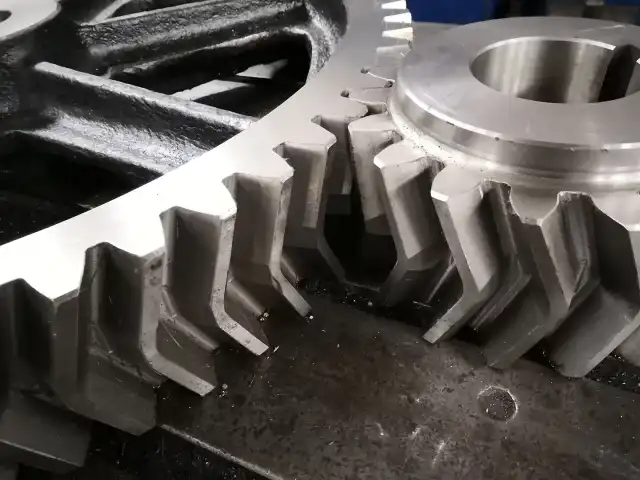
The Herringbone Helical Gear gets its name from the shape of bones made by two opposed helical sections meeting at the middle point. Each side has curved teeth (usually between 5° and 45° helix angles) that connect slowly instead of all at once. This constant impact spreads forces across several teeth at the same time, making a contact ratio that is much better than with straight-cut designs. Standard double helical gears need a gap in the middle to allow for tool clearance. True Herringbone Helical Gear designs don't need this gap at all. This continuous tooth structure is made by specialized Sykes gear generators, which ensure that the load is transferred continuously throughout the spinning cycle. When the helix angles are at right angles to each other, they create equal but opposite thrust forces that cancel each other out inside the structure. This gets rid of the axial loads that usually need expensive thrust bearing systems.
Material Selection and Manufacturing Standards
Our Herringbone Helical Gear products are made from high-quality metal steels that are strong and long-lasting enough for heavy-duty uses. For moderate loads, 45# steel is a choice. 20CrMnTi and 40CrNiMo are better at resisting wear, and SAE4340, 42CrMo, AISI4140, and 18CrNiMo7 are high-performance alloys for harsh situations. The choice relies on how much power you need, how fast you need to work, and the conditions where you will be working. Traditional forging and modern CNC cutting are both used in manufacturing processes. Once the blank shape is set by the first forging, the basic tooth form is made by cutting a Herringbone Helical Gear and hobbing. Before heat treatment methods like carburizing, cooling, and tempering, or induction hardening make the surface hard enough, precision milling smooths out the tooth surfaces. The final grinding steps reach an ISO 5-6 Grade level of accuracy, which makes sure that the tooth shapes are within very tight limits for size.
Core Operational Advantages
Because of their unique shape, Herringbone Helical Gear patterns are very useful in commercial settings. Bearings, shafts, and housings are less stressed when there is smooth motion and little shaking. When compared to spur gears, they make work areas much quieter, which makes operators more comfortable and helps meet stricter noise rules in the industry. The larger touch area and ongoing engagement pattern make it possible to carry more weight. This lets gearbox designs get smaller and more compact while keeping or even increasing power capacity. Opposing helix angles make the structure self-centering, which makes it less sensitive to mounting limits. This makes installation easier and lowers the risk of alignment-related problems
Comparing Herringbone Helical Gears with Other Gear Types for Optimal Selection
Performance Analysis Against Standard Helical Gears
Standard single helical gears also have angled teeth that make contact smooth, but they produce a lot of axial pressure that needs to be controlled by the bearings used and the way the case is made. In most setups, this axial force makes bearing loads 30% to 50% higher, which means that bigger bearings and stronger housings are needed. This problem is not a problem at all with the Herringbone Helical Gear layout, which lets engine designs be lighter and more efficient. Comparing load capacities shows another benefit. Herringbone Helical Gear patterns spread forces over about twice as much surface area as similar single-helical designs because their teeth contact on two sides. This lowers contact stress and increases gear life, especially in situations where loads change often or there are shock loads, which are common in mining and heavy industrial settings.
Distinguishing between Spur and Bevel Gear Solutions
Spur gears are easy to make and don't cost as much, but they make more noise and put more stress on the teeth. Because spur teeth contact across their entire width at once, they create impact forces with every mesh cycle. This makes them less useful for high-speed or precise tasks. Spur gears are still a cheap option for low-speed, moderate-load situations, but they aren't fine enough for aircraft, precise machinery, or high-performance industrial drives. Bevel gears are great at moving power between shafts that cross each other, but they add rolling friction and make fitting more difficult. Their efficiency is usually between 95 and 98%, while 98 to 99% is what Herringbone Helical Gear systems achieve when they are built correctly. Worm gears have high reduction ratios, but they are less efficient (often 50–90%) and generate a lot of heat that needs to be actively cooled in continuous-duty uses.
Real-World Application Decision Criteria
Conditions in mines are tough, with heavy shock loads, abrasive particles, and changing torque needs. Herringbone Helical Gear patterns are good for ball mills and rock crushers because they absorb impact forces while keeping precise contact. The strong tooth shape can handle the force of stopping and starting huge inertial loads without breaking teeth like lighter gear types do. For aerospace uses, reducing weight without lowering durability is important. By getting rid of thrust bearings in Herringbone Helical Gear designs, the weight of the unit is cut by 15 to 25 percent compared to single-helical designs that do the same thing. This reduction in weight directly leads to better fuel economy or more payload capability, both of which are important factors in designing airplanes and spacecraft.
Procurement Insights: How to Source the Best Herringbone Helical Gear
Evaluating Supplier Capabilities and Certifications
Quality control starts with making sure the seller is qualified. ISO 9001 certification shows that Herringbone Helical Gear, a company, uses organized quality management methods, but standards that are specific to gear give even more confidence. Look for manufacturers that follow AGMA (American Gear Manufacturers Association) standards or similar international rules that control the shape of the teeth, the properties of the material, and the testing procedures. Manufacturing skills go beyond simple machines for cutting. To make precise Herringbone Helical Gear units, you need special gear grinding tools that can reach ISO 5-6 Grade precision. To keep teeth from breaking or wearing down too quickly, heat treatment centers must make sure that the case depth and hardness are distributed evenly. Ask for proof of the inspection tools, like coordinate measure machines and gear testers that check for correct tooth profiles and accuracy of dimensions.
Customization Capabilities and OEM Considerations
Standard stock gears don't always meet the exact needs of industrial drives that are tuned. Engineers can define accurate parameters for custom Herringbone Helical Gear design, such as the number of teeth, the module (which can be anywhere from 0.5 to 50), the helix angle, and the face width. This improvement can make things 2 to 5 percent more efficient while also making them lighter and cheaper than normal parts that are too big. For OEM partnerships to work, sellers need to know how your whole system is designed. During the requirements discussion phase, we give you full expert advice and turn your performance goals into detailed design drawings. Our research team looks at load conditions, speed ranges, and weather factors to figure out the best way to choose materials and heat treat them.
Lead Times, Pricing Structures, and Talking About the Contract
Customized Herringbone Helical Gear units usually take 35 to 60 days to make from the time the order is confirmed until they are shipped. This schedule includes getting the materials, machining, heat treatment, precise grinding, and the final check. This schedule could be pushed back by complicated shapes or specialized materials, so starting to work with sources early on is very important for planning the project. The price of a Herringbone Helical Gear depends on how precisely it is made and what materials are used. These parts cost more up front than normal spur or single helix gears, but when you look at their total cost of ownership, you can see how valuable they are. In most industrial settings, the payback time is 18 to 36 months because the bearings last longer, cost less, and need less upkeep.
Maintenance and Performance Optimization for Longevity
Lubrication Strategies for Extended Service Life
Herringbone Helical Gear systems last a long time if they are properly oiled. The constant moving along the sloped tooth sides creates heat that needs to be controlled by choosing the right lubricant and delivering it in the right way. Extreme pressure ingredients in synthetic gear oils give the film the strength it needs to withstand high contact loads and keep working at temperatures above 200°F without breaking down. Choosing the right oil thickness suits different needs. Higher viscosity types make protected layers that are thicker, but they also raise the temps and churning losses. Options with a lower viscosity reduce friction, but the film thickness may not stay thick enough at high loads. We suggest that you look at the load-speed charts that lubricant makers provide to find the right one for your needs. For industrial gearbox uses, the most common choices are between ISO VG 220 and ISO VG 460.
Inspection Protocols and Wear Monitoring
Schedules for regular inspections stop problems that happen out of the blue and cause expensive production to stop. Visual checks are done at regular maintenance times to look for clear problems like broken teeth, strange wear patterns, or grease leakage. Vibration analysis is used for more advanced tracking. It finds changes in working signatures that show problems are starting to happen. Looking at the top of a tooth shows how wear happens. Polishing means that everything is working normally, while pitting or spalling means that there isn't enough grease or that the contact stress is too high for the material to handle. Scoring, which looks like scratch marks on the sides of teeth, happens when the lube film breaks down under high loads or temperatures. Finding these trends early on lets you fix things before they go horribly wrong.
Troubleshooting Common Issues
Too much noise is often a sign of imbalance, poor lubrication, or mistakes in the tooth shape. Systematic analysis starts with making sure the fitting is correct—the center distance and alignment of the shafts must be within certain limits. After that, the lubricant amount and state are checked to make sure there is enough oil and that it is not contaminated. Even if technical factors are fine, checking the gear teeth may show flaws in the way they were made that mean they need to be replaced. If wear starts to happen too quickly, it means that the working conditions are too high for the design. Load analysis checks that the real torque needs match the gear ratings, and speed tracking checks that the operation stays within the design limits. By measuring temperature, hot spots can be found that show where excess or a lack of greasing is happening. Recurrence can be avoided by getting to the root reasons instead of just changing worn Herringbone Helical Gear parts.
Technical Specifications and Standards You Must Know
Critical Dimensional Parameters
The module sets the basic size relationship between Herringbone Helical Gear teeth, Herringbone Helical Gear, which is found by dividing the pitch width by the number of teeth. Module sizes that we can make range from 0.5 (good for precision tools) to 50 (good for big industrial reducers). The load capacity is affected by the module choice. Larger modules have stronger teeth, but they also need bigger gear sizes. Generally, the helix angle, which is the angle of the teeth with respect to the gear shaft, affects how well the gear works. Smaller angles (5–15°) make axial thrust canceling less effective, but make manufacturing easier. For most commercial uses, moderate slopes (20 to 30°) are best for balance. Larger curves (35–45°) improve smoothness and load capacity, but they also make it more important to place accurately. To make sure that all forces are cancelled, the opposite parts of Herringbone Helical Gear designs must keep their helix angles exactly the same.
ISO and AGMA Quality Standards
ISO 1328 is the standard way to classify the accuracy of gears around the world. It has grades from 0 (highest precision) to 12 (lowest precision). Industrial Herringbone Helical Gear units usually get an ISO 5–6 grade of accuracy, which means they meet both performance and cost standards. This precise level makes sure that the machine runs smoothly and quietly, and that linked equipment doesn't feel too much shaking. The AGMA quality classes are similar, but they use different notation. For example, Q6–Q12 stand for common manufacturing norms. When it comes to tooth profile, pitch difference, and runout, higher quality classes have tighter limits. These specs have a direct effect on the amount of noise, how the work is distributed, and the service life. Our production methods aim for ISO 5–6 Grade accuracy by using precise grinding to fix any flaws that appeared during heat treatment.
Material Properties and Heat Treatment Requirements
The basic strength qualities depend on the material choice. For modest loads, carbon steels like 45# are a cheap option, while alloy steels with chromium, nickel, and molybdenum offer better hardness and hardenability. Premium types, such as SAE4340 or 18CrNiMo7, that are very strong and don't break easily, are often needed in aerospace uses. The hardness variation that is needed for the gear to last is created by heat treatment methods. Before hardening, carburizing adds carbon to the top layers. This makes cases that are 58–62 HRC hard and cores that are 30–40 HRC tough. Case depth requirements, which are usually between 0.8 and 1.5 mm for industrial Herringbone Helical Gear products, combine the resistance to surface wear with the resistance to bending fatigue of the core.
Conclusion
To choose the best Herringbone Helical Gear options for tough industrial drives, you have to find a balance between technical performance, manufacturing quality, and the dependability of the supply chain. Because they don't create force, distribute loads better, and run smoothly, Herringbone Helical Gear designs are the best at what they do. This guide explains design principles, application needs, and buying issues. By doing so, purchasing managers and engineers can make smart choices that improve equipment performance while keeping costs low. These important parts can be turned from simple parts into strategic benefits with the right supplier relationship that combines technical know-how, precise manufacturing, and quick service. Your dedication to quality in gear choice has a direct effect on how well your business runs, how much it costs to maintain, and how competitive it is in industry markets that are becoming more demanding.
FAQ
1. Which fields can use herringbone helical gear technology the most?
The main places where these specialty parts are used are in mining, naval propulsion systems, power generation equipment, and aircraft drives. Herringbone Helical Gear shapes are also used in heavy industrial equipment like steel mill drives, cement plant reducers, and large-scale material handling systems. This technology is useful for any task that needs to run smoothly and quietly while handling high-power loads.
2. How long does it usually take to make a handmade herringbone helical gear?
From the time an order is confirmed until it is delivered, it takes 35 to 60 days to make customized units. This schedule includes getting the materials, doing precise cutting, heat treatment processes, finishing grinding, and a full quality check. Complex Herringbone Helical Gear shapes, or specific material requirements, can make wait times longer, so involving suppliers early on is very important for keeping the project on schedule.
3. What kinds of licenses should I look for in gear suppliers?
Getting ISO 9001 approval shows that you handle quality in a planned way, and joining AGMA shows that you are committed to following industry standards. Ask for proof of the company's ability to make Herringbone Helical Gear units, such as details about their precise grinding tools and the controls for the heat treatment process. Third-party material approvals make sure that the makeup and mechanical qualities of the alloy meet the requirements. Inspection records that show accurate measurements and a smooth surface finish are proof of how well the product was made.
Partner with YIZHI MACHINERY for Superior Herringbone Helical Gear Solutions
YIZHI MACHINERY has been making custom Herringbone Helical Gear solutions for 15 years and works with companies all over the world in the mining, aircraft, and industrial machinery fields. Our ISO-compliant factories use cutting-edge CNC gear machining centers and precise grinding tools to make sure that all of our modules, from 0.5 to 50, are accurate to the ISO 5-6 grade. We know how important these parts are to your business, which is why we have strict quality standards for the whole production process, from choosing the materials to doing the final check. Our wide range of customization options can be used for everything from single-item trials to mass production. Lead times range from 35 to 60 days, and you can get real-time reports on the production process. In addition to manufacturing, we offer custom packing options that keep shipping damage rates below 0.1%, flexible logistics that include both air and sea freight options, and full visual tracking of all shipments. You will be successful from the planning stage through operation with technical advice, design help, and a one-year guarantee. Get in touch with us at sales@yizmachinery.com to talk about your needs with a reliable company that makes Herringbone Helical Gear products and is dedicated to providing precision-engineered solutions that make your industrial drives work better.
References
1. Dudley, D. W. (1994). Handbook of Practical Gear Design and Manufacture. CRC Press.
2. Townsend, D. P. (1991). Dudley's Gear Handbook: The Design, Manufacture, and Application of Gears. McGraw-Hill Education.
3. American Gear Manufacturers Association. (2015). AGMA 2001-D04: Fundamental Rating Factors and Calculation Methods for Involute Spur and Helical Gear Teeth.
4. International Organization for Standardization. (2013). ISO 1328-1:2013 - Cylindrical Gears - ISO System of Flank Tolerance Classification.
5. Radzevich, S. P. (2012). Dudley's Handbook of Practical Gear Design and Manufacture (2nd ed.). CRC Press.
6. Maitra, G. M. (2013). Handbook of Gear Design (2nd ed.). Tata McGraw-Hill Education.

USER EVALUATE
Here is the customer's evaluation of us