


Spur Gear Ring Uses in Robotics and Transmission Systems
Spur gear rings are important parts of mechanical transmission in robots and automated systems. They make it possible for complex machines to move at the same time and distribute power accurately. These annular gear designs have straight teeth that are cut parallel to the rotating axis. Their ring-like shape makes them different from solid gears. In robotic motors and planetary gearboxes, spur gear rings solve important engineering problems by providing high reduction ratios in small areas while still being very stable under load. Because they contact teeth simply, they lose little energy, which makes them essential for uses ranging from heavy-duty mine conveyors to collaborative robotic arms.
Understanding Spur Gear Rings and Their Role in Robotics and Transmission
Fundamental Design Characteristics
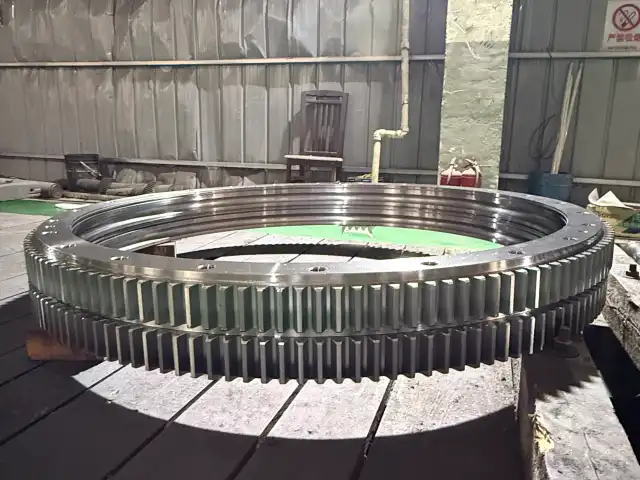
A spur gear ring is a cylinder-shaped part with straight teeth that is usually used as an internal ring gear in planetary systems or an external part in slewing devices. In contrast to normal pinions, the ring design can hold more than one planet gear at the same time, spreading the force evenly throughout the assembly. This design gets rid of the axial thrust forces that are common in spiral setups. This makes choosing bearings easier and makes the mechanical parts simpler. The parallel tooth alignment makes sure that there is instantaneous meshing contact, which turns input movement straight into predictable output motion. This is very important for robotic systems that need to be able to repeatably place objects within microns of accuracy.
External vs. Internal Configuration Distinctions
External spur gear rings put teeth on the outside of the ring's diameter and connect to smaller pinions in standard drive systems. These types work great in open-drive uses like ball mill girth gears, which need segmented manufacturing because the widths are so big (often over eight meters). On the other hand, internal ring gears have teeth that face inward and mesh with rotating planet gears to make the fixed outer element in planetary reducers. This set-up allows for small high-ratio reduction; for example, a robotic joint achiever can fit a 4:1 planetary stage inside the same space as a single-stage exterior mesh. Different types of materials are used for different parts. For example, AISI4140 or 42CrMo alloys are often used for external rings that work in rough settings because they have a surface hardness of 58 to 62 HRC after being carburized. On the other hand, 20CrMnTi may be used for internal rings in precision servos because it is tough but easy to machine.
Material Properties and Application Suitability
Modern spur gear rings are made from high-tech steel types that can handle a wide range of working needs. The 45# steel has a low cost and is good for light-duty uses like home device transmissions. On the other hand, SAE4340 and 40CrNiMo are better at resisting impact for mining equipment final drives that are hit with shock loads. 18CrNiMo7 and 17CrNiMo6 metals are being used more and more in aerospace systems because they can be deep hardened and have a fine grain structure that makes them strong enough to handle thermal cycles in turboprop reduction gears. Heat treatments like quenching and tempering, carburizing, or induction hardening can change the surface properties. For example, a case depth of 1.2 to 1.8 mm on 20CrNi2Mo guarantees a fatigue life exceeding 10^7 cycles under pulsating torque, which is supported by ISO 6336 standards. Precision in manufacturing is just as important as accuracy in design. For example, keeping ISO 8-9 grade limits during grinding operations keeps backlash below 0.05mm, which is necessary for robotic repetition.
Key Advantages and Applications of Spur Gear Rings in Robotics and Transmission Systems
Core Performance Benefits
The engineering community likes spur gear rings because they are simple and effective. Straight tooth shape transfers 95–98% of power more efficiently than worm gear assemblies, which lose 30–50% as friction heat (at best speeds). Easy installation reduces assembly work because there are no complicated axial preloading or thrust bearing formulas. Since spiral sliding friction is low, maintenance takes longer. A properly sized spur gear ring in a sealed planetary hub may only need relubrication after 5,000 hours. The cost is better with these parts. Hobbing and grinding are cheaper than spiral bevel or hypoid gear sets that require special cutting tools.
Robotic Actuator Integration
Collaborative robots like cobots increasingly use small harmonic drives with stiff circular spline internal spur gear rings. By bending a flexspline, a wave generator gradually fits its teeth into the ring. Within a 100mm circle, reduction ratios exceed 100:1. Dimensional stability affects ring placement accuracy. Careful engineering matches 18CrNiMo7 steel (11.5 µm/m·K) thermal expansion values to aluminum housings, ensuring gear mesh alignment in normal plant floor temperatures of 0°C to 60°C. SCARA robots use multi-stage planets. The wrist joints produce 50 Nm of power while turning with a resolution of less than one arcsecond thanks to spur gear rings holding each reduction stage in place. Because its planet gears share the load, the ring doesn't have single-tooth overload failure modes like pinion-only designs.
Industrial Transmission Gearbox Applications
Power is transmitted by large-diameter spur gear rings in heavy industry. Segmented outer rings 4–6 meters long are attached to spinning drum shells with fixed flanges in cement kiln drives. These systems transmit 500–1,200 kW via twin-pinions. They can handle 400°C process heat thermal expansion and run constantly at 1–3 rpm. Mining dragline swing mechanisms use similar technology. A 10-meter ring gear rotates the bucket boom 360 degrees and can withstand cyclic pressures equivalent to lifting a heavy freight car. Green energy uses include wind turbine yaw systems. Precision-ground internal rings secure 100-ton nacelles within ±0.5° accuracy, even with changing wind speeds. Strong construction, including cast 42CrMo blanks and induction-hardened raceways, guarantees 20 years of service in harsh offshore conditions.
Spur Gear Ring Selection Criteria for B2B Buyers
Technical Specification Priorities
Procurement engineers must consider several factors when choosing spur gear rings for robots or transmission systems. Material and tooth module depend on torque capacity. A mining conveyor reducer that handles 8,000 Nm needs Module 8-12 made in SAE4340, while a shared robot joint that sends 20 Nm needs Module 1.5 made of 20CrMnTi steel. Flexible module range is crucial. Suppliers that fit 0.5–50 modules can fit micro-motor reducers and ship propulsion gears. Applications require different surface hardness. To prevent scoring when boundary lubrication is used, aerospace actuators need 58–62 HRC case-hardened surfaces, while farming machinery soft-running gears need 45–50 HRC for shock absorption. Selecting the right precision grade impacts performance and cost. ISO 6-7 accuracy is good for high-speed robotic joints that need little slack, while ISO 8-9 accuracy is fine for slow-speed industrial drives where a little play won't affect positioning.
Comparative Analysis with Alternative Gear Types
For some applications, spur gear rings work better than others. Planetary setups with bevel gear rings can shift input and output shafts, but the teeth slide against each other, reducing efficiency by 85–90%. Worm gear systems can reach 100:1 single-stage ratios but generate too much heat. Infrequent-duty uses like valve actuators are fine, but robotics that need to work 24/7 are affected. Helical ring gears reduce noise by gradually engaging the teeth, but they add axial loads that require expensive thrust bearings, canceling out any initial savings. Cycloid drives handle shock loads better but require complex eccentric systems that don't fit motor mounts. The spur design is best for high-cycle-rate situations where total cost of ownership is important because it is efficient, easy to use, and only handles rotational loads.
Procurement Strategy Considerations
Smart buyers judge a supplier's skills beyond unit prices. Flexibility in custom manufacturing is crucial. Can the seller accommodate non-standard tooth counts and changed addendums for existing robot retrofits? Both planned and unplanned maintenance shutdowns require lead times. Emergency replacements must be processed in 15 days using air freight, but planned shutdowns take 35 to 60 days. Technical support depth distinguishes capable partners from commodity providers. Engineering maturity includes accessing FEA stress analysis, providing STEP/IGES CAD models for assembly verification, and working together on heat treatment optimization for harsh environments. Sharing statistical process control data about module variation and surface finish across production batches helps maintain quality in bulk purchasing deals. Prevents mid-run specification drift. Sellers who accept single-piece orders let you test a prototype for low cost before mass production.
Maintenance Tips and Common Challenges with Spur Gear Rings
Routine Preservation Practices
To make spur gear rings last longer, you need to follow strict repair procedures. When it comes to working conditions, lubrication plans vary. For example, synthetic PAO oils in sealed planetary gearboxes can go 3,000 hours without being changed, while open-drive mining gears need grease applied every day to the teeth that are visible. Engineer's blueing should be used to look at the tooth contact pattern as part of regular inspections. A properly aligned tooth should have 70–80% face width contact centered vertically on the tooth. Check the backlash every three months using dial markers. Any increases above 0.15 mm could mean that the bearings are wearing out or the case is warping and needs to be fixed. Use accelerometers placed near mesh zones to record vibrations. Spectral peaks at gear mesh frequency (GMF) plus sidebands show that tooth cracks are starting to form. To keep extra rings from rusting, store them in climate-controlled spaces with 40 to 60% humidity. When storing for more than six months, cover machined areas with protective coatings.
Addressing Operational Challenges
Spur gear systems still fail most often due to misalignment. Stress cracks form when the parallel shaft deviates more than 0.08 mm across a 300 mm face width, concentrating loads on the tooth edges. Correct the issue by precisely shimming or milling the case and checking alignment with laser tools. Backlash management requires different things. Too much space (>0.2mm) can cause impact loads and positioning errors, while insufficient backlash (<0.03mm) can cause teeth to stick when temperature rises. Temperature-compensated versions with matched aluminum housings and steel rings can handle 50°C changes without mesh. Wear patterns reveal the truth: even polishing indicates grit contamination that needs better sealing, while pitting near the pitch line indicates a thin lube film. Quenched-and-tempered steels often need to be replaced with case-carburized alternatives with 2-3 times the endurance strength in high-cycle applications.
Trusted Spur Gear Ring Suppliers and Brands for European and American Markets
Evaluating Manufacturer Credentials
You must look beyond the ad to find a reliable spur gear ring partner. IS9001 certification is a good start for quality security, but aircraft providers should demonstrate AS9100D traceability and process control. Material approvals matter. Request ASTM mill test results to verify alloy chemistry and mechanical properties. Previous customers' reviews emphasize delivery speed and expert support. Do sellers actively suggest design changes or passively fulfill orders? Inspect your manufacturing equipment with facility audits or public capability statements. CNC gear grinding centers and coordinate measuring tools are precise. A supplier with 10 years or more of experience with Tier 1 OEMs is reliable and does a good job.
Custom Manufacturing Service Capabilities
For complex projects, sellers must offer more than their catalog. Engineers must collaborate from idea to confirmation for customized tooth shapes like profile-shifted teeth that improve contact ratios. Performance can improve greatly with material experiments. A mine client who switched from 42CrMo to vacuum-degassed 18CrNiMo7 with controlled sulfide morphology lived 40% longer. Customizing heat treatment for each application reduces stress. Shock-loaded digger gears benefit from austempering's strong and tough bainitic microstructures. In volatile markets, responsive providers stock common blanks to deliver customized finish cutting in 20 days. The seller should work with freight transport companies to combine LCL shipments for sample orders, set aside 40-foot containers with anti-roll blocking for production numbers, and use integrated ERP systems to track shipments in real time to simplify global logistics.
YIZHI MACHINERY Manufacturing Excellence
Picky buyers seek out YIZHI MACHINERY for critical gear ring applications. With 15 years of experience making unique gears, we work with North American and European industrial tool, mine, and spacecraft manufacturers. We make spur gear rings from 20CrMnTi, SAE4340, AISI4140, and 18CrNiMo7. For ISO 8–9 accuracy, the rings are forged, hobbed, milled, and precision ground. Surface hardness is 45–62 HRC for different duty cycles. Carburizing and induction hardening can shape the material to your loading profile. Our production capacity is 0.5 to 50 modules with unique tooth counts. This allows us to make mining girth gears, micro-reducer rings, and more. ISO-compliant quality control is supported by CMM inspections and material approvals that can be traced to the mill.
Production wait times of 35–60 days balance speed and freedom. Single-piece prototypes for R&D testing are possible. Shock-absorbing liners and wooden boxes keep shipping damage below 0.1% across continents with our custom wrapping. Ocean freight, air express, and rail bridges allow real-time tracking from the plant floor to your receiving dock and travel time control. Technical support is available throughout a product's lifecycle. Your specifications are converted into CAD designs for manufacturing during a pre-sales consultation. Synchronized production updates show how manufacturing is going, and our one-year warranty quickly fixes problems to maintain quality. This holistic approach transforms buying into a creative partnership.
Conclusion
Spur gear rings are still an important part of modern robotics and transmission system engineering. They offer the best mix of efficiency, reliability, and cost-effectiveness in a wide range of industries. Their simple shape lets you precisely control torque in a wide range of uses, from collaborative robot joints to mine conveyor drives. High-tech materials and manufacturing methods make sure they work reliably in tough conditions. To make a good specification, you need to carefully consider how the technical factors (module, material grade, precision level, and heat treatment) fit with the needs of the business and the ability to maintain it. For the best long-term value and system uptime, it's important to work with skilled makers who offer full customization, quality assurance, and logistics support.
Frequently Asked Questions About Spur Gear Rings
1. How do I select the right material for my application?
The type of material used varies on the load, the speed, and the surroundings. 45# steel works well for light-duty tasks like small motor reducers, but SAE4340 or 40CrNiMo is needed for mining equipment that is subject to shock loads because it is more resistant to impact. 18CrNiMo7 is better at resisting wear, which is good for aerospace equipment. Think about the different types of heat treatment. For high-cycle uses, carburizing makes surfaces hard with tough cores, while through-hardening through cooling and tempering is best for moderate-duty continual operation.
2. What lead times should I expect for custom orders?
Standard customization usually takes 35 to 60 days from the time the order is confirmed until it is delivered. This time includes the casting, machining, heat treatment, and quality testing steps. For simple shapes using blanks that are already in stock, expedited handling may cut the time needed to 20 to 25 days. It could take up to 75 days to finish a complicated job that uses rare materials or very precise grades. Set realistic deadlines early on, and ask for updates on production milestones to make sure they work with your project plans.
3. Can suppliers provide single prototypes before production runs?
Reputable makers can handle small orders, like samples made of a single piece, so you can make sure they work before committing to larger amounts. For R&D projects and making unique machines, this freedom is very helpful. During the first talks, make sure that you understand how unit prices and lead times change for sample orders versus production numbers.
Partner with YIZHI MACHINERY for Precision Gear Solutions
Precision-engineered spur gear rings made for tough industrial uses will help your robotic systems and transmission units work better. At YIZHI MACHINERY, a reputable spur gear ring manufacturer with 15 years of experience, we can customize them in any way you need. We work with mining operations, military projects, and advanced machinery builders in North America and Europe. Our production follows ISO standards and makes modules in sizes from 0.5 to 50. These are made from high-quality metals like SAE4340 and 18CrNiMo7, and the surface hardness can be adjusted to meet your needs. Talk to our engineering team about the needs of your project, ask for full CAD models, or get a price that fits your needs. You can contact us at sales@yizmachinery.com or visit yizhimachinery.com to learn more about what we can do. We are your reliable source for spur gear rings for mission-critical uses
References
1. Budynas, R.G. & Nisbett, J.K. (2020). Shigley's Mechanical Engineering Design, 11th Edition. McGraw-Hill Education, New York.
2. Deutschman, A.D., Michels, W.J. & Wilson, C.E. (2018). Machine Design: Theory and Practice, 2nd Edition. Pearson Publishing, Boston.
3. Khurmi, R.S. & Gupta, J.K. (2019). A Textbook of Machine Design. S. Chand Publishing, New Delhi.
4. Maitra, G.M. (2017). Handbook of Gear Design, 3rd Edition. Tata McGraw-Hill, Mumbai.
5. Radzevich, S.P. (2021). Dudley's Handbook of Practical Gear Design and Manufacture, 4th Edition. CRC Press, Boca Raton.
6. Townsend, D.P. (2019). Dudley's Gear Handbook: The Design, Manufacture, and Application of Gears, 3rd Edition. McGraw-Hill Professional, New York.

USER EVALUATE
Here is the customer's evaluation of us