


Helical Gear Wheel vs Spur Gear: Key Differences
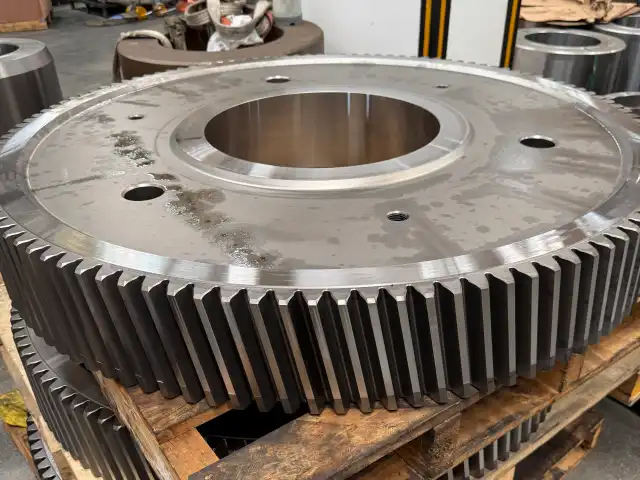
When choosing power transmission parts for industrial machinery, the choice between helical and spur gears has a big effect on how well the machine works, how loud it is, and how much it costs to maintain. A Helical Gear Wheel has teeth that are cut at an angle to the wheel's face, usually between 5° and 45°. This lets the teeth connect gradually, which lowers vibration and spreads loads over a bigger contact area. Spur gears, on the other hand, have straight teeth that are parallel to the gear plane. They are easier to make and transfer power directly, but they make more noise and stress concentrations when they mesh. By knowing these basic differences, engineers and buying workers can match the right type of gear to the needs of the application, making the most of both performance and budget.
Introduction
Gears are the most important part of industry tools, mining equipment, and aerospace systems that move power. Choosing between helical and spur gear designs has big effects on how long a machine lasts, how smoothly it runs, and how much it costs to own the whole thing. We know that procurement teams are under a lot of pressure to find the best balance between upfront prices and long-term value, while engineers expect parts that work to very high standards. This detailed guide looks at the technical differences, usage guidelines, and buying factors for these two main types of gear. It gives you useful information to help you make better choices about where to buy things and how to build systems.
Overview of Helical and Spur Gear Wheels
Industrial power transfer depends on two main types of gear designs, and each has its own technical trade-offs.
Structural Design and Geometry
Helical Gear Wheel construction features teeth angled across the gear face, creating a helix around the cylinder. This geometry enables gradual tooth engagement rather than full-face instantaneous contact. Helix angles range 5°–45° in precision manufacturing. Modules 0.5–50 accommodate delicate instruments to heavy mining equipment. Slanted teeth generate axial thrust requiring robust bearing systems. Spur gears have straight teeth parallel to motion axis—simpler, no axial loads, but sudden full-face contact transfers load abruptly, suited for moderate speeds where cost outweighs noise concerns.
Material Selection and Manufacturing
High-strength alloy steels enable operation in demanding industrial environments. Common materials include 42CrMo, AISI4140, 20CrMnTi for general use; 18CrNiMo7 or SAE4340 for high-performance applications. Forging ensures grain structure integrity, followed by cutting, hobbing, and grinding. Precision grinding achieves ISO 6 Grade—critical for high-speed applications. Heat treatments (carburizing, quenching/tempering, induction hardening) achieve 45–62 HRC surface hardness. Helical manufacturing complexity requires longer lead times: 35–60 days versus 25–45 days for spur gears.
Core Technical Differences Between Helical and Spur Gear Wheels
Knowing the technical differences between these types of gears helps you make smart design choices that meet the needs of the application.
Tooth Engagement and Contact Ratio
Helical gears' slanted teeth make contact at a single place and gradually spread out to make line contact as the gears turn. This slow engagement keeps several teeth in contact at the same time, which can be measured by the contact ratio. Higher contact ratios spread loads over more tooth surfaces, which lowers stress levels and makes gears last longer. In the same situations, research published in journals of gear engineering shows that helical shapes get contact ratios of 2.0 to 3.5, while spur gears only get 1.2 to 1.8.
Load Capacity and Efficiency
Helical Gear Wheel sets transmit 20–35% more torque than equivalent spur gears, per ISO 6336 engineering calculations. Larger contact areas enable higher power density—critical for space-constrained applications like aerospace actuators or compact mining gearboxes. Sliding friction between slanted teeth causes small efficiency losses of approximately 1–2% versus spur gears' pure rolling contact. High-quality Extreme Pressure oils effectively mitigate this friction, maintaining system efficiency above 96% with proper maintenance. Axial thrust requires thrust bearings but enables non-parallel shaft power transmission.
Noise, Vibration, and Harshness (NVH) Characteristics
Noise reduction is the primary reason helical gears are specified over spur gears. Gradual slanted tooth engagement virtually eliminates meshing shock causing spur gear whine. Industrial acoustics studies document helical gears operating 12–18 decibels quieter at equivalent speeds and loads—making them mandatory for noise-regulated environments or human-occupied facilities. Vibration attenuation provides collateral benefits including reduced bearing wear and extended component life. Lower vibration levels directly decrease wear loads on shafts, housings, and mounting structures, significantly improving mean time between failures.
Application Scenarios: When to Choose Helical Gears Over Spur Gears?
To choose the best gear design, you need to carefully look at operational parameters, environmental limits, and cost factors.
High-Speed and Precision Applications
Helical Gear Wheel parts are most often used in situations where the turning speed is higher than 1,500 RPM and controlling noise and shaking is important. Helical gears help machine tool wheels stay in the right place by reducing deflections caused by vibrations. Smooth power release keeps pressure from changing, which is good for high-speed compressors. To meet strict weight-to-power ratios and acoustic signature standards, aerospace actuator devices define helical designs. Precision transmission equipment used to make semiconductors, medical devices, and science instruments needs better backlash control, which is built into helical designs. The slow engagement of the teeth keeps the angle position stable, which is important for uses that need to measure tolerance in arc-seconds.
Heavy-Duty Industrial and Mining Equipment
Helical gears are being used more and more in large motors that power conveyors, crushers, and loaders, even though they cost more at first. The higher load capacity lets designers make gearboxes that are smaller and lighter, which means they don't need as much structural support and are easier to install. Mining companies like that vibration wear is lower because it means longer service gaps. This helps them cover the costs of buying new equipment because they have less downtime. YIZHI MACHINERY has a lot of experience making special helical gears for mining operations all over the world. They can design solutions that can handle settings with rough particles and shock loads from moving materials. Through heat treatments like carburizing, case levels can be adjusted for long-lasting surfaces while core toughness is maintained to prevent impact cracks.
Cost-Sensitive and Moderate-Speed Applications
Spur gears are still a good choice for situations where speeds stay below 1,200 RPM and noise levels aren't a big deal. The lower prices of production and easier bearing setups are good for agricultural equipment, material handling conveyors, and basic industry drives. When projects have limited funds, they often choose spur gears for transmission stages that aren't very important and helical gears for the last stages of the drive that need to be very quiet. Axial thrust makes designing shafts and bearings easier, which lowers the cost of parts and makes installation simpler. Maintenance teams like how easy it is to change spur gears and how many standard spur gear shapes are available.
Procurement Considerations for Helical vs Spur Gear Wheels
Sourcing methods that work balance technical requirements, the supplier's skills, and the total cost of ownership.
Supplier Qualification and Capabilities
When looking for Helical Gear Wheel parts, it's best to choose makers that can do a wide range of production processes, such as forging, precision grinding, and heat treatment. As a basic quality guarantee, suppliers should offer ISO 9001 certification. For more difficult tasks, they should also be able to offer ISO 6 Grade precision. This combined method is shown by YIZHI MACHINERY, which has high-precision CNC gear machining centers, automated gear grinding machines, and intelligent heat treatment lines that make sure the quality of each output batch is the same. Request supplier documentation confirming material traceability for specified alloys such as 20CrMnTi or SAE 4340. Reliable makers give certified mill test reports (MTRs) verifying chemical composition and mechanical properties. Coordinate with providers who offer full technical support, such as help with CAD models, finite element analysis (FEA) for load testing, and application engineering advice.
Cost Analysis and Lead Time Management
Choosing the right material has a big effect on the price. For example, expensive metals like 18CrNiMo7 cost 30–50% more than regular 45# steel. Costs are also affected by how precise they need to be. For example, ISO 6 Grade helical gears cost about 25–40% more than ISO 8 Grade versions because they need to be ground more. Unit prices are affected by volume, and price breaks usually happen at 50, 200, and 500 pieces. YIZHI MACHINERY can meet a wide range of buying needs because they have open minimum order requirements and can accept special orders for a single piece for prototype development or small-batch production. Helical gears usually take 35 to 60 days to make, which includes forging, precision machining, heat treatment, and final testing. For pressing needs, there are choices for faster production, but there are extra costs. Budget 15–20% of your budget in case there are problems with international shipping, clearing customs, or possible taxes when buying from global sellers. Look for providers that offer full shipping planning, such as custom packaging with shock-absorbing liners and wooden pallets that keep damage rates below 0.1%. Real-time tracking of shipments lets you see what's going on with all types of transport, like sea freight, air express, and train links between China and Europe.
Technical Documentation and Quality Assurance
Detailed dimensional sketches with tolerances, material specs, heat treatment needs, and acceptance criteria should all be part of complete purchase packages. Before full production starts, ask providers to provide First Article Inspection Reports (FAIR) that show they've followed the specs. YIZHI MACHINERY gives full inspection reports that include coordinate measuring machine (CMM) reports, surface hardness confirmation, and steel analysis proving the right heat treatment. Set up clear ways for people to talk about changes to the plan, reports on production, and quality issues. Misunderstandings that slow down projects are less likely to happen when suppliers offer technical help in multiple languages and can work with people in different time zones so that everyone can work together in real time. Being able to talk to engineering staff about tooth contact analysis, load distribution estimates, and failure mode analysis makes sure that specs match up with real-world conditions.
Maintenance and Longevity: Maximizing Gear Performance
Preventative repair practices greatly increase the useful life of gears while reducing unexpected downtime.
Lubrication Requirements
To handle the sliding friction that comes with angled tooth contact, Helical Gear Wheel systems require high-quality EP lubricants with anti-scuffing additives. When compared to regular mineral oils, synthetic gear oils with viscosity grades chosen based on working temperature ranges have better film strength. Lubrication intervals should be set based on working hours and load cycles. Depending on the complexity of the application, these intervals should usually be between 500 and 2,000 hours. Monitor lubricant condition by analyzing the oil on a regular basis to find metal particle densities that show abnormal wear. Trending analysis finds problems that are getting worse before they become catastrophic. This lets you schedule maintenance instead of making fixes when something goes wrong. As long as the cooling system can handle it, keep the oil temperatures within the range recommended by the maker, which is usually between 60°C and 80°C for best viscosity.
Alignment and Installation Best Practices
Helical gears require perfect shaft alignment due to sensitivity to horizontal and parallel errors. Laser alignment tools should verify alignment within 0.02mm. Bearing preload requires careful adjustment to control axial thrust without excessive friction. Load distribution across tooth faces depends on housing bore concentricity and perpendicularity; grinding tolerances must meet ISO 286 standards. Verify gear backlash (typically 0.04–0.10mm). Insufficient backlash causes premature wear; excessive backlash increases noise and impact loads. Temperature adjustment is critical for large gearboxes where thermal expansion changes mesh geometry.
Wear Monitoring and Troubleshooting
Use accelerometers placed on gear housings to record vibrations and set standard signatures during commissioning. Trending vibration amplitudes and frequency spectra reveals how tooth wear, misalignment, or bearing degradation are getting worse. As an addition to vibration analysis, acoustic monitoring can find changes in the way sounds are made before damage can be seen. Visual checks are done on a regular basis as part of routine care to check for problems like pitting, scoring, or breaking on the tooth surfaces. Small surface damage can usually be fixed by re-lubricating or realigning the gears, but large cracking needs to be replaced. Understanding how failures happen, like pitting caused by wear or tooth fractures caused by overload, helps fix problems and stops them from happening again.
Conclusion
Choosing between Helical Gear Wheel and spur gear designs has a big impact on how well equipment works, how much it costs to run, and how often it needs to be serviced. Helical Gear Wheel designs are better at reducing noise, can hold more weight, and run more smoothly. These qualities are needed for high-speed accurate uses in aerospace, advanced manufacturing, and modern mining. Spur gears are still useful in low-cost, moderate-speed situations where their simplicity and straight power transfer meet the needs of the job. For procurement to work well, application factors, provider skills, and lifecycle costs must all be carefully looked at. Working with seasoned makers that offer full technical support, certified materials, and flexible customization guarantees gear solutions that are perfectly matched to your business needs, providing measurable improvements in efficiency, dependability, and total cost of ownership.
FAQ
1. What creates the noise difference between helical and spur gears?
Spur gears make more noise because their full-width teeth connect instantly, causing impact shock with every meshing cycle. When the straight teeth touch quickly, they create sounds that can be heard. Helical Gear Wheel designs feature angled teeth that engage gradually, beginning with point contact and moving on to line contact. This progressive meshing keeps several teeth in touch at the same time, spreading loads smoothly without impact shocks, resulting in 12–18 decibel noise reductions compared to equivalent spur gears.
2. Can spur gears function effectively in high-speed applications?
When the speed goes above 1,500 RPM, noise, vibration, and dynamic loading get worse in spur gears. Instantaneous tooth contact creates impact forces that get stronger as the spinning speed goes up. This speeds up wear and could even cause a tooth to break. While careful planning, precise production, and the right amount of lubrication can increase the speed of a spur gear, helical configurations are more stable and quiet during long periods of high speed operation, making them the best choice for uses above 2,000 RPM.
3. How do I determine optimal gear material and heat treatment?
The type of material chosen relies on the load, the working environment, and the service life that is needed. For most uses, 42CrMo or AISI 4140 is used, and the steel is quenched and tempered to a core hardness of 28 to 32 HRC. Carburizing grades like 20CrMnTi or 18CrNiMo7 are needed for high-load situations because they make the surface hard (58–62 HRC) while keeping the cores tough (30–35 HRC). In places that are corrosive, you might need stainless metals or special treatments. Talk to makers that offer application engineering studies to find the right material properties and heat treatments for your working conditions and performance goals.
Partner with a Trusted Helical Gear Wheel Manufacturer
Precision-engineered gear solutions made just for tough industrial machinery, mining, and aerospace uses are what YIZHI MACHINERY does best. Our comprehensive capabilities span custom Helical Gear Wheel production utilizing premium materials including 20CrMnTi, SAE 4340, and 18CrNiMo7, processed through advanced forging, precision grinding, and sophisticated heat treatment, achieving ISO 6 Grade accuracy. With 15 years of manufacturing expertise and globally leading CNC machining centers, we deliver high-load-capacity gears with customized modules from 0.5–50 and helix angles optimized for your application. Our flexible production accommodates single-piece prototypes through volume orders, supported by comprehensive pre-sales design consultation, synchronized production updates, quality documentation, and one-year warranty coverage. Contact our engineering team at sales@yizmachinery.com to discuss your transmission requirements and receive customized procurement guidance ensuring optimal performance, durability, and cost-efficiency for your critical power transmission needs.
References
1. Dudley, D.W. (1994). Handbook of Practical Gear Design and Manufacture. CRC Press, Boca Raton.
2. ISO 6336-1:2019. Calculation of Load Capacity of Spur and Helical Gears – Part 1: Basic Principles, Introduction and General Influence Factors. International Organization for Standardization.
3. Litvin, F.L. & Fuentes, A. (2004). Gear Geometry and Applied Theory (2nd ed.). Cambridge University Press.
4. Shigley, J.E. & Mischke, C.R. (2001). Mechanical Engineering Design (6th ed.). McGraw-Hill, New York.
5. Townsend, D.P. (1992). Dudley's Gear Handbook: The Design, Manufacture, and Application of Gears (2nd ed.). McGraw-Hill Professional.
6. Kapelevich, A.L. (2013). Direct Gear Design. CRC Press, Boca Raton.

USER EVALUATE
Here is the customer's evaluation of us