


Best Precision Helical Gear for Automation
When looking for the best Precision Helical Gear for automation, the most important things to look for are making with tight tolerances, improved material selection, and reliable performance in harsh operating conditions. Due to its slanted teeth, a Precision Helical Gear transmits power smoothly, with noise levels below 70 dB(A) and load capacities 20–30% higher than normal gears. The best options have an ISO 6 grade of accuracy, a surface hardness of between 58 and 62 HRC, and helix angles that are custom made for each automation need. This makes sure that the parts will work reliably in industrial machinery, mining equipment, and military applications.
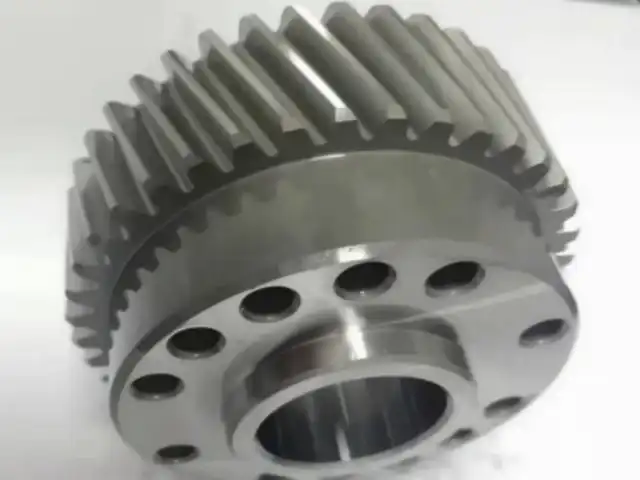
Understanding Precision Helical Gears: Fundamentals & Working Principles
What Defines a Precision Helical Gear?
A Precision Helical Gear is a round and hollow equip with teeth calculated between 5° and 45° to the shaft, empowering progressive engagement over the tooth width. Not at all like goad gears, this dynamic contact increments the contact proportion over 2.0, permitting numerous teeth to share loads at the same time, lessening stretch and progressing torque transmission—critical for variable-speed automated frameworks. Exactness forms accomplish ISO 6 precision through progressed hobbing, processing, and pounding. Tooth flanks are wrapped up to Ra 0.4–0.8 μm, minimizing vibration. Warm treatment such as carburizing makes a difficult surface (58–62 HRC) with a extreme center (30–40 HRC), adjusting wear resistance and affect strength.
How Helix Angle Affects Performance
Helix angle directly determines operating behavior in a Precision Helical Gear. Points between 15° and 25° offer ideal adjust between smooth fitting and sensible pivotal pushed. Higher points make strides stack sharing and decrease commotion but increment hub strengths, requiring more grounded orientation. Points underneath 10° carry on essentially to goad gears, losing smoothness benefits. For high-speed applications over 3000 RPM, bigger helix points are favored due to predominant vibration control. Engineers select points based on speed, stack, and framework firmness, guaranteeing productive operation without over the top bearing stretch or vitality misfortune in requesting computerization systems.
Material Selection for Demanding Environments
Material choice strongly impacts durability in Precision Helical Gear applications. Amalgam steels such as 20CrMnTi, 18CrNiMo7, and AISI 8620 give great hardenability and wear resistance. Carburizing shapes a solidified surface able of dealing with contact stresses over 1500 MPa, whereas the center remains extreme for stun assimilation. For through-hardened needs, materials like 42CrMo and AISI 4140 are extinguished and tempered to convey uniform quality, reasonable for medium-speed, high-torque frameworks like transports. Reliable fabric quality and legitimate warm treatment guarantee resistance to weakness, wear, and warm stretch in requesting mechanical environments.
Single Versus Double Helical Configurations
Single helical gears are widely used in compact systems, with axial thrust managed by angular contact or tapered roller bearings. In contrast, double helical (herringbone) gears use opposing helix angles to cancel axial forces internally, simplifying bearing requirements and improving stability. This makes them ideal for heavy-duty Precision Helical Gear applications in large industrial machines and aerospace drives. However, their higher manufacturing complexity and cost limit their use to critical systems where performance advantages justify the investment.
Comparing Precision Helical Gears to Other Gear Types
Helical Versus Spur Gears: Noise and Load Analysis
Spur gears engage instantly across the full tooth face, creating impact loads and noise levels often exceeding 85 dB at high speeds. In contrast, Precision Helical Gear designs engage gradually, distributing loads over a more extensive range and lessening crest push by approximately 25%. Clamor levels drop to 68–75 dB, making them appropriate for mechanical autonomy and accuracy fabricating. Proficiency is too somewhat higher, coming to 98–99% per organize versus 96–98% for goad gears. Over different stages, this proficiency pick up diminishes vitality utilization altogether, improving long-term operational execution and reliability.
Bevel and Worm Gear Alternatives
Bevel gears are designed for intersecting shafts, typically at 90°, but require complex manufacturing and precise alignment. Worm gears provide high reduction ratios and self-locking capability but suffer from low efficiency (50–70%) due to sliding friction and heat generation. In contrast, Precision Helical Gear systems maintain high efficiency and smooth bidirectional motion, making them more suitable for robotics and energy-sensitive applications where performance and durability are priorities over compactness or self-locking features.
Material Hardness and Performance Correlation
Surface hardness directly influences wear resistance in Precision Helical Gear systems. Solidified surfaces at 58–62 HRC can persevere over 10 million stack cycles some time recently setting happens, perfect for nonstop operation. Lower hardness levels (45–50 HRC) are way better for moderate-duty applications with stun stacking, as they diminish brittleness. Center hardness of 30–40 HRC gives sturdiness, anticipating disastrous disappointment amid over-burdens. Coordinating hardness profiles to obligation cycles guarantees ideal execution, adjusting wear resistance, weariness life, and affect resistance over different mechanical applications.
How to Choose the Best Precision Helical Gear Supplier
Essential Quality Certifications and Standards
Reliable suppliers demonstrate compliance with ISO 9001 and gear-specific standards like AGMA, ISO 1328, and DIN 3962. These define tolerances for profile accuracy, surface finish, and measurement consistency. High-grade suppliers provide inspection reports verifying compliance. Each Precision Helical Gear should undergo multi-stage inspection, including rolling tests that simulate real meshing conditions, ensuring functional accuracy beyond static measurements and guaranteeing reliability in critical applications.
Manufacturing Capabilities and Equipment
Advanced suppliers use CNC hobbing machines for pitch accuracy within 0.01 mm and automated grinding systems with CBN wheels for high-quality tooth finishes. Controlled heat treatment ensures consistent case depth (0.8–1.5 mm). Full-process integration—from forging to grinding—allows better quality control and shorter lead times (35–60 days). Such capabilities ensure every Precision Helical Gear meets strict requirements for low backlash, high efficiency, and long service life.
Evaluating Supplier Partnerships and Support
Strong suppliers offer engineering collaboration, CAD support, and real-time production updates. Early design consultation helps optimize geometry and avoid costly errors. Transparent workflows—from design to delivery—build trust and enable long-term partnerships. For Precision Helical Gear procurement, suppliers that provide customization, technical guidance, and consistent communication add significant value beyond basic manufacturing.
Cost Considerations and MOQ Flexibility
Pricing depends on materials, precision level, and production complexity. Premium carburized steels cost more but last significantly longer, reducing lifecycle costs. Flexible minimum order quantities, including single-piece production, support prototyping and spare parts management. Investing in higher-quality Precision Helical Gear solutions often reduces downtime and replacement frequency, delivering better long-term economic value.
Logistics Reliability and Damage Prevention
Proper packaging with shock-absorbing materials and custom wooden crates minimizes transport damage to below 0.1%. Flexible shipping options—sea, air, or rail—balance cost and delivery speed. Real-time tracking ensures visibility throughout logistics. Reliable delivery of Precision Helical Gear components prevents project delays and reduces the need for excess safety stock.
Maintenance Tips and Optimizing Precision Helical Gear Performance
Lubrication Selection and Scheduling
Proper lubrication forms a protective film, reducing friction and wear. Synthetic oils with extreme-pressure additives perform well under loads above 1000 MPa. Viscosity must match speed and temperature conditions. Continuous systems use circulating oil with filtration, while intermittent systems rely on periodic grease replacement. Monitoring oil condition helps detect wear or contamination early, ensuring optimal Precision Helical Gear performance.
Preventive Inspection Protocols
Regular inspections identify early damage such as cracks, pitting, or overheating. Vibration analysis detects misalignment or wear, while infrared thermography reveals hotspots from friction. Baseline measurements allow comparison, with deviations above 20% indicating potential issues. These methods extend Precision Helical Gear service life through proactive maintenance and reduced downtime.
Troubleshooting Common Wear Patterns
Pitting indicates fatigue from repeated stress, while scuffing results from lubrication failure. Scoring suggests contamination, and edge loading signals misalignment. Correct lubrication, filtration, and alignment prevent these issues. Understanding wear patterns ensures timely corrective actions, maintaining Precision Helical Gear reliability in demanding environments.
Installation Best Practices
Accurate alignment within 0.02 mm/m is critical for proper load distribution. Thermal fitting ensures secure mounting without residual stress. Backlash must be optimized—typically below 0.05 mm for precision systems—to balance clearance and positioning accuracy. Uniform backlash measurement ensures proper geometry before operation, ensuring consistent Precision Helical Gear performance.
Applications of Precision Helical Gears in Modern Automation
Robotics and Servo-Driven Systems
Robotic systems rely on Precision Helical Gear units for high positioning accuracy and low backlash (<3 arcminutes). Smooth torque transmission eliminates vibration, enabling precise assembly and welding tasks. Quiet operation also improves safety in collaborative robot environments.
CNC Machine Tool Spindles and Feed Drives
Helical gears convert high-speed motor output into controlled motion in CNC systems. Their vibration-free operation ensures micrometer-level accuracy and stable spindle performance. High efficiency reduces heat generation, maintaining precision over long operating periods.
Conveyor Systems in Mining Operations
Heavy-duty Precision Helical Gear systems handle shock loads and harsh conditions in mining conveyors. Large modules and hardened materials ensure durability, enabling service lives exceeding 20 years with proper maintenance, reducing downtime and operational costs.
Aerospace Actuator Applications
Aerospace applications demand extreme reliability under harsh conditions. Precision helical gears undergo extensive testing for fatigue, temperature resistance, and vibration tolerance. Optimized lightweight designs ensure high strength-to-weight ratios, supporting critical flight control systems.
Future Trends: Smart Gears and IoT Integration
Modern Precision Helical Gear systems are evolving with embedded sensors that monitor temperature, vibration, and noise in real time. Data analytics and machine learning enable predictive maintenance, reducing unexpected failures. Improved surface finishes and energy-efficient designs cut friction losses by 15–20%. Integration with Industry 4.0 systems enhances production planning and operational efficiency, positioning precision gears as intelligent components in advanced manufacturing ecosystems.
Conclusion
To choose the best Precision Helical Gear for automation, you have to weigh the technical requirements against the needs of the application and the supplier's abilities. The angled tooth design, tight production tolerances, and choice of material all work together to make the power transfer smooth and quiet, which is important for contemporary automatic systems. Assessing suppliers based on their certifications, production technology, ability to accommodate customizations, and dependability in shipping helps make sure that purchasing choices support the long-term success of operations. System uptime and gear service life are both increased by routine maintenance tasks like lubrication, condition tracking, and preventive checks. As automation technology improves and systems become smarter and more efficient, precision helix gears will also keep changing. They will add new materials, coatings, and sensing features that make them work better and meet the needs of new industries.
FAQ
1. What Distinguishes Precision Helical Gears from Standard Grades?
Precision Helical Gear units are made to stricter standards, such as ISO 6 grade or a similar standard. ISO 8–9 grades are common for standard gears. They're good enough for general industrial use but not precise enough for high-speed or positioning-critical tasks. The difference can be seen in the accuracy of the tooth shape, the regularity of the pitch, and the finish on the surface. These are all factors that directly affect noise levels, efficiency, and load capacity. Precision grades go through extra grinding steps and strict testing procedures that aren't part of standard production processes. This is why they cost more, but they work better and last longer.
2. How Do I Select Materials for Specific Operating Conditions?
Material choice takes into account the size of the load, the regularity of the cycles, and the surroundings. Case-hardened steels, such as 18CrNiMo7 or AISI 8620, are good for continuous high-load uses because they have tough cores and surfaces that wear down quickly. For moderate-duty cycles, types like 42CrMo that are through-hardened may be used because they offer balanced qualities at a lower cost. Corrosive conditions need different types of stainless steel or coats that protect them. Extreme temperatures require materials that can stay strong at high temperatures or tough at very low temperatures. Talking to experienced sellers will make sure that the materials chosen are right for the job and not just meet general requirements.
3. Can You Accommodate Custom Designs with CAD Support?
Custom gear design can be used when there are special mounting needs, limited room, or non-standard ratios that aren't offered in catalog goods. Our engineering team offers CAD drawing services that turn customer needs into plans that can be made. We look at the load conditions, choose the right materials, and make sure that the tooth shape is just right for each application. Before full production starts, plans are tested on prototypes, which lowers the chance of specification mistakes. Specific features, such as integral flanges, hollow bores, or unique hub designs, can be made custom, which is something that standard sources can't do.
Partner with a Trusted Precision Helical Gear Manufacturer
YIZHI MACHINERY makes high-quality, Precision Helical Gear units that are designed for challenging automation uses in the mining, aircraft, and industrial machinery industries. Our wide range of production skills, including advanced CNC hobbing, precise grinding, and smart heat treatment, allow us to make gears that are accurate to an ISO 6 grade and have a surface hardness of up to 62 HRC. We can completely customize our services to fit your needs, with modules ranging from 0.5 mm to 50 mm and helix angles from 5° to 45°. Our standard OEM process guarantees arrival within 35 to 60 days, and our low minimum order amounts mean that we can even make one item at a time. With 15 years of experience in production, we've built strong relationships with top companies around the world since 2016. Our full transportation services, which include custom packing and real-time tracking, make sure that your precision helical gears get to you on time and without damage. Get in touch with us at sales@yizmachinery.com to talk about your needs and find out why buying professionals choose YIZHI MACHINERY as their source for precision helical gears for important automation systems.
References
1. American Gear Manufacturers Association (AGMA). Fundamental Rating Factors and Calculation Methods for Involute Spur and Helical Gear Teeth. AGMA 2001-D04 Standard, 2004.
2. Budynas, R.G. and Nisbett, J.K. Shigley's Mechanical Engineering Design, 10th Edition. McGraw-Hill Education, 2015.
3. International Organization for Standardization. Cylindrical Gears – ISO System of Flank Tolerance Classification. ISO 1328-1:2013 Standard.
4. Litvin, F.L. and Fuentes, A. Gear Geometry and Applied Theory, 2nd Edition. Cambridge University Press, 2004.
5. Stadtfeld, H.J. Advanced Bevel Gear Technology. The Gleason Works, 2000.
6. Townsend, D.P. Dudley's Handbook of Practical Gear Design and Manufacture, 2nd Edition. CRC Press, 2010.

USER EVALUATE
Here is the customer's evaluation of us